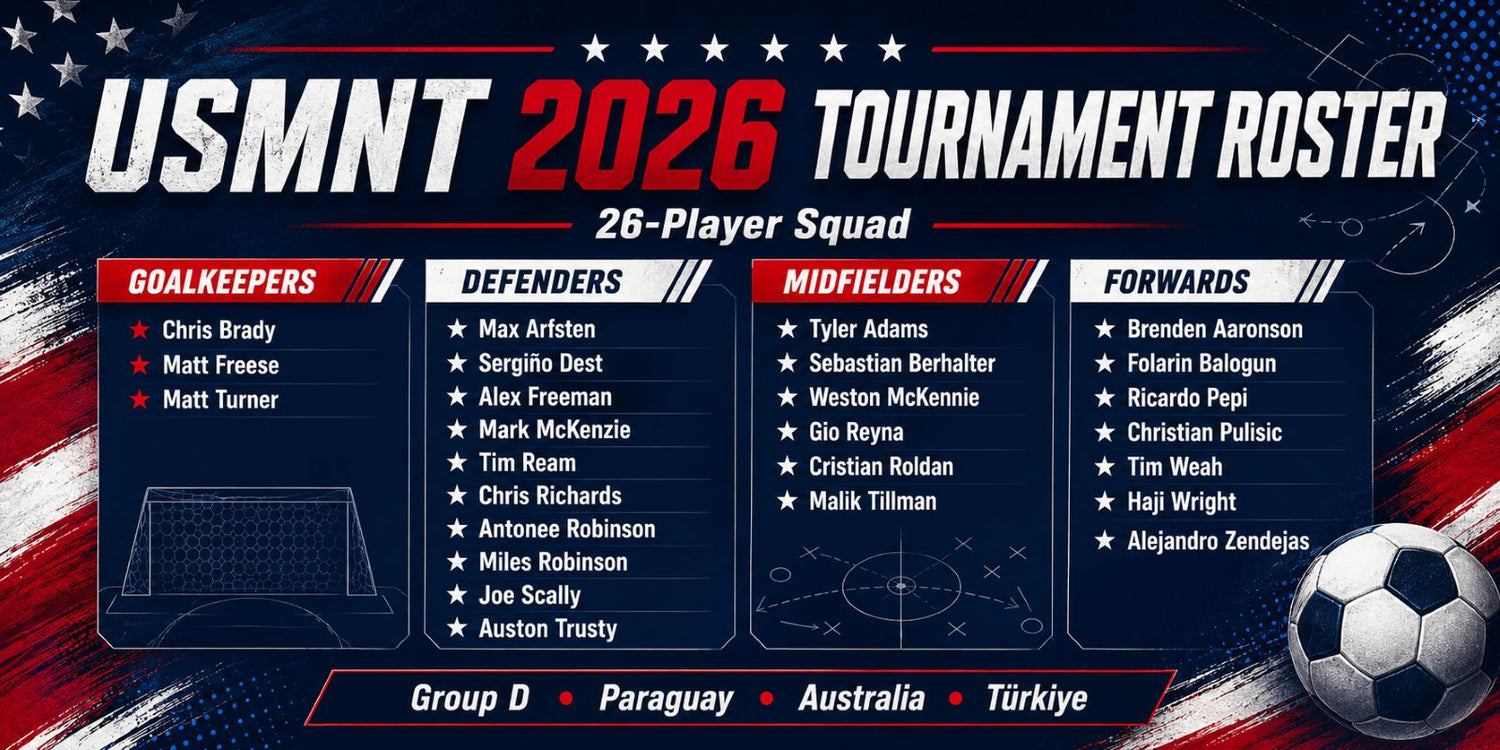
The USMNT 2026 roster features 26 players selected by Mauricio Pochettino for a home tournament campaign. This guide covers the full squad, experience profile, opening match lineup, tactical questions, remaining Group D schedule, and knockout expectations.
The article was updated after the United States defeated Paraguay four to one on June 12. It separates confirmed facts from editorial interpretation and contains no product promotion, tournament imagery, team crests, player portraits, or match footage.
Published: May 26, 2026
Last Updated: June 15, 2026
Information Checked Through: June 15, 2026
Author: RitFit Editorial Team
Primary Sources: U.S. Soccer team page and U.S. Soccer schedule page
Status: The squad and Paraguay result are confirmed. Later lineup choices, player availability, and operating details remain subject to change.
Table of Contents
Key Takeaways
- Complete squad: Pochettino selected 3 goalkeepers, 10 defenders, 6 midfielders, and 7 forwards.
- Experience balance: Thirteen players return from the 2022 squad and thirteen are first time selections.
- Strong opening: The United States earned three Group D points with a four to one win over Paraguay.
- Tactical flexibility: The opening lineup shifted between a protected defensive base and a more aggressive attacking structure.
- Next tests: Australia and Türkiye will challenge the squad in different ways before the knockout phase begins.
Full USMNT 2026 Roster
The squad contains 26 players across four position groups. The list below reflects the national association roster and the players available for the opening Group D match.
| Position | Players |
|---|---|
| Goalkeepers | Chris Brady, Matt Freese, Matt Turner |
| Defenders | Max Arfsten, Sergiño Dest, Alex Freeman, Mark McKenzie, Tim Ream, Chris Richards, Antonee Robinson, Miles Robinson, Joe Scally, Auston Trusty |
| Midfielders | Tyler Adams, Sebastian Berhalter, Weston McKennie, Gio Reyna, Cristian Roldan, Malik Tillman |
| Forwards | Brenden Aaronson, Folarin Balogun, Ricardo Pepi, Christian Pulisic, Tim Weah, Haji Wright, Alejandro Zendejas |
The unusually large defender group gives the coaching staff options for a back four, a back three, aggressive fullback roles, and late match protection without changing the entire squad structure.
Roster Composition and Experience
The selection balances continuity with new options. Half of the squad experienced the 2022 tournament, while the other half entered this event without prior senior tournament experience at this level.
- Position split: 3 goalkeepers, 10 defenders, 6 midfielders, and 7 forwards.
- Returning players: Brenden Aaronson, Tyler Adams, Sergiño Dest, Weston McKennie, Christian Pulisic, Tim Ream, Gio Reyna, Antonee Robinson, Cristian Roldan, Joe Scally, Matt Turner, Tim Weah, and Haji Wright.
- First time selections: Max Arfsten, Folarin Balogun, Sebastian Berhalter, Chris Brady, Alex Freeman, Matt Freese, Mark McKenzie, Ricardo Pepi, Chris Richards, Miles Robinson, Malik Tillman, Auston Trusty, and Alejandro Zendejas.
- Average age: The squad averaged 26 years and 332 days for the Paraguay opener.
- Experience total: The roster had 505 senior international appearances when announced.
The six player midfield is the narrowest position group, so Adams, McKennie, Tillman, Reyna, Berhalter, and Roldan must cover several roles across three group matches.
Opening Match Lineup and Tactical Base
The four to one win over Paraguay provided the clearest evidence of Pochettino's current preferences. Matt Freese started in goal, Alex Freeman joined the back line, Malik Tillman started in midfield, and Folarin Balogun led the attack.
| Player | Opening Match Function |
|---|---|
| Matt Freese | Goalkeeper and first distributor |
| Tim Ream | Central organizer and captain |
| Chris Richards | Recovery defender and aerial presence |
| Alex Freeman | Right sided defensive support |
| Antonee Robinson | Left width and recovery running |
| Sergiño Dest | High right width and combination play |
| Tyler Adams | Central protection and pressing control |
| Weston McKennie | Ball progression, duels, and forward runs |
| Malik Tillman | Connection between midfield and attack |
| Christian Pulisic | Left sided creator and transition threat |
| Folarin Balogun | Central runner and penalty area finisher |
Group D Status and Remaining Schedule
The United States opened Group D with three points. The remaining matches bring a direct, physical Australian side followed by a technically dangerous Türkiye team.
| Match | Date and Time | Location | Status |
|---|---|---|---|
| United States vs Paraguay | June 12, 6 p.m. Pacific Time | Los Angeles Stadium, Inglewood | United States won 4 to 1 |
| United States vs Australia | June 19, noon Pacific Time | Seattle Stadium, Seattle | Scheduled |
| United States vs Türkiye | June 25, 7 p.m. Pacific Time | Los Angeles Stadium, Inglewood | Scheduled |
The top two teams in each of the twelve groups advance to the Round of 32, together with the eight strongest third place teams. The expanded route creates margin for error, but finishing first or second provides the clearest qualification path.
Australia
Australia can turn matches into contests of second balls, aerial duels, set pieces, and transition running. The United States will need controlled possession and disciplined rest defense rather than allowing repeated end to end attacks.
Türkiye
Türkiye presents a more technical midfield test and can punish poor spacing around the penalty area. This match may require slower buildup, stronger counterpressing, and careful management of the spaces behind attacking fullbacks.
Players Who Can Shape the Campaign
The roster contains several players who can change a match through creativity, finishing, defensive control, or transition speed.
- Folarin Balogun: His two goals against Paraguay showed the value of direct running, calm finishing, and movement behind the defensive line.
- Christian Pulisic: He remains the main creative reference and can influence matches through dribbling, final passes, set pieces, and combination play.
- Tyler Adams: His positioning protects the back line and allows more attacking teammates to take calculated risks.
- Weston McKennie: His physical range, aerial ability, and late movement into the box add qualities that the other midfielders do not replicate in the same way.
- Malik Tillman and Gio Reyna: Both can connect midfield to attack, but they offer different solutions through carrying, combination play, shooting, and receiving between lines.
Depth will matter as much as star quality. Pepi, Wright, Aaronson, Weah, Berhalter, Roldan, and the defensive substitutes give Pochettino different ways to protect a lead or change the rhythm of a match.
Physical Demands Behind Squad Rotation
International tournament soccer requires repeated acceleration, deceleration, sprinting, jumping, contact tolerance, and rapid recovery. Research supports the importance of neuromuscular strength, core function, and repeated sprint capacity for soccer performance.[1,2,3]
- Strength and power: These qualities support acceleration, jumping, duels, and change of direction, although transfer depends on exercise selection and soccer specific practice.
- Core function: Trunk control can contribute to balance, agility, speed, and force transfer during technical actions.
- Repeated sprint capacity: Players must reproduce high intensity efforts after short recovery periods rather than relying on one maximal sprint.
- Rotation value: A 26 player squad helps coaches manage fatigue, role demands, minor knocks, and different opponent profiles.
This evidence explains why squad balance matters, but it does not predict individual selection or medical availability. Those decisions require direct assessment by the team's performance and medical staff.
What Success Looks Like for the United States
The opening win improved the team's position, but tournament evaluation should still follow clear stages.
- Immediate target: Secure advancement from Group D.
- Solid campaign: Win a Round of 32 match and reach the Round of 16.
- Strong campaign: Reach the quarterfinals while sustaining a clear tactical identity.
- Exceptional campaign: Use home support, squad depth, efficient finishing, and defensive resilience to reach the final four.
Results matter most, but the quality of performances also matters. Progress should be visible in chance creation, midfield control, defensive spacing, set piece execution, and the ability to manage different match states.
FAQs About the USMNT 2026 Roster
Who made the USMNT 2026 roster?
Mauricio Pochettino selected three goalkeepers, ten defenders, six midfielders, and seven forwards. The group combines thirteen returning players from the 2022 tournament with thirteen first time selections, giving the United States a balanced mix of prior experience, athletic range, and new tactical options.
What changed after the United States beat Paraguay?
The four to one opening win gave the United States three points and an early advantage in Group D. Folarin Balogun scored twice, Gio Reyna added the final goal, and the result reduced immediate qualification pressure before the remaining matches against Australia and Türkiye.
Which goalkeeper started the opening Group D match?
Matt Freese started against Paraguay and completed the match as the United States won four to one. Matt Turner and Chris Brady remained available as alternatives, so later selections may still depend on opponent demands, training performance, recovery, and the coaching staff preferred distribution profile.
How is the USMNT midfield structured?
The roster contains six listed midfielders, Tyler Adams, Sebastian Berhalter, Weston McKennie, Gio Reyna, Cristian Roldan, and Malik Tillman. Adams and McKennie provide defensive coverage and ball progression, while Tillman and Reyna offer creativity between lines, making rotation and role flexibility especially important.
Can the United States win Group D?
Yes. The opening victory created a strong platform, but Australia and Türkiye present different tactical problems. The United States must protect central spaces, manage set pieces, control transitions, and maintain efficient finishing, because one poor performance can still change the final order of the group.
What does the 2026 knockout format require?
The top two teams in each of the twelve groups advance directly to the Round of 32. The eight strongest third place teams also qualify, which creates more routes into the knockout phase, although finishing first or second usually offers a clearer and more controllable path.
Which USMNT players are most important to watch?
Christian Pulisic remains the primary chance creator, Tyler Adams organizes defensive balance, Weston McKennie adds duel strength and late runs, and Folarin Balogun threatens space behind defenses. Malik Tillman and Gio Reyna can also shape matches through receiving, combination play, and final third decisions.
When does the United States play its remaining Group D matches?
The United States faces Australia in Seattle on June 19 at noon Pacific Time, then plays Türkiye in Los Angeles on June 25 at seven in the evening Pacific Time. Supporters should confirm the national association schedule before matchday because operational details can change.
Conclusion
The USMNT 2026 roster combines thirteen returning players, thirteen first time selections, flexible defenders, a compact midfield, and several distinct attacking profiles. The four to one opening win showed the squad's potential, but Australia and Türkiye will test its control, adaptability, and recovery.
Advancement is the first benchmark. A deeper run will depend on midfield availability, Pulisic's creativity, Balogun's finishing, defensive discipline, and Pochettino's ability to use the full squad at the right moments.
Disclaimer
This independent editorial article is provided for general sports information and is not medical, coaching, or legal advice. RitFit is not affiliated with, sponsored by, endorsed by, or an official partner of the tournament organizer, participating associations, teams, players, venues, or media rights holders, and all third party names and marks remain the property of their respective owners.
References
- Silva JR, Nassis GP, Rebelo A. Strength training in soccer with a specific focus on highly trained players. Sports Med Open. 2015;1:17. https://pmc.ncbi.nlm.nih.gov/articles/PMC5005570/
- Luo S, Soh KG, Zhang L, et al. Effect of core training on skill related physical fitness performance among soccer players, a systematic review. Front Public Health. 2023;10:1046456. https://pmc.ncbi.nlm.nih.gov/articles/PMC9850239/
- Osses Rivera A, Yáñez Sepúlveda R, Jannas Vela S, Vigh Larsen JF, Monsalves Álvarez M. Effects of strength training on repeated sprint ability in team sports players, a systematic review. PeerJ. 2024;12:e17756. https://pmc.ncbi.nlm.nih.gov/articles/PMC11313415/