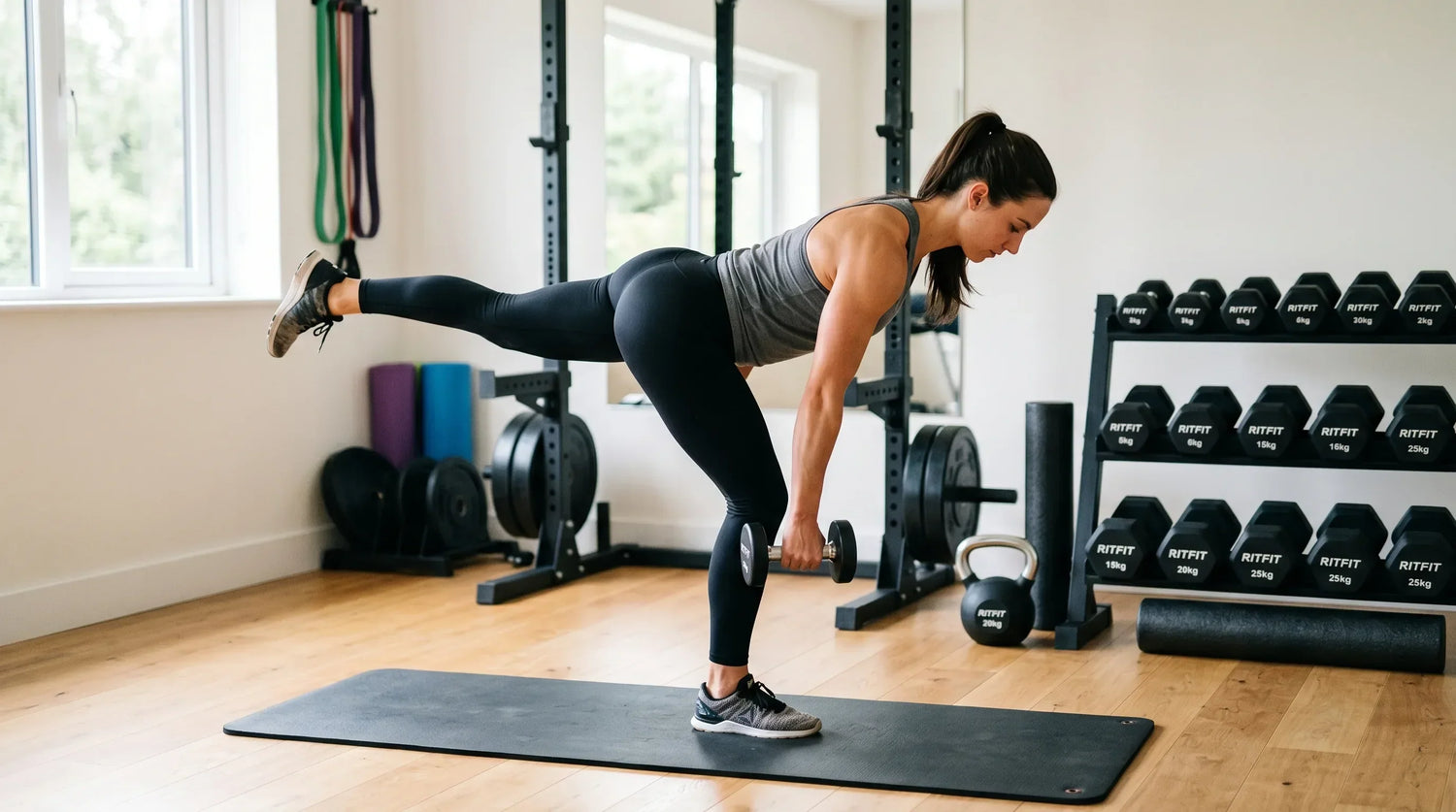
Single leg RDLs primarily work the hamstrings and glutes of the standing leg, with a long list of stabilizers keeping you balanced. The single leg setup is what makes them so different from a normal deadlift.
This guide breaks down every muscle the single leg Romanian deadlift trains, why it matters, and how to load and program it for real results.
Table of Contents
Key Takeaways
- Primary movers: The single leg RDL mainly trains the hamstrings and gluteus maximus of the working leg through a one leg hip hinge.
- Stabilizers do real work: The gluteus medius, erector spinae, core, calves, and ankle keep the pelvis level and you balanced.
- Unilateral is the point: Training one side at a time exposes and corrects left to right imbalances that bilateral deadlifts can hide.
- Lighter loads, more control: Balance limits the weight, so coaches advise prioritizing control over heavy loading.
- Scalable for anyone: Start with bodyweight or a kickstand stance, then load with a dumbbell or kettlebell as balance improves.
What Muscles Do Single Leg RDLs Work
Single leg RDLs primarily work the hamstrings and glutes of the standing leg. According to strength coaches, the movement targets the posterior chain through a unilateral hip hinge.
- Primary movers: Hamstrings and gluteus maximus of the working leg.
- Main stabilizers: Gluteus medius, erector spinae, core and obliques, calves, ankle stabilizers, and adductors.
- Supporting muscles: Upper back and lats help hold posture when you carry a weight.
The standing leg does the lifting while the rest of the body fights to stay square. That combination is what trains strength and balance at the same time.
See how RITFIT builds posterior chain strength at home in the video below, then apply the same hinge focus to your single leg RDLs.
Primary Movers
The hamstrings and gluteus maximus drive the single leg RDL. They lengthen as you hinge and then pull you back to standing.
- Hamstrings: They stretch under load during the descent and produce force to reverse the hinge. This eccentric loading is a key driver of hamstring strength.
- Gluteus maximus: The largest muscle in the body extends the hip to bring your torso back upright. It is the main engine at the top of each rep.
Because the load sits on one leg, each rep concentrates work on a single side. That focus is hard to match with bilateral hinges.
Key Stabilizers That Make It Harder
The stabilizers are what separate a single leg RDL from a regular one. They turn a hinge into a full body balance challenge.
- Gluteus medius: One strength guide highlights how it keeps the pelvis level and stops the hip twisting open on the standing leg.
- Erector spinae: The lower back muscles hold a neutral spine so you hinge instead of round.
- Core and obliques: Trainers describe these as resisting rotation and keeping the torso aligned.
- Calves, ankle, and adductors: These make the small corrections that keep you steady on one foot.
If your hip rotates open or you wobble, those stabilizers are being challenged. That demand is the whole reason to train the lift unilaterally.
Single Leg RDL vs Bilateral RDL
Both hit the posterior chain, but they are not interchangeable. The single leg version trades load for balance and symmetry.
| Factor | Single Leg RDL | Bilateral RDL |
|---|---|---|
| Load | Lighter, balance limited | Heavier, more total load |
| Main demand | Balance, control, symmetry | Maximal posterior chain strength |
| Stabilizers | Very high | Moderate |
According to physical therapists, the RDL pattern biases the glutes and hamstrings while a conventional deadlift involves more quadriceps. Coaches also advise using lighter loads on the single leg version and prioritizing control. For a heavier, more stable option, try the Smith machine Romanian deadlift.
Benefits of the Single Leg RDL
The single leg RDL builds strength while fixing problems other lifts ignore. Its biggest value is unilateral training.
- Corrects imbalances: Training one side at a time exposes left to right strength gaps and helps even them out.
- Improves balance: Every rep challenges your foot, ankle, hip, and trunk to coordinate, which builds proprioception.
- Builds the posterior chain: Strong glutes and hamstrings carry over to running, jumping, and bigger bilateral lifts.
Pair it with a single leg hip thrust for extra glute work. Both reinforce the same single side control.
Equipment You Can Use
The single leg RDL works with almost any load. That flexibility makes it easy to train at home or in a full gym.
- Bodyweight: The best starting point for learning the hinge and balance.
- Dumbbells and kettlebells: A pair of dumbbells or a set of kettlebells lets you load one or both hands. See our guide to kettlebell deadlifts for grip options.
- Barbell, landmine, or Smith: These add stability or heavier loading once your balance is solid.
Hold the weight in the hand opposite the working leg for a stronger anti rotation challenge. Switch to both hands when you want more total load.
How to Program It
Your sets and reps depend on the goal. One strength coaching guide suggests two clear ranges.
- Balance and stability: Roughly 4 to 6 sets of 5 to 8 reps per leg, using lighter loads and strict control.
- Hamstring hypertrophy: Roughly 5 to 10 sets of 8 to 15 reps per leg across your week, building total volume.
Treat it as an accessory to squats and deadlifts, not a max strength test. Add a few sets after your main lower body work or pair it with leg curl alternatives for stronger hamstrings.
How Beginners Should Scale It
Beginners should master balance before load. Coaches recommend a kickstand or bodyweight progression first.
- Start bodyweight: Learn the hip hinge and keep the pelvis square before adding any weight.
- Use a kickstand: Rest the back toe lightly on the floor for balance, then reduce that support over time.
- Add load slowly: Introduce a light dumbbell or kettlebell only once you can hinge without twisting.
For a full step by step walkthrough, see our guide on how to do a single leg Romanian deadlift with correct form. Nail the technique there, then use this article to target the right muscles.
FAQs About Single Leg RDLs
What muscles do single leg RDLs work?
Single leg RDLs primarily work the hamstrings and gluteus maximus of the standing leg. They also heavily engage the gluteus medius, erector spinae, core, calves, and adductors as stabilizers. According to coaching sources, this combination trains the posterior chain while challenging balance on one leg at the same time.
Do single leg RDLs work the glutes or hamstrings more?
They train both heavily, with the hamstrings stretching under load and the gluteus maximus driving the hip back up. The gluteus medius also works hard to stabilize the pelvis. Where you feel it most depends on your hinge depth, knee bend, and how square you keep your hips.
Are single leg RDLs better than regular RDLs?
Neither is better, since they serve different goals. Bilateral RDLs let you lift heavier for raw posterior chain strength. Single leg RDLs use lighter loads but build balance, stability, and symmetry. Most lifters benefit from programming both, using the single leg version as an accessory movement.
Why are single leg RDLs so hard to balance?
Because standing on one foot forces your ankle, knee, hip, and spine to coordinate while you hinge. The gluteus medius and foot stabilizers make constant small corrections. Coaches suggest a tripod foot, a soft knee bend, and slow tempo, or holding a wall until your balance improves.
What equipment do I need for single leg RDLs?
You can use bodyweight, dumbbells, a kettlebell, a barbell, a landmine, or a Smith machine. Beginners should start with bodyweight, then add a light dumbbell or kettlebell. Holding the weight in the hand opposite the standing leg adds a stronger anti rotation challenge for the core.
How many sets and reps of single leg RDLs should I do?
It depends on your goal. One strength coaching guide suggests about 4 to 6 sets of 5 to 8 reps for balance, or 5 to 10 sets of 8 to 15 reps across the week for hamstring size. Treat it as an accessory to your main lower body lifts.
Can single leg RDLs fix muscle imbalances?
Yes. Training one leg at a time exposes left to right strength gaps that bilateral lifts can hide. By working each side independently, you can give a weaker leg equal volume and effort. Over time this helps even out strength and reduce compensation during bigger lifts.
Do single leg RDLs work your core?
Yes. Your core and obliques work to resist rotation and keep your torso aligned while you balance on one leg. The erector spinae also stabilizes the spine so you can hinge without rounding. This anti rotation demand is a meaningful bonus on top of the leg work.
Should beginners do single leg RDLs?
Yes, with scaling. Beginners should start with the bodyweight or kickstand version to learn the hip hinge and balance first. Add a light dumbbell or kettlebell only after you can hinge without twisting your hips. Mastering form early protects your lower back and builds confidence.
How heavy should I go on single leg RDLs?
Lighter than you think. Balance and control limit the load, so coaches advise choosing a weight where you keep your hips square and still feel the hamstrings and glutes. If you cannot control the descent or stay balanced, the weight is too heavy for now.
Conclusion
Single leg RDLs mainly train the hamstrings and glutes of the working leg, backed by a hardworking team of stabilizers. The single leg setup is what builds balance, symmetry, and a stronger posterior chain.
Start with bodyweight, load it with dumbbells or kettlebells as you progress, and treat it as an accessory to your main lifts. Master the form first, then chase the right muscles.
Disclaimer
This article is for general educational purposes only and is not medical or professional training advice. Muscle and programming guidance reflects coaching and clinician sources, not clinical research, and individual results vary. Consult a qualified professional before starting a new exercise, especially if you have a back, hip, or balance condition.