Sprint intervals, fast running, jump rope, rowing, boxing, cycling intervals, swimming, and stair climbing are among the highest calorie burning exercises. The best choice depends on your body weight, intensity, fitness level, joint tolerance, and whether you can repeat the workout consistently.
This guide ranks the best calorie burning exercises, explains why calorie burn varies, and shows how to combine cardio with strength training using RitFit home gym equipment for more sustainable fat loss.
Key Takeaways
- Sprint intervals and fast running burn calories quickly: They demand high effort from large muscle groups and raise heart rate fast.
- Jump rope, rowing, boxing, and cycling intervals are efficient: These workouts combine conditioning, coordination, and repeated high effort.
- Strength training supports long term fat loss: It helps preserve lean mass, improve performance, and build a stronger body.
- Low impact options still work: Incline walking, swimming, cycling, and rowing can burn meaningful calories with less joint stress.
- Consistency beats one extreme workout: The best exercise is challenging enough to work, but realistic enough to repeat.
Table of Contents
Quick Answer
The exercise that usually burns the most calories per minute is sprint interval training, followed closely by fast running, jump rope, rowing, boxing, and cycling intervals. However, total calorie burn depends on how hard you work, how long you train, and how often you can recover well enough to repeat the workout.
If your goal is fat loss, do not choose an exercise only because it has the highest short term burn. Choose a mix of cardio, strength training, and daily movement that creates a realistic calorie deficit without causing burnout or joint irritation.
How Calorie Burning Works
Exercise burns calories by increasing energy expenditure above resting levels. Researchers define physical activity as body movement produced by skeletal muscles that results in energy expenditure, which can be measured in kilocalories.[1]
- Body weight: A heavier person usually burns more calories doing the same workout because moving more mass requires more energy.
- Intensity: Faster speed, heavier resistance, steeper incline, and shorter rest periods usually increase calorie burn.
- Duration: Longer workouts usually burn more total calories, even if the per minute burn is lower.
- Muscle involvement: Full body exercises often burn more than isolation movements because more muscle mass is active.
- Fitness level: A trained person may move more efficiently, but can also sustain harder work for longer.
How We Ranked These Exercises
This ranking uses estimated calorie burn, muscle involvement, intensity potential, accessibility, joint impact, and long term sustainability. Energy expenditure can be estimated through oxygen consumption, heat production, carbon dioxide production, wearable sensors, and related objective methods, but every method has limitations.[2]
The calorie ranges below are practical estimates for a 160 lb person, not fixed promises. Your actual result may be higher or lower based on pace, resistance, technique, rest time, workout environment, and training history.
Top Calorie Burning Exercises Ranked
1. Sprint Intervals
Sprint intervals usually burn the most calories per minute because they require near maximum effort from the legs, hips, core, and cardiovascular system. Use short work periods and longer recovery periods to protect form and reduce injury risk.
- Best for: Advanced exercisers who already tolerate running and high intensity training.
- Sample format: Sprint for 20 to 30 seconds, walk for 2 to 3 minutes, repeat 5 to 8 rounds.
- Safety note: Avoid all out sprinting if you are new to training, returning from injury, or dealing with joint pain.
2. Fast Running
Fast running is one of the most reliable calorie burning workouts because it uses large muscle groups and keeps effort high for the whole session. It is also easy to scale by adjusting pace, terrain, incline, and session length.
- Best for: People who want a simple high calorie workout with minimal equipment.
- At home option: Use treadmill intervals or incline running when outdoor running is not practical.
- Recovery tip: Rotate running days with low impact cardio or strength training to manage joint stress.
3. Jump Rope
Jump rope burns calories quickly because it combines rhythm, foot speed, coordination, and repeated elastic effort. It is space efficient, but it can stress the calves, ankles, and knees if volume increases too fast.
- Best for: Short conditioning finishers and home workouts.
- Beginner format: Jump for 30 seconds, rest for 30 to 60 seconds, repeat 8 to 12 rounds.
- Home setup: Use supportive shoes and protective flooring such as rubber gym flooring mats.
4. Rowing
Rowing is a strong calorie burner because it trains the legs, hips, back, arms, and core in one repeating pattern. It is often lower impact than running while still allowing hard intervals.
- Best for: Full body conditioning with less pounding than running.
- Training tip: Drive with the legs first, then finish with the hips, back, and arms.
- Programming idea: Alternate 250 meter hard rows with easy recovery rows for 6 to 10 rounds.
5. Boxing or Kickboxing
Boxing and kickboxing can burn a lot of calories because they blend fast footwork, striking, rotation, and repeated bursts of effort. They also keep many people engaged because the workout feels skill based rather than repetitive.
- Best for: Conditioning, coordination, stress relief, and upper body endurance.
- Home format: Use 3 minute rounds with 1 minute rest, then repeat 4 to 8 rounds.
- Strength pairing: Add presses, rows, carries, and core work from a RitFit dumbbell set.
6. Cycling Intervals
Cycling intervals can burn calories fast while reducing impact on the knees, ankles, and hips compared with running. Resistance and cadence control make it easier to train hard without needing complex movement skills.
- Best for: Low impact HIIT, conditioning, and recovery friendly fat loss programs.
- Sample format: Pedal hard for 40 seconds, recover for 80 seconds, repeat 8 to 12 rounds.
- Progression tip: Increase resistance gradually instead of turning every ride into a maximum effort session.
7. Swimming
Swimming burns calories while training the upper body, lower body, breathing control, and core stability. It is especially useful for people who want a joint friendly option that still feels challenging.
- Best for: Low impact conditioning and active recovery.
- Workout idea: Swim 25 to 50 yards at a strong pace, rest briefly, then repeat for 15 to 30 minutes.
- Limitation: Access to a pool and swimming skill can make consistency harder for some people.
8. Stair Climbing
Stair climbing burns calories because each step requires your body to work against gravity. It strongly involves the glutes, quads, hamstrings, and calves, making it a useful bridge between cardio and lower body training.
- Best for: Lower body endurance, conditioning, and short high effort cardio sessions.
- At home option: Use real stairs, step ups, or controlled box step patterns.
- Equipment pairing: A stable platform like the RitFit classic 3 in 1 plyo box can support step up variations.
9. Dumbbell and Kettlebell Circuits
Dumbbell and kettlebell circuits burn calories by combining resistance training with limited rest. They are especially useful for home gyms because one pair of weights can support squats, presses, rows, lunges, carries, hinges, and core work.
- Best for: Full body conditioning, strength endurance, and compact home gym training.
- Sample circuit: Goblet squat, push press, Romanian deadlift, bent over row, and farmer carry.
- RitFit option: Build circuits with RitFit hex rubber dumbbells for simple progressive loading.
10. Strength Training
Strength training usually burns fewer calories per minute than hard cardio, but it is essential for preserving and building lean mass. Research comparing training modes suggests aerobic training is strong for reducing body mass and fat mass, while resistance training helps increase or preserve lean body mass.[3]
- Best for: Long term body composition, strength, muscle retention, and metabolic health.
- Core equipment: A bench, dumbbells, barbell, plates, and rack can cover most strength needs.
- RitFit setup: Pair barbells and weight plates with a RitFit weight bench for compound lifts and accessory training.
11. Incline Walking
Incline walking is not the fastest calorie burner, but it is one of the most repeatable fat loss tools. It raises energy demand compared with flat walking while staying easier on the joints than sprinting or jumping.
- Best for: Beginners, recovery days, low impact fat loss, and longer cardio sessions.
- Simple format: Walk 25 to 45 minutes at a challenging incline while maintaining nasal or controlled breathing.
- Fat loss role: Walking helps increase weekly activity without creating the recovery cost of daily HIIT.
Calorie Burn Comparison Table
The table below gives practical estimated ranges for a 160 lb person. Use it as a comparison tool, not as a promise of exact results.
| Exercise | Estimated Burn Per Minute | Impact Level | Best Use |
|---|---|---|---|
| Sprint intervals | High to very high | High | Short advanced conditioning |
| Fast running | High | Moderate to high | Steady calorie burn |
| Jump rope | Moderate to high | Moderate to high | Short home finishers |
| Rowing | Moderate to high | Low to moderate | Full body intervals |
| Boxing or kickboxing | Moderate to high | Moderate | Skill based conditioning |
| Cycling intervals | Moderate to high | Low | Low impact HIIT |
| Swimming | Moderate to high | Low | Joint friendly cardio |
| Stair climbing | Moderate to high | Moderate | Lower body conditioning |
| Dumbbell circuits | Moderate | Variable | Strength plus conditioning |
| Strength training | Low to moderate | Variable | Lean mass and strength |
| Incline walking | Low to moderate | Low | Sustainable fat loss |
Cardio vs Strength Training
Cardio usually burns more calories during the session, while strength training helps improve body composition over time. A strong fat loss program uses both because aerobic work raises immediate energy expenditure and lifting supports lean mass.
Exercise training can support weight loss, body composition changes, and weight maintenance, but results vary widely across individuals and programs.[4] This is why your weekly plan should balance calorie burn, recovery, nutrition, sleep, and strength progression.
- Choose cardio for immediate burn: Running, rowing, cycling, swimming, and stair climbing raise session energy expenditure quickly.
- Choose strength for long term structure: Squats, presses, hinges, rows, and carries help keep your body strong during fat loss.
- Choose circuits for a hybrid effect: Dumbbell and kettlebell circuits blend resistance, heart rate elevation, and time efficiency.
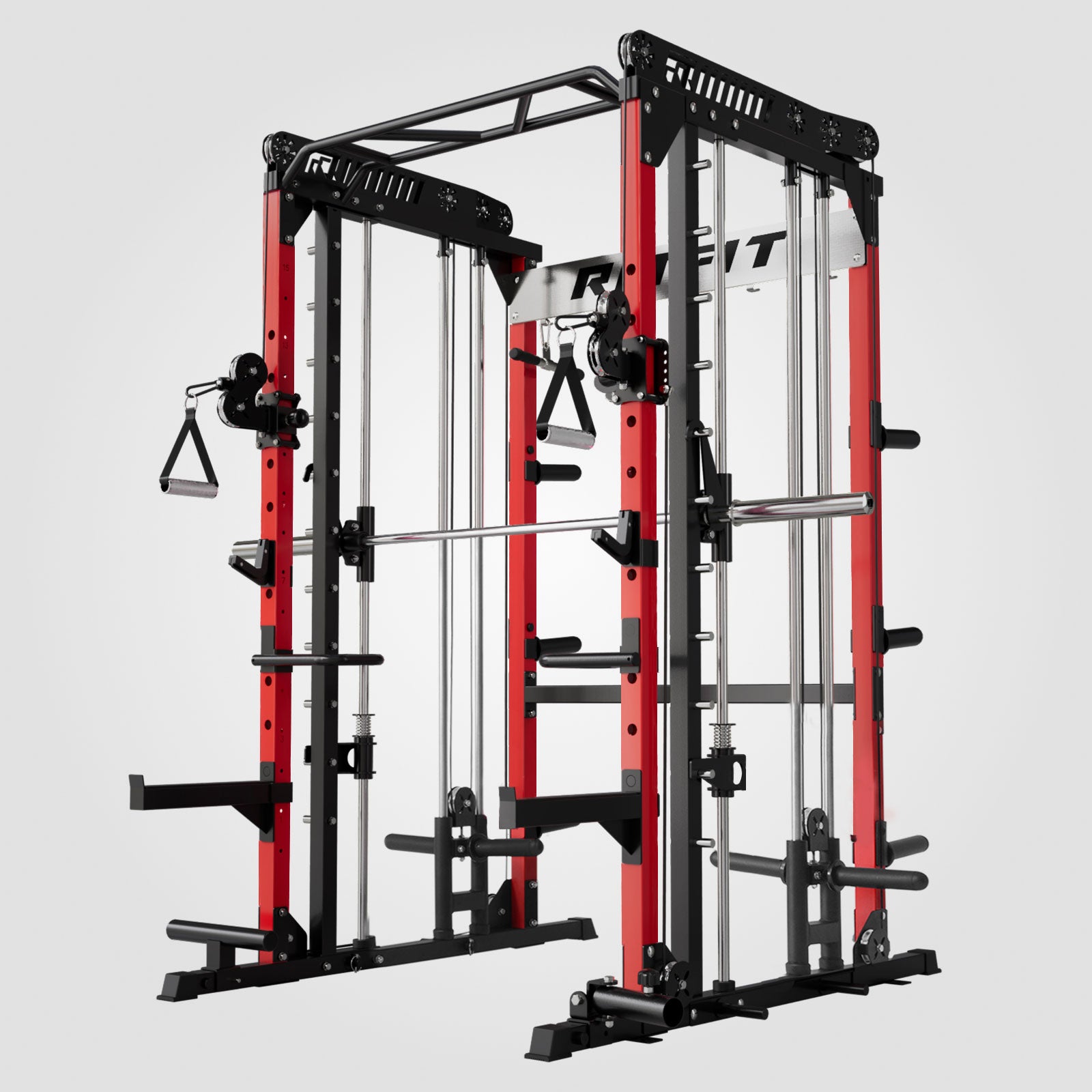
- Use equipment strategically: A RitFit Smith machine can support guided squats, presses, rows, split squats, and controlled strength work at home.
Home Gym Plan for Fat Loss
The best home gym plan for calorie burning combines repeatable cardio, progressive strength training, and short conditioning finishers. This approach helps you burn calories now while protecting the muscle you need for long term performance.
| Day | Workout Focus | Example Session |
|---|---|---|
| Monday | Strength plus finisher | Squat, bench press, row, then 8 minutes jump rope |
| Tuesday | Cardio intervals | Running, cycling, or rowing intervals for 20 minutes |
| Wednesday | Strength training | Deadlift pattern, overhead press, lunge, core carry |
| Thursday | Low impact cardio | Incline walking, cycling, or swimming for 30 to 45 minutes |
| Friday | Dumbbell circuit | Goblet squat, push press, row, Romanian deadlift, farmer carry |
| Saturday | Active recovery | Walking, mobility, light cycling, or easy swimming |
| Sunday | Rest | Recover, hydrate, and prepare for the next week |
If you want one simple strength base, combine dumbbells, plates, a bench, and a rack or Smith machine. For compact spaces, start with adjustable loading tools and add larger equipment as your training becomes more consistent.
Common Calorie Burn Mistakes
- Chasing the hardest workout every day: Daily high intensity training can reduce recovery and increase injury risk. Use hard sessions sparingly and let low impact cardio build weekly volume.
- Trusting machine calories too closely: Cardio machines and watches estimate calorie burn, but they can be inaccurate. Use them to compare your own sessions, not to justify extra food automatically.
- Ignoring strength training: Cardio helps burn calories, but lifting helps preserve the lean mass that supports performance. A balanced plan usually works better than cardio alone.
- Doing too little total movement: One workout cannot offset a fully sedentary day for everyone. Walking and daily steps help raise weekly energy expenditure in a sustainable way.
- Trying to spot reduce belly fat: No exercise burns fat from only one body area. Fat loss comes from an overall calorie deficit, consistent training, sleep, and nutrition.
Physical activity is especially important for long term weight maintenance because exercise alone often produces smaller weight changes than people expect. The most successful plan is usually the one that combines training, nutrition, daily movement, and behavior habits.[5]
Frequently Asked Questions
What exercise burns the most calories in 30 minutes?
Sprint intervals, fast running, jump rope, rowing, and cycling intervals usually burn the most calories in 30 minutes. Your exact number depends on body weight, pace, resistance, rest time, and fitness level, so use calorie estimates as a guide rather than a guarantee.
What exercise burns the most calories at home?
Jump rope, dumbbell circuits, stair climbing, rowing, and cycling intervals are among the best home calorie burning exercises. For most people, the strongest home plan combines short cardio finishers with strength training using dumbbells, a bench, plates, or a Smith machine.
Does strength training burn enough calories for fat loss?
Yes. Strength training can support fat loss, especially when paired with nutrition control and cardio. It may burn fewer calories during the session than hard running, but it helps preserve lean mass, improve training capacity, and build a stronger body during weight loss.
Is running better than cycling for burning calories?
Often yes. Running usually burns more calories per minute than moderate cycling because it is weight bearing and uses large muscle groups. Cycling can still match high effort cardio when resistance and cadence are high, and it is often easier on the joints.
What low impact exercise burns the most calories?
Rowing, cycling intervals, swimming, and incline walking are strong low impact calorie burning options. Rowing and cycling are usually easier to push hard, swimming is joint friendly, and incline walking is one of the most repeatable choices for beginners.
Can walking help you lose weight?
Yes. Walking can help weight loss by increasing daily energy expenditure without adding much recovery stress. It works best when paired with a calorie controlled diet, strength training, consistent steps, and gradual increases in pace, incline, distance, or weekly walking time.
How accurate are smartwatch calorie burn estimates?
Smartwatch calorie estimates are useful for trends, but they are not perfectly accurate. They rely on heart rate, movement, body data, and algorithms, so use them to compare your own workouts over time rather than treating every number as exact.
Should you do cardio or strength training first for fat loss?
Do strength training first when preserving muscle and lifting performance are priorities. Do cardio first when endurance is the main goal. For most fat loss plans, lift first, then add a short cardio finisher, or separate hard cardio and lifting on different days.
Conclusion
The highest calorie burning exercises are usually sprint intervals, fast running, jump rope, rowing, boxing, cycling intervals, swimming, and stair climbing. For sustainable fat loss, combine these workouts with strength training, daily movement, and a realistic nutrition plan.
A well built RitFit home gym can help you train strength, conditioning, and low impact cardio support in one place. Start with repeatable workouts, progress slowly, and choose exercises you can perform safely for months, not just once.
Disclaimer: This article is for general educational purposes only and is not medical advice. If you have heart disease, joint pain, pregnancy related concerns, obesity related complications, or are new to high intensity exercise, consult a qualified healthcare professional before starting sprint intervals, HIIT, or heavy strength training.
References
- Caspersen CJ Powell KE Christenson GM. Physical activity, exercise, and physical fitness: definitions and distinctions for health related research. Public Health Rep. 1985;100(2):126-131.
- Hills AP Mokhtar N Byrne NM. Assessment of physical activity and energy expenditure: an overview of objective measures. Front Nutr. 2014;1:5. doi:10.3389/fnut.2014.00005
- Willis LH Slentz CA Bateman LA Shields AT Piner LW Bales CW Houmard JA Kraus WE. Effects of aerobic and resistance training on body mass and fat mass in overweight or obese adults. J Appl Physiol. 2012;113(12):1831-1837. doi:10.1152/japplphysiol.01370.2011
- Bellicha A van Baak MA Battista F Beaulieu K Blundell JE Busetto L Carraca EV Dicker D Encantado J Ermolao A Farpour Lambert N Pramono A Woodward E Oppert JM. Effect of exercise training on weight loss, body composition changes, and weight maintenance in adults with overweight or obesity: an overview of 12 systematic reviews and 149 studies. Obes Rev. 2021;22(S4):e13256. doi:10.1111/obr.13256
- Cox CE. Role of physical activity for weight loss and weight maintenance. Diabetes Spectr. 2017;30(3):157-160. doi:10.2337/ds17-0013