A barre workout is a low impact fitness routine that blends ballet inspired positions, Pilates style core control, light strength training, and stretching. It uses small controlled movements, isometric holds, and high repetition sets to build muscular endurance, balance, posture awareness, and full body control at home.
This guide explains what barre is, what muscles it works, how it compares with Pilates and strength training, and how to start safely with simple home equipment from RitFit home gym equipment.
Key Takeaways
- Barre is low impact but challenging: It uses small ranges of motion, long holds, and controlled pulses to fatigue muscles without heavy joint impact.
- Barre works the full body: Most routines target the glutes, thighs, calves, deep core, shoulders, arms, and postural muscles.
- Barre is beginner friendly: You can start with a mat, chair, light dumbbells, and enough space to move safely.
- Barre supports endurance and control: It is best for muscle stamina, balance, flexibility, posture, and active recovery.
- Barre works best with strength training: Pairing barre with progressive resistance training creates a more complete home fitness plan.
Table of Contents
- What Is a Barre Workout?
- How Barre Workouts Work
- What Muscles Does Barre Work?
- Benefits of Barre Workouts
- Barre vs Pilates vs Strength Training
- What Equipment Do You Need?
- Sample 40 Minute Home Barre Workout
- Barre and Strength Training Weekly Schedule
- Common Barre Workout Mistakes
- Who Should Be Careful With Barre?
What Is a Barre Workout?
A barre workout is a full body training style that uses a barre or stable support for balance while you perform small, precise, high repetition movements. It draws from ballet conditioning, Pilates, yoga, mobility work, and light resistance training to improve strength endurance and body control.
Most barre classes follow a predictable flow, including warm up, upper body work, thigh and glute exercises at the barre, core training, and cool down stretching. Pilates based movement has been described as a system that can improve muscle strength, endurance, flexibility, posture, and balance, which explains why barre often shares similar movement goals.[1]
How Barre Workouts Work
Barre works by keeping muscles under tension long enough to create fatigue with light resistance. Instead of lifting heavy weights for low reps, you perform pulses, holds, and controlled repetitions until the target muscles feel challenged.
Time Under Tension
Time under tension means your muscles stay active for an extended period during each set. A 60 second plie hold or 30 small glute pulses can feel intense because the muscle has little time to relax.
Small Range Movement
Small range movement helps you stay controlled while keeping tension on the target muscle. This is why barre pulses often feel harder than they look.
Isometric Holds
Isometric holds build control by asking your muscles to stay active without changing joint position. Chair pose, plank holds, and low plie holds are common examples.
Mind Muscle Connection
Barre improves body awareness because each movement requires precise alignment and controlled breathing. This can help beginners learn where they should feel an exercise before adding heavier resistance.
What Muscles Does Barre Work?
Barre works the lower body, core, arms, shoulders, calves, and postural muscles. The exact focus depends on the class design, but most home barre workouts emphasize glutes, thighs, core stability, and controlled upper body endurance.
- Glutes: Glute pulses, arabesque lifts, hip extensions, and bridge variations target the gluteus maximus and gluteus medius.
- Quads: Plie squats, chair holds, and narrow stance pulses place sustained tension on the front of the thighs.
- Hamstrings: Leg curls, bridge holds, and hinge based moves help train the back of the thighs.
- Calves: Releve holds and heel lifts challenge calf endurance and ankle stability.
- Core: Planks, dead bugs, crunch pulses, and standing balance work train the deep core and trunk control.
- Arms and shoulders: Light dumbbell curls, presses, triceps extensions, and lateral raises improve upper body endurance.
- Postural muscles: Upright positions and core bracing help train the muscles that support a tall spine.
Benefits of Barre Workouts
Barre can improve muscular endurance, posture control, balance, coordination, flexibility, and exercise consistency. It is especially useful for beginners who want a structured home workout that feels challenging without heavy loading.
Builds Muscular Endurance
Barre is most effective for muscular endurance because the sets are long and the rest periods are short. This makes it useful for people who want stronger legs, glutes, arms, and core without starting with heavy weights.
Supports Better Posture Awareness
Barre encourages tall spine alignment, rib control, pelvic positioning, and controlled shoulder placement. A systematic review on Pilates and posture found supportive evidence for posture related improvements, which is relevant because barre uses many similar alignment principles.[2]
Improves Balance and Coordination
Barre improves balance by asking you to stabilize on one leg, move slowly, and control your center of gravity. The barre or chair gives support, but your feet, ankles, hips, and core still need to work.
Creates a Low Impact Training Option
Barre is low impact because it usually avoids jumping, sprinting, and heavy landing forces. Regular physical activity is linked with broad health benefits, but beginners should choose intensity and movement options that fit their current ability.[3]
Fits Small Home Gym Spaces
Barre fits small spaces because most moves require only a mat, stable support, and light resistance. For better comfort during floor work, consider placing your mat over high density interlocking gym flooring mats.
Barre vs Pilates vs Strength Training
Barre, Pilates, and strength training are different tools, not direct replacements for one another. Barre is best for muscular endurance and control, Pilates is best for core centered movement quality, and strength training is best for progressive overload and measurable strength gains.
- Barre: Choose barre if you want low impact leg, glute, core, and posture work with small pulses and long holds.
- Pilates: Choose Pilates if you want deeper focus on breathing, spinal control, core sequencing, and precise mat or reformer movement.
- Strength training: Choose strength training if you want to increase maximum strength, load progression, and muscle building potential.
- Best combination: Use barre for control and endurance, then use weights for progressive strength work.
Progressive resistance training has strong evidence for improving strength and physical function, so barre should not be the only training method if your goal is long term strength development.[4] A balanced home plan can combine barre with dumbbells, benches, racks, and Smith machine training.
What Equipment Do You Need?
You need a stable support, mat, light dumbbells, and optional resistance bands for most home barre workouts. Beginners can start with bodyweight only, then add equipment as balance, control, and confidence improve.
- Stable support: Use a chair, countertop, wall, or a stable rack upright. The support should not slide or wobble when you hold it lightly.
- Exercise mat: Use a mat for core work, stretching, and floor glute exercises. A non slip yoga mat can make floor based barre more comfortable.
- Light dumbbells: Use 1 to 5 pound dumbbells for curls, presses, triceps work, and shoulder endurance. Browse RitFit dumbbells if you want simple resistance options for home training.
- Resistance bands: Use bands for glute activation, hip abduction, and thigh work. Bands are optional but useful when bodyweight pulses become too easy.
- Bench: Use a bench for elevated bridges, supported core work, and strength sessions that complement barre. A stable option from the RitFit weight benches collection can support both barre accessories and traditional lifting.
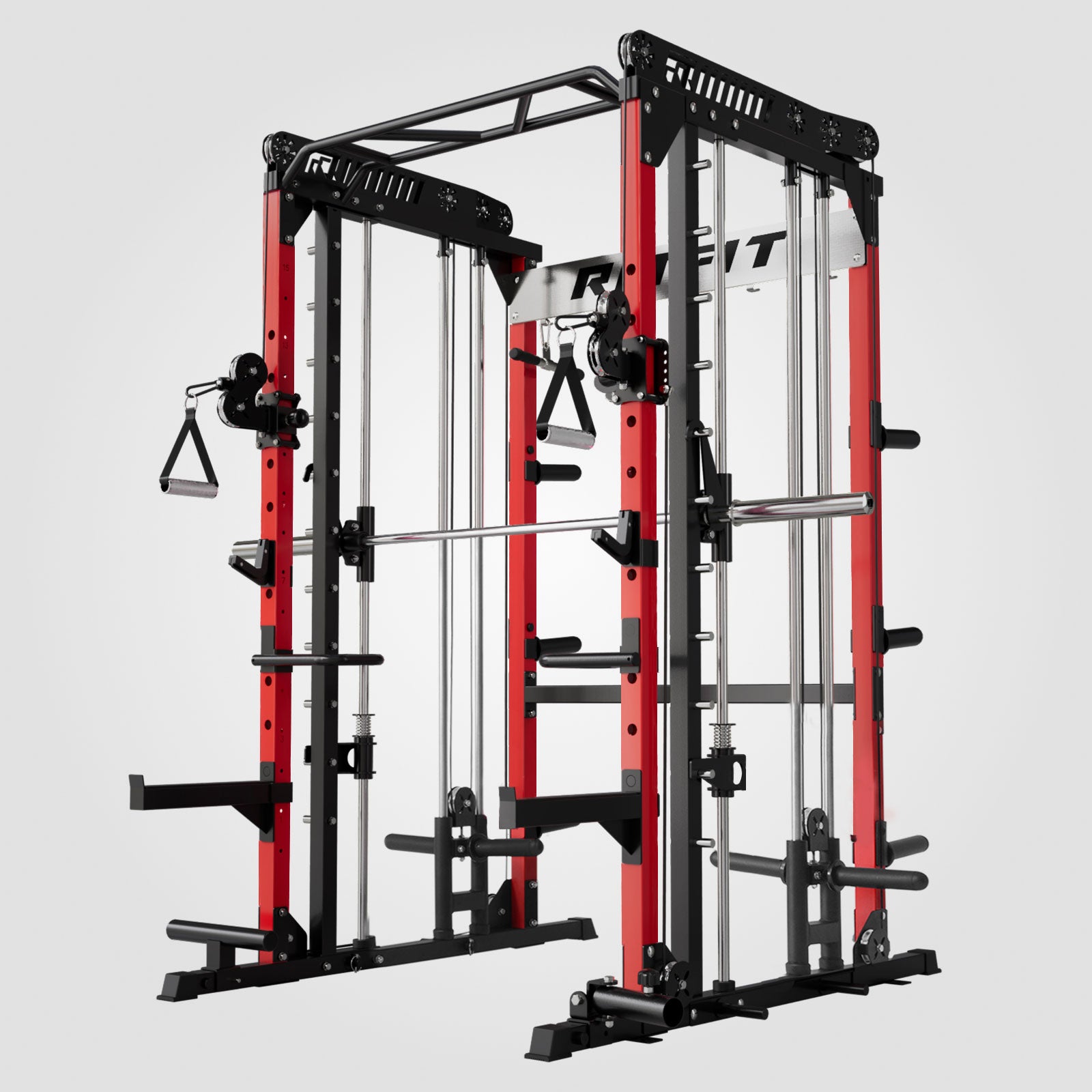
- Rack or Smith machine: Use a power rack or Smith machine frame as a stable hand support only when it is properly assembled and positioned. Explore RitFit power rack systems or the RitFit Smith machine collection for broader home gym strength training.
Sample 40 Minute Home Barre Workout
This beginner home barre workout trains the full body with low impact movements and simple equipment. Move slowly, keep your breathing steady, and stop if you feel sharp pain or dizziness.
Warm Up, 5 Minutes
Start with marching in place, arm circles, torso rotations, bodyweight squats, and standing hamstring curls. Use this time to raise body temperature and practice tall posture before the harder sets.
Upper Body, 8 Minutes
Perform biceps curls, overhead presses, triceps kickbacks, lateral raises, and chest fly pulses with light dumbbells. Keep the weights light enough that your shoulders stay relaxed and your ribs do not flare.
Lower Body at the Barre, 15 Minutes
Perform plie squat pulses, heel lifts, chair holds, standing leg extensions, and glute kicks. Keep your knees tracking over your toes and use the support for balance, not for pulling your body upward.
Core, 8 Minutes
Perform crunch pulses, bicycle crunches, dead bugs, plank holds, and side plank modifications. Core stability exercises have evidence for supporting function and pain outcomes in nonspecific low back pain, but anyone with active back pain should get individualized guidance.[5]
Cool Down, 4 Minutes
Finish with quad stretches, hamstring stretches, cat cow, child pose, and a chest opener. Stretch gently and avoid forcing range of motion when muscles are fatigued.
Barre and Strength Training Weekly Schedule
The best weekly plan uses barre for endurance, control, and active recovery while strength training covers progressive overload. This approach helps you avoid treating barre as a replacement for all forms of resistance training.
- Monday: Strength training with squats, presses, rows, and hip hinge work.
- Tuesday: Barre lower body and core session with light dumbbells or bands.
- Wednesday: Rest, walking, or gentle mobility.
- Thursday: Strength training with lunges, deadlift variations, push exercises, and pulling work.
- Friday: Barre upper body, posture, and flexibility session.
- Saturday: Optional recovery barre or full body low impact conditioning.
- Sunday: Rest and prepare for the next training week.
If you want to build a broader home setup, organize small tools, mats, and cable handles through the RitFit home gym accessories collection. A clean setup makes it easier to stay consistent with short barre sessions and heavier strength days.
Common Barre Workout Mistakes
The most common barre mistakes come from moving too fast, using too much support, or ignoring alignment. Good barre training should feel controlled, precise, and challenging without joint pain.
- Using momentum: Move slowly enough to feel the target muscle working. Fast bouncing can reduce tension and irritate joints.
- Letting knees collapse inward: Keep your knees tracking in the same direction as your toes. This is especially important during plie squats and chair holds.
- Arching the lower back: Keep your ribs stacked over your pelvis during leg lifts and core work. If your low back takes over, reduce the range of motion.
- Gripping the barre too hard: Use the support for balance, not for pulling. Your legs and core should still do the work.
- Choosing weights that are too heavy: Light dumbbells are enough for most barre arm sequences. If your neck or traps take over, reduce the load.
- Skipping recovery: Barre can create deep muscle fatigue even without heavy weights. Allow recovery between hard lower body sessions.
- Expecting barre to replace strength training: Barre supports endurance and control, while heavier resistance supports progressive strength. Use both for a complete plan.
Who Should Be Careful With Barre?
Barre is low impact, but it is not automatically right for every body or every situation. Modify the workout if you are pregnant, postpartum, recovering from surgery, managing balance issues, or dealing with knee, hip, ankle, shoulder, or back pain.
- Pregnancy and postpartum: Get clearance from a qualified healthcare professional before starting or changing your routine. Avoid positions that feel unstable or create pelvic pressure.
- Knee pain: Reduce squat depth and avoid forcing turnout. Keep your knees tracking over your toes.
- Hip pain: Use smaller leg lift ranges and avoid aggressive external rotation. Pain in the front of the hip is a sign to modify.
- Lower back pain: Reduce back extension and focus on neutral rib and pelvis alignment. Seek professional guidance if pain is persistent or sharp.
- Balance limitations: Use a stable support and avoid single leg moves until you feel steady. Place your mat on a non slip surface.
FAQs
What is a barre workout good for?
A barre workout is good for building muscular endurance, posture control, balance, and low impact conditioning. It uses small controlled movements, light resistance, and long holds to challenge the thighs, glutes, calves, core, arms, and stabilizing muscles without heavy joint impact.
Is a barre workout good for beginners?
Yes. A barre workout is beginner friendly because most moves are low impact, bodyweight based, and easy to scale. Start with short sessions, use a chair or stable rack for balance, choose light dumbbells, and focus on alignment before adding more pulses or longer holds.
Can barre workouts help with weight loss?
Yes. Barre workouts can support weight loss when they are combined with consistent nutrition, enough total activity, and strength training. Barre may help you burn calories and build exercise consistency, but fat loss still depends on an overall calorie balance across the week.
Do you need a ballet barre for a home barre workout?
No. You do not need a ballet barre for a home barre workout if you have a sturdy chair, countertop, wall, or power rack. The support should not wobble, slide, or force your shoulders to shrug while you balance during leg work.
What equipment do you need for barre workouts at home?
Home barre workouts usually need a mat, stable support, light dumbbells, and optional resistance bands. Beginners can start with bodyweight only, then add small loads when form stays controlled and the target muscles fatigue without joint pain. A soft floor surface can improve comfort during core work.
Is barre better than Pilates?
Barre is not better than Pilates, it serves a slightly different purpose. Barre usually emphasizes standing lower body endurance, pulses, balance, and ballet inspired positions, while Pilates often emphasizes core control, spinal alignment, breathing, and mat or reformer based movement.
Should you combine barre with strength training?
Yes. Combining barre with strength training gives you a more complete routine because barre improves control and endurance, while progressive resistance builds greater strength. Use barre on lighter days, then train squats, presses, rows, and hip hinges with weights on separate strength days.
How often should beginners do barre workouts?
Beginners should do barre workouts two or three times per week at first. This frequency gives your thighs, glutes, calves, and core enough practice to improve, while leaving recovery time for walking, mobility, and strength sessions as soreness improves gradually.
Conclusion
A barre workout is a low impact way to build muscular endurance, posture control, balance, flexibility, and full body awareness at home. For the best long term results, combine barre with progressive strength training, use stable equipment, and choose movement quality over speed or intensity.
Disclaimer: This article is for general fitness education only and is not medical advice. If you are pregnant, postpartum, recovering from injury, managing pain, or unsure whether barre is appropriate for you, consult a qualified healthcare professional before starting a new exercise program.
References
- Kloubec J. Pilates: how does it work and who needs it? Muscles Ligaments Tendons J. 2011;1(2):61-66.
- Li F, Dev RDO, Soh KG, Wang C, Yuan Y. Effects of Pilates on body posture: a systematic review. Arch Rehabil Res Clin Transl. 2024;6(3):100345. doi:10.1016/j.arrct.2024.100345
- Warburton DER, Nicol CW, Bredin SSD. Health benefits of physical activity: the evidence. CMAJ. 2006;174(6):801-809. doi:10.1503/cmaj.051351
- Liu CJ, Latham NK. Progressive resistance strength training for improving physical function in older adults. Cochrane Database Syst Rev. 2009;(3):CD002759. doi:10.1002/14651858.CD002759.pub2
- Smrcina Z, Woelfel S, Burcal C. A systematic review of the effectiveness of core stability exercises in patients with non-specific low back pain. Int J Sports Phys Ther. 2022;17(5):766-774. doi:10.26603/001c.37251