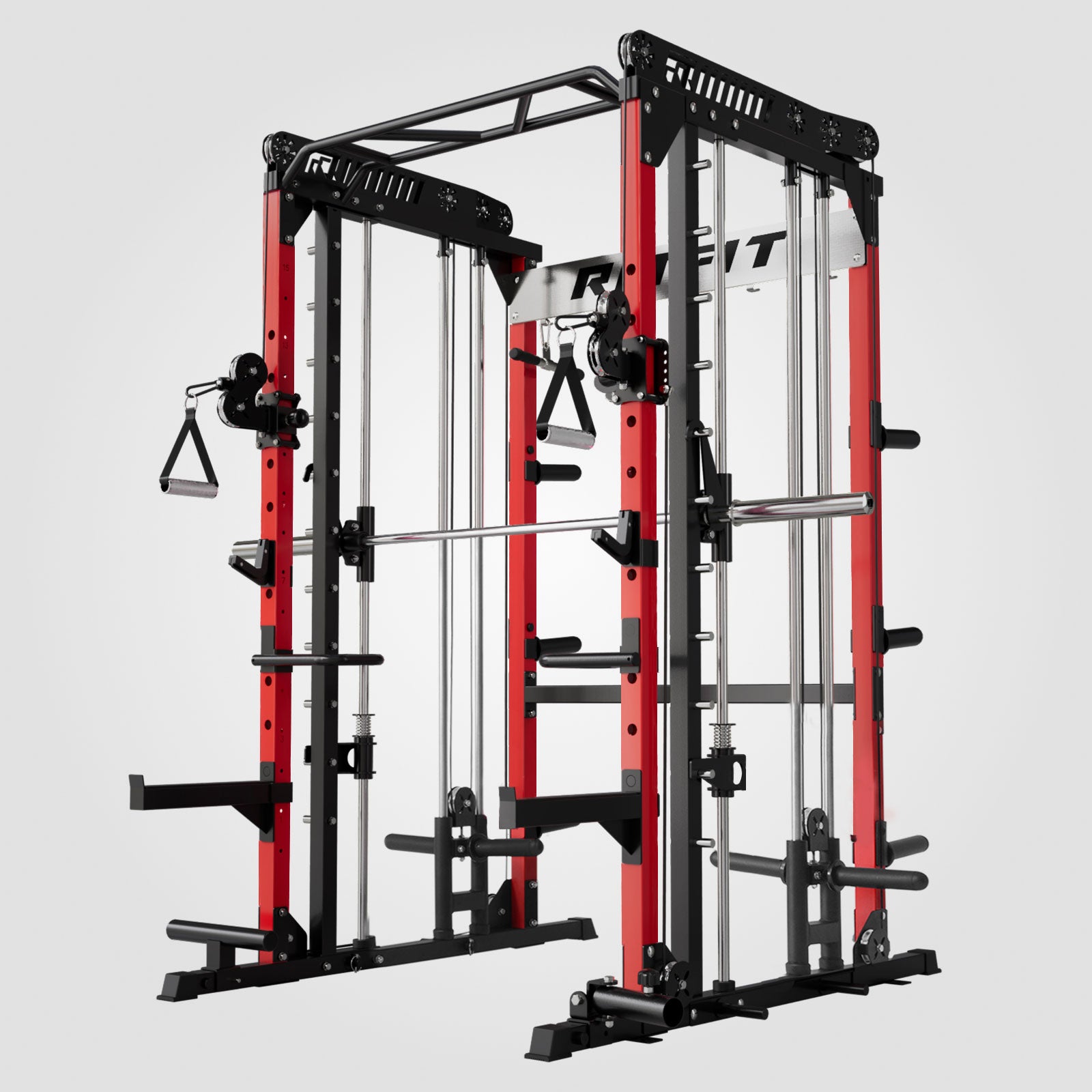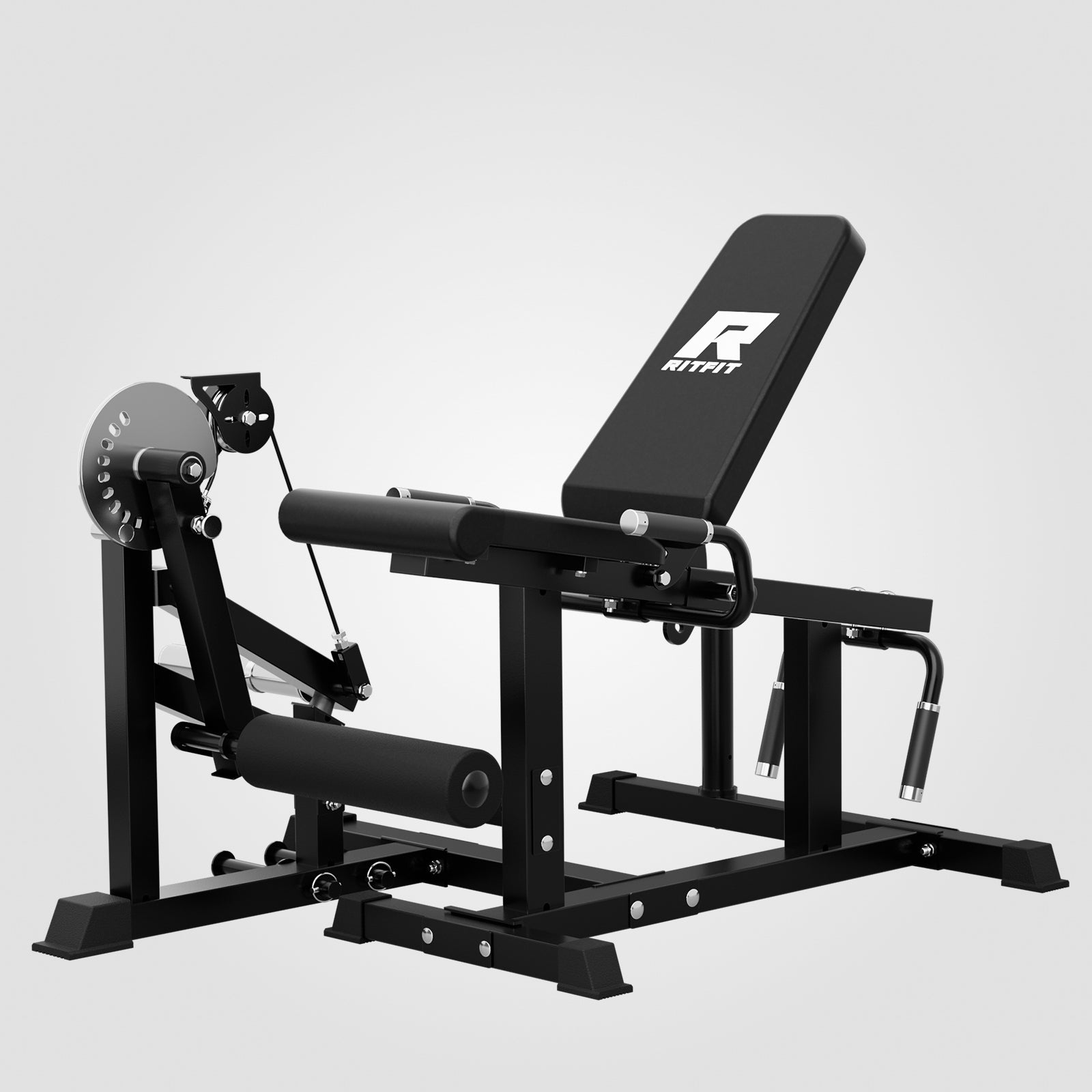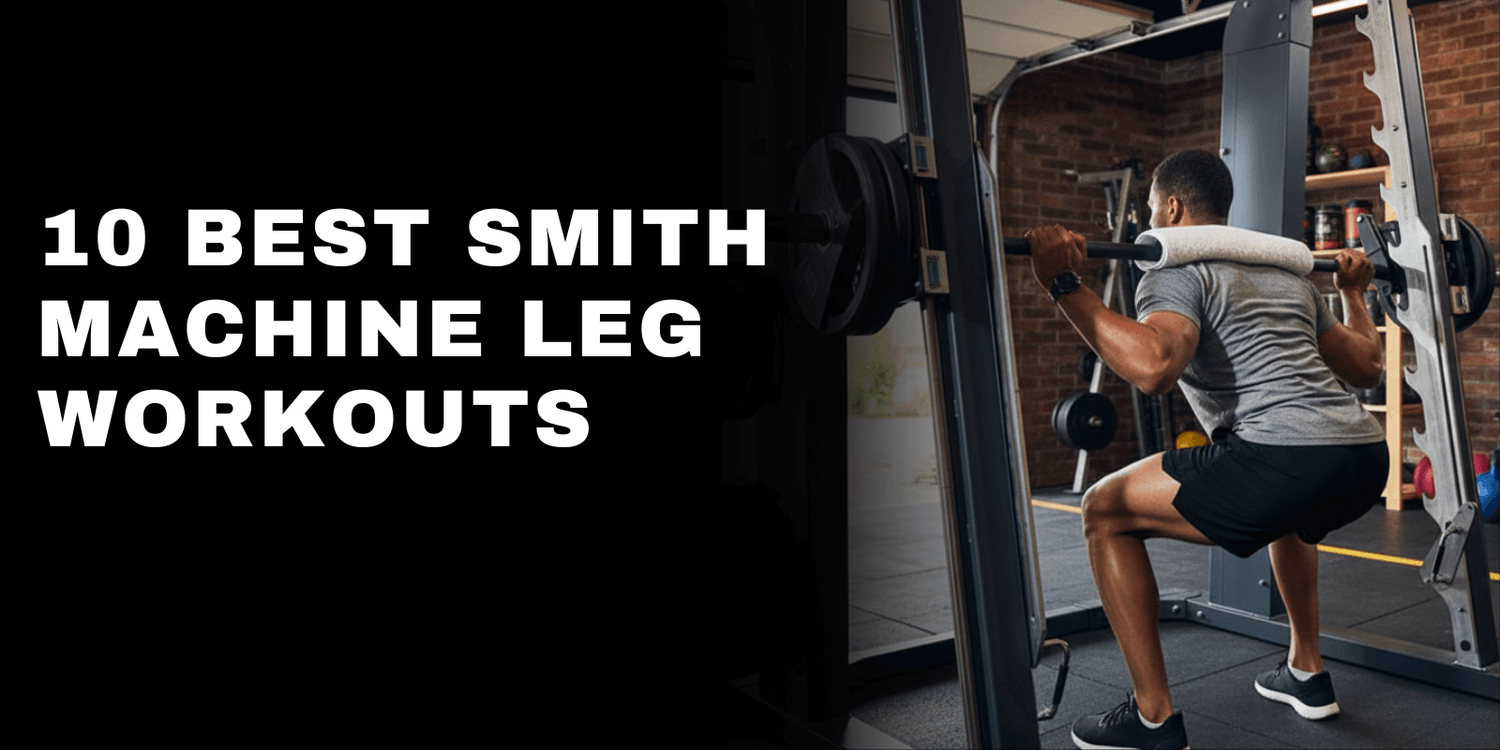
A Smith machine leg exercise can train the quads, glutes, hamstrings, and calves when the bar path, foot position, safety stops, and load are matched to your body and machine. As a sports medicine physician, I use the guided bar as a stability tool, not a guarantee of safety.
Choose four to five exercises for one session, start with light ramp up sets, and use a pain free range you can control. The ten exercises below preserve the original workout structure while adding clearer setup, progression, and safety guidance.
Table of Contents
Key Takeaways
- Choose four to five movements: One squat, one hip hinge, one single leg exercise, one glute movement, and one calf exercise can cover a complete beginner leg day.
- Set the safety stops: Position them just below your lowest controlled range before adding challenging weight.
- Adjust foot position individually: Rail angle, limb length, ankle mobility, and training goal affect the stance that works best.
- Progress gradually: Add repetitions before adding weight, and keep most sets about one to three clean repetitions from failure.
- Respect pain signals: Stop for sharp pain, numbness, tingling, swelling, or symptoms that worsen from set to set.
The Benefits of Smith Machine Leg Workouts
Smith machine leg exercises reduce balance demands and let you focus more attention on controlled lower body movement. They can support muscle growth and strength when the machine setup, exercise selection, and weekly workload match your ability.
Use the guided bar for stability, controlled overload, and repeatable technique, not as permission to ignore form.
- Self spotting options: The rotating hooks and adjustable safety stops can make it easier to end a difficult set without a human spotter. Test both systems with an unloaded or lightly loaded bar before training.
- Lower stability demand: The rails reduce side to side movement, which may help you concentrate on the quads, glutes, hamstrings, or calves. The machine still requires bracing, foot pressure, and control.
- Repeatable bar path: A consistent path can make progression easier to track across sessions. It also means your stance must fit the machine instead of forcing free weight mechanics onto fixed rails.
- Flexible exercise selection: One station can support squats, split squats, lunges, Romanian deadlifts, hip thrusts, hip raises, and calf raises. Beginners can review whether a Smith machine is good for beginners before choosing a full program.
- Individual foot placement: Small stance changes alter trunk position, shin angle, hip demand, and knee demand. Squat biomechanics vary with depth, stance, trunk angle, load, and individual structure, so there is no single universally safest foot position.[1]
For equipment options, explore the original Smith Machine collection. Confirm the bar path, starting resistance, safety hardware, dimensions, and approved attachments before copying any exercise setup.
10 Best Smith Machine Leg Workouts
Smith Machine Split Squat
Muscles Worked:
How to Do:
- Set the bar slightly below standing shoulder height and place it across your upper back, not directly on your neck.
- Step one foot forward and the other backward while keeping enough side to side width for balance.
- Unrack the bar, brace your trunk, and lower the back knee toward the floor under control.
- Keep the front foot planted and let the front knee track in the same direction as the toes.
- Drive through the whole front foot to stand, then complete all repetitions before changing sides.
Pro Tips:
- Use a stable base: Keep the feet on separate train tracks instead of placing them on one narrow line.
- Choose stride length by goal: A slightly longer stride usually increases hip involvement, while a shorter comfortable stride may increase knee demand.
- Control the pelvis: Keep the hips facing forward and avoid rotating toward the working leg.
- Review the movement: Use this detailed Bulgarian split squat form guide for additional stance and balance cues.
Workout Routine for Beginners:
- Sets: 3
- Repetitions: 8 to 12 per leg
- Rest: 60 to 90 seconds
- Effort: Stop with 2 to 3 controlled repetitions remaining
Smith Machine Front Squat
Muscles Worked:
How to Do:
- Set the bar near upper chest height and position it across the front deltoids.
- Use a clean grip, crossed arm grip, or straps that keep the bar secure without wrist pain.
- Stand where the rails allow an upright, balanced descent with the whole foot planted.
- Brace, keep the elbows lifted, and bend the knees and hips together as you descend.
- Reach your deepest controlled position, then push through the whole foot to stand.
Pro Tips:
- Let the knees move naturally: The knees may travel forward when they remain aligned with the toes and the heels stay planted.
- Keep the elbows high: Dropping the elbows can allow the upper back to round and the bar to roll forward.
- Use a controlled depth: Stop before the pelvis tucks excessively or the feet lose stable pressure.
- Study the setup: Follow the full Smith machine front squat guide for grip and stance options.
Workout Routine for Beginners:
- Sets: 3
- Repetitions: 8 to 10
- Rest: 90 to 120 seconds
- Effort: Stop with 2 controlled repetitions remaining
Smith Machine Back Squat
Muscles Worked:
How to Do:
- Set the bar slightly below shoulder height and place it across the upper trapezius area.
- Position the feet where you can keep the whole foot planted throughout the machine's rail path.
- Unrack the bar, brace the abdomen, and keep the ribs stacked over the pelvis.
- Bend the hips and knees together while allowing the knees to track with the toes.
- Descend to a controlled depth, then push the floor away and stand without snapping the knees.
Pro Tips:
- Check the rail direction: Vertical and angled Smith machines may require different body orientation and foot position.
- Avoid fixed distance rules: Do not assume every lifter must place the feet a specific number of inches forward.
- Control the lowering phase: Use a smooth descent instead of bouncing into the bottom position.
- Compare variations: Review the best Smith machine squat exercises before choosing a quad or glute emphasis.
Workout Routine for Beginners:
- Sets: 3
- Repetitions: 8 to 12
- Rest: 90 to 120 seconds
- Effort: Stop with 2 to 3 controlled repetitions remaining
Smith Machine Hack Squat
Muscles Worked:
How to Do:
- Set the bar slightly below shoulder height and position it securely across the upper back.
- Place the feet forward only far enough to keep the torso supported and the heels planted.
- Unrack the bar, brace the trunk, and maintain even pressure across both feet.
- Lower the hips downward as the knees bend and track in line with the toes.
- Stop at your deepest controlled position, then extend the knees and hips to stand.
Pro Tips:
- Use the rails as support: Keep contact with the bar consistent without pressing the spine aggressively into it.
- Keep the heels down: Move the feet slightly if the heels lift or the knees feel forced.
- Maintain muscular tension: Finish each repetition with control instead of forcefully locking the knees.
- Modify the range: Use the depth that preserves stable feet, knee tracking, and trunk control.
Workout Routine for Beginners:
- Sets: 3
- Repetitions: 10 to 15
- Rest: 90 seconds
- Effort: Stop with 2 controlled repetitions remaining
Smith Machine Romanian Deadlift
Muscles Worked:
How to Do:
- Set the bar around mid thigh height and stand with the feet approximately hip width apart.
- Grip the bar slightly outside the thighs, unrack it, and soften the knees.
- Push the hips backward while keeping the bar close to the legs and the spine controlled.
- Lower only until the hamstrings limit further hip movement without back rounding.
- Drive the hips forward and squeeze the glutes to return to a tall standing position.
Pro Tips:
- Lead with the hips: Think about closing a car door behind you instead of squatting straight down.
- Use an individual range: Mid shin is not a required target because hamstring mobility and body proportions differ.
- Keep the neck neutral: Let the gaze follow the torso instead of lifting the chin toward a mirror.
- Review the hinge: Use the detailed Smith machine Romanian deadlift guide for additional bracing cues.
Workout Routine for Beginners:
- Sets: 3
- Repetitions: 8 to 12
- Rest: 90 to 120 seconds
- Effort: Stop when grip or spinal position begins to limit technique
Smith Machine Calf Raise
Muscles Worked:
How to Do:
- Place a stable, nonslip, load rated step under the bar and test that it cannot move.
- Set the bar across the upper back and place the balls of the feet securely on the step.
- Unrack the bar with the knees softly extended and the trunk braced.
- Lower the heels under control until you feel a comfortable calf stretch.
- Rise onto the toes, pause briefly at the top, and lower without bouncing.
Pro Tips:
- Test the platform first: Never reposition or kick the step while supporting a loaded bar.
- Use full control: Pause briefly at the stretched position instead of relying on a rapid rebound.
- Keep the knees soft: Avoid snapping them into a hard locked position.
- Reduce load when balance changes: Stop if the feet slide, the step shifts, or the ankles roll outward.
Workout Routine for Beginners:
- Sets: 3
- Repetitions: 12 to 20
- Rest: 60 seconds
- Tempo: Lower slowly and pause at the stretched position
Smith Machine Hip Raise
Muscles Worked:
How to Do:
- Set the bar low enough to reach the hips while lying on a mat with the knees bent.
- Place a thick bar pad between the bar and the front of the pelvis.
- Set the feet flat, brace the trunk, and extend the hips enough to unrack the bar.
- Raise the hips until the torso and thighs form a controlled line without overextending the lower back.
- Squeeze the glutes, then lower the hips slowly to the starting position.
Pro Tips:
- Keep the shoulders grounded: Unlike a bench supported hip thrust, the upper back remains on the floor.
- Use a neutral neck: Keep the chin gently tucked instead of throwing the head backward.
- Adjust the feet: Move them slightly closer if the hamstrings cramp or dominate the movement.
- Finish with the glutes: Stop when the hips are fully extended rather than arching the lumbar spine for extra height.
Workout Routine for Beginners:
- Sets: 3
- Repetitions: 12 to 15
- Rest: 60 to 90 seconds
- Equipment: Thick bar pad and nonslip mat
Smith Machine Reverse Lunges
Muscles Worked:
How to Do:
- Set the bar slightly below shoulder height and place it securely across the upper back.
- Stand with the feet approximately hip width apart and confirm the safety stop position.
- Unrack the bar and step one foot backward into a stable split stance.
- Lower until the front foot stays planted and both knees move through a controlled range.
- Push through the front foot to return, then regain balance before beginning the next repetition.
Pro Tips:
- Use adequate stance width: Keep the feet on separate tracks to reduce side to side instability.
- Choose torso angle intentionally: A small forward lean may increase hip demand, while a more upright torso may increase knee demand.
- Do not chase exact angles: Both knees do not need to reach precisely 90 degrees for the repetition to be effective.
- Start with a fixed stance: Beginners may find stationary split squats easier than stepping backward under load.
Workout Routine for Beginners:
- Sets: 3
- Repetitions: 8 to 10 per leg
- Rest: 90 seconds
- Progression: Master a stationary stance before alternating repetitions
Smith Machine Hip Thrust
Muscles Worked:
How to Do:
- Place a stable bench behind the bar and prevent it from sliding against the floor or frame.
- Sit with the lower shoulder blades supported by the bench and position a thick pad over the hips.
- Set the feet approximately shoulder width apart and place the bar securely in the hip crease.
- Drive through the feet and extend the hips while keeping the ribs controlled and chin gently tucked.
- Pause when the hips are fully extended, then lower slowly without losing bench or foot position.
Pro Tips:
- Secure the bench: Stop immediately if the bench shifts, tips, or moves away from the machine.
- Adjust the feet: Aim for comfortable shin alignment at the top instead of forcing an exact universal position.
- Avoid back extension: Finish by contracting the glutes and controlling the pelvis rather than arching the lower back.
- Use more than one glute pattern: A training study found similar gluteal growth from hip thrust and squat programs, while the squat produced greater quadriceps and adductor growth in the studied participants.[2] Review the full Smith machine hip thrust setup guide before progressing load.
Workout Routine for Beginners:
- Sets: 3 to 4
- Repetitions: 8 to 12
- Rest: 90 to 120 seconds
- Equipment: Stable bench, thick hip pad, and safety stops
Smith Machine Leg Press, Vertical Leg Press
Muscles Worked:
How to Do:
- Install the manufacturer approved leg press plate and confirm every locking point before loading weight.
- Set the safety stops to prevent the carriage from reaching the torso if a repetition fails.
- Lie on a nonslip mat and place both feet securely on the center of the approved plate.
- Extend the knees and hips under control, then lower only while the pelvis and lower back remain stable.
- End the set before technical failure and use the approved reracking method described by the manufacturer.
Pro Tips:
- Do not improvise the contact surface: A bare round bar does not provide the stable platform of a purpose built leg press plate.
- Use supervision: A competent spotter or coach should verify the setup before the first loaded attempt.
- Protect pelvic control: Stop the descent before the pelvis rolls away from the floor or the lower back loses control.
- Choose an alternative when uncertain: Back squats, split squats, or a purpose built leg press are more appropriate when equipment compatibility is unclear.
Workout Routine for Beginners:
- Beginner recommendation: Choose another exercise unless qualified supervision and approved equipment are available
- Experienced lifter sets: 2 to 3
- Experienced lifter repetitions: 10 to 15
- Rest: 90 to 120 seconds
Training Templates
How to Choose a Template
Choose one template and follow it for four to six weeks before making major changes. Begin with five to eight minutes of general movement and two or three lighter ramp up sets for the first exercise.
- Progress repetitions first: Add one repetition per set until you reach the top of the listed range, then add a small amount of weight.
- Use RIR: Repetitions in reserve estimates how many clean repetitions you could complete before technical failure.
- Avoid mandatory failure: Evidence does not show that every set must reach failure for hypertrophy, and proximity to failure should be balanced with fatigue and exercise safety.[3]
- Manage weekly volume: Higher training volume can support greater hypertrophy in trained lifters, but it also increases time and recovery demands.[4]
- Check the starting load: Smith bars vary in counterbalance and starting resistance, so review how much a Smith machine bar weighs before recording total load.
Template 1: Beginner Full Leg Day, Once Per Week
This template covers the major lower body movement patterns with five exercises. Start with two working sets per movement when recovery or experience is limited.
- Back Squat: 3 sets of 8 to 12, rest 90 to 120 seconds
- Romanian Deadlift: 3 sets of 8 to 12, rest 90 to 120 seconds
- Split Squat: 2 to 3 sets of 8 to 12 per leg, rest 60 to 90 seconds
- Hip Raise: 3 sets of 12 to 15, rest 60 to 90 seconds
- Calf Raise: 3 sets of 12 to 20, rest 60 seconds
Template 2: Quad Focus Day
This template emphasizes knee dominant patterns while retaining a stable unilateral exercise. Reduce one squat movement if knee soreness or recovery worsens across sessions.
- Front Squat: 4 sets of 6 to 10, rest 120 seconds
- Hack Squat: 3 sets of 10 to 15, rest 90 seconds
- Reverse Lunge: 3 sets of 8 to 10 per leg, rest 90 seconds
- Calf Raise: 4 sets of 12 to 20, rest 60 seconds
Template 3: Glute and Hamstring Focus Day
This template combines horizontal hip extension, a hip hinge, a squat, and a unilateral pattern. Keep the lumbar spine controlled as fatigue accumulates.
- Hip Thrust: 4 sets of 8 to 12, rest 120 seconds
- Romanian Deadlift: 3 sets of 8 to 12, rest 90 to 120 seconds
- Back Squat with a comfortable stance: 3 sets of 8 to 12, rest 90 to 120 seconds
- Split Squat with a comfortable longer stride: 2 to 3 sets of 10 to 12 per leg, rest 60 to 90 seconds
Template 4: Joint Conscious Strength Day
This template uses controlled ranges and moderate effort rather than claiming that one exercise is universally knee friendly. Symptoms should guide exercise substitution and professional evaluation.
- Back Squat at a comfortable depth: 3 sets of 6 to 10, rest 120 seconds
- Hip Raise: 3 sets of 12 to 15, rest 60 to 90 seconds
- Romanian Deadlift: 3 sets of 8 to 12, rest 90 seconds
- Calf Raise: 3 sets of 12 to 20, rest 60 seconds
- Optional substitution: Replace the squat with a shorter range hack squat only when that variation feels controlled and does not worsen symptoms.
Common Mistakes to Avoid in Smith Machine Leg Exercises
Smith machine rails reduce some balance demands, but they do not correct poor setup automatically. The most common problems come from copying another person's stance, skipping safety checks, using excessive load, and forcing range through pain.
Set the machine first, control every repetition, and let your anatomy guide the stance.
- Mistake 1, treating it exactly like a free weight squat: A fixed rail changes how the bar and body can move. Adjust stance and orientation to fit the machine while maintaining stable foot pressure.
- Mistake 2, copying a fixed foot distance: Three inches, six inches, or eighteen inches forward will not suit every lifter. Start light and adjust until the heels remain planted and the joints move comfortably.
- Mistake 3, forcing the knees behind the toes: Forward knee travel is not automatically an error. Focus on knee tracking, foot stability, control, and symptoms rather than an arbitrary toe line.
- Mistake 4, skipping safety stops: The stops are the main backup when a repetition stalls. Set them before loading challenging weight and test them with an empty bar.
- Mistake 5, ignoring the machine's starting resistance: Counterbalanced Smith bars may feel different from a standard 45 pound Olympic bar. Record the machine and plate load consistently instead of assuming every bar is identical.
- Mistake 6, rounding through the lower back: Reduce load or range when the pelvis and spine cannot remain controlled. Guided rails do not protect the back from poor bracing.
- Mistake 7, taking every exercise to failure: Fatigue can make reracking, stepping, and bench supported movements less predictable. Keep most sets short of technical failure and reserve harder efforts for stable exercises.
- Mistake 8, training through warning symptoms: Sharp pain, spreading pain, numbness, tingling, joint swelling, or worsening weakness are reasons to stop. Seek qualified evaluation when symptoms persist or affect normal activity.
FAQs
Is a Smith machine good for leg workouts?
Yes. A Smith machine can train the quads, glutes, hamstrings, and calves while reducing balance demands. It does not remove injury risk, so set the safety stops, test the bar path with a light load, and choose a stance that feels controlled throughout the full range.
How many Smith machine leg exercises should I do in one workout?
Most beginners need four or five Smith machine leg exercises in one session. Choose one squat pattern, one hip hinge, one single leg movement, one glute exercise, and one calf exercise, then adjust total sets according to recovery, training frequency, and exercise experience.
How should I place my feet for Smith machine squats?
Place your feet where the whole foot stays planted and your knees track comfortably with your toes. The best position depends on the rail angle, limb proportions, ankle mobility, and training goal, so begin with a light load and make small stance adjustments.
Can Smith machine leg workouts build bigger glutes?
Yes. Smith machine squats, split squats, reverse lunges, hip raises, and hip thrusts can all train the glutes effectively. Use a controlled range, maintain stable foot pressure, and progress load or repetitions gradually instead of relying on one exercise or forcing every set to failure.
What should I do if my knees hurt during Smith machine squats?
Stop the set if pain is sharp, worsening, or changes your movement. Reduce the load, review foot position, shorten the range to a comfortable depth, and confirm that the knees track with the toes, then seek qualified evaluation when pain persists, swelling appears, or daily activity is affected.
Are Smith machine vertical leg presses safe for beginners?
Not usually. A Smith machine vertical leg press should only be performed when the manufacturer approves the setup and a secure leg press attachment, safety stops, and competent supervision are available. Beginners are generally better served by squats, split squats, or a purpose built leg press machine.
Final Thoughts
A Smith machine can support a complete leg workout when you treat its fixed bar path as a setup variable rather than a shortcut. Select four to five movements, use safety stops, progress gradually, and adjust stance and range according to control, recovery, and symptoms.
For most lifters, a squat, Romanian deadlift, split squat, hip thrust or hip raise, and calf raise provide a balanced starting session. The advanced vertical leg press should remain equipment dependent and optional.
Disclaimer: This article provides general fitness education and is not medical advice. Consult a qualified clinician before training if you have persistent knee, hip, ankle, back, nerve, balance, or postsurgical concerns. Stop any exercise that causes sharp pain, spreading pain, numbness, tingling, swelling, dizziness, or worsening weakness. Follow the Smith machine manufacturer's instructions and use only approved attachments.
References
- Straub RK, Powers CM. A biomechanical review of the squat exercise: implications for clinical practice. Int J Sports Phys Ther. 2024;19(4):490-501. doi:10.26603/001c.94600
- Plotkin DL, Rodas MA, Vigotsky AD, et al. Hip thrust and back squat training elicit similar gluteus muscle hypertrophy and transfer similarly to the deadlift. Front Physiol. 2023;14:1279170. doi:10.3389/fphys.2023.1279170
- Refalo MC, Helms ER, Trexler ET, Hamilton DL, Fyfe JJ. Influence of resistance training proximity-to-failure on skeletal muscle hypertrophy: a systematic review with meta-analysis. Sports Med. 2023;53(3):649-665. doi:10.1007/s40279-022-01784-y
- Schoenfeld BJ, Contreras B, Krieger J, et al. Resistance training volume enhances muscle hypertrophy but not strength in trained men. Med Sci Sports Exerc. 2019;51(1):94-103. doi:10.1249/MSS.0000000000001764