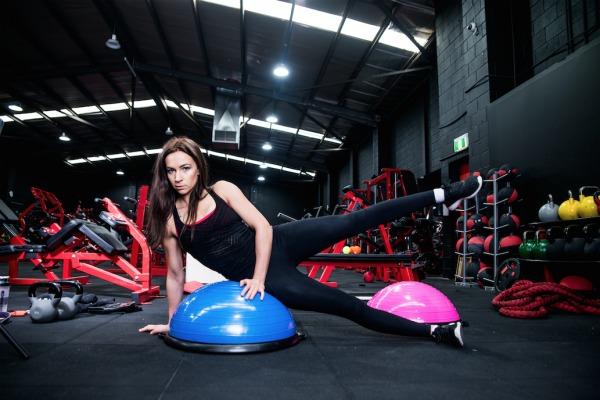
BOSU ball exercises for core and balance are a practical way to build midsection strength and improve balance at home, using a single piece of balance training equipment. A BOSU ball, so named because you can use either side up, is a half stability ball mounted on a sturdy plastic platform.
This guide breaks down 10 BOSU ball exercises for core and balance, with clear step-by-step cues you can follow without a trainer. Each move targets your abs, hips, and lower body while training your stabilizer muscles on an unstable surface.
Quick Answer: BOSU ball exercises for core and balance use an unstable half-ball surface to force your abs, hips, and stabilizing muscles to work harder during lunges, planks, bridges, and squats. Practicing these ten moves two to three times a week can strengthen your midsection and improve balance, coordination, and ankle stability.
Key Takeaways
- Unstable surface training: The BOSU ball challenges your core and balance by making stabilizer muscles react to movement on an unstable surface.
- Full-body coverage: The ten moves work your legs, glutes, arms, shoulders, and midsection in a single session.
- Both sides usable: You can train on the rounded dome or the flat platform, which adds variety and difficulty.
- Beginner friendly: Each exercise can be scaled by adding a weight, holding a position longer, or choosing the stable side.
- Progressive results: Practicing two to three times a week can improve core control, coordination, and ankle stability over time.
What Is a BOSU Ball and Why Use It for Core and Balance?
A BOSU ball is a half stability ball set on a flat plastic platform, and training on it strengthens your core and improves balance by forcing your stabilizing muscles to react to an unstable surface. You can use the rounded dome or flip it to the flat side, which allows a wide range of exercises and difficulty levels.
- Core overload: Your abs and hips must work continuously to keep your body steady on the moving surface.
- Balance and coordination: Small stabilizing muscles in your feet and ankles activate more than they do on a firm floor.
- Compact and portable: One ball fits in a home gym corner and replaces several bulky pieces of equipment.
You can start with a dedicated BOSU ball trainer, or pair the moves with a wider exercise for balance routine at home.
10 BOSU Ball Exercises for Core and Balance
The ten BOSU ball exercises for core and balance below form a full-body session that requires coordination on an unstable surface. Try them at home or at the gym, and adjust the reps and hold times to your fitness level.
1. BOSU Lunge
The BOSU lunge works your glutes, hamstrings, quadriceps, and calves while challenging your balance.
- Place the BOSU ball with the plastic platform facing down and stand two to three feet behind it.
- Step forward and place your right foot on the center of the dome, then bend both knees into a lunge until both reach 90 degrees.
- Keep your torso upright and hips facing forward, then return to standing. Repeat 10 to 15 times per side.
2. BOSU Lunge and Twist
Add a twist to your lunge to work your core and lower body at the same time.
- Stand upright and hold the BOSU ball at your chest with both hands, elbows pulled in.
- Step forward with your right foot and lower your left knee toward the ground.
- As you lower, twist your torso to the right, aiming your left elbow toward your right knee. Repeat 10 to 12 times per side.
3. BOSU Pushup
Boost your core work while challenging your chest and triceps with an upper body move.
- Place the rounded side of the ball on the ground and kneel behind it.
- Rest your hands palm down on the platform and step your feet back into a pushup position with a straight body.
- Lower your chest toward the platform until your elbows form 90 degrees, then press back up. Do 8 to 12 reps for three sets.
For more moves that target your upper body, see these upper body exercises on a balance ball trainer.
4. BOSU Overhead Squat
This squat uses the BOSU ball as a weight to hit your legs, core, and shoulders.
- Stand with feet shoulder width apart and press the BOSU ball overhead with both arms.
- Tip your hips back and squat down as if sitting in a chair, keeping your heels flat and arms extended.
- Keep your knees in line with your toes, then return to standing. Perform 12 to 15 reps for three sets.
5. BOSU Split Squat
A split squat on the BOSU ball strengthens your hips, butt, and legs while training each leg on its own.
- Place the ball with the platform facing up and stand beside it.
- Put your left foot in the center of the ball and lower into a squat, bending both knees.
- Press through your feet and return to standing. Repeat 10 to 12 times per side for at least two sets.
6. BOSU Bridge
The BOSU bridge challenges your glutes and the stabilizing muscles of your hips.
- Place the ball platform side down and sit just behind it with your feet on the center of the dome.
- Lie back with knees bent, arms at your sides, and press your hips up until your body forms a straight line from shoulders to knees.
- Hold for three seconds, then lower and stop just before your glutes touch the floor. Do 15 to 20 reps for two to three sets.
7. BOSU Plank
A plank on the BOSU ball increases the work on your shoulders, chest, abs, hips, and quads.
- Place the ball platform side down, kneel behind it, and rest your forearms on either side of the center of the dome.
- Step your legs back so your body forms a straight line from heels to head.
- Hold for 30 to 60 seconds with your abs tight, keeping your hips from dipping. Rest, then repeat twice.
8. BOSU Single Leg Balance Deadlift
A deadlift on the BOSU ball targets your hamstrings and glutes while strengthening your ankle stabilizers.
- Place the ball with the dome side down and stand with one foot centered on the flat platform.
- Tip your torso forward and lift your back leg until your body forms a T shape.
- Reach toward the floor, then squeeze your glutes to return to standing. Do 12 reps per leg.
9. BOSU V-Up
BOSU V-ups work your abs while testing your balance on the dome.
- Sit on the center of the dome with knees bent and feet on the floor.
- Lift your feet and draw your knees toward your chest, then straighten your legs and lean your torso back into a V.
- Hold the position, then pull back to sitting. Perform 15 to 20 reps for two to three sets.
10. BOSU Burpee
Finish your session with a quick burst of cardio and strength by adding a BOSU ball to a burpee.
- Stand with knees slightly bent and hold the ball in front of your body, elbows drawn in.
- Squat down and place the dome on the ground, then hop your legs back into a pushup position.
- Jump your feet back, stand up, and lift the ball overhead. Do as many reps as you can in 60 seconds.
How Often Should You Do BOSU Ball Exercises?
You can do BOSU ball exercises for core and balance two to three times a week on non-consecutive days, which gives your stabilizer muscles time to recover after an unstable-surface session. On other days you can add them as a finisher to your regular home workout.
- Start small: Begin with one or two sets of each move and add reps as your balance improves.
- Combine with strength: Pair the routine with effective exercise ball exercises for a fuller core challenge.
- Add variety: Swap in a balance pad or switch to the 20 super effective stability ball exercises to keep the workout interesting.
"While you can't spot reduce love handle fat, doing obliques exercises will help you tone the sides of your abs so that once you've reduced fat in that area, the oblique muscles will show."
Jeff Cavaliere, MSPT, CSCS, Athlean-X
How to Stay Safe Working Out on a BOSU Ball
Work near a wall or sturdy surface until you feel stable, and move slowly through each rep so you can recover your balance without losing control. The unstable surface makes it easy to overdo it at first, so keep your range controlled.
- Warm up: Spend five minutes loosening your hips, ankles, and shoulders before you start.
- Choose the stable side first: Beginners can keep the platform on the floor and progress to the dome side later.
- Stop if you feel pain: If you have joint issues or persistent discomfort, talk to a personal trainer or physical therapist first.
For a visual cue on a core movement you can add to your BOSU ball routine, watch how a bicycle crunch is performed by a qualified instructor.
FAQs About BOSU Ball Exercises for Core and Balance
Do BOSU ball exercises really improve balance?
Yes. Training on an unstable surface forces your ankles, hips, and core to react to movement, which strengthens balance and coordination over time. Practicing regularly for a few weeks gives the most noticeable gains. Beginners should start with the stable side.
Is a BOSU ball good for core strength?
Yes. The rounded dome makes your abs and deep stabilizer muscles work continuously to keep your body level. Exercises such as the plank, V-up, and bridge add extra core work. It builds strength in a different way than a stable floor.
How often should a beginner use a BOSU ball?
Start with once or twice a week and two sets per exercise, keeping each rep controlled and slow. Wait a full day between sessions to let your stabilizer muscles recover. Increase frequency only after your balance feels steady on the unstable surface.
Can you do BOSU ball exercises at home without a trainer?
Yes. All ten moves in this guide use simple cues and no heavy equipment beyond the ball itself. Work near a wall for safety. If you prefer more guidance, follow a beginner plan like 14 best BOSU ball exercises for beginners.
How do I progress from the basic BOSU moves?
Increase the number of reps and sets, hold balance-based moves longer, or flip to the harder side of the ball. You can also add a light weight to lunge or squat moves once your balance is solid. Progress slowly to avoid strain.
Are BOSU ball exercises safe for older adults?
Yes, when done with care and a support nearby. Foam and surface choices affect stability, so older or less steady athletes should start on a firm surface and use a chair or wall. Review safe balance exercises for seniors before starting.
Conclusion
BOSU ball exercises for core and balance give you a complete full-body workout from a single piece of equipment at home. The ten moves in this guide work your legs, arms, abs, and stabilizers while building coordination on an unstable surface.
Start with the easier side, move slowly, and add reps as your balance improves. For a fresh setup and to save on your next order, check the RitFit discount guide before you buy.
Disclaimer
The information in this article is for general educational purposes and is not medical advice or a substitute for professional guidance. Consult a doctor or qualified trainer before starting a new exercise program, especially if you have an injury or medical condition.
References
1. Behm DG, Anderson K, Curnew RS. Muscle force and activation under stable and unstable conditions. J Strength Cond Res. 2002;16(3):416-422. doi:10.1519/1533-4287(2002)016<0416:MFAAUS>2.0.CO;2
2. Behm DG, Drinkwater EJ, Willardson JM, Cowley PM. The use of instability to train the core musculature. Appl Physiol Nutr Metab. 2010;35(1):91-108. doi:10.1139/H09-127