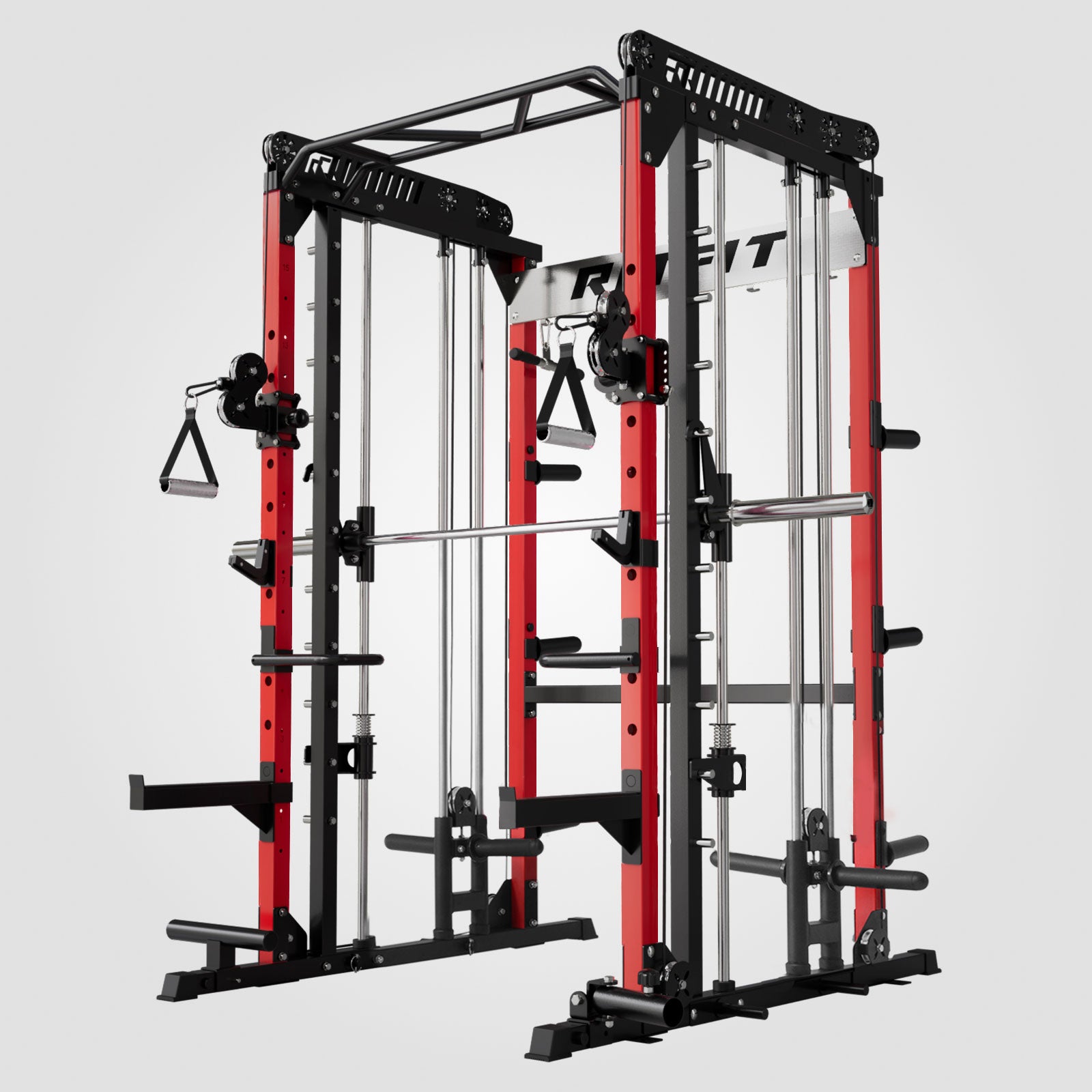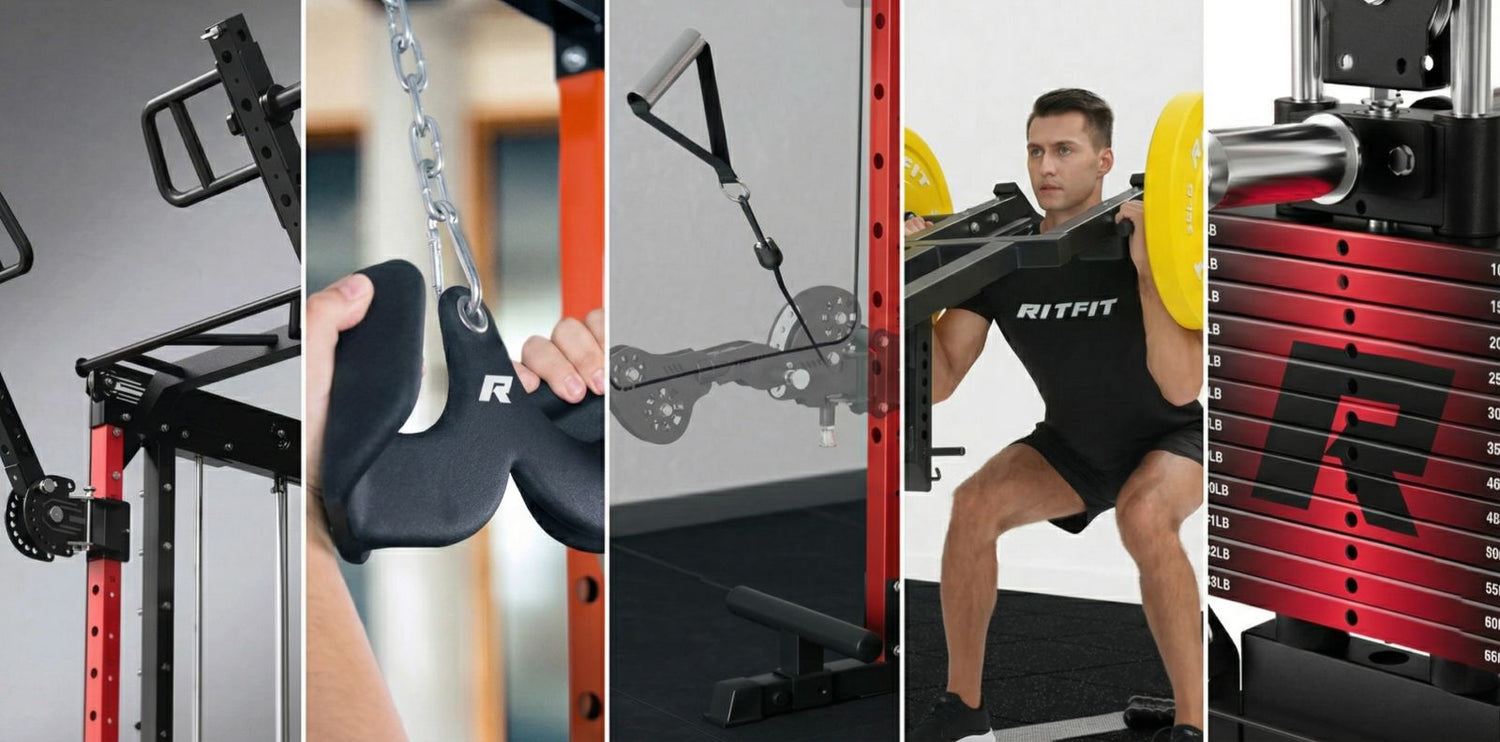
The best 2x2 power rack attachments are the ones that add useful training options without creating compatibility, space, or safety problems. For most home gym owners, that means choosing attachments that expand lower body training, cable work, pressing strength, and loading convenience.
This guide compares five high value rack attachments by training goal, space impact, and buying considerations, so you can decide which upgrade should come first.
Table of Contents
Key Takeaways
- Compatibility comes first: A 2x2 upright does not guarantee universal fit, so always check hole size, hole spacing, rack width, and attachment hardware.
- Hack squat attachments add lower body variety: They are best for lifters who want more guided quad, glute, and calf work from a rack based setup.
- Weight stacks improve training speed: They make cable resistance changes faster, which is useful for drop sets, supersets, and shared home gyms.
- Lat pulldown attachments improve pulling stability: A leg holder and high pulley setup can make heavier pulldowns more practical than basic cable work.
- Lever arms and rotary cable arms expand movement options: They are best for users who want more machine style pressing and more flexible cable angles.
What Does 2x2 Mean on a Power Rack?
2x2 usually refers to the upright tube size of a power rack, but it does not mean every 2x2 attachment will fit every 2x2 rack. Hole diameter, hole spacing, rack width, rack depth, pin length, and mounting style can all affect compatibility.
Before buying any power rack attachment, compare the attachment specifications with your rack manual and product page. This is especially important for moving parts, plate loaded arms, cable systems, and attachments that extend outside the rack footprint.
Quick Comparison of the Best 2x2 Power Rack Attachments
The best attachment depends on the training gap you need to solve first. Use this comparison to match each upgrade with your home gym goal.
| Attachment | Best Training Goal | Main Benefit | Space Impact | Best User Type |
|---|---|---|---|---|
| Hack Squat Attachment | Lower body variety | Guided squat and calf raise work | High | Lifters who want more leg training without a standalone machine |
| Weight Stack | Cable training convenience | Fast resistance changes | Low to moderate | Users who train with pulleys often |
| Lat Pulldown Attachment | Upper body pulling | More stable vertical pulling | Moderate | Lifters who want back training beyond pull ups |
| Rotary Cable Arms | Cable angle variety | More cable path options | Moderate | Users who want rotational and unilateral cable work |
| Lever Arms | Machine style pressing | Guided pressing and unilateral loading | Moderate to high | Lifters who train chest and shoulders alone |
Hack Squat Attachment
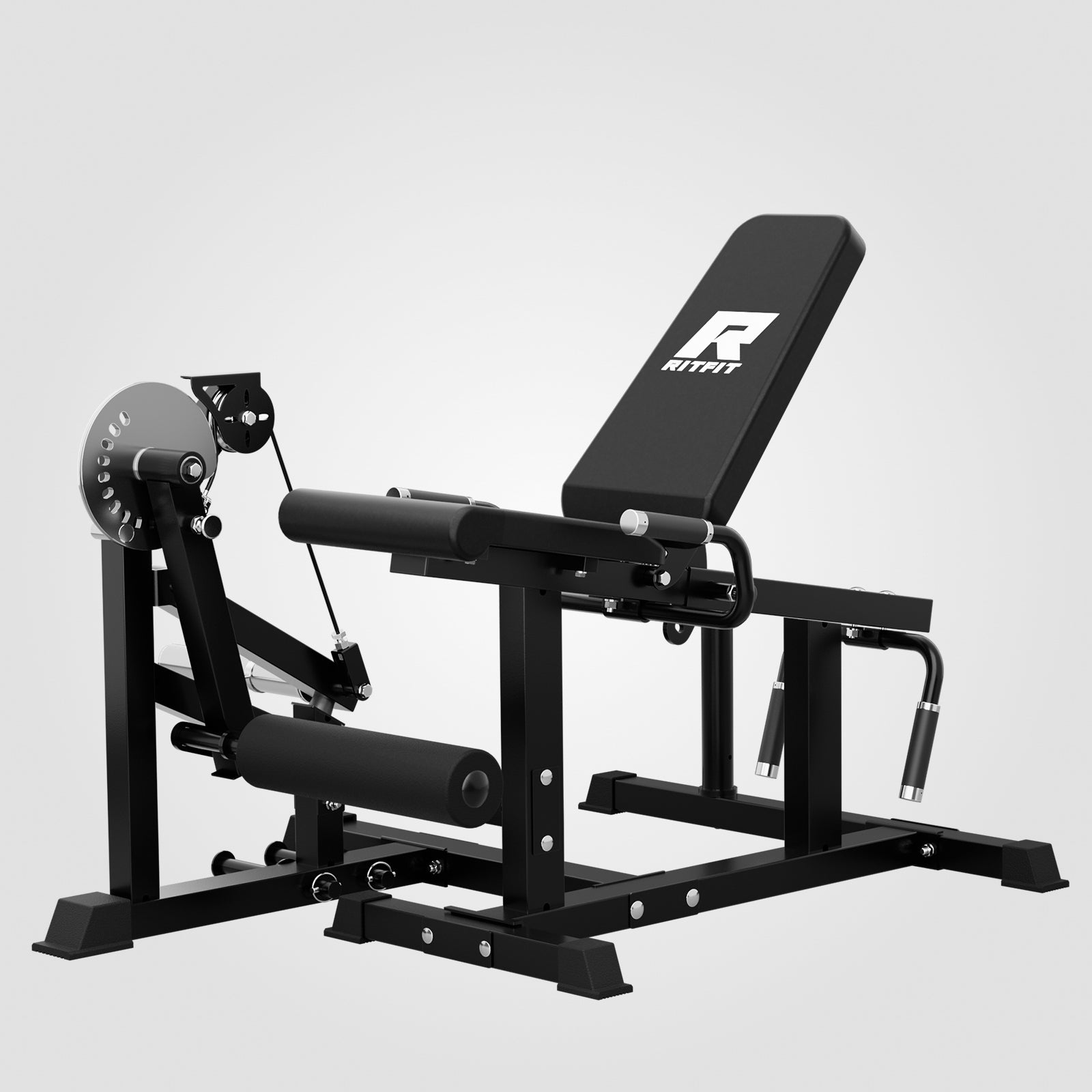
A hack squat attachment is the strongest first upgrade if your rack already covers upper body basics but your leg training feels limited. It adds a guided lower body pressing pattern that can make quad focused training easier to repeat than many free weight variations.
The RitFit AT02A hack squat rack attachment is a relevant option to review if you want a rack mounted lower body upgrade. Confirm your rack dimensions and product compatibility before purchase.
Key Exercises It Supports
Use a hack squat attachment for hack squats, single leg hack squats, standing calf raises, and single leg calf raises.
- Best For: Lifters who want more quad and calf training options without buying a full standalone hack squat machine.
- Main Benefit: The guided path can reduce the balance demand of the movement, which may help you focus on controlled lower body loading.
- Training Note: Resistance training can support strength and hypertrophy when load, volume, and effort are progressed over time.[1]
- Check Before Buying: Confirm upright size, hole spacing, pin size, rack depth, plate clearance, and usable floor space.
- Space Impact: This attachment usually extends outward from the rack, so it needs more working room than compact handles or pulley accessories.
Weight Stack
A weight stack attachment is best for users who want faster cable resistance changes. It does not create a new movement pattern by itself, but it can make existing pulley exercises more convenient and easier to progress.
If your rack uses a compatible cable system, a weight stack attachment for cable training can reduce the time spent loading and unloading plates. Always match the weight stack to the exact rack series listed on the product page.
Key Exercises It Supports
Use a weight stack with cable rows, pulldowns, triceps pushdowns, cable curls, cable crunches, face pulls, and other compatible pulley movements.
- Best For: Home gym owners who use cable movements often and want quick resistance changes between exercises.
- Main Benefit: A selector pin can make drop sets, supersets, and shared workouts more practical than plate loading.
- Training Note: Machine based and free weight training can both improve strength and hypertrophy, and the best choice often depends on goals, preference, and exercise specificity.[2]
- Check Before Buying: Confirm exact rack series compatibility, pulley connection, cable travel, stack weight, and whether extra plate loading is supported.
- Space Impact: Weight stacks usually add height or rear depth, but they often take less open floor space than large leg attachments.
Lat Pulldown Attachment
A lat pulldown attachment is the best choice if you want more stable upper body pulling than a basic pulley or pull up bar alone. It gives you a seated or braced vertical pulling setup, which is useful for back training and scalable resistance.
A lat pulldown attachment with leg holder is especially helpful when heavier pulldown sets require lower body anchoring. Check whether the attachment is made for your specific rack model before adding it to your setup.
Key Exercises It Supports
Use a lat pulldown attachment for wide grip pulldowns, neutral grip pulldowns, V bar pulldowns, straight arm pulldowns, face pulls, seated rows, and kneeling cable crunches.
- Best For: Lifters who want repeatable back training without depending only on pull ups or improvised cable positions.
- Main Benefit: A leg holder helps keep the body stable during heavier vertical pulls.
- Training Note: Recent EMG research on lat pulldown variations shows that exercise setup can influence prime mover excitation, so grip, bar path, and body position matter.[3]
- Check Before Buying: Confirm cable height, seat or leg holder position, rack compatibility, attachment width, and cable handle clearance.
- Accessory Pairing: Pairing this setup with a multi grip lat pull down bar can expand grip options for back training.
Rotary Cable Arms
Rotary cable arms are best for users who want more cable angle flexibility than fixed pulleys provide. They can make unilateral work, rotational training, and angled arm movements easier to set up.
The RitFit TAM1 tornado arm attachment is a relevant example for users building a more adjustable cable station around a compatible rack. Confirm rack series and mounting requirements before purchase.
Key Exercises It Supports
Use rotary cable arms for cable fly variations, Bayesian curls, angled triceps pushdowns, lateral raises, rotational chops, Pallof presses, and cable kickbacks.
- Best For: Users who want a more flexible cable path for bodybuilding, rehab style accessories, and rotational core work.
- Main Benefit: Adjustable arm positions can make cable resistance line up more naturally with the movement you are training.
- Training Note: Cable exercises still need controlled technique, full usable range, and appropriate load selection to support productive resistance training.
- Check Before Buying: Confirm arm clearance, locking positions, rack mounting points, cable routing, and whether both arms can move freely in your space.
- Accessory Pairing: Cable machine handles can improve comfort and control for single arm cable work.
Lever Arms
Lever arms are best for lifters who want machine style pressing and pulling from a rack based system. They allow each side to move independently, which can be useful for unilateral pressing, controlled loading, and solo home gym training.
The RitFit LAM1 adjustable lever arm attachment is a relevant option for compatible M1 PRO setups. Do not assume lever arms fit unrelated racks unless the product specifications clearly confirm it.
Key Exercises It Supports
Use lever arms for chest press, shoulder press, jammer press, rows, shrugs, belt squat variations, and assisted lower body patterns when the rack setup supports them.
- Best For: Lifters who train alone and want a guided pressing option that does not require balancing a barbell or dumbbells.
- Main Benefit: Independent arms can help train one side at a time and may make near failure pressing sets easier to manage.
- Training Note: Machine and free weight squat comparisons suggest different tools can create different performance outcomes, so attachment choice should match the movement you want to improve.[4]
- Check Before Buying: Confirm upright compatibility, pin size, arm length, plate loading clearance, safety stops, and storage position.
- Space Impact: Lever arms need room in front of the rack, especially during pressing and jammer style movements.
What to Look for in 2x2 Power Rack Attachments
The most important buying factor is compatibility, not exercise variety. A powerful attachment becomes a poor purchase if the holes, pins, rack width, or movement clearance do not match your setup.
- Rack Upright Size: Confirm that your rack uses 2x2 uprights and that the attachment is designed for that upright size.
- Hole Diameter: Check the exact hole size because 2x2 racks can use different pin diameters.
- Hole Spacing: Confirm whether the attachment needs specific hole spacing to lock in safely.
- Rack Width And Depth: Measure the inside and outside rack dimensions before buying attachments with crossmembers, arms, seats, or leg holders.
- Floor Space: Large attachments like hack squat units and lever arms need more working clearance than handles or small pulley accessories.
- Training Priority: Buy the attachment that solves your biggest training limitation first, not the one that simply looks the most advanced.
- Storage: Consider whether the attachment can stay mounted or needs to be removed between workouts.
- Product Page Confirmation: Review the compatibility notes on each product page, especially for rack specific accessories.
If you are still building your rack system, browsing RitFit power racks and rack packages can make compatibility planning easier. Buying a rack and attachment ecosystem together often reduces guesswork.
Which 2x2 Power Rack Attachment Should You Buy First?
Buy the attachment that fixes the biggest limitation in your current training first. Most home gym owners should start with leg training, cable convenience, or back training because those upgrades tend to change the most workouts.
- Choose a hack squat attachment first: Pick this if your lower body training is limited to barbell squats and lunges.
- Choose a weight stack first: Pick this if you already use cables often and want faster resistance changes.
- Choose a lat pulldown attachment first: Pick this if you want more scalable back training than pull ups alone.
- Choose rotary cable arms first: Pick this if you want more cable angles for bodybuilding, core work, and single arm training.
- Choose lever arms first: Pick this if you want guided pressing movements for chest and shoulders.
FAQs
What attachments fit a 2x2 power rack?
Attachments that match your rack upright size, hole diameter, hole spacing, and mounting style are the right fit. A 2x2 label alone is not enough, because rack width, pin length, hardware design, and product series compatibility can still differ between brands and models.
Are 2x2 power rack attachments universal?
No. 2x2 power rack attachments are not always universal, even when the upright size looks the same. You should confirm the product page, rack manual, hole diameter, hole spacing, and hardware requirements before buying, especially for lever arms, cable arms, seats, and large leg attachments.
Which 2x2 power rack attachment should I buy first?
Buy the attachment that solves your biggest training gap first. Choose a hack squat attachment for leg variety, a weight stack for faster cable changes, a lat pulldown for back training, rotary cable arms for cable angles, or lever arms for guided pressing.
Can a rack attachment replace a standalone machine?
Yes. A rack attachment can replace some standalone machine functions when it is compatible, stable, and suited to your training goal. Hack squat attachments, lat pulldowns, lever arms, and cable arms can save floor space, but they may not feel identical to commercial machines.
Is a hack squat attachment worth it for a home gym?
Yes. A hack squat attachment is worth it if you want more lower body training without adding a full standalone leg machine. It is most useful for quad focused squats, calf raises, and lifters who want guided leg work from a rack based setup.
Do lever arms work like a chest press machine?
Yes. Lever arms can mimic some chest press machine patterns when mounted correctly on a compatible rack. The feel depends on arm length, handle position, loading angle, and bench setup, so they should be viewed as a versatile rack attachment rather than an exact machine duplicate.
How much space do power rack attachments need?
Power rack attachments need enough space for mounting, loading, movement, and safe entry or exit. Small cable handles need little room, while hack squat attachments and lever arms may require several feet of open space in front of or behind the rack.
What should I check before buying a lat pulldown attachment?
Check rack compatibility, cable height, leg holder position, seat setup, pulley path, and handle clearance before buying a lat pulldown attachment. You should also confirm whether the attachment is designed for your exact rack series, because many lat pulldown parts are not universal.
Conclusion
The best 2x2 power rack attachments are the ones that make your rack more useful while still fitting your space, rack geometry, and training goals. Start with the attachment that fixes your biggest limitation, then build a compatible system around it.
For most home gyms, the highest impact upgrades are a hack squat attachment for leg training, a weight stack for cable convenience, and a lat pulldown attachment for scalable back work.
Disclaimer: This article is for general fitness and equipment planning only. Always follow your rack manual, product instructions, hardware requirements, and safe loading limits. Consult a qualified fitness professional if you are new to strength training, returning from injury, or unsure whether a movement is appropriate for your body.
References
- Krzysztofik M, Wilk M, Wojdała G, Gołaś A. Maximizing muscle hypertrophy: a systematic review of advanced resistance training techniques and methods. Int J Environ Res Public Health. 2019;16(24):4897. doi:10.3390/ijerph16244897.
- Haugen ME, Vårvik FT, Larsen S, Haugen AS, van den Tillaar R, Bjørnsen T. Effect of free weight vs machine based strength training on maximal strength, hypertrophy and jump performance: a systematic review and meta analysis. BMC Sports Sci Med Rehabil. 2023;15:103. doi:10.1186/s13102-023-00713-4.
- Padovan R, Toninelli N, Longo S, Tornatore G, Esposito F, Cè E, Coratella G. High density electromyography excitation in front vs back lat pull down prime movers. J Hum Kinet. 2024;91:47-60. doi:10.5114/jhk/185211.
- Schwarz NA, Harper SP, Waldhelm A, McKinley Barnard SK, Holden SL, Kovaleski JE. A comparison of machine versus free weight squats for the enhancement of lower body power, speed, and change of direction ability during an initial training phase of recreationally active women. Sports. 2019;7(10):215. doi:10.3390/sports7100215.