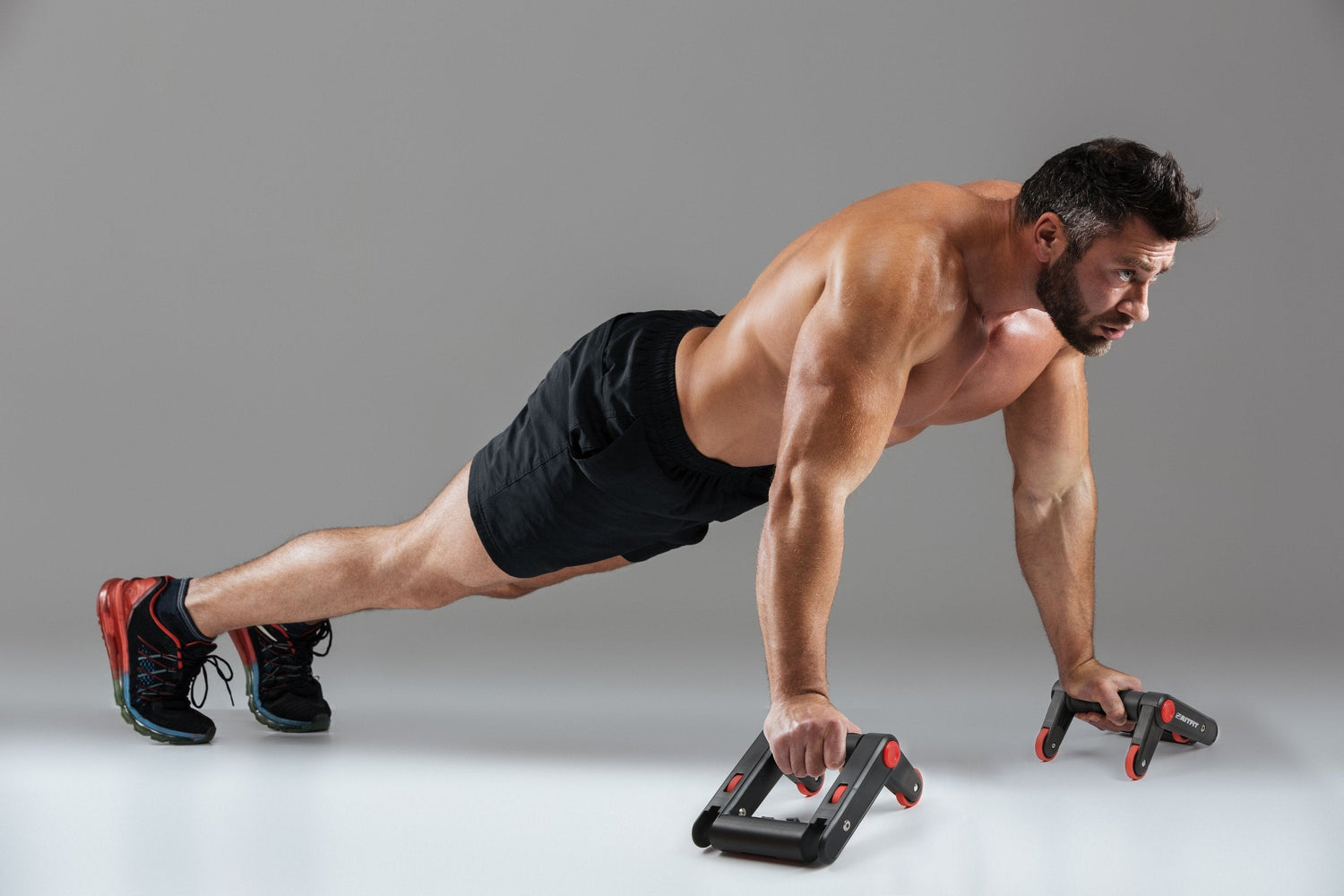
Ab roller exercises train the entire core in one movement, because the wheel forces your trunk to resist extension while your arms and shoulders hold the path. The rectus abdominis, the obliques, and the deep stabilizers do the bracing, and the lats, shoulders, and triceps keep the roll controlled.
This guide walks through nine ab roller exercises, from the plank and the band-assisted kneeling rollout up to the front, V, and single-arm variations, plus the form cues and common mistakes that decide whether the movement trains your abs or your lower back.
Quick Answer: Ab roller exercises work the rectus abdominis, the obliques, and the deep core first, then recruit the lats, shoulders, and triceps to keep the roll steady. They build genuine core strength when the ribs stay down and the hips stay tucked, and the progression runs from a plank to a kneeling rollout to a standing rollout.
Key Takeaways
- Primary movers: ab roller exercises load the rectus abdominis, the obliques, and the deep core stabilizers first, with the lats, shoulders, and triceps assisting.
- Progression order: begin with the ab roller plank, move to band-assisted kneeling rollouts, and only then chase the front, V, and single-arm versions.
- Form decides the target: tucking the pelvis and keeping the ribs down keeps the work in the abs instead of the lower back.
- Honest limits: an ab roller strengthens and builds core muscle, but it does not burn belly fat or flatten a stomach by itself.
- Workout dose: three to four sets of eight to twelve controlled reps, two or three times a week, is enough to keep progressing.
What Muscles Do Ab Roller Exercises Work?
Ab roller exercises work the rectus abdominis, the obliques, and the deep core stabilizers first, because the wheel forces the trunk to resist extension. The lats, shoulders, and triceps act as stabilizers that steer the roll path, while the glutes keep the pelvis from sagging.
- Rectus abdominis: the front abdominal wall carries the anti-extension load, which is why a rollout feels hardest at the point farthest from your knees.
- Obliques and deep core: the internal and external obliques plus the transverse abdominis hold the trunk square and stop the hips from rotating during a single-arm rollout.
- Lats and shoulders: the lats, rear deltoids, and shoulder stabilizers pull the wheel back toward the knees and keep the elbows from collapsing.
- Triceps and chest: the triceps and pectorals drive the push-up and chest fly variations, which is how one tool covers more than core work.
- Glutes: the glutes hold the pelvis tucked so the lower back does not take over the movement.
The emphasis shifts with the variation you pick, so treat the list as a map rather than a ranking. A dedicated ab roller muscle building guide covers how the abdominals actually grow.
"Probably the most shocking result of this entire experiment was the level of rectus abdominis activity elicited by a bodyweight chin-up! It beat out any other abdominal exercise, weighted exercises and all, in mean and peak rectus abdominis activity."
Bret Contreras, PhD, PhD in Sports Science, known as The Glute Guy, Contreras Strength Institute, Inside the Muscles: Best Ab Exercises (T-Nation)
How to Use an Ab Roller Correctly
An ab roller is used correctly when you start from a kneeling position with the pelvis tucked and the ribs pulled down, never from a relaxed lower back. Keep the wheel under the shoulders and stop the rollout the moment the hips start to drop.
- Step 1: Kneel on a padded surface with the wheel directly under your shoulders and both hands gripping the handles.
- Step 2: Tuck the pelvis, brace the abs, and pull the ribs down before the wheel moves an inch.
- Step 3: Roll forward only as far as you can hold that position without the lower back arching.
- Step 4: Pull the wheel back with the abs and lats rather than yanking it with the arms.
- Sagging hips: a dropping pelvis turns the rollout into a lower back extension, which is the most common way the movement goes wrong.
- Rolling too far too soon: extra range you cannot control adds risk without adding core work.
- Leading with the arms: bending the elbows early shortens the lever and lets the abs off the hook.
- Holding your breath: breathe out on the way down and keep the brace so the trunk stays pressurized.
- Skipping the padding: bare floors beat up the knees long before the abs fatigue, so roll out on a mat or interlocking floor tiles.
A stable surface matters more than most people expect, so set up on a RitFit rubber gym flooring mat when you train on concrete, and compare tile sizes in the gym mats and flooring collection if you plan to cover a whole corner.

Ab Roller Exercises for Beginners
The ab roller plank, the band-assisted kneeling rollout, and the ab roller push-up are the three beginner ab roller exercises to master first. All three teach the bracing pattern you need before you attempt a full rollout from the knees.
Ab Roller Plank
The ab roller plank holds the wheel still and trains the trunk to stay rigid, which makes it the safest starting point for anyone new to the tool.
- Step 1: Grip the handles with the ab roller directly beneath your shoulders and your legs fully extended.
- Step 2: Raise your torso until your shoulders, hips, and ankles form one straight line, tighten your stomach, squeeze your glutes, and hold for 20 to 30 seconds before building up.

- Muscles Worked: Abs, Glutes, Obliques
Knee Roll-Outs with Resistance Band
Knee roll-outs with a resistance band give you a built-in assist, so you can practice the full rollout pattern before you can control your bodyweight alone.
- Step 1: Kneel on the mat, fix your feet on one end of the resistance band, and grip the handles of the ab roller with your arms extended.
- Step 2: Slowly roll forward with your arms extended in front of you, then return to the start with the band helping you back.
- Muscles Worked: Torsos, Biceps, Shoulder, Abs
Ab Roller Push-Ups
The ab roller push-up turns the same tool into an upper-body movement, and the rolling handles make the shoulders work harder to stay quiet.
- Step 1: Place two ab rollers on the floor in the same spot your hands would sit during a push-up, then grip the handles and start in a high plank position.
- Step 2: Bend the elbows to lower your chest toward the floor, keep the core engaged, and hold the hips in line with the rest of your body.

- Muscles Worked: Chest, Triceps, Shoulder
Warm up with a few unweighted core drills before you touch the wheel, and the five ab warm-up exercises take about five minutes. When these three feel routine, the ab roller workout for beginners is the natural next session.
Advanced Ab Roller Exercises and Progressions
Front rollouts, V rollouts, and single-arm rollouts are the next three ab roller exercises once the kneeling version feels controlled. Add them one at a time and keep the hips level before you chase more range.
Front Ab Roll-Outs
The front ab rollout is the standard version most people picture, and it demands the whole trunk stay braced from the first inch to the last.
- Step 1: Start in a kneeling position, grip the handles, and keep your back straight with the arms extended.
- Step 2: Slowly roll forward until your belly is just above the ground and your body is in a straight line.
- Step 3: Roll back toward your feet to return to the start.

- Muscles Worked: Arms, Back, Shoulder
V Roll-Outs
V rollouts add a steering demand, because the two rollers travel apart at an angle and the obliques have to keep the trunk from twisting.
- Step 1: Start in a kneeling position and grip the handles.
- Step 2: With the arms extended, roll out slowly and let the two rollers form an angle between 0 and 180 degrees.
- Step 3: Return to your starting position and repeat.

- Muscles Worked: Abs, Obliques, Biceps, Triceps, Chest
One-Arm Rollout
The single-arm rollout is the hardest variation here, and it exposes any weakness in hip position immediately.
- Step 1: Start in a kneeling position and grip the handles of one ab roller with your right hand.
- Step 2: Slowly roll out while engaging your core, and keep your weight centered over the working arm so you do not tip sideways.
- Step 3: Return to the start, then switch to the left hand and repeat.
- Muscles Worked: Abs, Obliques, Biceps, Chest
When the kneeling versions stop being a challenge, extend the range by walking the wheel out from a standing position instead of adding repetitions. The waistline exercise guide shows how rollouts fit into a wider trunk routine.
Push-Up and Band Variations You Can Pair With an Ab Roller
An ab roller with a resistance band adds front raises, face pull-downs, and chest flys to the same session, so one tool covers core and upper body. These variations work best as finish work after your rollouts, when the trunk is already warm.
Front and Side Raise With Ab Rollers
Front and side raises move the load onto the shoulders while the roller handles stay in your hands, which makes them a useful shoulder warm-up before heavier pressing.
- Step 1: Grip the handles on one end of the band, stand with your feet shoulder-width apart, and step on the other end of the band.
- Step 2: Raise your arms until you feel tension in the band, then return to the start.

- Muscles Worked: Biceps, Shoulder
Face Pull-Down
The face pull-down builds the rear shoulder and upper back muscles that hold your posture together, and a band makes the resistance easy to dial up or down.
- Step 1: Fix the end of the band in a doorjamb at chest level and stand facing the door with your palms facing out and down.
- Step 2: Pull the band down and out to shoulder height, then let it travel back up under control.

- Muscles Worked: Shoulder, Biceps, Chest, Lats
Chest Fly
The band chest fly finishes the session by loading the chest through a long arc, and the staggered stance keeps your lower back out of it.
- Step 1: Fix the end of the band in a doorjamb at chest level and stand with your back to the door, gripping the handles with your elbows bent so your fists sit in front of your chest.
- Step 2: Step forward until you feel tension, then step your left leg back into a staggered stance and hinge slightly from the hips.
- Step 3: Press both bands forward, then bring your elbows back to the start.

- Muscles Worked: Chest, Biceps
Band tension is only as good as the band, so start with a matched set from the resistance bands collection and lay a RitFit non-slip yoga mat down before the kneeling work.
Does the Ab Roller Actually Work?
The ab roller does work for core strength, because the rollout is one of the few movements that trains the abs to resist extension through a long range. It does not burn belly fat or flatten your stomach on its own.
- What it does well: a rollout loads the rectus abdominis and obliques through a longer range than crunches, and it teaches the bracing pattern that carries over to squats and deadlifts.
- What it cannot do: no core exercise removes fat from the waist, so visible abs still come down to overall body fat and calorie intake.
- Who gets the most from it: lifters who already train three to four days a week and want a harder trunk stimulus than planks and crunches provide.
- Who should wait: anyone with an active lower back, wrist, or shoulder injury should get clearance before rolling out, because the wheel loads the spine in a long lever position.
If love handles are the actual goal, the love handle exercise guide explains why oblique work alone will not shift them.
Ab Roller Workout Plan for Beginners
Three to four sets of eight to twelve controlled reps, two or three times a week, is enough for most beginners. Add one rep or a few inches of range each week rather than adding more sets.
- Warm-up: two minutes of dead bugs or one 20 second ab roller plank hold.
- Main work: three to four sets of eight to twelve kneeling rollouts, resting 60 to 90 seconds between sets.
- Assistance: two sets of ab roller push-ups or band-assisted rollouts to finish.
- Frequency: two or three sessions a week with at least one rest day in between.
- Progression rule: earn more range or one extra rep per set before you add a set, and drop back to the band when the hips start sagging.
Round the week out with a bench session, and the bench ab workout pairs well with two roller days because it hits the trunk from a different angle.
FAQs About Ab Roller Exercises
What do ab roller exercises work?
Ab roller exercises work the rectus abdominis, the obliques, and the deep core stabilizers as the primary movers, because the rollout asks the trunk to resist extension under load. The lats, rear deltoids, triceps, and glutes assist by controlling the roll path and holding the pelvis in place, so a rollout is a full trunk movement rather than an abs-only drill.
Is the ab roller a good exercise?
Yes. The ab roller is a good exercise for building core strength, because few other movements load the abs through a long range while demanding that the trunk resist extension. It is not a fat loss tool, so visible abs still depend on overall body fat, which no amount of rolling will change on its own.
How do you use an ab roller correctly?
Kneel with the wheel under your shoulders, tuck the pelvis, and pull the ribs down before you move. Roll forward only as far as you can keep the hips from dropping, then pull the wheel back with the abs and lats instead of the arms. Stop the rep the moment the lower back starts to arch.
How many ab roller exercises should a beginner do?
Two or three movements per session is plenty at the start, so pick the plank, the band-assisted kneeling rollout, and the push-up before you add anything harder. Three to four sets of eight to twelve controlled reps, two or three times a week, gives you enough practice to progress without beating up the lower back.
How long does it take to see results from ab roller exercises?
Most people notice steadier hip position and longer controlled rollouts within three to four weeks of consistent practice. Visible abdominal definition depends on body fat rather than training time, so pair the roller with overall strength work and a sensible calorie intake if a leaner midsection is the goal.
Can you do an ab roller workout with a resistance band?
Yes. A resistance band anchors under your feet or in a doorjamb and takes some of the load, which is how beginners practice kneeling rollouts, front raises, face pull-downs, and chest flys before they can control a full rollout. Keep the band anchored low for rollouts and at chest height for the upper-body variations.
Conclusion
Ab roller exercises build real core strength because they train the trunk to resist extension through a long range, and the progression from plank to standing rollout gives you years of room to grow. Keep the pelvis tucked, stop before the lower back arches, and the wheel stays a training tool rather than a risk.
Pick two or three beginner variations this week and add a rep or a few inches before you add a set. If you are new to RitFit, the RitFit discount guide lists the current ways to save on your first order.
Disclaimer
Ab roller exercises are a general fitness suggestion rather than medical advice, and they are not suitable if you have a current back, shoulder, or wrist injury. Check with a qualified physician or physical therapist before starting any new core training program.