








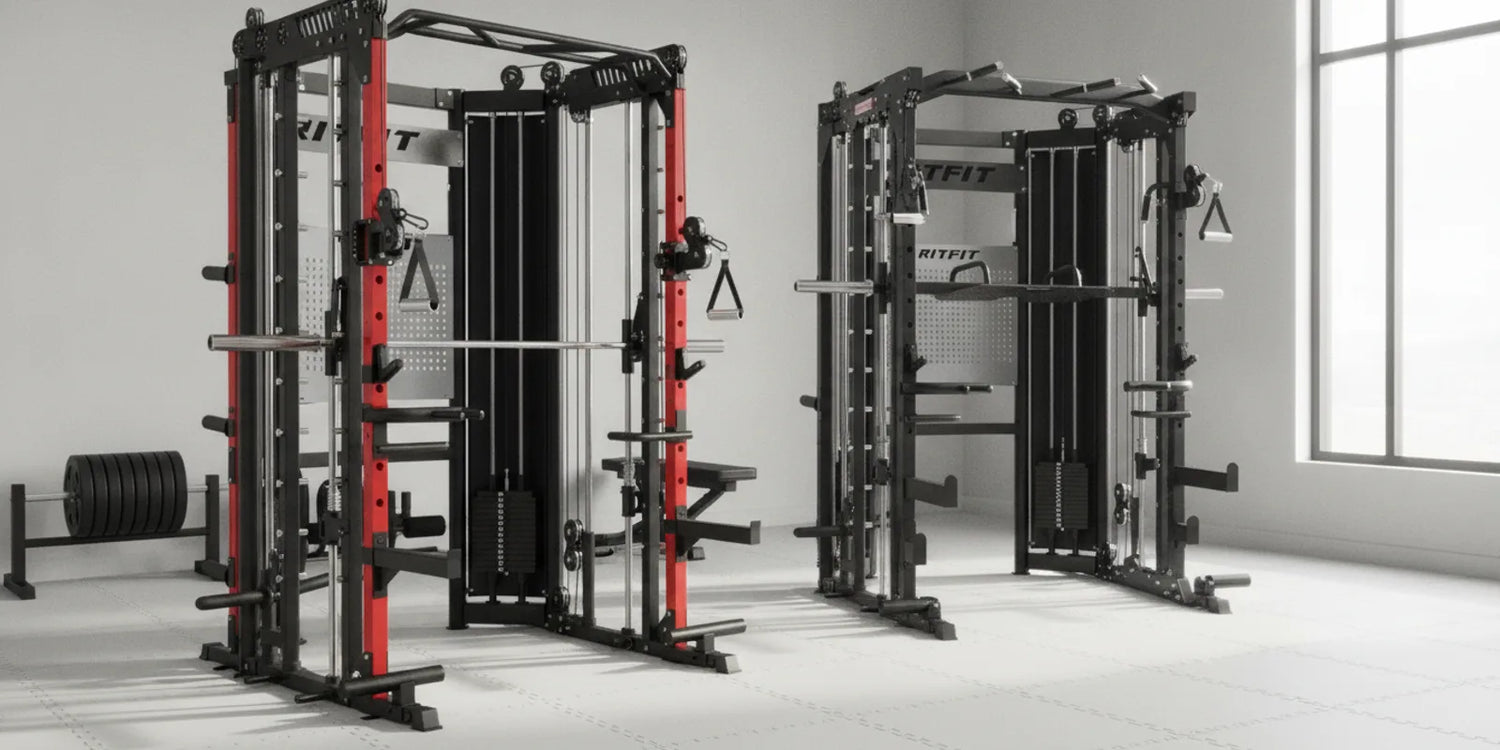
Finding an affordable all-in-one home gym that actually delivers a full-body workout in a small apartment or condo is harder than it looks. Most guides point you toward machines that cost $3,000 or more, leaving budget-conscious buyers wondering what you can realistically get for $500 to $1,500.
This guide cuts through the noise by focusing on real footprint measurements, resistance capacity, and first-year cost comparisons so you can make a confident purchase decision without overspending or ending up with a machine that does not fit your space.
Quick Answer: An affordable all-in-one home gym in the $800 to $1,500 range, such as the RitFit M1 Pro, delivers full-body strength training in as little as 20 square feet, covering cable pulls, smith machine movements, lat pulldowns, and low rows, making it a cost-effective alternative to a gym membership for small apartments and condos.
Key Takeaways
- Price reality: The average all-in-one home gym costs around $1,855 according to one equipment guide, but capable machines for small spaces start under $1,500 with a weight stack and cable system.
- Space minimum: Compact all-in-one units occupy under 10 sq ft of base footprint, but you need a 7-by-10-foot area minimum including clearance and an 84-to-88-inch ceiling height.
- Resistance matters: For effective strength training, look for at least 150 to 200 lbs of cable resistance. A weight stack provides better load precision than a power rod system for progressive overload.
- ROI is real: A $1,000 to $1,500 machine pays for itself within two to three years compared to a typical $50 to $60 monthly gym membership, with no recurring fees after the break-even point.
- RitFit M1 Pro: For most small-space buyers under $1,500, the RitFit M1 Pro combines a smith machine, dual cables, lat pulldown, and low row in a compact footprint suited to apartment and garage setups.
What Makes an All-in-One Home Gym Affordable?
An affordable all-in-one home gym occupies the price range between $500 and $1,500, offering enough resistance capacity and exercise variety for full-body strength training without requiring multiple separate machines. One industry guide places the average all-in-one home gym cost at around $1,855, which means well-equipped machines below that threshold represent genuine value.
What Do You Get Under $800?
Entry-level all-in-one machines under $800 typically use power rod or plate-loaded resistance systems with limited exercise stations. These options suit beginners who prioritize low cost over load precision, but they often lack the cable crossover or lat pulldown functionality that intermediate lifters need for pulling movements.
- Power rod systems: Lightweight and compact, but resistance increments are fixed and heavy loads above 210 lbs are not always achievable.
- Plate-loaded cable towers: More durable feel, but you need to purchase and store weight plates separately, adding to total cost.
- Exercise variety: Most under-$800 machines cover 30 to 50 exercises, compared to 100 or more on a full all-in-one smith machine system.
- Build quality: Steel gauge at this price tier is typically 14 to 16 gauge, which handles beginner loads but may flex under heavier compound movements.
What Is the Sweet Spot Between $800 and $1,500?
The $800 to $1,500 range is where all-in-one home gyms shift from a basic cable station to a complete training system, offering a weight stack, a smith machine bar path, and dedicated lat pulldown and low row stations in one frame. This tier covers the core needs of most beginner-to-intermediate lifters without requiring the $2,000 to $3,000 outlay of commercial-grade dual-stack units.
- Weight stack systems: Allow precise load increments, which is essential for progressive overload in compound movements like rows and presses.
- Steel gauge: Machines in this range typically use 12 to 14 gauge steel, providing better rigidity for heavier cable loads.
- All-in-one functionality: The best options in this bracket combine a smith machine, functional trainer cables, lat pulldown, and low row in a single footprint, replacing what would otherwise require four to seven separate machines.
- Accessories included: Many units at this price include a cable handle set, a lat bar, and a tricep rope, reducing additional accessory spend.
- Warranty coverage: Expect 1 to 3 years on parts at this price tier, compared to 5 to 10 years on premium commercial units.
Explore the full range of options in the best affordable home gym equipment guide if you want to compare individual components alongside all-in-one packages.
How Much Floor Space Do You Actually Need for an All-in-One Home Gym?
A compact all-in-one home gym machine requires a base footprint of under 10 sq ft, but safe usable training space demands at least a 7-by-10-foot area after adding 2 to 3 feet of clearance on each open side for movement range. One 2026 equipment guide categorizes footprints as compact under 10 sq ft and medium 10 to 20 sq ft, with 2 to 3 ft of side and rear clearance required in both cases.
What Are the Minimum Floor Space Requirements by Machine Type?
Machine base dimensions tell only part of the story. The active training zone, bench placement, and overhead bar path all extend the practical footprint well beyond what the product spec sheet shows.
- Compact single-stack cable units: Base footprint of 9 to 12 sq ft, but active zone extends to roughly 60 to 70 sq ft including bench and movement space.
- Smith machine combined with cables: Base of 15 to 25 sq ft, active zone roughly 7 ft wide by 10 ft deep to allow bench press and squat movement paths.
- Dual-stack functional trainers: Base of 15 to 20 sq ft, but require 3 to 4 ft of lateral clearance on each side for cable crossover exercises.
- Corner-fit all-in-one designs: Engineered for garage corners and tight rooms, these push the active footprint into a right-angle layout that can fit in as little as a 10-by-10-foot corner space.
Before ordering, measure your available floor area without furniture. Subtract at least 2 ft along each wall for side access, since a spare bedroom or single-car garage bay typically offers enough clearance for a compact all-in-one unit.
What Ceiling Height and Wall Clearance Do Most Buyers Miss?
Ceiling height is the single most overlooked specification in apartment home gym purchases, and a low ceiling can disqualify otherwise well-suited machines. Most all-in-one units with a lat pulldown or overhead cable attachment require 84 to 88 inches, or 7 to 7.3 feet, of ceiling clearance at minimum, and taller users doing standing overhead press movements need at least 96 inches, or 8 feet, of ceiling-to-floor height.
- Measure floor to ceiling: Include any ceiling light fixtures, beams, or HVAC ducts that may reduce effective clearance at the machine footprint location.
- Basement gyms: Exposed joists and ductwork in unfinished basements commonly reduce effective ceiling height to 84 inches or less, which limits overhead attachment use.
- Wall clearance at rear: Most cable column machines need at least 12 inches between the weight stack enclosure and the nearest wall to allow weight carriage movement without obstruction.
- Door clearance: Verify the assembled unit fits through the access door before purchase. Many all-in-one machines must be partially disassembled for room entry.
Check the complete home gym setup guide for a detailed room-preparation checklist before your machine arrives.
What Resistance Range and Exercise Variety Do Budget All-in-One Machines Offer?
Budget all-in-one home gym machines in the under-$1,500 category typically deliver 160 to 250 lbs of cable resistance, which covers the needs of beginner-to-intermediate lifters across all major muscle groups. A 2025 systematic review found that home training setups relying only on sandbags or ankle weights struggled to reach the 60 to 85 percent of 1RM intensity required for effective muscle adaptation, underscoring why a proper weight stack matters for training progress.[1]
Does a Cable Weight Stack or Power Rod System Matter More?
A cable weight stack system provides precise, repeatable load increments that support consistent progressive overload, while a power rod system offers lighter resistance that is well-suited for rehabilitation-style training but less effective for heavy compound pulls. For anyone targeting strength gains or hypertrophy, a weight stack is the more reliable long-term choice within the under-$1,500 budget tier.
- Weight stack advantages: Resistance adjusts in 5 to 10 lb increments, making it straightforward to track week-over-week progression in rows, pulldowns, and cable presses.
- Power rod limitations: Maximum resistance is often capped at 210 lbs total, and the feel of the resistance curve differs from free weights or cable stacks, which some lifters find less intuitive for compound movements.
- Pulley ratio: All-in-one machines use either a 1:1 or 2:1 pulley ratio. A 1:1 ratio means the weight on the stack equals the resistance felt at the handle, giving a more predictable training stimulus.
- Plate-loaded alternative: Plate-loaded cable towers let you exceed stack limits as your strength grows, but require purchasing and storing additional bumper or standard plates.
How Many Exercises Can You Get From One Budget Machine?
A well-designed all-in-one home gym in the $800 to $1,500 range covers 80 or more distinct exercises when it combines a smith machine bar path with adjustable cable columns, a lat pulldown station, and a low row footplate. This replaces the functional equivalent of a squat rack, a functional trainer, a lat pulldown machine, and a cable crossover unit.
- Upper body pushing: Smith machine bench press, incline press, shoulder press, cable fly variations, tricep pushdowns.
- Upper body pulling: Lat pulldowns, seated cable rows, face pulls, straight-arm pulldowns, bicep cable curls.
- Lower body: Smith machine squats, Romanian deadlifts, cable kickbacks, cable pull-throughs, low cable squats.
- Core and functional: Cable woodchops, pallof press, cable crunches, rotational pulls.
- What you miss: Dedicated leg press, hack squat machine, chest-supported row machine, and cardio equipment are not included in any all-in-one cable unit at this price tier.
Read more about the full training potential of combined cable and smith setups in the guide to functional trainer with smith machine explained.
Which RitFit All-in-One Home Gym Fits Your Budget and Space in 2026?
RitFit offers several all-in-one home gym options designed for buyers who want a complete training system without commercial-gym pricing. The right choice depends on your available floor space, training experience, and whether you want a standalone cable unit or a full package that includes a bench and weight plates.
| Option | Core Stations | Active Area Needed | Cable Resistance | Best For |
|---|---|---|---|---|
| RitFit M1 Pro | Smith machine, dual cable, lat pulldown, low row | ~20 sq ft with clearance | 200+ lbs stack | Beginners to intermediate, small spaces, budget under $1,500 |
| RitFit BPC06 Package | Smith machine, functional trainer, bench, plates included | ~25 sq ft with clearance | 200+ lbs stack | Intermediate lifters wanting a complete ready-to-train package |
| Entry-level cable only | Single-stack cable crossover or functional trainer | ~12-15 sq ft | 160 lbs | Pure cable training focus, very tight budgets under $800 |
Footprint estimates include minimum side and rear clearance for safe use. Actual room requirements may vary based on ceiling height and accessory storage.
How Does the RitFit M1 Pro Stand Out at Its Price Point?
The RitFit M1 Pro delivers a smith machine, dual adjustable cable columns, a lat pulldown station, and a low row footplate in a single compact frame, which makes it one of the most complete training systems available under $1,500 for apartment and garage gyms. Its aluminum pulley system and 11 to 14 gauge steel construction provide the build quality typically seen in machines priced $500 to $1,000 higher.
- Smith machine bar path: Provides a guided movement pattern for squats, bench press, and shoulder press, which is particularly useful for solo training without a spotter.
- Dual cable columns: Allow unilateral training, cable crossover variations, and rotational exercises that a single-stack unit cannot replicate.
- Compact corner-friendly design: The frame is engineered to fit into garage corners or bedroom walls, minimizing the footprint in tight spaces.
- Upgrade-ready: Accessories such as a landmine attachment, dip bars, and additional cable handles can be added over time without replacing the base unit.
Watch a full build and feature demo of the RitFit M1 Pro below, which covers assembly, the 10 standout features, and a real training demo including a 405 lb bench press on the smith machine.
For a full breakdown of how the M1 Pro compares to other all-in-one power rack configurations, read the highest-rated all-in-one home gym guide.
Is an All-in-One Home Gym Worth the Price Compared to a Gym Membership?
A $1,000 to $1,500 all-in-one home gym breaks even with a typical $50 to $60 monthly gym membership in two to three years of consistent use, after which every workout is effectively free. A pilot study of 67 middle-aged adults found that eight weeks of home-based resistance training, done twice per week, improved fitness parameters and significantly reduced depressive symptoms, supporting the value of training at home with proper equipment.[2]
A separate cost-effectiveness analysis found resistance training programs to be less costly and more effective than alternative exercise interventions over comparable time horizons.[3]
What Does the First-Year Cost Comparison Actually Look Like?
Breaking down the first-year cost reveals how quickly a home gym investment compares favorably to a commercial gym membership, especially when factoring in commute time and convenience.
- Gym membership baseline: A national average gym membership runs roughly $50 to $60 per month, adding up to several hundred dollars per year before factoring in initiation fees that many gyms charge.
- Machine cost amortized: A $1,200 all-in-one machine costs the equivalent of 20 to 24 months of gym membership fees, meaning break-even arrives in year two without any further monthly expense.
- No commute cost: The average gym commute adds 30 to 45 minutes round-trip per session. Training at home recovers that time entirely.
- No peak-hour wait: A home machine is available 24 hours a day with no equipment queue, which tends to improve training consistency.
- Hidden gym costs: Parking, gym bag gear, and food or drinks purchased near the gym add an estimated $10 to $20 per month to the true cost of a commercial gym membership.
For a deeper look at the value case for all-in-one machines, read are all-in-one home gyms worth it and reasons to add an all-in-one smith machine to your setup.
A third-party review walks through the RitFit M1 Pro to show how the machine value holds up against a gym membership.
What Are the Most Common Mistakes When Buying an Affordable All-in-One Home Gym?
The most preventable all-in-one home gym purchase mistakes involve space, specifications, and shipping factors that buyers routinely overlook until the machine has already arrived at their door. Understanding these pitfalls before you order saves the considerable hassle of returns, assembly-in-wrong-room issues, and performance disappointment.
- Not measuring ceiling height: A 7-foot ceiling disqualifies most all-in-one machines with overhead cable attachments. Measure floor to the lowest fixed obstruction, not the nominal ceiling height.
- Confusing footprint with active zone: A machine with a 15 sq ft base still requires a 70 sq ft active zone for safe use. Measure the full training area, not just the equipment dimensions.
- Ignoring shipping weight and delivery method: All-in-one smith machine units typically weigh 400 to 700 lbs and arrive via freight delivery, not standard parcel service. Confirm your building allows freight access and factor in assembly labor.
- Choosing power rod over weight stack: Power rod systems save money upfront but limit progressive overload potential past beginner stages. Buyers who want long-term training value consistently report preferring weight stack systems within 12 months.
- Overlooking total cost of ownership: The machine price does not include weight plates for plate-loaded models, a weight bench if not bundled, and accessory handles. Budget an additional $100 to $300 for a complete first-day setup.
- Buying a machine designed for a garage when the space is a spare bedroom: Garage-optimized designs often require 8-foot ceilings and wide door clearance that apartment or condo spaces cannot accommodate.
"Before purchasing any home gym equipment, identify which movements you actually need to replicate from the gym, because buying the wrong all-in-one machine means spending money on features you'll never use while missing the ones you actually need."
Jeff Cavaliere, MSPT, CSCS, Physical Therapist and Strength Coach, Athlean-X
See the full best all-in-one home gym equipment guide for a comprehensive overview of how to match machine type to your specific training goals.
How Do You Plan for Long-Term Upgrades and Accessory Costs?
A well-chosen all-in-one home gym in the $800 to $1,500 range should serve most buyers for three to five years before an upgrade becomes necessary, with accessory additions extending its utility well before that point. Planning your upgrade path at purchase time prevents the common mistake of buying a machine that maxes out its capacity within 12 months.
- Accessory cables and handles: A basic set of cable attachments, such as a D-handle, lat bar, rope, and ankle strap, typically costs $50 to $120 and immediately expands the exercise library without any structural change to the machine.
- Weight stack add-ons: Some machines allow additional weight plates to be bolted onto the existing stack, increasing resistance capacity for lifters who progress past the base stack limit.
- Benches and flooring: An adjustable weight bench of $150 to $300 and rubber gym flooring tiles of $80 to $150 for a 7-by-7-foot area are the two highest-ROI additions that improve training versatility and floor protection.
- Barbell and plates: If your all-in-one unit includes a smith machine bar path but no free-bar option, adding a quality best affordable Olympic barbell opens up deadlifts, barbell rows, and floor-based movements the machine frame cannot facilitate.
- When to upgrade the machine itself: Consider upgrading when your working cable weight consistently reaches the stack maximum, or when you begin programming movements that require a dual-stack functional trainer for independent arm cable work.
- Multiple users: If two people with different strength levels train on the same machine, read the guide on the best home gym for multiple users to understand weight stack requirements and station accessibility for shared use.
Browse the full RitFit home gym equipment collection to see which accessories pair with your all-in-one setup as your training evolves.
FAQs About Affordable All-in-One Home Gyms
What is the most affordable all-in-one home gym that works for full-body training?
The most affordable all-in-one home gyms that support full-body training typically start around $800 to $1,200 and include a cable pulley system, lat pulldown, and low-row station. The RitFit M1 Pro is a widely reviewed option in this range, combining a smith machine with dual cable functions in a compact footprint suited to apartment and garage setups.
How much floor space do I need for an all-in-one home gym in a small apartment?
Compact all-in-one home gym machines occupy under 10 square feet of base footprint, but you need 2 to 3 feet of clearance on each open side for safe movement. A 7-by-10-foot area is a practical minimum for a cable-based unit, and ceiling height of at least 84 to 88 inches is required for overhead exercises.
Is buying an all-in-one home gym cheaper than a gym membership in the long run?
At a national average gym membership of roughly $50 to $60 per month, a $1,000 to $1,500 all-in-one home gym pays for itself within two to three years of consistent use, with no recurring fees afterward. A cost-effectiveness analysis found resistance training programs to be less costly and more effective than alternative exercise interventions over comparable time horizons.
What resistance level should I look for in a budget all-in-one home gym?
For effective full-body strength training, look for at least 150 to 200 lbs of usable cable resistance. Machines under $1,500 typically offer 160 to 250 lbs, adequate for most beginner-to-intermediate lifters. Choose a weight stack model over a power rod system to ensure precise load increments for progressive overload.
Can a single all-in-one home gym machine replace an entire commercial gym?
An all-in-one home gym with a smith machine, dual cables, lat pulldown, and low-row station can replicate the majority of exercises performed in a commercial gym. You may lack dedicated cardio equipment and heavy free-weight platforms, but for strength training and hypertrophy goals, a well-chosen unit covers most typical workout needs.
What are the most common mistakes when buying an affordable all-in-one home gym?
The most common mistakes include underestimating ceiling clearance needs, ignoring shipping weight and freight delivery requirements, choosing a power rod when a weight stack better suits progressive overload, and buying a garage-scale unit for an apartment corner. Measuring your available footprint and ceiling height before ordering is essential.
Conclusion
An affordable all-in-one home gym in the $800 to $1,500 range delivers genuine full-body training capability for small apartments and condos, provided you match the machine to your actual floor space, ceiling height, and resistance needs. The RitFit M1 Pro stands out in this tier for combining a smith machine, dual cables, lat pulldown, and low row at a price that breaks even with gym membership costs within two to three years.
Start by measuring your available floor area and ceiling height, then browse the home gym equipment collection to find the right setup for your space and budget.
Disclaimer
The information in this article is intended for general fitness and purchasing guidance only and does not constitute professional medical, structural, or safety advice. Consult a qualified fitness professional or structural engineer before installing heavy gym equipment in your home, particularly in multi-story buildings or older construction.
References
1. Bärg M, Idiart-Borda Polotto V, Geiger S, Held S, Brinkmann C. Effects of home- and gym-based resistance training on glycemic control in patients with type 2 diabetes mellitus-a systematic review and meta-analysis. Diabetol Metab Syndr. 2025;17(1):228. doi:10.1186/s13098-025-01793-7. PMCID: PMC12175443
2. Kikuchi N, Ohta T, Hashimoto Y, et al. Effect of Online Home-Based Resistance Exercise Training on Physical Fitness, Depression, Stress, and Well-Being in Middle-Aged Persons: A Pilot Study. Int J Environ Res Public Health. 2023;20(3). doi:10.3390/ijerph20031769. PMCID: PMC9914297
3. Davis JC, Marra CA, Robertson MC, et al. Economic evaluation of dose-response resistance training in older women: a cost-effectiveness and cost-utility analysis. Osteoporos Int. 2011;22(5):1355-66. doi:10.1007/s00198-010-1356-5. PMCID: PMC4508130





