








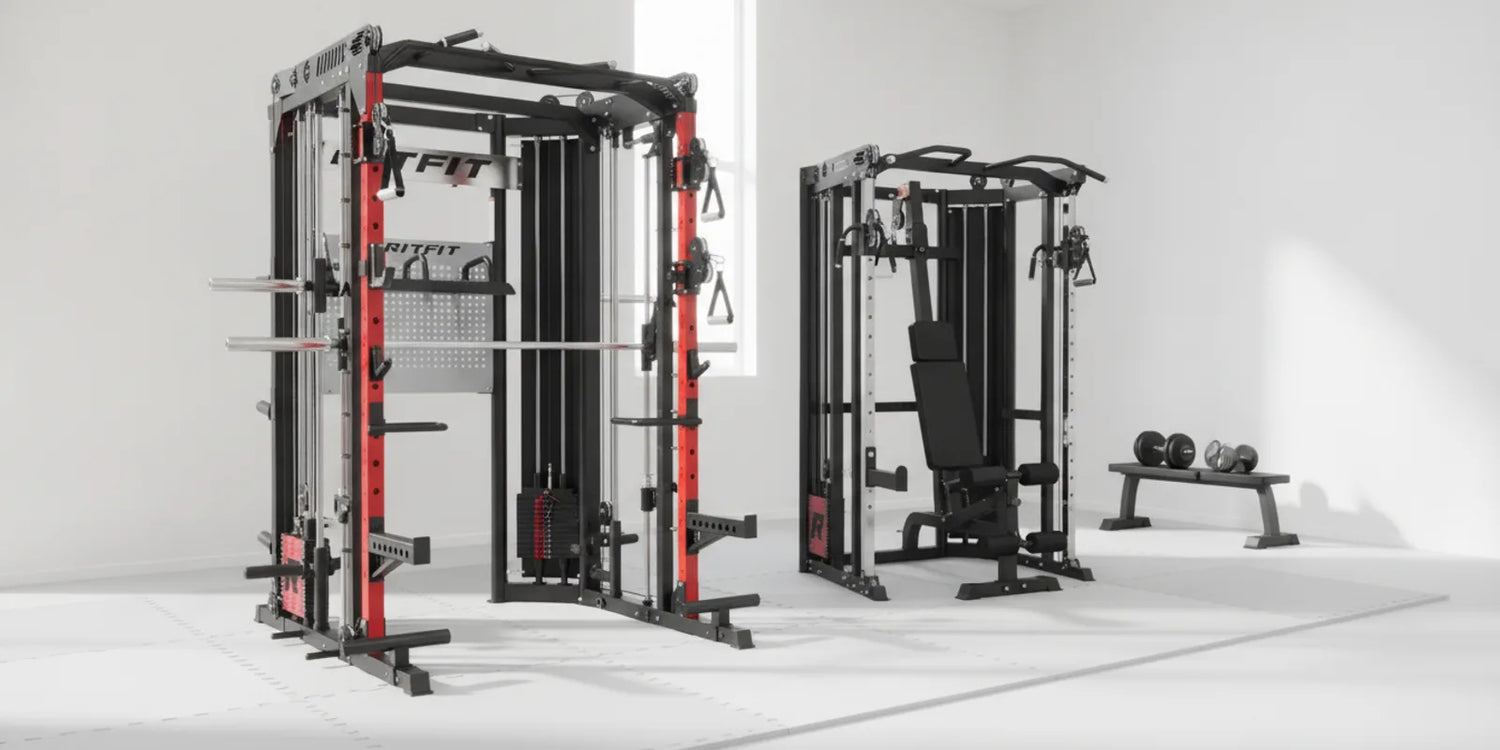
The best home gym for small spaces depends on the floor you can actually train on: adjustable dumbbells and a movable bench suit a shared room, while a Smith and cable machine suits a permanent strength area. A small advertised footprint alone cannot tell you whether either setup fits.
Use this guide to compare room requirements, two current RitFit configurations, and the equipment included in their prices before deciding what to buy.
Quick Answer: The best home gym for small spaces is a setup that leaves enough room for your chosen exercises, equipment access, and overhead movement. Start with adjustable dumbbells and a movable bench if a fixed frame would block the room; consider an all-in-one machine only after checking its outer dimensions, loading space, bench position, and full cable travel.
Key Takeaways
- Clearance beats footprint: A machine that fits against the wall can still be unusable if you cannot reach the cables or open a door.
- Check height by model and exercise: The assembled height must clear the ceiling, and pull-ups or overhead work may need additional space.
- Choose the smallest useful setup: A movable dumbbell and bench setup may suit a shared room better than a permanent machine.
- Compare complete costs: A machine price and a bench-and-plates package price cover different equipment.
- Confirm each upgrade: Attachment fit depends on the exact model, mounting dimensions, and exercise clearance.
Why Small Space Means Measuring Clearance, Not Just the Machine
A small space home gym is defined by three separate measurements, not one. The physical footprint of the machine is only the start, because the clearance zone and ceiling height decide whether you can actually train safely.
Footprint vs. Clearance Zone vs. Ceiling Height
A machine footprint describes occupied floor, while the training area also includes your body, bench, moving cables, and access to weights. Storage dimensions for a folded bench do not describe the space it needs during a workout.
- Outer dimensions: Check the assembled length and width, including the Smith bar, storage horns, and any protruding attachments.
- Training area: Map your bench position, cable reach, and side access for loading plates; the required clearance varies by exercise and model.
- Ceiling height: Compare the full assembled height with the lowest beam or fixture, then check headroom and hand or bar travel for your planned movements.
- Door and window swing: Keep entry, exit, and ventilation paths clear with the equipment in use.
What Ceiling Height Do You Need for a Small Home Gym?
A small home gym needs more vertical room than the selected machine's assembled height, plus any assembly allowance specified in its manual. Pull-ups, standing presses, and overhead attachments need movement-specific checks, so a seven-foot or eight-foot ceiling is not a universal fit guarantee.
How to Measure Your Space in 4 Steps
Measuring correctly takes four quick steps with a tape measure and painters tape. Do this before you compare any specific model so you shop by real fit instead of hope.
- Step 1: Measure floor length and width, then multiply for total square footage.
- Step 2: Measure floor to ceiling height, noting any beams, vents, or light fixtures.
- Step 3: Tape the outer machine dimensions, then mark the actual bench, plate-loading access, and cable exercise positions using the selected manual.
- Step 4: Check those positions against doors and overhead obstructions, and confirm delivery access and floor suitability before ordering.
If you are still planning the room itself, our guide to small home gym equipment essentials covers layout order before you commit to a large frame.
Which Machine Types Actually Fit Under 30 Square Feet?
Some cable trainers and Smith combos have a stated machine footprint under 30 square feet, but that figure does not establish a usable workout area. Check the outer dimensions and exercise layout for the exact model, especially when the bar or storage extends beyond its base.
Compact Smith and Functional Trainer Combos
A combo unit combines a Smith bar, cable pulleys, and rack functions in one permanent frame for squats, bench presses, and cable work. It makes sense when you want those functions and can leave the full operating area available between sessions.
- Shared frame: Several functions use the same structure, although attachments and the Smith bar may project beyond its feet.
- Resistance system: Selectorized stacks simplify changes; plate-loaded cables require compatible plates and access to their loading horns.
- Wall placement: Follow the manual's installation requirements and retain access to rear storage and moving components.
To understand how these two functions combine, read our breakdown of a functional trainer with Smith machine before you choose a layout.
Cable Based and Wall Adjacent Setups
A shallow cable trainer can preserve floor behind the exercise position, but rows and fly movements still use open space in front. Check its working layout and mounting requirements before treating a narrow room or shared passage as a suitable location.
- Narrow depth: A shallow frame protrudes less into the room, which matters most in bedrooms and hallways.
- Adjustable pulleys: Height adjustable cables cover presses, rows, and pulldowns without extra stations.
- Bench pairing: A folding bench slides into the clearance zone when needed and stores flat when not.
For station specific ideas, our guide to the best chest machines for home gyms shows how one frame can replace several single purpose pieces.
All in One Machine vs Rack, Dumbbells, and Bench
An all-in-one machine suits a permanent area where you want both guided barbell and cable exercises, while adjustable dumbbells and a movable bench suit a room that must serve other purposes. A folding rack adds barbell options only if the wall, anchoring, bar length, and open training position are suitable.
- Choose the all in one if: Your regular program uses Smith squats or presses and cable exercises, and its full layout clears the room.
- Choose dumbbells and a bench if: You mainly need presses, rows, and split squats, or must store equipment after training.
- Choose a rack build if: Free-weight barbell training is the priority and you have loading space at both ends of the bar.
How Do You Match a RitFit All in One to Your Space and Budget?
A RitFit shortlist should start with outer dimensions, resistance type, and the equipment you already own. These two configurations serve different purchases, so compare their complete contents rather than treating their prices as equivalent packages.
| Model and selected configuration | Outer size and derived area | Training functions and buyer fit | Included versus extra |
|---|---|---|---|
|
RitFit M1 PRO, Black / No Weight Stack $1,299.99 |
79.1 inches long including Smith bar × 63 inches wide × 85.3 inches high. Approximate outer rectangle: 34.6 sq ft. |
Smith, rack, and 2:1 cable system with 15 pulley positions; 2 × 2 inch, 14-gauge steel. Consider it if you already own compatible plates and want to choose your bench separately. |
M1 PRO machine included. Bench, training plates, and the optional 264 lb weight-stack set are separate; add a separate barbell if you want free-weight rack lifts. |
|
RitFit BPC06, BWB01 / Fleck Bumper Plates / 320lbs $3,499.99 |
79.9 inches long including Smith bar × 53.9 inches wide × 87.1 inches high. Approximate outer rectangle: 29.9 sq ft. |
Smith, rack, and 1:1 cable system with 17 pulley settings; 2 × 2 inch, 13-gauge steel. Consider it for a permanent area when you want a bench-and-plates package and selectorized cable changes. |
BPC06 with 260 lb total weight stacks, BWB01 bench, and 320 lb Fleck bumper plates. The stacks and bumper plates are distinct; do not assume a separate free-weight barbell is included. |
Official product pages and variant data checked October 19, 2026; both selected variants were orderable at these USD listing prices, before checkout promotions, and prices or stock may change.
Outer rectangle = listed length × width ÷ 144, rounded to one decimal; it excludes exercise and loading clearance. The pages advertise smaller footprints of 20.9 sq ft for M1 PRO and 27.2 sq ft for BPC06, so use the listed outer dimensions and confirm the installation layout rather than sizing your room from those footprint labels.
Under 15 sq ft: Tightest Apartments and Bedroom Corners
This heading describes a machine-footprint category only, not a complete training room; neither named machine above has a verified outer rectangle under 15 square feet. If that is all the floor you can use, start by checking whether adjustable dumbbells and a movable bench leave room for your actual exercises.
- Consider a shallow cable trainer only if: Its installation requirements and full exercise positions fit beyond the frame.
- Keep the room usable: Stored equipment still needs a clear workout position and an unobstructed exit.
15 to 30 sq ft: Spare Room and Garage Corner
This tier also refers to machine footprint, not usable room area, and some outer dimensions exceed the advertised footprint. A Smith and cable combo is worth considering only when your room accommodates the larger outline plus bench placement, cable movement, loading, and access.
The walkthrough above shows how a compact all in one behaves once installed, which helps you judge real clearance needs.
Home Gym Setups for Under 50, 50 to 100, and Over 100 Square Feet
Room shape and unobstructed dimensions matter alongside total square footage when choosing home gym equipment for limited space. Use these room-area tiers to decide what to measure next, rather than as promises that a particular machine will fit.
| Total usable room area | First setup to evaluate | Decision before purchase |
|---|---|---|
| Under 50 sq ft | Adjustable dumbbells and a movable or folding bench | Confirm the unfolded bench and your body fit through each exercise without blocking the exit; skip a fixed machine if they do not. |
| 50 to 100 sq ft | Dumbbells and bench, or one measured all-in-one layout | Tape the exact outer outline, bench position, cable travel, and plate access; a long narrow room may fail despite adequate area. |
| Over 100 sq ft | All-in-one package or rack build matched to your program | Check bar-end loading, storage, ceiling clearance, delivery access, and the space remaining for movement. |
These are room-area planning categories, not minimum operating areas; a smaller stored setup also needs exercise clearance when opened.
"From start to finish, this was a great buy. I was trying to decide on a few different machines and vendors, but ultimately bought from RitFit and could not be happier. They provided the most value and accessories all together. Installation took a few hours, but once it was set up, it was awesome! The whole family uses it, nd we are still looking at other items to go along with this for the home gym!"
Robert H., Verified Buyer, RitFit BPC06 All-In-One Smith Machine Home Gym Package
Is an All in One Worth the Price Versus Separate Pieces?
An all in one is worth considering when its Smith, rack, and cable functions match your routine and fit a permanent layout. Value depends on the complete usable setup, so no general savings claim follows from the machine price alone.
- Compare the same contents: Add the bench, plates, any separate barbell, flooring, and assembly costs you need before comparing a frame with a bundle.
- Count what you own: Existing compatible plates and a bench can make a machine-only purchase sensible; starting from nothing may favor a complete package.
- Pay for useful functions: Choose movable equipment if a fixed frame would crowd the room or most of its stations would go unused.
If you want the reasoning laid out in depth, our best all-in-one home gym equipment guide and the case for a combo frame in 7 reasons to add an all-in-one Smith machine both weigh value against separate builds.
Can You Expand an All in One Machine Later?
An all in one can accept upgrades only when the manufacturer confirms compatibility for the exact machine and attachment. Similar upright sizes or hole patterns alone do not establish fit, load limits, or enough room to use the add-on.
- Match the hardware: Confirm upright dimensions, hole diameter and spacing, mounting geometry, and the model's approved attachment list.
- Check resistance upgrades: Use only a weight-stack conversion or added resistance approved for your model and version.
- Measure again: Lever arms, leg-press attachments, and dip bars change the operating envelope even when the base stays in place.
If you expect to share the setup or grow it for two lifters, our guide to the best home gym for multiple users covers frames that scale with attachments.
"Solid all in one rack. The pulleys and smith machine are so smooth. Ample room to store attachments and barbells. Time consuming assembly but easy"
Khristian P. Verified Buyer, RitFit M1 PRO Multi-Functional Smith Machine with Cable Crossover System and Squat Rack for Home Gym
What Are the Most Common Small Space Buying Mistakes?
The most common small space buying mistake is choosing a machine by its slim wall footprint while ignoring the clearance zone and ceiling height. This leads to units that technically fit but cannot be used safely.
- Ignoring clearance: A published footprint does not include every cable position, bench angle, or plate-loading movement.
- Skipping the ceiling check: A lat bar or Smith bar that hits a low basement ceiling makes full range movements impossible.
- Blocking doors: Placing a unit where it blocks a door swing or closet turns a workable room into a hazard.
- Overbuying stations: A large multi station gym in a tiny room wastes money on capacity you cannot physically use.
Comparing a rack focused build can also help, and our roundup of the best all-in-one power rack for a home gym shows how frame choice affects both fit and future add ons.
What Can Home Based Strength Training Actually Deliver?
Home based strength training can deliver meaningful gains in muscle strength and function, which is the real payoff behind fitting a machine into a small space. The evidence is strongest for consistent, progressive resistance work rather than any single machine feature.
In one 4-week home based training pilot study in older adults, participants increased leg power by 16.9% using no specialist equipment.[1] A separate six-month randomized controlled trial of home based resistance training improved lower limb strength and concluded that home training is a valid, cost effective exercise modality.[2]
Broader research also highlights that regular resistance and strength training can significantly reduce sarcopenia risk by improving muscle mass, strength, and mobility, and that low cost home based programs are a practical, scalable way to maintain muscle health.[3] A compact all in one simply makes that consistency easier by keeping equipment ready in your own room.
"Many people underestimate the power of at-home workouts, believing that they lack the equipment or space to make meaningful progress."
Jeff Cavaliere, MSPT, CSCS, Physical Therapist and Strength Coach, Athlean-X
Where Can You Buy a Compact Home Gym for a Small Space?
RitFit's official store lets you check the exact configuration, manual, and included equipment before ordering a compact home gym. Choose by room fit first, then confirm the variant and complete cost at checkout.
Compare the machine-only M1 PRO configuration above if you already own plates, or the RitFit BPC06 All-in-One Smith Machine Home Gym Package with the selected BWB01 bench and 320 lb Fleck plates if you need those items. Browse RitFit all-in-one home gyms for other configurations, and confirm doorway access, floor suitability, assembly requirements, and any separately required barbell before paying.
What Warranty Applies to These RitFit Setups?
RitFit's published warranty gives category schedules, but it does not individually name M1 PRO or BPC06. The rack rows below use the Power Cage Basic Warranty as a category reference; confirm the exact model's applicable coverage with RitFit before purchase.
| Model or included item | Policy category basis | Frame | Parts | Pads/Upholstery |
|---|---|---|---|---|
| RitFit M1 PRO | Power Cage Basic, category reference | 3 years | 1 year | 90 days for cover and upholstery |
| RitFit BPC06 rack | Power Cage Basic, category reference | 3 years | 1 year | 90 days for cover and upholstery |
| BWB01 bench in selected BPC06 package | Benches, separate category | 3 years | 6 months | 6 months |
Source: RitFit warranty policy, checked October 19, 2026; category schedules are not additional model-specific guarantees.
Coverage applies to the original purchaser, starts on the order date unless specified otherwise, is nontransferable, and is limited to the lower 48 U.S. states. Misuse, cosmetic wear, environmental damage, and force majeure exclusions apply.
Fit reminder before the FAQs: The general area and ceiling ranges below do not establish operating clearance for either shortlisted machine; use the exact outer dimensions, manual, and your exercise layout.
FAQs About Small Space All in One Home Gyms
How many square feet do I really need for an all in one home gym?
Beyond the machine footprint, plan for a clearance zone around it. Many compact units install in under 15 square feet, but cable and Smith movements need two to three feet on the sides and front, so a realistic usable area is often 25 to 40 square feet including movement space.
What ceiling height do I need for a small space all in one machine?
Most all in one machines with a lat pulldown or Smith bar need roughly seven to seven and a half feet of ceiling height so the bar and cables travel fully. Measure your ceiling first, then choose a shorter frame model if you have a low basement or garage ceiling.
Is an all in one home gym worth it compared to buying pieces separately?
An all in one bundles a rack, cables, and often a Smith machine into one footprint, which usually costs less and takes less space than buying each piece. For small rooms it is often the better value, though modular setups give you more room to expand later if space allows.
Can I expand an all in one machine after buying it?
Expandability depends entirely on the frame. Rack based all in ones with standard attachment holes accept add ons like dip bars, storage pegs, and extra pulleys over time, while fully enclosed or digital units are harder to grow. If future upgrades matter, choose an attachment ready frame from the start.
What is the most common small space buying mistake?
Buying based only on the slim wall footprint and forgetting the clearance zone. A machine that fits against the wall can still be unusable if you cannot open a door, reach the cables, or stand back for movements. Always measure clearance and ceiling height before ordering.
Conclusion
The best all in one home gym machines for small spaces are the ones you can actually use, so measure footprint, clearance, and ceiling height before you shop. Match a slim functional trainer or a compact Smith and cable combo to your real usable area, then leave room to move.
Ready to shortlist a machine that fits? Measure your room today, then choose the configuration that leaves clearance to move and grow.
Disclaimer
This article is for general educational purposes and does not replace personalized fitness or medical advice. Consult a qualified professional before starting a new strength training program or installing heavy equipment at home.
Save on your next RitFit order
Tap the button to copy your code, then paste it at checkout.
References
1. Cegielski J, Brook MS, Quinlan JI, et al. A 4-week, lifestyle-integrated, home-based exercise training program elicits improvements in physical function and lean mass in older men and women: a pilot study. F1000Res. 2017;6:1235. doi:10.12688/f1000research.11894.2
2. Vitale JA, Bonato M, Borghi S, et al. Home-Based Resistance Training for Older Subjects during the COVID-19 Outbreak in Italy: Preliminary Results of a Six-Months RCT. Int J Environ Res Public Health. 2020;17(24). doi:10.3390/ijerph17249533
3. Forni R, Gargiulo P, Boretti G, et al. The Impact of Persevering Home Full-Body In-Bed Gym Exercise on Body Muscles in Aging: A Case Report by Quantitative Radio-Densitometric Study Using 3D and 2D Color CT. Diagnostics (Basel). 2024;14(24). doi:10.3390/diagnostics14242808





