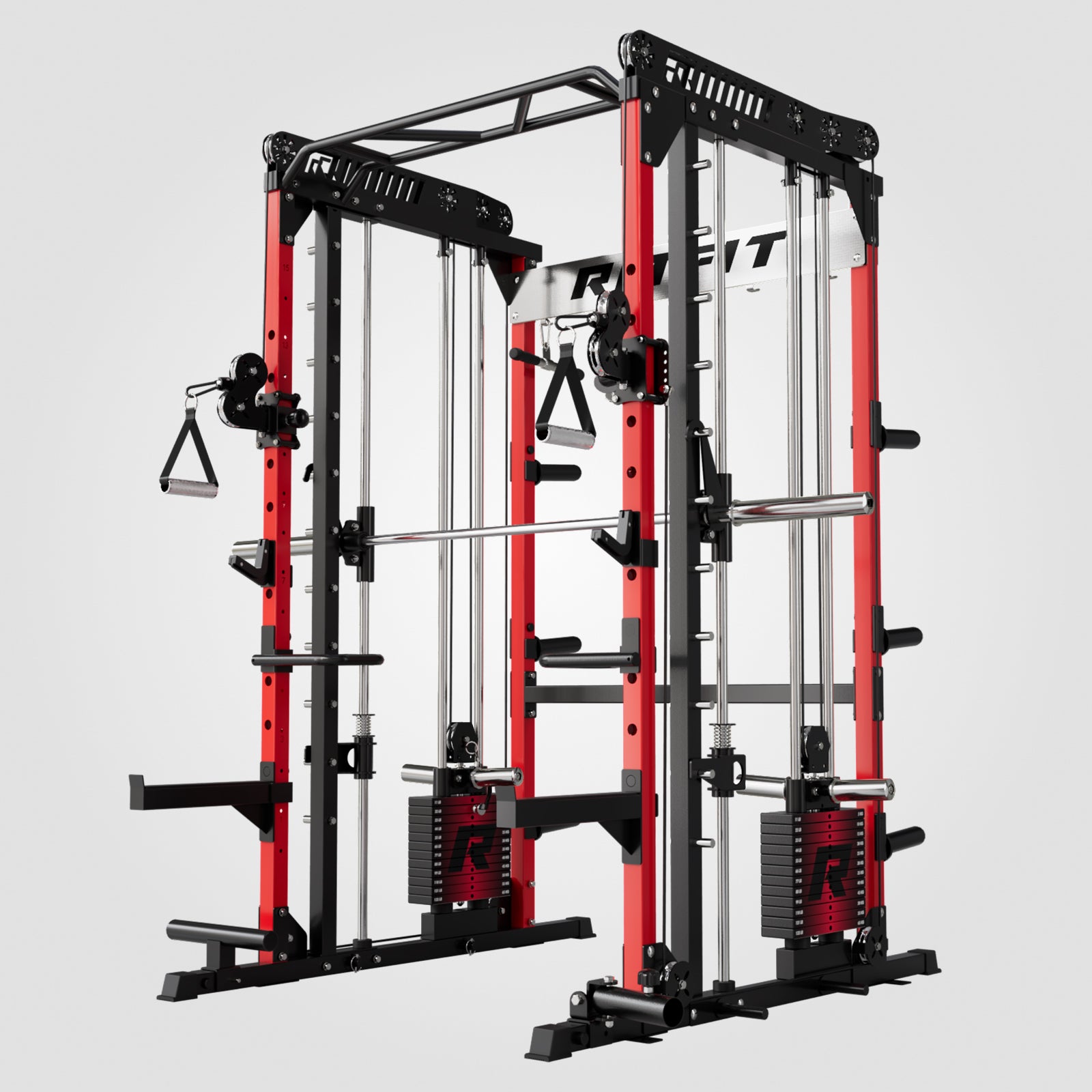
For a homeowner working with under 30 square feet, an all-in-one Smith machine or functional trainer combo delivers the widest range of full-body exercises per square foot, more than a cable-only digital smart gym.
This guide breaks down the exact footprint math, RitFit's BPC06, M1, M2, and PSR05 packages, and the measuring steps you need before you order.
Quick Answer: For most homeowners with under 30 square feet, an all-in-one Smith machine and functional trainer package, such as RitFit's M1 or BPC06, delivers more full-body exercises per square foot than a digital-resistance smart gym, provided you also allow 2 to 3 feet of side clearance and 7 feet of ceiling height for cable and bar movements.
Key Takeaways
- Footprint vs. clearance: Under 30 square feet covers the machine's floor footprint alone, and you still need 2 to 3 feet of side clearance plus 7 feet of ceiling height on top.
- Digital vs. mechanical: Digital smart gyms fold to the smallest footprint, but an all-in-one Smith machine and functional trainer combo supports real barbell squats, presses, and deadlifts.
- RitFit lineup: The BPC06 and M1 fit the tightest corners, while the M2 and PSR05 leave more room to add attachments later.
- Measure first: Recording floor space, clearance, and ceiling height before ordering prevents the most common small-space sizing mistakes.
- One machine, full body: A single all-in-one unit can cover squats, presses, pulls, rows, and hip thrusts without leaving the same footprint.
What Actually Counts as Under 30 Square Feet for a Home Gym Machine?
Under 30 square feet describes the machine's floor footprint alone, not the surrounding walking space, and most all-in-one Smith machine or functional trainer packages measure between 25 and 30 square feet before clearance is added. Compact, purpose-built exercise systems can retain a full training range while minimizing footprint, volume, and part count.[1]
- Machine footprint: The floor area the frame itself occupies, typically listed as length by width in the product specs.
- Working clearance: An additional 2 to 3 feet on the sides and in front for cable pulls, bar unracking, and bench positioning.
- Ceiling clearance: At least 7 feet of usable height for lat pulldowns and overhead presses.
- Fold-down depth: Some digital-resistance units collapse to a shallow depth when stored, which is a separate number from the working footprint.
Micro-gym style setups, even in institutional settings, are recognized for combining compact size with real training accessibility.[2] Browse the full RitFit Smith machine collection to compare footprints side by side.
Should You Choose a Smart Digital Gym or an All-in-One Smith Machine for a Tight Space?
A digital-resistance smart gym occupies the smallest floor footprint and folds away between sessions. An all-in-one Smith machine with a functional trainer needs a similar footprint but supports true barbell squats, bench presses, and deadlifts that a digital-only unit cannot replicate.
- Digital-resistance smart gyms: Motorized or electromagnetic resistance, foldable, quiet, but capped resistance and no free-weight barbell feel.
- All-in-one Smith machine and functional trainer combos: Fixed-path barbell plus adjustable cable pulleys, higher weight capacity, closer to a true gym experience.
- Power-rod machines: Compact resistance bands or rods in a frame, good for accessory work but limited for heavy compound lifts.
The functional trainer with Smith machine explained guide breaks down how the hybrid design works, and the roundup of reasons to add an all-in-one Smith machine covers the tradeoffs against buying separate equipment.
Which RitFit All-in-One Machine Fits Your Space and Goals?
The right RitFit all-in-one machine depends on your exact footprint, budget, and whether you plan to add attachments later, and the BPC06, M1, M2, and PSR05 packages each target a different combination of those three factors.
| Model | Approx. Footprint | Configuration | Best For |
|---|---|---|---|
| RitFit BPC06 | ~5x5.5 ft | Smith machine, functional trainer, bench | Tightest budget-conscious small spaces |
| RitFit M1 | ~5x6 ft | Smith machine, cable functional trainer | Beginners wanting one flexible entry-level machine |
| RitFit M2 | ~5.5x6.5 ft | Modular Smith machine, expandable attachments | Intermediate lifters planning to add accessories |
| RitFit PSR05 | ~5x6 ft | Smith machine package with bench included | Homeowners wanting a bundled, ready-to-lift setup |
Footprint ranges reflect the machine frame only, exclude working clearance, and are approximate. Check each product page for exact dimensions.
For the tightest corner, start with the RitFit BPC06 all-in-one Smith machine package or the RitFit M1 multi-functional Smith machine. If you expect to add attachments later, the RitFit M2 modular Smith machine or the RitFit PSR05 Smith machine package leaves more room to grow.
How Do You Measure Your Space Before Buying a Compact All-in-One Machine?
Measuring your space correctly starts with the floor footprint, then adds clearance and ceiling height, and takes about ten minutes with a tape measure and a notepad.
- Measure the open floor area: Clear the corner or wall you plan to use and record length by width in feet.
- Add side and front clearance: Add 2 to 3 feet on each side for cable arms and bar unracking, plus 3 feet in front for bench placement.
- Measure ceiling height: Stand under the spot and measure floor to ceiling, aiming for at least 7 feet of clearance for full lat pulldown extension.
- Check doorway width: Confirm the machine's boxed or assembled width clears your doorways and any hallway turns.
- Mark it on the floor: Use tape to outline the final footprint plus clearance before you order, so you can walk through the space.
If your marked outline exceeds about 30 square feet including clearance, a medium-footprint dual-stack trainer may fit your room better than a compact all-in-one unit.
What Common Mistakes Do Homeowners Make When Sizing a Small-Space Machine?
Homeowners most often measure only the machine's boxed footprint and skip ceiling height and side clearance, which later blocks full bar path extension and pulldown range of motion.
- Ignoring ceiling height: A machine that fits the floor plan can still block lat pulldowns if the ceiling sits below 7 feet.
- Skipping fold-down depth: Buyers assume a compact footprint stays compact, then discover the folded depth differs from the working depth.
- Underestimating bench swing room: A flat or adjustable bench needs its own 3 feet of clearance in front of the frame.
- Placing the machine against two walls: Corner placement can trap cable arms and block the intended range of motion for cable exercises.
- Forgetting the doorway path: A machine that fits the room may not fit through the door or up a stairwell.
Pairing your machine with a foldable utility bench instead of a fixed one keeps your measured footprint accurate on both training and rest days.
Is a Compact All-in-One Machine Worth the Price?
A compact all-in-one machine is worth the price for most homeowners because it replaces a rack, a cable station, and a bench in one purchase. A peer-reviewed paper on clinical exercise spaces also notes that having any dedicated resistance-training space on-site, regardless of its overall size, lowers the barrier to starting and sticking with a routine.[3]
- Equipment consolidation: One machine typically replaces a squat rack, lat pulldown tower, cable station, and bench.
- No membership fees: A one-time purchase avoids recurring gym or app subscription costs over years of use.
- Consistency: Training at home removes commute time, which supports sticking with a routine over the long run.
See the full best all-in-one home gym equipment guide for a broader breakdown of what these machines typically cost compared to buying separate equipment.
What Are the Long-Term Upgrade and Expansion Costs?
Long-term costs for an all-in-one machine usually come from added attachments and replacement cables rather than the base unit itself, and modular frames like the M2 keep those costs lower over time.
- Attachments: Lat pulldown bars, tricep ropes, and ankle straps are the most common additions, usually bought individually as needs grow.
- Cable and pulley wear: Cables and pulleys are wear items on any functional trainer and typically need replacement after years of regular use.
- Weight plates: Plate-loaded Smith machines require buying weight plates separately, which adds to the true total cost.
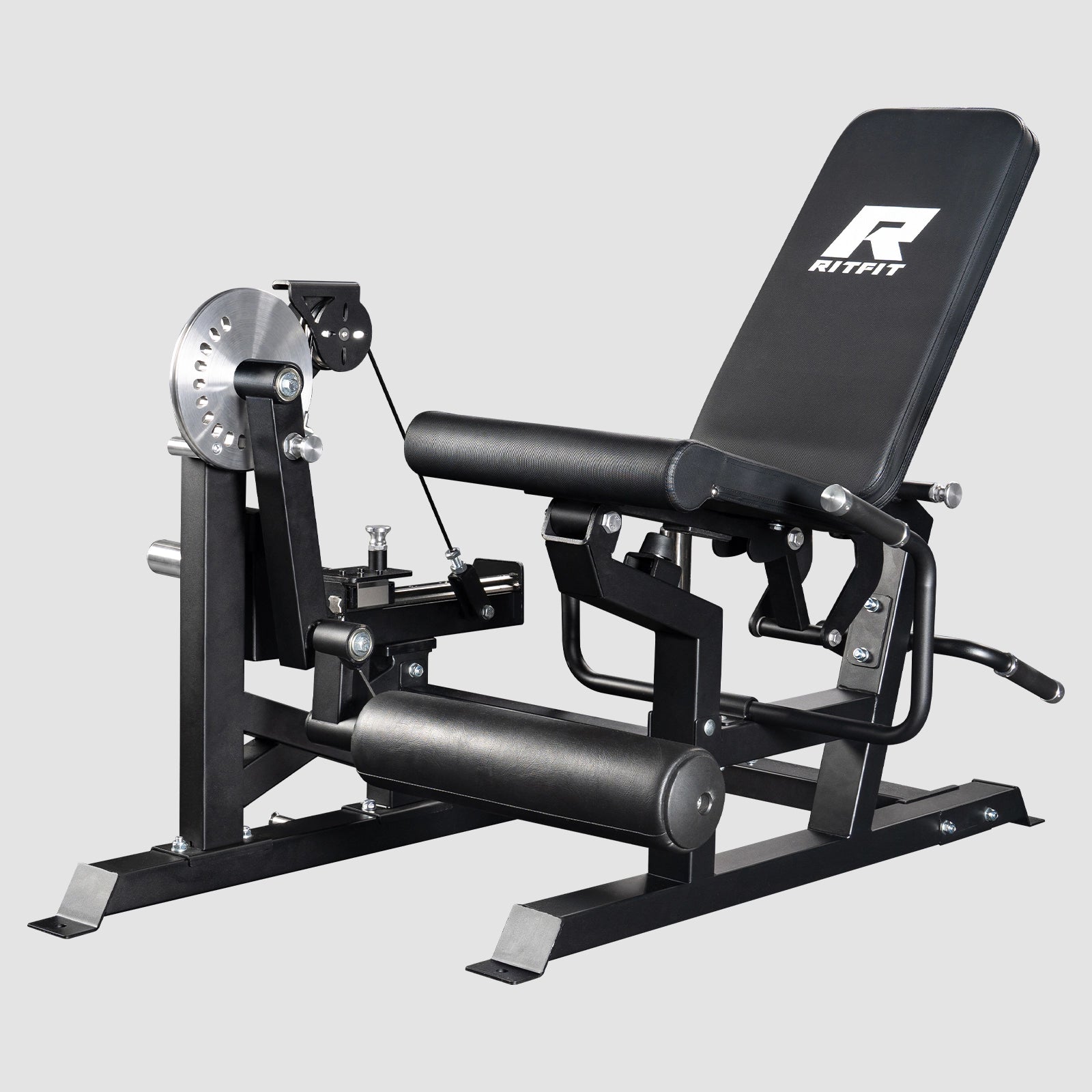
- Modular expansion: Modular frames let you add a leg press or lat tower attachment later instead of buying a second machine.
The RitFit M1 Pro all-in-one Smith machine guide walks through a real attachment upgrade path if you start with an entry-level frame.
What Full-Body Exercises Can You Actually Do in This Footprint?
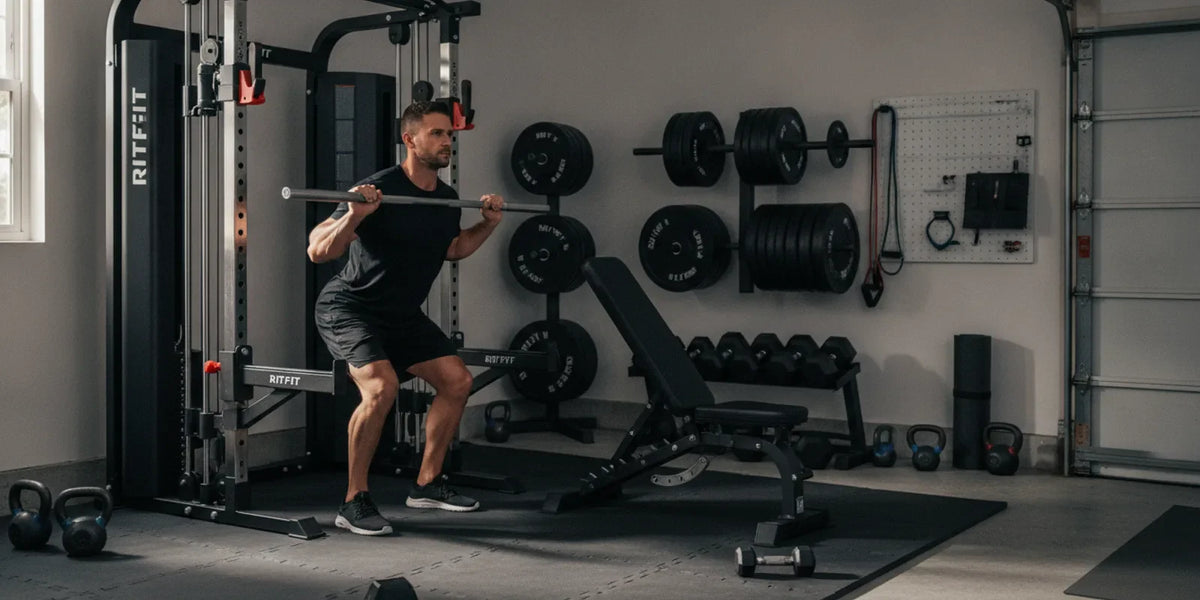
A single all-in-one Smith machine and functional trainer combo covers pressing, pulling, squatting, and cable-based accessory work, so most homeowners can complete a full-body session without leaving the same 30 square feet.
- Squat: Guided bar path on the Smith machine for safe, unassisted squatting.
- Bench press: Flat or incline pressing using the same guided rails.
- Lat pulldown: High pulley cable attachment for vertical pulling.
- Cable row: Low pulley attachment for horizontal pulling and back work.
- Deadlift: Open floor space in front of the frame for barbell or dumbbell deadlifts.
- Hip thrust: Bench positioned under the low pulley or against the frame for loaded hip thrusts.
This walkthrough shows a full-body routine performed entirely on a compact all-in-one home gym setup.
"Once or twice a week of an effective routine can be sufficient to maintain muscle mass."
Eric Helms, PhD, Natural Pro Bodybuilder, Researcher and Coach, 3D Muscle Journey
FAQs About All-in-One Smart Strength Training Machines for Small Spaces
How much floor space does an all-in-one smart strength machine actually need?
Most compact all-in-one Smith machine or functional trainer packages fit inside a 5x6 ft footprint, which is under 30 square feet, but you should add 2 to 3 feet of clearance on the sides and in front for cable movements and bar path, plus enough ceiling height for a full lat pulldown reach.
Is a digital smart gym or a Smith machine better for a small space?
A digital-resistance smart gym typically has the smallest floor footprint and folds away, while an all-in-one Smith machine with a functional trainer takes slightly more space but supports true barbell work like squats and bench presses, which digital-only units cannot replicate.
Can one all-in-one machine really replace a full home gym?
Yes for most strength goals, one all-in-one Smith machine or functional trainer combo covers pressing, pulling, squatting, and cable-based accessory work, so a homeowner rarely needs separate racks, benches, or cable stations, unless training for specialized sport-specific movements that call for dedicated equipment.
What is the biggest mistake people make when buying a compact home gym machine?
The most common mistake is measuring only the machine's footprint and skipping ceiling height and side clearance, which leaves users unable to fully extend the bar path, rack the barbell safely, or perform overhead and pulldown movements without hitting a wall or ceiling.
How can you expand an all-in-one machine setup without adding much floor space?
Yes, most all-in-one Smith machines accept add-on attachments such as lat pulldown bars, tricep ropes, dip handles, and ankle straps that mount directly onto the existing frame, so you gain new exercises without increasing the machine's original footprint or buying a second unit.
Conclusion
An all-in-one Smith machine or functional trainer, not a cable-only smart gym, gives homeowners under 30 square feet the widest range of full-body exercises per square foot.
Measure your floor space, clearance, and ceiling height first, then match the result to the RitFit BPC06, M1, M2, or PSR05 package that fits your budget and goals.
Disclaimer
This article is for general informational purposes and reflects typical product specifications and footprint estimates at the time of writing, not a guarantee of fit for every home or local building code. Always confirm exact machine dimensions, ceiling height, and any structural requirements with the manufacturer or a qualified professional before purchasing or installing home gym equipment.
Save on your next RitFit order
Tap the button to copy your code, then paste it at checkout.
References
1. Johnson MJ, et al. Affordable stroke therapy in high-, low- and middle-income countries: from Theradrive to Rehab CARES, a compact robot gym. J Rehabil Assist Technol Eng. 2017;4:2055668317708732. doi:10.1177/2055668317708732
2. Mózes N, Árva D, Major D, Fekete M, Dósa N, Lehoczki A, et al. Micro-gyms as a catalyst for healthy aging in university and healthcare settings: applications for the Semmelweis-EUniWell Workplace Health Promotion Model Program. GeroScience. 2025. doi:10.1007/s11357-025-01595-9
3. Nadolsky K, Baraki A, Nadolsky S. Incorporating a gym facility in a lifestyle medicine practice for patients with diabetes mellitus. Am J Lifestyle Med. 2022. doi:10.1177/15598276221089898