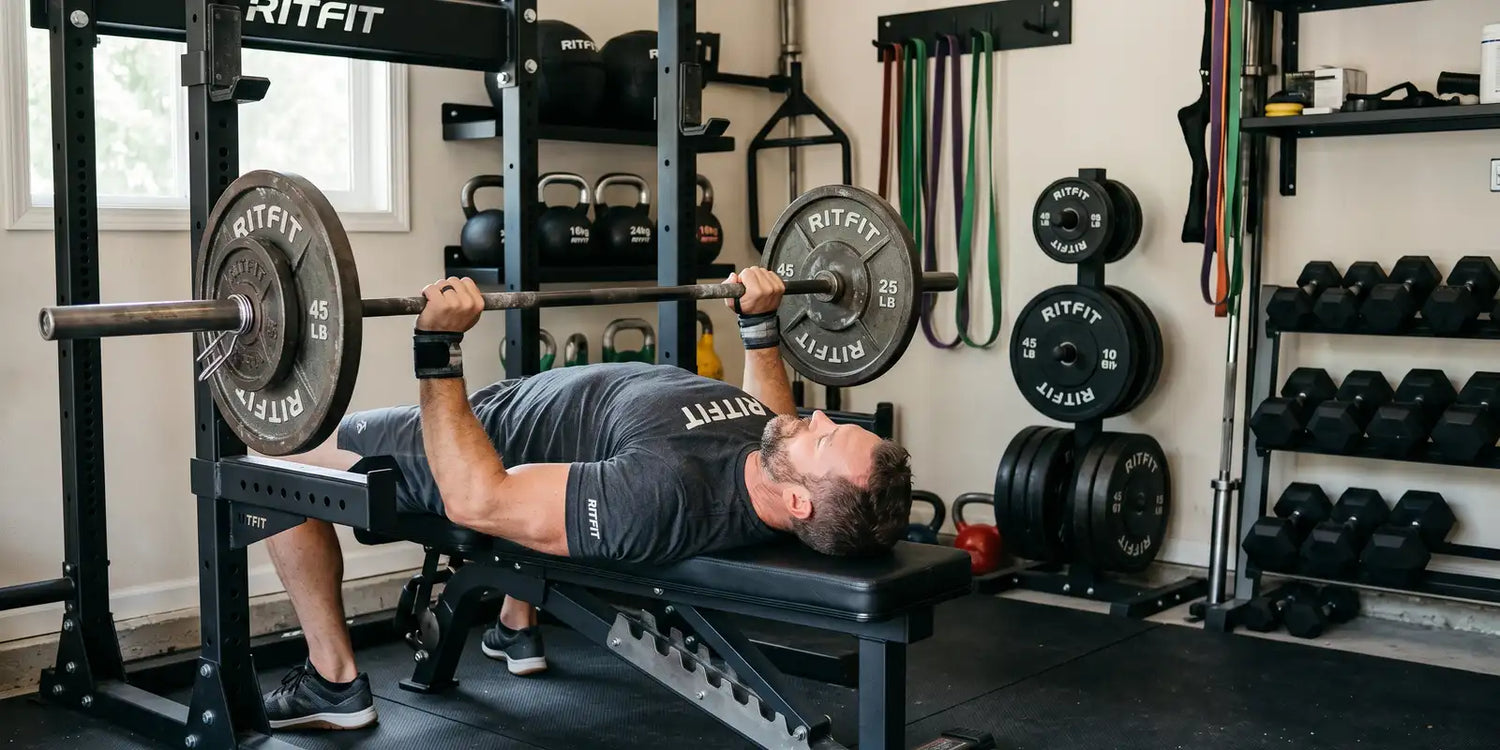
Knowing where your bench press stands relative to other men your age and size gives you a realistic baseline and helps you set meaningful training goals. The numbers vary significantly by bodyweight, experience level, and age group.
This guide covers credible bench press standards for men across all categories, explains the muscles and factors behind those numbers, and gives clear steps to move up to the next level.
Table of Contents
Key Takeaways
- Average bench press strength for men peaks in the mid-20s to early 40s and declines gradually after 45, accelerating after 50.
- Bodyweight is a major variable: a 135 lb bench press is untrained for a 220 lb man but elite for a 114 lb man.
- The five standard experience levels (untrained, novice, intermediate, advanced, elite) provide a practical benchmarking framework.
- The pectoralis major, anterior deltoid, and triceps brachii are the primary movers in the bench press.
- Lean body mass and upper-body force production capacity are the strongest predictors of bench press 1RM.
Average Bench Press for Men by Age
Bench press strength follows a predictable age curve. Fitness norms databases suggest men in their 20s can typically bench press around one times their bodyweight at the 50th percentile; by their 50s this typically drops to approximately 0.75 times bodyweight.
Competitive powerlifting databases suggest male bench press strength peaks in the mid-20s to early 40s, then declines gradually after 45, with the rate of decline accelerating after 50. Consistent resistance training substantially slows this decline compared to a sedentary lifestyle.
| Age Group | Bodyweight Ratio (50th percentile) | General Trend |
|---|---|---|
| 20-29 | ~1.0x bodyweight | Strength building phase; greatest adaptation potential |
| 30-39 | ~0.9x bodyweight | Near-peak; maintain or continue progressing with consistent training |
| 40-49 | ~0.8x bodyweight | Gradual decline begins; recoverable with structured programming |
| 50-59 | ~0.75x bodyweight | Decline accelerates; prioritize technique, volume, and recovery |
| 60+ | ~0.68x bodyweight | Strength maintenance is achievable; injury prevention becomes priority |
Ratios are approximate general fitness benchmarks based on industry norms databases; competitive powerlifters of all ages typically score significantly above these values.
Average Bench Press Standards by Bodyweight
Bodyweight is the most important variable when comparing bench press numbers between men. According to ExRx.net strength standards (NSCA-approved), the following 1RM benchmarks apply to men aged 18 to 39.
| Body Weight (lb) | Untrained | Novice | Intermediate | Advanced | Elite |
|---|---|---|---|---|---|
| 114 | 85 | 110 | 130 | 180 | 220 |
| 123 | 90 | 115 | 140 | 195 | 240 |
| 132 | 100 | 125 | 155 | 210 | 260 |
| 148 | 110 | 140 | 170 | 235 | 290 |
| 165 | 120 | 150 | 185 | 255 | 320 |
| 181 | 130 | 165 | 200 | 275 | 345 |
| 198 | 135 | 175 | 215 | 290 | 360 |
| 220 | 140 | 185 | 225 | 305 | 380 |
| 242 | 145 | 190 | 230 | 315 | 395 |
| 275 | 150 | 195 | 240 | 325 | 405 |
| 319 | 155 | 200 | 245 | 335 | 415 |
| 320+ | 160 | 205 | 250 | 340 | 425 |
All values are 1RM in pounds for men aged 18-39. Source: ExRx.net / NSCA-approved standards. Men aged 40-49 can expect modestly lower benchmarks; men aged 50-59 should expect a further reduction as age-related strength decline progresses.
The average American man weighs approximately 198 lb, placing the intermediate 1RM benchmark at 215 lb according to these standards. A 135 lb bench press falls in the untrained range for this weight class, which is a useful baseline for those just starting out.
For a deeper dive into how barbell and dumbbell variations compare for building strength, see the dumbbell vs barbell bench press comparison.
Understanding the Experience Levels
The five experience tiers used in most strength standards frameworks describe cumulative training history, not just current performance. Moving between levels requires months to years of consistent training.
- Untrained: No consistent resistance training history. Represents baseline physical capacity without specific bench press training.
- Novice: A few months of consistent training. Linear progression (adding weight each session) is still readily achievable.
- Intermediate: Six months to two years of structured training. Progress is measured weekly or monthly rather than session to session.
- Advanced: Multiple years of consistent, purposeful programming. Significant increases require dedicated periodization.
- Elite: Competitive-level performance. Typically requires years of sport-specific programming and represents the top few percent of trained lifters.
Most recreational gym-goers who train consistently for one to two years reach the intermediate tier. Reaching the advanced tier requires intentional programming, adequate nutrition, and years of dedicated effort.
What Muscles Drive Your Bench Press
Research shows the bench press primarily engages three muscle groups: the pectoralis major, the anterior deltoid, and the triceps brachii (both lateral and long heads).[1] Understanding which muscles are working helps you train accessory movements to bring up weaknesses.
- Pectoralis major: The primary driver of horizontal shoulder adduction (pushing the bar away from the chest). The wider your grip and the greater the range of motion, the more the pecs are involved.
- Anterior deltoid: Assists shoulder flexion throughout the lift. Shoulder pressing exercises directly strengthen this secondary mover.
- Triceps brachii: Responsible for elbow extension during the lockout phase. Weak triceps frequently create a sticking point in the upper portion of the press.[3]
Understanding the muscles the bench press works helps you identify which accessories to add to address plateaus.
Key Factors That Determine Your Bench Press
Raw strength on the bench press is shaped by several interacting variables. A study found that lean body mass and upper-body torque production (the ability to horizontally adduct the shoulder and extend the elbow) together accounted for about 43% of the variance in bench press 1RM among trained individuals.[2]
Additional factors include arm length and limb proportions (which affect the effective range of motion and leverage), training history, and technical proficiency such as leg drive and back arch.
- Lean body mass: More muscle tissue generally produces more contractile force. Building overall upper-body muscle is the primary long-term lever for improving your bench press.
- Technique: Mastering proper bench press form (bar path, shoulder blade retraction, leg drive, grip width) can meaningfully increase performance without adding any muscle.
- Limb proportions: Longer arms increase the range of motion and reduce mechanical advantage, making the lift harder. This is a fixed variable but worth understanding when comparing your numbers to population averages.
- Programming: Consistent exposure to bench press frequency (2 to 3 times per week) and progressive overload over months is the most reliable predictor of improvement.
How to Improve Your Bench Press
Progressing through the experience tiers requires targeted work both on the competition lift and on accessory exercises that address limiting muscles.
- Increase bench frequency: Training the bench press two to three times per week produces faster technical and strength adaptations than once per week.
- Vary the angle: Incorporating the best incline angle for bench press targets the upper chest and anterior deltoid, building a more complete pressing base.
- Add triceps accessory work: Close-grip bench press, triceps pushdowns, and overhead extensions build the lockout strength that limits many intermediate lifters.
- Use a quality adjustable bench: A stable, decline-to-incline RitFit adjustable utility bench allows all bench angles to be trained at home.
- Prioritize recovery: Strength gains happen between sessions, not during them. Eight hours of sleep and adequate protein intake per day directly support bench press progression.
For home or gym training, explore the full range of adjustable weight benches to find the right setup for your training space.
FAQs About Average Bench Press for Men
What is a good bench press for a man?
Yes, there is a clear benchmark. For a 198 lb man aged 18 to 39, benching 215 lb places you at the intermediate level according to NSCA-approved ExRx.net standards.
Most men who train consistently for one to two years reach this tier, making it a solid goal for recreational lifters.
Is benching your bodyweight impressive?
Yes, for most weight classes it represents at least the novice-to-intermediate threshold. For a 198 lb man, benching one times bodyweight puts you between the novice and intermediate levels according to ExRx strength standards.
Consistent gym-goers typically reach bodyweight bench within six to twelve months of structured training.
How does age affect the average bench press for men?
Bench press strength typically peaks in the mid-20s to early 40s and declines gradually with age, accelerating after 50.
Men who maintain structured resistance training can significantly slow this decline and often outperform sedentary younger men.
What is the average bench press for an untrained man?
For an average American man weighing around 198 lb, the untrained bench press benchmark is approximately 135 lb according to ExRx.net standards. This represents a single-rep maximum with no prior consistent bench press training, not a typical working weight for ongoing sessions.
Why does bodyweight affect bench press averages so much?
Heavier men generally have more total muscle mass, producing greater absolute force. A 135 lb bench press is elite for a 114 lb man but falls in the untrained range for a man over 220 lb.
This illustrates why raw numbers alone are misleading without bodyweight context in any strength comparison.
How often should I bench press to increase my average?
Two to three bench press sessions per week is the most commonly recommended frequency for intermediate lifters seeking to increase their 1RM. Each session should include variation in rep range and intensity, along with accessory work targeting the triceps, anterior deltoid, and upper chest to address sticking points.
Is the Smith machine bench press comparable to free barbell standards?
No, not directly. The Smith machine bench press guides the bar along a fixed track, reducing the stability demand on the shoulder.
Smith machine lifts are typically heavier than free barbell equivalents and should not be compared against the ExRx free barbell standards above.
Conclusion
Average bench press standards for men depend primarily on bodyweight, age, and training experience. For most men, the intermediate benchmark (around 215 lb for a 198 lb man) is an achievable goal within one to two years of consistent training.
Focus on progressive overload, sound technique, and accessory work targeting the triceps and anterior deltoid to move steadily up the tiers. Explore adjustable weight benches to build a reliable home pressing setup.
Disclaimer
This article presents general strength standards and benchmarks for informational purposes only and does not constitute personal fitness advice or medical guidance. Individual strength capacity varies widely based on genetics, training history, and health status.
Consult a qualified fitness professional before starting a new strength training program, especially if you have a history of shoulder, elbow, or wrist injuries.
References
- Gołaś A, Maszczyk A, Pietraszewski P, et al. Muscular activity patterns of female and male athletes during the flat bench press. Biol Sport. 2018;35(2):175-179. https://pmc.ncbi.nlm.nih.gov/articles/PMC6234306/
- Van Every DW, Coleman M, Plotkin DL, et al. Biomechanical, Anthropometric and Psychological Determinants of Barbell Bench Press Strength. Sports (Basel). 2022;10(12). https://pmc.ncbi.nlm.nih.gov/articles/PMC9785143/
- Saeterbakken AH, Solstad TEJ, Behm DG, et al. Muscle activity in asymmetric bench press among resistance-trained individuals. Eur J Appl Physiol. 2020;120(11):2517-2524. https://pmc.ncbi.nlm.nih.gov/articles/PMC7560911/