








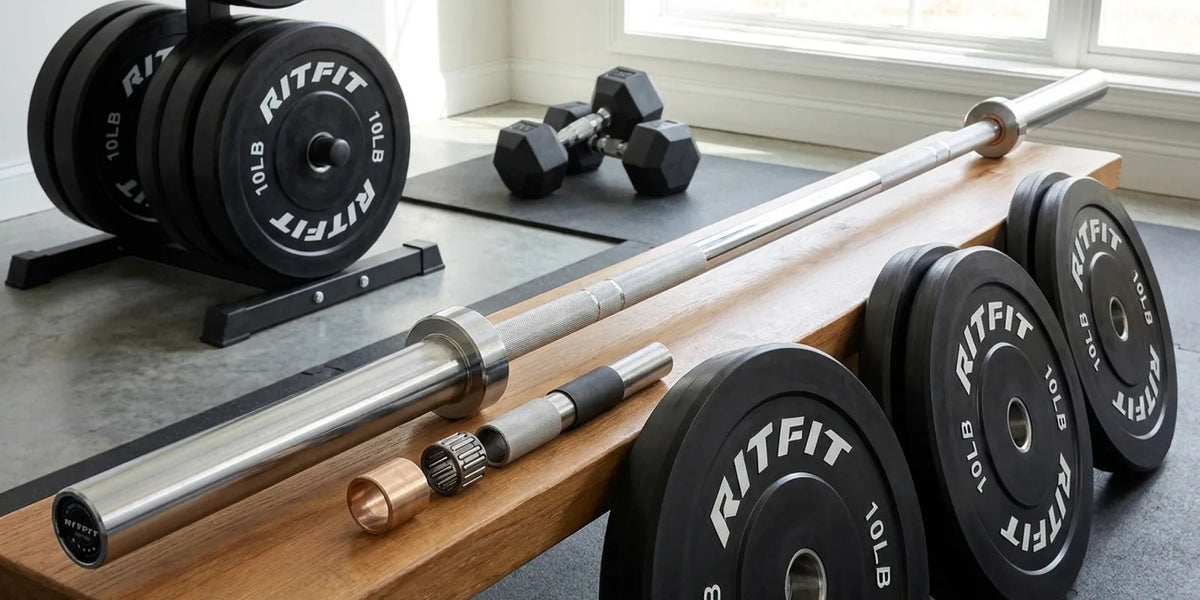
This barbell steel and coating guide breaks down the five spec lines that actually change how a bar performs: steel rating, finish, sleeve bearings, shaft diameter and knurling. Most buyers treat those lines as one quality score and overpay for numbers their training never touches.
The sections below translate each spec into plain consequences for grip, rust, spin and bar life, then match them to a training style and a budget. Length and weight charts are covered elsewhere, so this guide stays on steel, coating, bearings, diameter and knurl.
Quick Answer: A barbell steel and coating guide first checks steel rating, because a 190,000 to 200,000 PSI bar resists bending while unrated bars often do not. Stainless steel and Cerakote fight rust best, bushings suit powerlifting while needle bearings suit Olympic lifts, and a 28 mm to 29 mm shaft fits most hands.
Key Takeaways
- Steel rating: A 190,000 to 200,000 PSI tensile rating is the practical floor for a bar that survives years of squats and deadlifts, and unrated steel is the usual cost-cutting move.
- Coating trade-off: Bare steel keeps the sharpest grip, stainless steel and Cerakote resist rust best, black zinc wears faster on the shaft, and hard chrome can feel slippery on high-rep sets.
- Bearing choice: Bushings give slower, more controlled sleeve rotation for powerlifting, while needle bearings spin faster for the snatch and clean and jerk.
- Shaft diameter: A 28 mm to 29 mm shaft fits most hands, and 32 mm bars spread the hand open enough to cost grip on pressing movements.
- Knurl and rust: Aggressive knurl with a center knurl helps heavy squats, and any bar in a humid garage needs wiping and a light oil film to stay rust free.
What Do the Numbers on an Olympic Bar Spec Sheet Actually Mean?
Barbell spec sheets describe four independent things: steel strength, shaft thickness, sleeve rotation and surface grip. Reading them as one quality score is the single most common buying mistake.
Steel strength and yield rating decide whether a bar bends. Shaft diameter and knurl decide how it feels in your hands.
- Tensile strength: The stated breaking point of the shaft, quoted in pounds per square inch, or PSI.
- Yield strength: The point where the steel stops springing back, and the number most brands treat as a trade secret.
- Shaft diameter: The thickness of the bar where you grip it, usually 28 mm to 32 mm.
- Sleeve diameter: The loading section, which is 2 inches or 50 mm on an Olympic bar so standard plates fit.
- Loadable sleeve length: How much plate the sleeve physically holds, which matters once you pass three plates a side.
- Rotation mechanism: Bushings or needle bearings, the part that lets the sleeves spin.
- Knurl spec: How aggressive the texture is, and whether the center section carries knurl too.
Bar geometry is not purely cosmetic, either. One peer-reviewed study compared a traditional barbell bench press with an experimental bar design and found differences in muscle activation between the two.[1]
Published specs for one well known power bar list an 86 inch length, a 28.5 mm shaft, 17 inches of loadable sleeve length, a 4 inch center knurl and a 1500 lb max capacity.
How Do Steel Grade and Tensile Strength Rating Change How Long a Bar Lasts?
A higher tensile rating is what keeps a bar from bending permanently under heavy squats and deadlifts. Quality Olympic bars are commonly sold at 190,000 to 200,000 PSI or higher.
- 190k to 200k PSI: The range most buying guides treat as the sensible floor for a serious power bar.
- Missing PSI rating: A bar with no tensile number at all is usually unrated steel, which is exactly where corners get cut.
- Specs that do not add up: One barbell guide warns that a $250 bar advertising specs like a $700 bar is a warning sign rather than a bargain.
- Yield versus tensile: Tensile gets marketed because it looks impressive, while yield strength is the number that predicts a bend.
For a home gym, the useful question is narrower. If your working squat and deadlift stay below a few plates a side and you are not dropping the bar from overhead, a mid-tier steel rating will outlast your training for years.
Comparing a handful of bars side by side makes the rating differences obvious, and the full barbells range lists steel and capacity options in one place.
Which Barbell Coating Should You Choose: Zinc, Chrome, Cerakote, or Stainless?
Stainless steel wins on natural grip, while Cerakote is the best coated option for humid spaces and colored finishes. Black zinc and hard chrome are the budget finishes, with clear trade-offs on wear and feel.
| Finish | Rust resistance | Grip feel | Watch out for |
|---|---|---|---|
| Bare steel | Low, rusts without regular oil | Sharpest raw grip | Constant maintenance in humid air |
| Black zinc | Good | Matte, moderate | Grip wears down faster and shows wear over time |
| Hard chrome | High, resists rust and scratches | Polished, can feel slippery | Loses traction on high rep sets |
| Cerakote | Superior | Good, even when hands sweat | Usually costs more than zinc |
| Stainless steel | Excellent, no coating needed | Best natural grip | Highest cost of the group |
Finish behavior summarized from a published barbell coating guide. Relative rankings are qualitative, not lab tested salt spray results.
Cerakote is a ceramic based coating originally developed for firearms, and one coating guide notes it grips better than chrome because it is less slippery. Stainless steel takes the opposite approach by removing the coating problem entirely, since the material itself resists rust.
"Great quality barbell. First time building a home gym and I think this was worth adding when I purchased my rack from RitFit."
Caitlyn L. Verified Buyer, RitFit 7FT Olympic Barbell Bar 2'' Weight Lifting Bar
Needle Bearings vs Bushings: Which Sleeve Rotation Do You Need?
Bushings are the right call for squat, bench press and deadlift. Needle bearings are built for the snatch and the clean and jerk, and neither option makes a bar stronger.
- Bushings: Slower, more controlled sleeve rotation that suits general strength training and powerlifting, and they cost less.
- Needle bearings: Faster, smoother sleeve rotation that suits Olympic weightlifting, where the bar must spin during a turnover.
- Bushing material: Bronze or composite bushings are the quality choice, while one buying guide flags brass or steel bushings as a red flag.
- Cost signal: That same guide puts a cast bronze bushing at roughly $0.50 wholesale, which makes cheap bushing material a telling shortcut.
- Spin versus control: Too much spin on a heavy deadlift feels unstable, and too little spin on a fast clean puts torque into your wrists and shoulders.
If you deadlift and squat more than you snatch, a bushing bar is the simpler and cheaper answer. Only add needle bearings when the Olympic lifts are actually in your program.
Rotation feel is easier to judge on video than on a spec sheet, and the clip below shows how much movement a bar can carry through a rep.
Does Shaft Diameter Change Your Grip? 28mm vs 30mm vs 32mm
A thinner shaft lets your hand close further around the bar, and a closed hand is what generates grip force. A 32 mm shaft spreads the fingers open and costs you hold on heavy pressing.
- 28 mm to 28.5 mm: The classic power bar shaft, thin enough to grip hard and stiff enough for heavy squats.
- 29 mm: A middle ground used on plenty of all purpose bars for mixed squat, bench press and deadlift work.
- 30 mm: Thicker and stiffer, which some lifters like under a squat but find harder to hold on bench press.
- 32 mm: Spreads the hand wide, and coaching guidance is blunt about avoiding it for a home gym.
- Hand size: Smaller hands lose the most wrap on a thicker shaft, so test one in person if you can.
Diameter matters mechanically, not just by feel. Handle geometry changed grasping strategy, how grip force distributed across the hand, and twisting ability in a peer-reviewed ergonomics study.[2]
Standard Olympic barbells cluster in the thinner range for exactly that reason, because shaft diameter is a fit decision rather than a strength decision.
"The standard bar length is a little over 7 feet, has '2-inch'/50mm diameter sleeves for loading the plates on, and weighs 20kg/44.1lbs. For home gym purposes, a 28.5 or 29mm bar will be the most durable and provide the best service over time. NEVER buy a 32mm bar. They are either junk, or a specialty squat bar that a home gym doesn't need."
Mark Rippetoe, Strength Coach and Author of Starting Strength, Starting Strength, How to Build a Home Gym
How Do Knurling Depth and a Center Knurl Change Bar Control?
Knurl depth controls how much friction the bar gives you without tearing up your hands. Aggressive knurl belongs on a power bar, while a passive knurl suits high-rep or beginner work.
- Aggressive knurl: Grips a heavy squat or deadlift with less hand squeeze, at the cost of comfort on long sets.
- Passive knurl: Gentler on the palms and a better fit for high volume work or sensitive hands.
- Center knurl: Adds friction against your back so the bar is less likely to slide during heavy back squats.
- No center knurl: More comfortable on cleans and front loaded work, where a smooth center section will not scrape.
- Depth versus coating: A thick finish can soften the bite of the knurl, which is one reason bare steel feels sharper.
Ring markings are not cosmetic either. Grip width changed kinematics, horizontal kinetics and muscle activity at the sticking region of a one-rep-max bench press in a study of recreationally trained lifters.[3]
Chalk and consistent ring placement matter more than raw knurl aggression once your hands adapt, and a few barbell accessories make that setup repeatable.
Can Bare Steel or Rust Resistant Coatings Survive a Garage Gym?
Any bare steel bar will rust in a humid garage unless you manage moisture on purpose. Rust is a maintenance problem first and a coating problem second.
- Wipe after every session: Hand oils and chalk hold moisture against the steel, so a dry cloth is the first line of defense.
- Oil bare steel: A thin oil film on an uncoated shaft is the standard routine in humid climates.
- Store off concrete: Concrete wicks moisture, so a rack, wall mount or a RitFit deadlift jack barbell stand keeps the bar off the floor.
- Match coating to climate: Cerakote or stainless steel pays for itself in a damp basement, while black zinc and chrome cope fine in dry air.
- Watch the plates too: Barbell weight plates sit on the same humid floor, and RitFit Silver Steel Strip Olympic plates need the same attention.
- Never store damp: A bar wrapped in a wet towel or left in a cold trunk spots within days.
None of this is exotic. A two minute wipe-down and a light oil film is what separates a bar that lasts a decade from one that pits in a season.
Which RitFit 7 ft Olympic Barbell Bar Should You Buy for General Weightlifting?
Match the bar to your main lift first, then to your budget. General strength work and heavy powerlifting pull toward different capacity tiers even inside one brand.
| Your training | Bar to start with | Why it fits |
|---|---|---|
| General strength work across squat, bench press and deadlift | RitFit 7 ft Olympic Barbell Bar, 500 lb or 700 lb option | Capacity headroom above typical home gym working weights on a full length bar. |
| Heavy powerlifting with three or more plates a side | RitFit 7 ft Olympic Barbell Bar, 1000 lb option | The highest listed capacity in the range leaves margin for heavy squats and pulls. |
| Beginners and lighter technique work | RitFit 15 kg Pink Leopard Olympic training barbell | A 15 kg starting weight makes it easier to learn positions before loading heavy. |
| Locking plates in place | RitFit Olympic barbell clamps | Collars keep plates from sliding along the sleeves during fast or uneven reps. |
Capacity figures are the listed options on the RitFit product pages. Match capacity to the weight you actually train with, not to a number you hope to reach.
Every bar above uses the same 2 inch sleeve, so existing plates and clamps carry over. If you want the exact collar and sleeve numbers before ordering, the Olympic barbell collars technical specification page lists them.
"7 Feet Olympic Weight Lifting Barbell Bars | with 500-1000LBS Capacity Options Good quality and easy to handle. I like it!!!"
Roy Chao, Verified Buyer, RitFit 7FT Olympic Barbell Bar 2'' Weight Lifting Bar
FAQs About Barbell Steel, Coatings and Bearings
Does barbell shaft diameter affect grip strength?
Yes. A thicker shaft spreads your hand open and reduces how much you can wrap around it, so a 32 mm bar feels harder to hold on heavy presses. Most home gym lifters do best with a 28 mm to 29 mm shaft, while 30 mm bars trade some grip for a stiffer feel.
Is cerakote better than stainless steel for a barbell?
Neither is universally better. Stainless steel needs no coating, resists rust on its own, and keeps the sharpest natural grip. Cerakote adds a ceramic coating with strong corrosion resistance plus color options, which helps if you want a specific look or train in a humid space.
Do needle bearings make a barbell spin faster than bushings?
Yes. Needle bearings let the sleeves rotate faster and more freely, which suits Olympic weightlifting where the bar must spin during a snatch or clean. Bushings rotate more slowly and predictably, which is what powerlifters want for squat, bench press and deadlift. Neither option is stronger.
How do I stop a barbell from rusting in a garage gym?
Start with a coated or stainless bar if your garage is humid, then wipe the shaft and sleeves after every session to remove hand oils and chalk. Store the bar off bare concrete, keep a light oil film on bare steel, and never leave it wrapped in a damp towel.
What is a good tensile strength for a powerlifting barbell?
Look for a 190,000 to 200,000 PSI or higher tensile rating on a power bar. Tensile strength is the steel's stated breaking point, so 200k PSI class bars resist bending across years of squats and deadlifts. Cheap bars often skip the PSI rating entirely.
Is a barbell with center knurl better for squats?
For most lifters, yes. Center knurling adds friction against your back, so the bar is less likely to slide during heavy back squats. It is less comfortable for cleans or high rep front loaded work, where a smooth center section is usually preferred.
Conclusion
A bar is a decade long purchase, so buy the spec you will actually use. Steel rating and sleeve rotation decide how a bar performs, coating and knurl decide how it feels, and shaft diameter decides whether your hands can hold it under load.
Set a capacity that clears your working weight, then match the finish to your climate. First time buyers can check the RitFit discount guide before ordering.
Disclaimer
This guide covers equipment selection and general training considerations only and is not medical advice. Consult a qualified physician or physical therapist before starting a new strength program, especially if you have an injury, a joint condition or ongoing pain.
References
1. Melani A, Gobbi G, Galli D, et al. Muscle Activation in Traditional and Experimental Barbell Bench Press Exercise: A Potential New Tool for Fitness Maintenance. Sports (Basel). 2019;7(10). doi:10.3390/sports7100224. PMCID: PMC6835758
2. Seo NJ, Armstrong TJ. Effect of elliptic handle shape on grasping strategies, grip force distribution, and twisting ability. Ergonomics. 2011;54(10):961-70. doi:10.1080/00140139.2011.606923. PMCID: PMC8856563
3. Larsen S, Gomo O, van den Tillaar R. A Biomechanical Analysis of Wide, Medium, and Narrow Grip Width Effects on Kinematics, Horizontal Kinetics, and Muscle Activity on the Sticking Region in Recreationally Trained Males During 1-RM Bench Pressing. Front Sports Act Living. 2020;2:637066. doi:10.3389/fspor.2020.637066. PMCID: PMC7862765





