








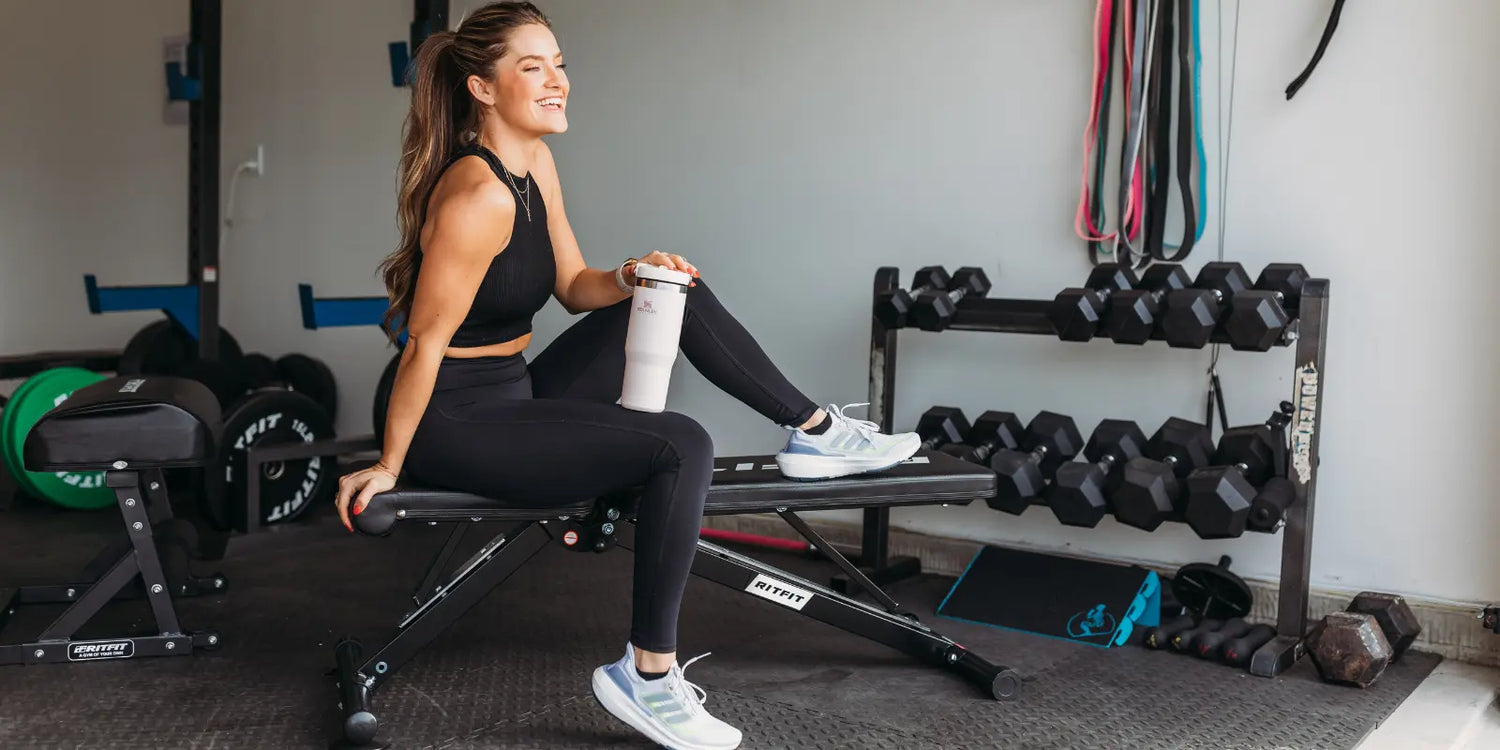
A bench workout full body routine is one of the most efficient ways to build strength at home. A single adjustable bench and a pair of dumbbells give you access to every major muscle group, from your chest and back to your legs, glutes, and core.
This guide covers the best full-body bench exercises, how to structure your weekly schedule, which angles to use for maximum muscle targeting, and how to keep progressing week after week. Whether you are a beginner or an experienced lifter, you will find a ready-to-follow plan here.
Quick Answer: A bench workout full body routine trains up to nine muscle groups using a single adjustable bench and dumbbells. Train two to three days per week, perform three to four sets of eight to twelve reps, and use flat, incline, and decline angles to target every area for consistent strength gains.
Key Takeaways
- Nine muscle groups: A weight bench can activate chest, back, shoulders, arms, core, glutes, hamstrings, quads, and calves in a single session.
- Optimal frequency: Training full body two to three days per week gives each muscle group enough stimulus to grow while allowing adequate recovery.
- Hypertrophy rep range: Three to four sets of eight to twelve reps per exercise is the standard guideline for building muscle with bench workouts.
- Angle variety matters: Flat, 30-45 degree incline, and 15-30 degree decline settings each shift muscle emphasis, making an adjustable bench a versatile training tool.
- Progressive overload is essential: Add weight once you complete all reps with clean form, or increase time under tension by slowing the eccentric phase.
What Muscles Does a Full Body Bench Workout Train?
A weight bench can activate up to nine major muscle groups in a single session, including the chest, back, shoulders, arms, core, glutes, hamstrings, quads, and calves. This makes it one of the most efficient pieces of equipment for home gym training, providing a complete full body bench workout with minimal equipment.
- Chest (pectoralis major): Targeted through flat and incline pressing movements. Muscle activation increases significantly as pressing intensity rises from moderate to near-maximal loads.[1]
- Back (latissimus dorsi, rhomboids): Engaged during chest-supported rows and single-arm dumbbell rows with one hand braced on the bench pad.
- Shoulders (anterior and posterior deltoids): Worked through seated shoulder presses and rear delt raises, with the front delts heavily involved in incline pressing.
- Arms (biceps and triceps): Biceps are isolated with incline curls; triceps are targeted through close-grip presses and bench dips.
- Core (rectus abdominis, obliques): Activated during decline sit-ups, elevated plank holds, and leg raises gripping the bench sides.
- Glutes and hamstrings: Trained through Bulgarian split squats with the rear foot elevated and hip thrusts with the upper back on the bench.
- Quads and calves: Quads are loaded during step-ups and split squats; calf raises can be added using the bench edge for balance support.
This coverage makes a full body workout with a home workout bench a practical alternative to a full gym setup. The RitFit 1300LB Adjustable Weight Bench BWB01 supports all the angle positions and weight loads described in this guide.
Which Exercises Cover Every Muscle Group on a Bench?
The most effective bench workout full body routine organizes exercises into four movement categories, each targeting a distinct muscle group. Push movements build the chest, shoulders, and triceps; pull movements develop the back and biceps; lower body moves target the legs and glutes; and core exercises strengthen the abdominals and stabilizers.[1]
Upper Body Push: Chest, Shoulders, Triceps
Flat dumbbell bench press, incline press at 30-45 degrees, and seated shoulder press are the core pressing movements. Bench dips isolate the triceps without any additional equipment.
- Flat dumbbell bench press: Stack wrists over elbows, retract shoulder blades, and press straight up. Perform 4 sets of 8 reps for strength or 3 sets of 10-12 for hypertrophy.
- Incline press (30-45 degrees): Shifts load to upper chest and front deltoids. Keep elbows under the dumbbells, not flared wide, to protect the rotator cuffs.
- Seated shoulder press: Sit upright on the bench with core braced. Press dumbbells directly overhead, keeping ribs down throughout the movement.
- Bench dips: Place hands on the bench edge, slide hips off, and lower until elbows reach 90 degrees. Keep elbows pointing back, not flaring outward.
- Decline press (15-30 degrees): Reduces shoulder involvement and targets the lower chest and triceps. Lock feet under the bench support for stability.
Upper Body Pull: Back and Biceps
Chest-supported rows and single-arm dumbbell rows are the primary pull exercises, both of which use the bench as a stable brace to isolate the back without lower back strain.
- Chest-supported dumbbell row: Set bench to 30 degrees, lie face down, and row dumbbells to the hips. Keep the back flat and avoid twisting the torso.
- Single-arm bench row: Place one knee and hand on the bench, hold a dumbbell in the opposite hand, and pull it toward the hip. Squeeze the shoulder blade at the top of each rep.
- Incline biceps curl: Set bench to 45-60 degrees, sit back with arms hanging freely, and curl dumbbells upward. The incline position increases the stretch on the biceps at the bottom.
- Rear delt fly: Bench at 45 degrees, lie face down with light dumbbells. Pull elbows back and out, squeezing shoulder blades together at the top.
Lower Body and Glutes
Lower body exercises using a bench are among the most demanding movements in a full body bench routine, with Bulgarian split squats and hip thrusts building unilateral leg strength and glute power that carries over to everyday movement.
- Bulgarian split squat: Stand a stride in front of the bench, place the rear foot on the pad, and lower until the front thigh is parallel to the floor. Perform 3 sets of 10 reps per leg.
- Bench hip thrust: Rest the upper back on the bench, place a dumbbell across the hips, and drive through the heels to raise the hips to full extension. Hold for one second at the top.
- Step-ups: Step onto the bench with one foot and drive through the heel to stand fully. This trains explosiveness and corrects left-right strength imbalances.
- Glute bridge (bench-elevated): Shoulders on the bench, feet flat, drive hips upward. A bodyweight variation that teaches hip extension mechanics before loading.
Explore a detailed leg workout at home with a bench to expand your lower body programming beyond these foundational movements.
Core and Stability
Core exercises on a bench add a stability challenge that floor-based movements cannot replicate, because the elevated or angled surface forces deeper engagement of the abdominals and spinal stabilizers.
- Decline sit-up: Anchor feet under a support or have a partner hold them. Lower slowly, pause at the bottom, and curl back up under control. Set the bench at 15-30 degrees.
- Elevated plank hold: Place feet on the bench and forearms on the floor. The inclined body angle increases core recruitment compared to a flat floor plank. Hold 30-60 seconds per set.
- Lying leg raise: Lie flat on the bench, grip the sides with both hands, and raise legs to 90 degrees. Lower slowly to prevent hip flexor compensation.
- Incline crunch: Lie back on an incline bench, cross arms over chest, and curl the torso upward. Focus on the upper abdominals by keeping the lower back pinned to the pad.
For a dedicated core session, see the bench ab workout guide covering progressions for all fitness levels.
How Should You Structure Your Bench Workout Schedule?
A full body bench workout schedule of two to three days per week is the most effective framework for most people, because it trains each muscle group with enough frequency to stimulate growth while allowing at least 48 hours of recovery between sessions. A peer-reviewed study found that full-body resistance training produced greater fat mass loss than a split-body routine in well-trained males.[2]
Training Frequency: 2 to 3 Days Per Week
A Monday, Wednesday, Friday schedule is the most practical starting point for beginners. More advanced lifters can use an upper-lower split that still relies on the bench as the primary piece of equipment for both upper and lower body days.
- Beginners (2 days per week): Two full-body sessions with 72 hours between them reduce injury risk while building the foundational movement patterns for bench-based training.
- Intermediate lifters (3 days per week): Three sessions allow enough volume per muscle group to drive hypertrophy. Rest at least one day between each session.
- Advanced lifters (4+ days): At this stage, an upper-lower or push-pull-legs split with bench movements in each category can increase overall training volume without compromising recovery.
- Pairing upper and lower body exercises: Alternating between upper and lower body sets in the same session, such as a bench press followed by a Bulgarian split squat, maintains training volume while cutting total session time significantly.[3]
Coaches typically advise keeping at least 48 hours between sessions training the same muscle groups to allow protein synthesis to peak and fatigue to dissipate before the next training stimulus.
"Real fat loss requires total-body strength training and conditioning that drives results. That means combining functional movements with compound lifts, aiming for the largest muscle groups that elevate heart rate and improve energy expenditure the most."
Jeff Cavaliere, MSPT, CSCS, Physical Therapist and Strength Coach, Athlean-X, How To Get Six Pack Abs Guide
Sets, Reps, and Rest Guidelines
Rep range and rest periods should match your training goal. For muscle building (hypertrophy), three to four sets of eight to twelve reps is the most widely recommended range for full body bench exercises. When those numbers feel manageable, increase load, slow the tempo, or reduce rest time to maintain the training stimulus.
- Strength focus: 3-5 sets of 4-6 reps with 2-3 minutes rest. Prioritize compound presses and rows with heavier dumbbells or a barbell.
- Hypertrophy focus: 3-4 sets of 8-12 reps with 60-90 seconds rest. This range produces the most consistent muscle growth for most lifters.
- Muscular endurance: 2-3 sets of 15-20 reps with 30-60 seconds rest. Useful for conditioning days or when adding volume without increasing load.
- Beginner progression (weeks 1-2): 3 sets of 10 reps, moderate load, 90-second rest. Concentrate on joint alignment and controlling the lowering phase of each rep.
- Beginner progression (weeks 3-4): 4 sets of 8 reps, add 5-10 lbs per dumbbell, 2-minute rest. Tighten setup before every set.
What Does a Sample 3-Day Full Body Bench Plan Look Like?
A complete 3-day bench workout full body plan covers every major movement pattern across the week, with each session balanced between pushing, pulling, lower body, and core work. The plan below uses only a bench and dumbbells and is suitable for beginners through intermediate lifters.
| Day | Exercise | Sets x Reps | Focus |
|---|---|---|---|
| Day 1 (Monday) | Incline Bench Press | 3 x 10 | Upper Chest |
| Day 1 | Single-Arm Row | 3 x 10 each | Back |
| Day 1 | Bulgarian Split Squat | 3 x 12 each | Legs |
| Day 1 | Lying Leg Raise | 3 x 15 | Core |
| Day 2 (Wednesday) | Flat Bench Press | 3 x 8 | Chest |
| Day 2 | Rear Delt Raise | 3 x 12 | Shoulders |
| Day 2 | Bench Hip Thrust | 3 x 15 | Glutes |
| Day 2 | Elevated Plank Hold | 3 x 45 sec | Core |
| Day 3 (Friday) | Seated Shoulder Press | 3 x 10 | Shoulders |
| Day 3 | Step-Ups | 3 x 10 each | Legs |
| Day 3 | Bench Dips | 3 x 12 | Triceps |
| Day 3 | Decline Sit-Up | 3 x 15 | Core |
Rest 60-90 seconds between sets. Choose a weight that allows clean form throughout all reps. Increase load only when technique remains sharp across all sets.
Watch this 20-minute follow-along session to see how a full body dumbbell and bench workout flows in real time:
This sample plan pairs well with a full body workout with a home workout bench for additional programming options once you have mastered the foundational movements.
How Do Bench Angles Change What Muscles You Train?
Bench angles shift the mechanical tension across different portions of the chest, shoulders, and triceps, making angle variety one of the most practical ways to maximize muscle development with a single piece of equipment. Adjusting between flat, incline, and decline positions essentially gives you three different pressing exercises from one bench.
Flat Bench: Raw Pressing Power
The flat bench position distributes load evenly across the mid-chest and anterior deltoids, making it the best baseline position for building overall pressing strength with a barbell or dumbbells.
- Wrist and elbow alignment: Stack wrists directly over elbows throughout the press. Flared elbows shift stress onto the shoulder joint, increasing injury risk over time.
- Shoulder blade setup: Retract and depress shoulder blades before unracking the weight and hold that position through every rep to protect the rotator cuffs.
- Bar or dumbbell path: Press straight up, not forward toward the face. The arc should finish directly over the mid-chest to upper ribs.
Incline Bench (30-45 Degrees): Upper Chest and Front Delts
Setting the bench to 30-45 degrees shifts mechanical tension toward the clavicular head of the pectoralis major and increases anterior deltoid involvement, building the upper chest thickness that flat pressing alone cannot deliver.
- Optimal angle: A 30-degree incline keeps the chest heavily involved. Steeper angles above 45 degrees transfer the load increasingly to the front deltoids rather than the chest.
- Lower back arch: If the lower back lifts off the pad when pressing at a steep incline, drop the weight or reduce the angle. Lumbar extension under load creates injury risk.
- Dumbbell advantage: Dumbbells allow natural wrist rotation throughout the press, reducing joint stress compared to a fixed-grip barbell at incline angles.
Decline Bench (15-30 Degrees): Lower Chest and Triceps
Decline pressing reduces shoulder joint flexion, which makes it a useful variation for lifters who experience discomfort during flat or incline pressing and want to continue training the chest without aggravating the shoulder.
- Angle setting: A 15-30 degree decline is sufficient. Steeper declines make foot positioning unstable and limit the range of motion benefit.
- Foot security: Lock feet firmly under the support pad before pressing. Unsecured feet shift the body during the movement and reduce stability.
- Bar or dumbbell track: Press toward the chin, not straight up. The bar or dumbbell should track over the lower chest throughout the lift.
Rotate between all three angles across your training week to ensure balanced upper body development and prevent the adaptation plateaus that come from always pressing at the same angle.
How Do You Keep Getting Stronger with Progressive Overload?
Progressive overload is the foundational principle behind any successful bench workout full body routine. Without consistently increasing the demand placed on your muscles, strength and muscle growth plateau. The key is to increase one variable at a time to maintain progress without compromising form.
When Should You Add Weight?
Add weight when you can complete all prescribed sets and reps with clean technique and still feel you have one to two reps left in reserve at the end of each set. A standard rule is to increase the load by five pounds per dumbbell once you hit the top of your rep range for two consecutive sessions.
- Two-rep rule: If you finish a set of 12 reps and could comfortably do 13 or 14, the weight is too light and should be increased next session.
- Form breakdown signal: If your form breaks before reaching the target rep count, the weight is too heavy. Stay at the current load until technique is consistent across all reps and sets.
- Progression sequence: Add reps before adding weight. If your target is 3 sets of 8 reps, work up to 3 sets of 12 reps with the current weight before moving to the next dumbbell increment.
What Can You Do When Progress Stalls?
When adding weight no longer drives improvement, manipulate other training variables to restart adaptation. A change in tempo, angle, or exercise variation can break a plateau without requiring heavier loads.
- Slow the eccentric phase: Lower the dumbbell over three seconds instead of one. This increases time under tension and creates a stronger growth stimulus at the same load.
- Paused reps: Add a one-to-two second pause at the bottom of each press or squat. This eliminates momentum and forces the target muscle to work through the full range.
- Change bench angle: Switching from flat to incline or switching to a single-arm variation challenges stabilizers that adapted to the bilateral movement pattern.
- Reduce rest time: Shortening rest from 90 seconds to 60 seconds increases metabolic demand and can restart hypertrophy when the load has plateaued.
- Deload week: After six to eight weeks of consistent training, take one week at 50-60 percent of normal load. This allows accumulated fatigue to clear and often results in a performance jump the following week.
For more structured programming beyond the basics, review the bench press standards guide for strength benchmarks and the full body bench workout for periodization strategies.
What Common Mistakes Should You Avoid?
The most common errors in a bench workout full body routine fall into two categories: skipping entire movement patterns, and using poor setup mechanics that reduce effectiveness and raise injury risk. Correcting these early builds a sustainable training foundation.
- Skipping lower body and core work: Many lifters start with pressing movements and stop there. A full body session must include Bulgarian split squats, step-ups, or hip thrusts for the lower body, plus at least one core exercise. Skipping legs weakens the structural base that supports every upper body lift.
- Never adjusting the bench angle: Keeping the bench fixed to a flat position reduces variety and slows results. Rotate between flat, incline, and decline angles across sessions to challenge muscles from new directions and prevent adaptation plateaus.
- Using an unstable or unevenly positioned bench: A bench that wobbles or sits on an uneven surface compromises form and safety on every rep. Always place it on a flat surface and verify that all locking mechanisms are secured before loading weight.
- Increasing weight before technique is consistent: Loading too heavy too early is the most frequent cause of shoulder and elbow injuries in bench-based training. Master the movement pattern at a moderate weight before adding load.
- Elbow flare during pressing movements: Wide elbows at 90 degrees to the torso place excessive stress on the anterior shoulder capsule. Keep elbows at 45-75 degrees relative to the body on all pressing variations.
- Neglecting the warm-up: Five minutes of arm circles, light dumbbell presses, and bodyweight glute bridges before the main session primes the joints and activates the stabilizing muscles that protect the shoulder during heavy pressing.
- Stopping progress when the set rep count is easy: A weight that allows clean 3 sets of 12 across all sessions without difficulty is no longer a sufficient stimulus. Apply the progression cues above to maintain the training adaptation signal.
Learn how to avoid these errors in a broader context by reviewing our bench ab workout and leg workouts at home with a bench for safe programming. For lifters ready to expand beyond a basic bench routine, a full body workout with a Smith machine adds guided bar path and safety hooks that allow heavier loading without a spotter. You can also supplement bench sessions with hamstring workouts with a bench for targeted posterior chain development.
FAQs About Bench Workout Full Body
Can you get a full body workout with just a bench and dumbbells?
Yes. A weight bench and a pair of dumbbells cover every major muscle group. You can press for chest and shoulders, row for back, dip for triceps, curl for biceps, perform Bulgarian split squats and hip thrusts for legs and glutes, and do leg raises for your core, all within a compact home gym setup.
How many days per week should I do a full body bench workout?
Two to three days per week works well for most people. This frequency lets you hit each muscle group often enough to stimulate growth while giving your body at least 48 hours between sessions to recover. A Monday, Wednesday, Friday schedule is a common starting point for beginners.
What is the best bench angle for targeting the upper chest?
A 30 to 45-degree incline is the most effective angle for emphasizing the upper chest and front deltoids. Coaching guidelines point to 30 degrees as a reliable starting point, because lower angles keep more chest involvement, while steeper angles shift the load increasingly onto the shoulders.
How do I know when to increase the weight in my bench workout?
Add weight when you can complete all prescribed reps, typically 3 to 4 sets of 8 to 12 reps, with clean technique and still feel you have 1 to 2 reps left in reserve. A common rule is to increase the load by 5 pounds when you hit the top of your rep range for two consecutive sessions.
What are the most common mistakes in a full body bench workout?
The most frequent errors include skipping lower body and core exercises in favor of pure pressing, failing to adjust bench angles across sessions to vary muscle stimulus, using an unstable or unevenly positioned bench, and increasing weight before technique is consistent. Training only the upper body limits balanced strength development and raises injury risk.
Conclusion
A bench workout full body routine is a highly practical and effective training method for home gym athletes. With a quality adjustable bench and a set of dumbbells, you can train all nine major muscle groups, follow a structured 2-3 day weekly schedule, and apply progressive overload to keep building strength over time.
Start with the 3-day plan outlined above, focus on mastering technique before adding load, and rotate bench angles to ensure balanced development. Browse adjustable workout benches from RitFit Sports to find the right bench for your training goals and available space.
Disclaimer
The information in this article is intended for general fitness education only and does not constitute medical advice, diagnosis, or personalized training prescription. Consult a qualified healthcare or fitness professional before beginning any new training routine, especially if you have pre-existing injuries or medical conditions.
References
1. van den Tillaar R. Comparison of Kinematics and Muscle Activation between Push-up and Bench Press. Sports Med Int Open. 2019;3(3):E74-E81. doi:10.1055/a-1001-2526. https://pmc.ncbi.nlm.nih.gov/articles/PMC6728153/
2. Full-body resistance training promotes greater fat mass loss than a split-body routine in well-trained males. J Int Soc Sports Nutr. 2024. https://pmc.ncbi.nlm.nih.gov/articles/PMC11236007/
3. Pena Garcia-Orea G, Rodriguez-Rosell D, et al. Acute Effect of Upper-Lower Body Super-Set vs. Traditional-Set Configurations on Bar Execution Velocity and Volume. Sports (Basel). 2022;10(7):110. doi:10.3390/sports10070110. https://pmc.ncbi.nlm.nih.gov/articles/PMC9323249/





