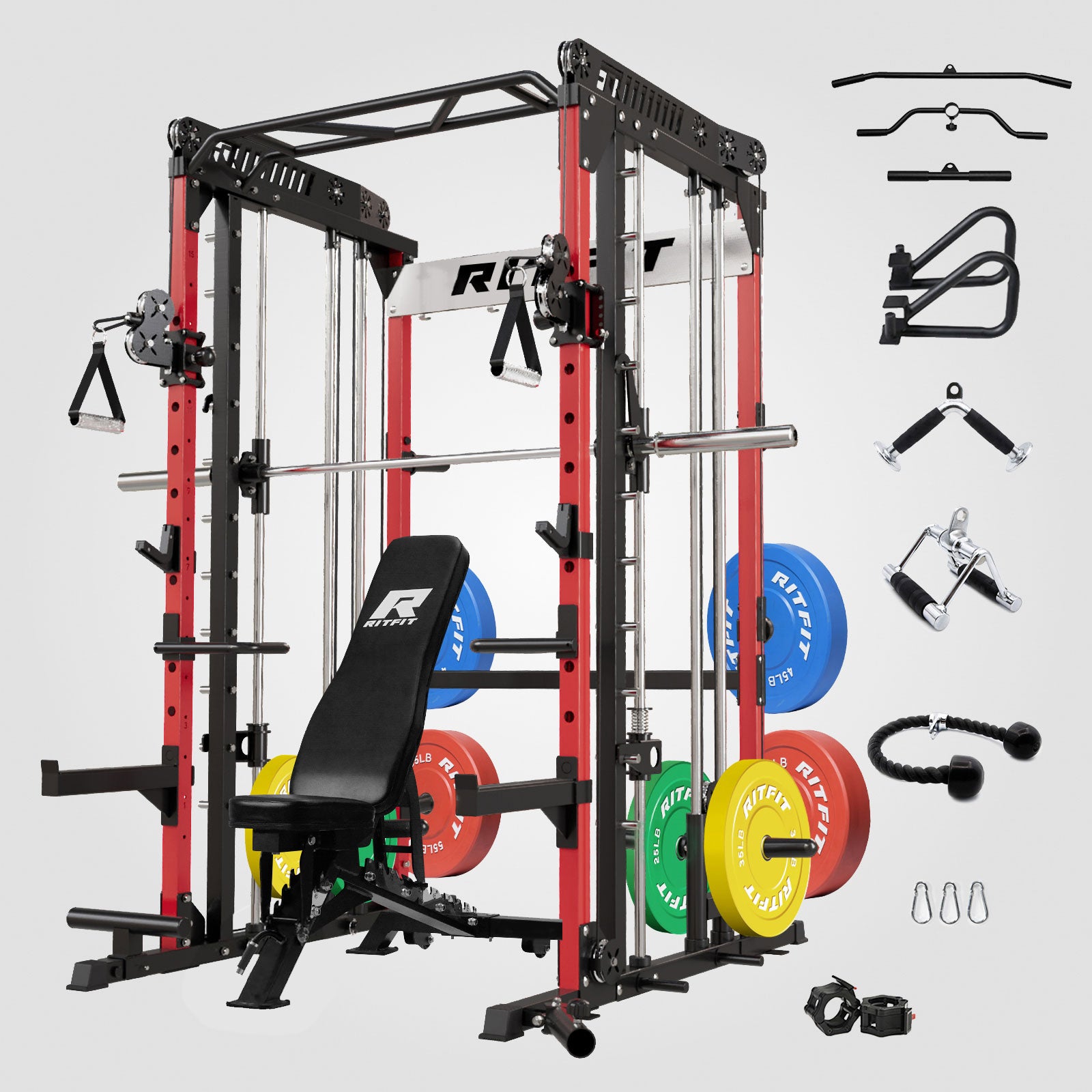
The best all in one power rack for a home gym should combine safe barbell training, cable exercises, pull ups, and storage in one compact footprint. For lifters who want a rack based setup without buying separate machines, the RitFit P3 Power Cage is a strong option for garage gyms, basement gyms, and dedicated home strength rooms.
This guide explains what the RitFit P3 offers, who it fits best, what space you need, and how to compare it with traditional racks and Smith machine combos.
Key Takeaways
- Best fit: The RitFit P3 is best for home gym users who want free weight rack training plus cable crossover exercises in one setup.
- Space need: The rack measures 67.2 inches by 59.1 inches by 81 inches, but users should plan extra working space for barbells and cable movement.
- Training value: The P3 supports squats, bench press, pull ups, lat pulldowns, rows, cable flys, landmine work, and accessory movements.
- Safety focus: J hooks and safety spotter arms help solo lifters train with more control when properly adjusted.
- Buying note: The P3 is not a Smith machine, so it is better for users who prefer independent barbell control over a fixed guided bar path.
What Makes an All in One Power Rack Useful for Home Gyms?
An all in one power rack is useful because it lets users train strength, cable work, and bodyweight movements without filling the room with separate machines. This matters most for garage gym and basement gym owners who need one main training station to do more than one job.
Space Efficiency Meets Training Variety
A traditional setup may require a squat rack, cable machine, pull up station, landmine setup, and plate storage. The RitFit P3 combines these functions in a 67.2 inch by 59.1 inch by 81 inch frame with roughly 17.53 square feet of floor footprint.
Cost Efficiency Over Separate Equipment
The P3 can reduce the need to buy a separate rack, cable crossover machine, pull up station, and storage system. Users who want to compare broader rack options can also review RitFit racks and power cage packages before choosing a final configuration.
Better Solo Training Support
Home gym users often train without a spotter, so adjustable J hooks and safety arms are important. The P3 safety spotter arms are listed at 440 lbs capacity, which gives lifters a built in backup when they set the catch height correctly.
RitFit P3 Power Cage Specifications
The RitFit P3 is built for users who want a rack first training experience with cable versatility added into the same station. The numbers below should be checked against the current product page before purchase because product specifications can change.
| Feature | RitFit P3 Specification | Why It Matters |
|---|---|---|
| Footprint | 67.2 inches by 59.1 inches | Helps users plan garage or basement placement |
| Height | 81 inches | Important for ceiling clearance and pull up use |
| Static rack capacity | 1200 lbs | Supports heavy rack based barbell training |
| Steel frame | 14 gauge steel with 2 inch by 2 inch tubing | Provides the core rack structure |
| Pulley system | 21 aluminum pulleys | Supports smoother cable movement than basic plastic pulley setups |
| Pulley ratio | 2 to 1 | Creates controlled resistance for cable exercises |
| Pull up bar capacity | 308 lbs | Supports bodyweight pulling movements |
| Storage peg capacity | 240 lbs each | Keeps plates organized near the rack |
RitFit P3 Power Cage: Key Features
Heavy Duty Steel Frame
The RitFit P3 uses 14 gauge steel uprights and 2 inch by 2 inch tubing to support rack based lifting. This construction is designed for squats, bench press, rack pulls, overhead press, and other compound lifts performed inside or around the cage.
Integrated Cable Crossover System
The cable system expands the rack beyond barbell training by supporting lat pulldowns, seated rows, cable flys, tricep pushdowns, curls, face pulls, and core rotations. Resistance training can improve strength and muscle size when it is programmed with appropriate load, volume, and progression.[1]
All Aluminum Pulley System
The P3 uses 21 aluminum pulleys to create a smoother cable feel than many entry level pulley systems. A smoother cable path matters because home gym users often rely on cable work for controlled accessory training after heavy barbell lifts.
Multi Grip Pull Up Bar
The multi grip pull up bar supports wide, close, neutral, and angled grip positions. This gives users more variety for lats, upper back, biceps, forearms, and hanging core movements.
Included Training Attachments
The P3 includes key rack accessories that support barbell work, cable work, landmine movement, and plate organization. Users who want to expand the setup later can browse compatible rack attachments for additional training options.
- J Hooks: These hold the barbell for squats, bench press, shoulder press, and rack setup.
- Safety Spotter Arms: These help catch the bar when properly positioned for solo training.
- Storage Pegs: These keep plates close to the rack and reduce floor clutter.
- Landmine Attachment: This supports rotational rows, presses, squats, and full body strength work.
- Aluminum Alloy Handles: These support pulldown, rowing, curling, and pushdown exercises.
What Exercises Can You Do on the RitFit P3?
The RitFit P3 supports a full body strength program because it combines rack training, cable training, pull ups, and landmine work. Free weight and machine based resistance training can both improve strength and hypertrophy, so a combined rack and cable setup can serve multiple training goals.[2]
- Lower Body: Back squats, front squats, split squats, rack pulls, Romanian deadlifts, and landmine squats.
- Upper Body Push: Bench press, incline press, overhead press, close grip press, cable flys, and landmine presses.
- Upper Body Pull: Pull ups, lat pulldowns, seated rows, face pulls, cable curls, and rear delt flys.
- Core: Cable woodchops, Pallof presses, hanging knee raises, plank rows, and landmine rotations.
For a complete rack setup, most users will also need an Olympic barbell, weight plates, and a bench. RitFit users can pair the P3 with Olympic barbells and weight plates and a stable adjustable weight bench for pressing and supported rows.
Before You Buy: Space and Setup Checklist
The P3 needs more than its frame footprint because barbells, cable arms, plates, and user movement all require extra clearance. A practical working area is about 8 feet long, 7 feet wide, and 8 feet high.
- Ceiling Height: Measure from floor to ceiling and leave extra room for pull ups, bar movement, and head clearance.
- Floor Surface: Use a level floor with rubber gym flooring to protect the surface and reduce vibration.
- Barbell Clearance: Leave side space for loading and unloading plates safely.
- Cable Path: Keep the front and sides open enough for flys, rows, pulldowns, and rotational work.
- Plate Storage: Plan where plates will sit so they do not block walkways or cable movement.
RitFit P3 vs Traditional Power Rack vs Smith Machine Combo
The RitFit P3 is best understood as a free weight power cage with integrated cable training. It is different from a Smith machine because the barbell path is controlled by the lifter rather than fixed on guide rails.
| Option | Best For | Main Limitation |
|---|---|---|
| Traditional Power Rack | Barbell focused lifters who mostly squat, bench, and press | Usually lacks built in cable crossover training |
| Smith Machine Combo | Users who want guided bar movement and added machine support | Does not provide the same independent bar path as free weights |
| RitFit P3 Power Cage | Home gym users who want free weight training plus cable versatility | Not ideal for users who specifically want a fixed Smith bar |
Users still deciding between guided and free weight setups can read the RitFit Smith machine vs power rack guide before choosing. Those who want a standalone cable unit can also compare the P3 with a dedicated cable crossover machine.
Who Should Choose the RitFit P3?
The RitFit P3 is a strong choice for lifters who want a central home gym station for strength, cable training, and bodyweight exercises. It works especially well for users who prefer free weight barbell training but still want cable based accessory work.
- Garage Gym Owners: The P3 gives broad training variety without requiring several large machines.
- Basement Gym Users: The 81 inch height may fit many basement layouts, but ceiling height must be measured first.
- Solo Lifters: Adjustable safety arms and J hooks help create a more controlled training environment.
- Intermediate Lifters: The rack capacity and exercise variety support progressive overload over time.
- Hybrid Trainers: Users can combine squats, presses, rows, pulldowns, cable flys, and landmine work in one session.
Who Should Not Choose the RitFit P3?
The RitFit P3 is not the best choice for every home gym. It may not fit users who want a fixed Smith machine bar, have very low ceilings, or only need a basic squat stand.
- Smith Machine Only Users: Choose a Smith machine if you specifically want a guided vertical bar path.
- Very Low Ceiling Rooms: Measure carefully if your ceiling is close to 81 inches or if you plan to do pull ups.
- Minimalist Lifters: A simpler rack may be enough if you never use cable exercises or landmine training.
- Frequent Movers: A full cage is less portable than a folding rack or compact squat stand.
Progressive Training on the RitFit P3
The P3 supports progressive overload because users can increase barbell load, cable resistance, repetitions, sets, or exercise difficulty. Combining free weights, machines, or both can be useful for novice lifters when the program is consistent and progressively structured.[3]
- Start With Setup Quality: Set J hooks and safety arms before adding heavy weight.
- Progress Slowly: Add small weight increases only after the movement feels controlled.
- Use Cable Work Strategically: Add rows, pulldowns, face pulls, and pushdowns after compound barbell lifts.
- Track Main Lifts: Record squat, bench press, overhead press, pull up, and row performance weekly.
- Balance Volume: Use enough total work to progress without adding unnecessary fatigue.
Maintenance and Longevity Tips
The RitFit P3 requires basic maintenance to keep the rack stable and the cable system smooth. Most home users should inspect the rack regularly, especially after assembly and during the first few weeks of use.
- Weekly: Wipe down cables, pulleys, handles, and contact points to remove dust and chalk.
- Monthly: Check bolts, J hooks, safety arms, storage pegs, and cable routing.
- Annually: Inspect cable condition and replace any cable that shows fraying or damage.
- As Needed: Lubricate moving parts only according to the product instructions.
Is the RitFit P3 Worth It for a Home Gym?
The RitFit P3 is worth considering if you want one rack to handle barbell strength work, cable accessories, pull ups, landmine movements, and plate storage. Muscle growth focused training depends on consistent tension, sufficient volume, and progressive challenge, so a versatile station can help users train more muscle groups without switching machines.[4]
The best value comes from using the full system, not just the squat rack portion. If you plan to use the cable crossover, pull up bar, safety arms, and landmine attachment regularly, the P3 gives more training variety than a basic rack.
FAQs
Is the RitFit P3 Power Cage good for a small home gym?
Yes. The RitFit P3 Power Cage is a good option for many small home gyms because it combines rack training, cable work, pull ups, and storage in one station. Measure ceiling height, barbell clearance, and cable movement space before buying.
How much space do you need for the RitFit P3 Power Cage?
You should plan about 8 feet long, 7 feet wide, and 8 feet high for comfortable use. The rack itself is smaller, but extra room is needed for barbell loading, cable exercises, pull ups, and safe movement around the cage.
Can beginners use an all in one power rack safely?
Yes. Beginners can use an all in one power rack safely when they learn proper setup, start light, and adjust the safety arms correctly. The key is controlled progression, stable flooring, clear bar paths, and avoiding heavy attempts before technique is consistent.
What exercises can you do on the RitFit P3 Power Cage?
You can train squats, bench press, overhead press, rack pulls, pull ups, lat pulldowns, seated rows, cable flys, face pulls, curls, pushdowns, and landmine movements. This makes the P3 useful for full body strength, hypertrophy, and accessory training.
Is the RitFit P3 better than a Smith machine combo?
It depends on your training preference. The RitFit P3 is better if you want free weight barbell control with cable versatility, while a Smith machine combo is better if you prefer a guided bar path for fixed movement patterns.
Do you need a bench with the RitFit P3 Power Cage?
Yes. A bench is strongly recommended if you want to perform bench press, incline press, seated shoulder press, chest supported rows, and more complete upper body training. Choose a stable adjustable bench that fits your rack height and floor space.
Should you choose the RitFit P3 for garage gym training?
Yes. The RitFit P3 is well suited for garage gym training if you want one main station for heavy lifts and cable accessories. Check floor level, moisture control, ceiling clearance, and walking space before setting up the rack.
Conclusion
The RitFit P3 Power Cage is a strong all in one power rack choice for home gym users who want barbell training, cable work, pull ups, landmine exercises, and storage in one station. It is best for lifters who value free weight control, compact versatility, and a rack based setup that can grow with their training.
Explore the RitFit P3 Power Cage to compare current packages, specifications, and available options.
Disclaimer
This article is for general product education and fitness planning only. Always review the current RitFit product page, assembly manual, and safety instructions before purchase or use. Consult a qualified fitness professional if you are new to strength training, recovering from injury, or unsure how to set up rack safety positions.
References
- Lopez P, Radaelli R, Taaffe DR, Newton RU, Galvao DA, Trajano GS, Teodoro JL, Kraemer WJ, Hakkinen K, Pinto RS. Resistance training load effects on muscle hypertrophy and strength gain: systematic review and network meta analysis. Med Sci Sports Exerc. 2021;53(6):1206-1216. doi:10.1249/MSS.0000000000002585
- Haugen ME, Varvik FT, Larsen S, Haugen AS, van den Tillaar R, Bjornsen T. Effect of free weight vs machine based strength training on maximal strength, hypertrophy and jump performance: a systematic review and meta analysis. BMC Sports Sci Med Rehabil. 2023;15:103. doi:10.1186/s13102-023-00713-4
- Aerenhouts D, D'Hondt E. Using machines or free weights for resistance training in novice males? A randomized parallel trial. Int J Environ Res Public Health. 2020;17(21):7848. doi:10.3390/ijerph17217848
- Krzysztofik M, Wilk M, Wojdala G, Golas A. Maximizing muscle hypertrophy: a systematic review of advanced resistance training techniques and methods. Int J Environ Res Public Health. 2019;16(24):4897. doi:10.3390/ijerph16244897