








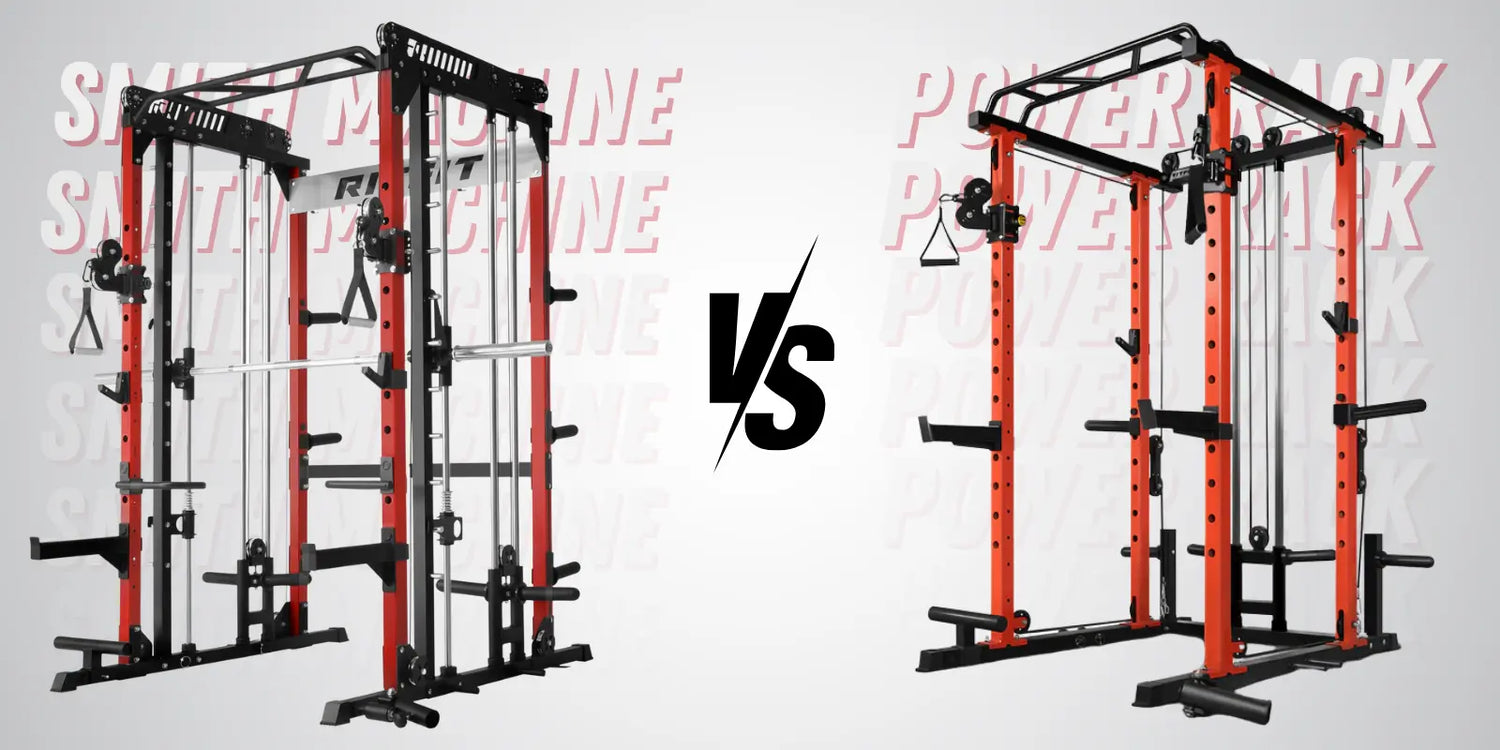
The Smith machine vs power rack decision usually comes down to one question: do you want the bar guided on rails or free in your hands? A power rack is usually the better primary choice for long term free weight strength, while a Smith machine is often the better choice for guided solo training and controlled accessory work.
This guide compares the two across bar path, safety, attachments, footprint, and budget, with real specs, buyer reviews, and research so you can pick the centerpiece that fits your home gym.
Quick Answer: A power rack is generally better for long term barbell strength and free weight skill, while a Smith machine is generally better for guided solo training and controlled accessory work. Choose the rack for natural bar paths and classic lifts, or the Smith machine for built in guidance, faster self spotting, and bundled cables.
Key Takeaways
- Bar path is the core difference: A power rack leaves the bar path free and lifter controlled, while a Smith machine fixes it on rails for a repeatable line of motion.
- Safety works differently, not better or worse: Racks catch missed lifts with adjustable safety arms, while Smith stations re rack the bar instantly with twist lock hooks.
- Both build muscle: Programming quality, effort, and progression matter more than the tool when muscle growth is the goal.
- Think in systems, not single lifts: Space, attachment ecosystem, and upgrade path usually decide the better long term centerpiece.
- Match the tool to the lifter: Choose a rack for a free weight foundation, or a Smith station for guided training, cables, and storage in one footprint.
What Is a Power Rack?
A power rack is a freestanding steel frame that holds a free barbell on adjustable J hooks and safety arms. Because the bar is never attached to the machine, you control the path from start to finish.
- Classic compound lifts: Back squats, front squats, bench press, overhead press, pin work, and rack pulls all fit naturally in a rack, which is why it remains the standard base for barbell training at home.
- Natural bar path: The bar can move in the way that matches your body, so balance and path control stay with you instead of the machine.
- Attachment flexibility: A rack expands over time with spotter arms, dip handles, landmine mounts, and plate storage, so the same frame covers more training years.
- Capacity you can verify: Strength claims belong on the spec sheet, and the 1,200 lbs capacity listed for the RitFit P3 Power Cage is the kind of concrete number worth comparing.
If you squat, bench, and press heavy in a garage gym, an open rack like the RitFit P3 Power Cage gives you a stable platform for the big lifts, and its smooth cable system with aluminum pulleys adds lat pulldown and rowing work without a second station.
Compared with a Smith station, the rack keeps the working area open on every side, and it pairs naturally with an adjustable weight bench, plates, and a standard barbell bought on your own schedule.
"really love this power cage with smith machine attachment. The installation is straightforward actually it is part of the fun. The bar, the grip are solid, smith machine part moves very smooth. The cage is pretty sturdy for the price paid. Highly recommend for home gym!"
Xin F. Verified Buyer, RitFit 1000lbs Power Cage
What Is a Smith Machine?
A Smith machine guides its bar on fixed rails, so the line of motion is controlled for you. Twist lock hooks let you re rack the bar at almost any point, which is why solo lifters trust it for hard sets without a spotter.
- Controlled hypertrophy work: Split squats, presses, rows, calf raises, and higher rep accessory sets are common Smith machine staples, because the fixed path removes balance demand from the rep.
- Solo training confidence: The bar locks in quickly at multiple points, which makes failed reps manageable and rest pauses fast.
- All in one value: Modern stations bundle cables, storage, and pull up options into one frame, like the setups in the RitFit Smith machine collection.
- Bar weight you should know: The guided bar does not feel like a free barbell, and the M1 PRO Smith bar weighs about 33 lbs, so check how much a Smith machine bar weighs before you load your first plate.
Modern stations make the rails one part of a bigger system: the RitFit M2 SERIES package pairs its 3D Smith carriage with dual 143 lbs weight stacks, 13 plates per side, so guided lifting and cable work share one footprint. Buyers comparing an all in one station with a functional trainer with a Smith machine should weigh which cable angles they will actually use.
Specs are where all in one stations prove their value. The RitFit M1 Smith Machine page lists a 1,600 lbs maximum rack load on 2x2 inch 14-gauge steel, a 20.9 sq ft footprint, 15 adjustable cable crossover positions, and a 3-year warranty on frame and welding with 1 year on bolts and pulleys, which are the exact lines to check when you compare spec per dollar.
Bundled models like the RitFit Buffalo Smith Machine package the same idea around a dedicated weight stack, so one delivery covers rails, cables, and storage at once.
"Rack is great, easy to assemble. I went back and bought the plate stack while the plate load is good, I like the ease of use from the weight stack , if I had different plates and not bumpers it would be lot easier to throw weight on and off. I am enjoying the 3d smith as well"
dillon d. Verified Buyer, RitFit M2 SERIES Multi-Functional Modular Home Gym Package
Smith Machine vs Power Rack: Comparison Table
The two tools differ most in bar path, safety mechanism, and how each one grows with your home gym. This table puts the differences side by side before the detailed sections below.
| Feature | Power Rack | Smith Machine |
|---|---|---|
| Bar path | Free and lifter controlled | Fixed on rails and machine guided |
| Skill demand | Higher, because balance and path control stay with you | Lower, because rails guide the line of travel |
| Safety mechanism | Adjustable safety arms catch a missed lift | Twist lock hooks and stops re rack the bar at any point |
| Solo confidence | High when safeties are set and tested | High, because lockouts are fast for self spotting |
| Attachment ecosystem | J hooks, spotter arms, dip handles, landmine mounts | Dual cables, lat pulldown, pull up bar, weight stacks |
| Footprint | Open modular layout, for example the P3 cage | One bundled station, for example the M1 PRO at 20.9 sq ft |
| Budget shape | Rack, bench, barbell, and plates bought over time | One purchase with cables and storage included |
| Best fit | Barbell first strength lifters | Solo lifters and shared home gyms |
The comparison reflects general differences between the two tool types, not a verdict on any specific model.
"I was interested in this package because it was a way to get everything at once (rack, functional trainer, bench, bar, weights) and was reasonably priced. I found quite a few product reviews and comparison videos to others in the same price range; this one had the better reviews and was a more complete package."
Samantha Downes, Verified Buyer, RitFit 1-6K PC-410CC Package
What Are the Biggest Differences Between a Smith Machine and a Power Rack?
The core difference is bar path: a power rack leaves it free while a Smith machine fixes it on rails. Four more differences shape the buying decision: safety mechanics, stability demand, the attachment ecosystem, and total space and budget.
Which Is Safer for Solo Lifting at Home?
Neither tool is objectively safer, because both protect you through setup rather than luck. A rack catches a failed lift on safety arms you set before the set starts, while a Smith machine lets you twist the bar onto its hooks at almost any point of the rep.
Bar Path Freedom and Skill Development
The rack asks you to steer the bar, which builds free weight skill you keep for life, while the rails make every rep repeatable, which builds confidence under fatigue.
Muscle Emphasis and Stability Demand
Free weight lifting demands more stabilization, while guided lifting shifts more of the task toward the primary movement pattern. A systematic review and meta-analysis found that free weight training improved free weight strength outcomes most, machine based training improved machine based performance most, and hypertrophy differences between the two were small.[1]
Stability and Force Production
A review of instability resistance training concluded that more stable lifting conditions allow greater force output, while instability raises stabilizer demand and can reduce overload for prime movers.[2]
What That Means for Beginners
Beginners can make good progress with either machines or free weights when effort and progression are matched. A randomized trial in novice males found that both approaches improved muscularity, strength, and functional capacity in a structured program, so the best beginner choice is often the one they can use consistently and safely.[3]
Attachment Ecosystem and Compatibility
A rack grows with spotter arms, dip handles, landmine mounts, and plate storage, while a Smith station often arrives with dual cables, a lat pulldown path, a pull up bar, and weight stacks already included. The practical question is which ecosystem matches the work you already do, because unused attachments still claim floor space.
Footprint, Budget, and Upgrade Space
A basic rack keeps the footprint open and lets you buy the bench, barbell, and plates over time, while a Smith station bundles cables and storage into one larger purchase and one delivery. If your room is tight, a guide like the best Smith machine for low ceilings can help you think through height clearance before you buy.
"The BPC05 is an excellent machine. It has exceeded my expectations in every way. The only improvements i would suggest, is to make the machine about 6 inches taller, and move the smith bar portion out from the weight stack another 6 inches to really give more space to perform without being cramped."
Shane S. Verified Buyer, RitFit Home Gym Package Bpc05 Power Cage
When Is a Smith Machine the Better Choice?
A Smith machine is the better choice when guided movement and solo confidence matter more than free weight skill. It is especially practical for solo home gym users who want to press hard without a spotter and move fast between exercises.
- Solo bench and press work: The guided path and quick re rack make heavy pressing manageable when no training partner is around.
- Accessory hypertrophy: Split squats, calf raises, rows, lunges, and controlled pressing variations sit naturally on the rails.
- All in one value: One station can make more sense than building out separate rack packages plus cable equipment when floor space is the constraint.
- Older adult training: A systematic review and meta-analysis found that machine based resistance training improves strength and functional capacity in older adults, which supports guided systems as a practical option for that group.[4]
"Few pieces of equipment in the home exercise industry are as comprehensive and versatile as this all-in-one gym system. The robust system provides a natural, centered bar path for compound lifts like squats, presses, and rows, and incorporates a dual cable crossover station with a full rack of precision-engineered attachments."
Tom Eskey, CF-L1, CPT, Home Gym Equipment Reviewer, on the RitFit M1 Smith Machine, Garage Gym Revisited
"The M1 Pro has re-energized my workout regimen. The smith machine has been a great help in being able regain strength in my shoulders after previous shoukder injuries. The landmine was a pleasant surprise having used it a great deal after not realizing it was included when I devided to order the M1."
Joseph, Verified Buyer, RitFit M1 PRO Multi-Functional Smith Machine with Cable Crossover System and Squat Rack for Home Gym
When Is a Power Rack the Better Choice for Long Term Strength?
A power rack is the better choice for long term barbell strength and a setup that grows with you. It gives you the most direct path to classic squat, bench, overhead press, and rack based progression.
- Strength first training: If your plan centers on progressive barbell work, a rack is the stronger primary investment.
- Movement freedom: You are not locked into rails, so the bar can move in the path your body needs.
- Exercise variety with fewer constraints: Pull ups, pin presses, free bar benching, squatting, and rack pulls all fit naturally.
- Traditional home gym foundation: Many buyers start with a rack, plates, and bench, then add cables or guided tools later, and a power rack package can simplify that first purchase.
"Just wanted to workout cause I gain weight and going to the gym is not functional for me but now with this machine I can get a better workout on my time and without feeling judged Really enjoy all these different workout that I can do. Will enjoy for a life time Thank you Ritfit"
John D. Verified Buyer, RitFit 1-6K PC-410CC Package
Do I Need a Smith Machine for My Home Gym?
You need a Smith machine if you train alone and want guided lockouts plus cables in one station. If classic barbell strength is the priority and you set safeties carefully, a power rack covers that path with less complexity.
Most home gyms answer this question in two moves: start with the tool that matches your main goal, then add the other function later if the budget allows. Hybrid models blur the line, because a 3D Smith carriage on a rack frame gives you a free bar and a guided bar in one footprint.
Which Should a Beginner or a Shared Family Gym Buy First?
Beginners and shared family gyms can start with either tool when the setup matches the users: a Smith station gives newer lifters guided confidence and one station for everyone, while a rack suits groups who already know how to set safeties. Agree on the safety routine before the first heavy set, because shared setups depend on consistent habits.
| If this is you | Fitting setup | Why it fits |
|---|---|---|
| You train alone and want guided presses plus cables | RitFit M1 Smith Machine | 1,600 lbs frame, 15 cable positions, one footprint |
| You want barbell strength on a value budget | RitFit P3 Power Cage | 1,200 lbs capacity, smooth cable system, open platform |
| Your family shares one modular station | RitFit M2 SERIES package | 3D Smith carriage, dual 143 lbs stacks, grows with each user |
| You want one complete purchase | RitFit Buffalo Smith Machine package | Bundled weight stack and cables in one delivery |
Setups stay inside the RitFit lineup for this guide, so match the row to your main goal before comparing details.
On value, compare what the box actually contains instead of the total alone: a rack purchase adds a bench, barbell, and plates over time, while an all in one station lands with cables, a pull up bar, and storage already mounted. Tighter budgets can start with a smaller Smith package like the RitFit PSR05 home gym package and expand later as the budget allows.
How Do They Compare for Common Goals?
Both tools deliver results, but each shines in a different area depending on your primary goal and experience level. The fastest way to decide is to find the goal that sounds like your training week.
For muscle building: Both can work well, because muscle growth responds to hard sets, sufficient volume, and progression. The rack often shines in compound lifts, while the Smith machine often shines in controlled accessory work.
For strength carryover: A power rack usually wins because it trains the exact free weight skills used in classic barbell lifting. A Smith machine can still build strength, but the carryover is more equipment specific.
For beginners: The better choice is the one you can learn, repeat, and progress with confidence. Some beginners prefer the guided feel of a Smith machine, while others want to learn free weights from day one.
For shared home gyms: A Smith machine can be easier to share across mixed experience levels, especially when one user wants more guidance. A power rack is usually the better choice when multiple users already know how to lift with safeties and a free bar.
For all in one convenience: A Smith based station often wins when you want one machine to cover cables, pressing, pulling, and guided lower body work, which is also why many buyers read up on how to train safely on the Smith machine at home before buying.
For cable style training: A cable machine loads through pulleys for constant tension at many angles, which suits rows, curls, tricep pushdowns, and face pulls, while the Smith machine's fixed rails suit heavy guided pressing and squatting. Many all in one Smith stations include a dual cable crossover, so one unit can cover both styles.
"You only need a power rack, barbell, bench and (ideally) some dumbbells to run this program. You could replace the bench work in this program with dips, dumbbell press, smith-machine press or machine chest press."
Jeff Nippard, Science-Based Natural Bodybuilder and Powerlifter, JeffNippard.com
How to Choose Step by Step
A five step framework moves you past the noise: goal, training style, room, system, and year two. Write your answers down and the right tool usually becomes obvious.
- Step 1, define the main goal: Choose a power rack if your priority is classic barbell strength, and choose a Smith machine if your priority is guided solo training and controlled volume.
- Step 2, assess your training style: If you push sets alone and want faster self spotting, a Smith machine deserves serious consideration.
- Step 3, assess your room: Check floor area, bar clearance, bench clearance, and ceiling height before you compare price tags.
- Step 4, think about the full system: A rack may need more separate pieces, while a Smith station may already include cables, storage, and pull up options, and hybrid models like the RitFit M3 Home Gym Smith Machine combine rack work, cables, and a Smith carriage in one upgrade.
- Step 5, buy for year two, not week one: Choose the tool that still makes sense after your confidence, strength, and exercise library improve.
How to Use Each Safely and Effectively
Both tools are safe when setup is deliberate: set stops or safeties before the hard sets, not during them. Small setup habits decide whether either tool protects you the way it was engineered to.
Smith machine: Set the stops before hard sets, position your bench or stance carefully, and do not force a free weight groove onto a fixed path. Guided training works best when you let the machine dictate a stable line and adjust your setup around it.
Power rack: Set your safeties before every heavy set, test them with an empty bar, and leave enough space around the rack for plates and bench movement. A rack is extremely safe when the setup is deliberate and consistent.
FAQs About Smith Machine vs Power Rack
Is a Smith machine safer than a power rack for solo lifting?
Yes.
A Smith machine can feel safer for solo lifting because the bar tracks on rails and can be re racked quickly, but a power rack with well set safeties is also very safe.
The better choice depends on how confident you are with free weight control and setup.
Which is better for home gym strength, a Smith machine or a power rack?
No. A power rack is usually better for long term strength because it supports natural bar paths, full free weight skill, and more carryover to classic barbell lifts. A Smith machine is still useful when controlled reps, solo training confidence, and accessory volume matter more.
Can beginners build muscle with a Smith machine instead of a power rack?
Yes.
Beginners can build muscle with either option when programming, effort, and progression are solid, but the training experience is different.
A Smith machine simplifies balance and setup, while a power rack builds free weight skill earlier and usually offers more room to grow.
Does a power rack take less space than a Smith machine?
Usually.
A basic power rack often has a simpler footprint than a full Smith machine system, but the total space you need also depends on plate storage, bench use, and bar clearance.
Some all in one Smith systems justify their size by combining cables, pull up stations, and storage.
Should older adults choose a Smith machine or a power rack?
It depends.
A Smith machine can be appealing for older adults who want more control, simpler setup, and lower balance demand, while a power rack is excellent when they are comfortable using safeties and free weights.
The right answer depends on mobility, confidence, and training goals.
Will a Smith machine replace a power rack for long term training?
No. A Smith machine is a strong supplement and sometimes a practical primary tool, but it does not fully replace a power rack for lifters who want natural bar paths and classic barbell progression. Many home gym buyers eventually prefer a setup that includes both functions.
What is the difference between a Smith machine and a power rack?
The bar path is the core difference. A Smith machine guides the bar on fixed rails so the line of motion is controlled for you, while a power rack holds a free barbell that you steer yourself between J hooks and adjustable safety arms. A Smith station often bundles cables and storage, while a rack keeps the setup open and modular.
Do I need a Smith machine for my home gym?
Not necessarily. You need a Smith machine if you often train alone, like quick lockouts on heavy presses, or want one station that combines guided lifting with cables. If your main goal is classic barbell strength and you are comfortable setting safety arms, a power rack covers more of that path for less complexity.
How does a cable machine compare with a Smith machine?
A cable machine uses pulleys and handles for constant tension across many angles, which suits rows, curls, tricep pushdowns, and face pulls. A Smith machine fixes the bar on rails, which suits heavy guided pressing and squatting. Many all in one Smith stations include a dual cable crossover, so one unit can cover both styles.
Conclusion
The best answer is not universal. Choose a power rack if you want a true free weight foundation, and choose a Smith machine if you want guided solo training, simpler setup, and controlled accessory work with cables in one station.
Think about the full system you need, your ceiling height and floor space, and the training style that keeps you showing up, because many home gyms end up blending both functions as budgets allow. For more savings on your setup, check the RitFit discount guide before you buy.
Disclaimer
This article is for general educational purposes only and is not medical advice. If you have pain, a recent injury, post surgical restrictions, dizziness, numbness, or uncertainty about exercise selection, speak with a qualified clinician or coach before starting a new training plan.
References
1. Haugen ME, Vårvik FT, Larsen S, Haugen AS, van den Tillaar R, Bjørnsen T. Effect of free-weight vs. machine-based strength training on maximal strength, hypertrophy and jump performance - a systematic review and meta-analysis. BMC Sports Sci Med Rehabil. 2023;15(1):103. doi:10.1186/s13102-023-00713-4. PMCID: PMC10426227
2. Behm DG, Colado JC. Instability resistance training across the exercise continuum. Sports Health. 2013;5(6):500-3. doi:10.1177/1941738113477815. PMCID: PMC3806173
3. Aerenhouts D, D'Hondt E. Using Machines or Free Weights for Resistance Training in Novice Males? A Randomized Parallel Trial. Int J Environ Res Public Health. 2020;17(21). doi:10.3390/ijerph17217848. PMCID: PMC7662789
4. Kirk A, Steele J, Fisher JP. Machine-Based Resistance Training Improves Functional Capacity in Older Adults: A Systematic Review and Meta-Analysis. J Funct Morphol Kinesiol. 2024;9(4). doi:10.3390/jfmk9040239. PMCID: PMC11586963





