








Table of Contents
Many people think of doing many crunches or spending a lot of time at the gym when they want to build a strong midsection. But the "six-pack" muscles you see in the mirror aren't the only ones that make up your core strength. It's about the deep, stabilizing layers that support your spine, help you stand up straight, and give you the energy to move around every day.
If you're busy, it's hard to find an hour to work out. The good news is? You don't need a lot of time or a room full of machines to see real results. By using a versatile tool like the RitFit Gator Adjustable Weight Bench, you can target your deep core muscles, specifically the transverse abdominis, in just 10 minutes from the comfort of your home. Engage your deep abs before you move. This simple 'bracing' action locks your spine in its safest position and stops your lower back from taking a beating during heavy lifts[1].
Why Use a Weight Bench for Your Core?
Most people perform ab exercises on the floor, which is a wonderful starting point.
Adding weight bench workouts for abs, on the other hand, adds two game-changing factors: elevation and adjustable angles.
Using a bench makes it easier for you to move around. For instance, when you lift your legs, they can go lower than the floor, which makes your deep core work harder to keep your pelvis stable. Furthermore, with a bench like the RitFit Gator, you can go from a flat position to an incline or decline. Because of this flexibility, you can easily adjust ab workouts on weight bench routines to fit your current fitness level. This makes them easy for beginners and hard for more experienced athletes.
Understanding the "Deep Core"
It's important to know what we're really training before we start doing the movements. Your core is a group of muscles that work together to hold your body in place, like a natural corset.
- Transverse Abdominis (TVA): The deepest layer. Clinical studies demonstrate that the TVA provides the primary stabilization required for functional lifting, acting as the body's built-in "bracing" mechanism[2].
- Obliques: Located on the sides of your torso, these handle rotation and side-bending.
- Rectus Abdominis: The most superficial layer, often referred to as the "six-pack."
- Erector Spinae: The muscles that run along your lower back and give it support.
The goal of doing functional weight bench exercises for abs is to get these muscles to work together. Not only does this tone your midsection, but it also lowers your risk of lower back pain and makes it easier to balance while doing everyday things.
The 10-Minute Deep Core Routine
This routine consists of nine high-impact exercises. Perform each move for 40 seconds, followed by 20 seconds of rest. This "no-repeat" circuit keeps the heart rate up and ensures every muscle group is hit within the 10-minute window.
Bench-Supported 360 Breathing

The foundation of all core work is the breath. "360-degree" diaphragmatic breathing increases intra-abdominal pressure, creating a protective "pneumatic cylinder" around your lumbar vertebrae.
Execution: Lie on the bench. Feel your ribs expand in all directions (360°) as you inhale. On the exhale, draw your belly button toward the bench.
Incline Leg Lifts
Set your bench to a slight incline and hold onto the top of the bench or the leg rollers behind your head for stability. With your lower back pressed firmly into the padding, slowly lift your legs toward the ceiling and lower them back down. Because of the incline, your lower abs have to work significantly harder to control the descent. This is one of the most effective weight bench exercises for abs for those targeting the lower abdominal region.
Seated Bench Knee Tucks
Sit on the edge of the bench, gripping the sides for balance. Lean back slightly, keeping your spine long and chest open. Extend your legs out in front of you, then pull your knees toward your chest while simultaneously bringing your torso slightly forward. This "crunching" motion targets the entire abdominal wall, while the bench provides a stable base that a soft floor often lacks.
Bench Dead Bug (Stability Focus)
Lying on the bench, lift your legs to a 90-degree angle (tabletop position). Extend your arms toward the ceiling. Slowly lower your right arm behind your head while extending your left leg straight out. The narrow surface of the bench adds a balance challenge, forcing your deep stabilizers to fire to keep you from wobbling. This is a premier ab workout on a weight bench for functional strength and anti-extension.
Slow-Motion Weight Bench Sit-Ups
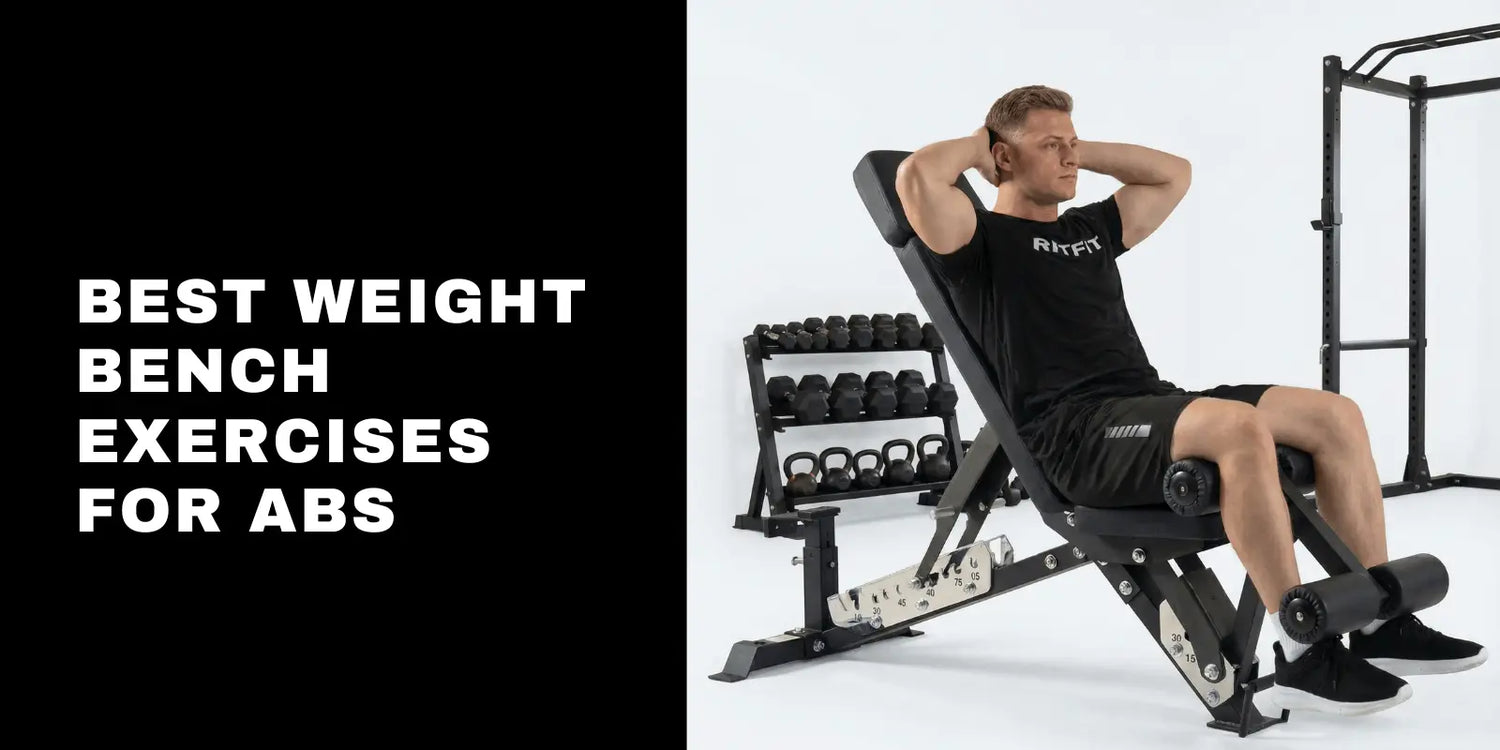
Using the leg rollers on the bench to secure your feet, perform a traditional sit-up but with a twist: go slow. Spend three seconds on the way up and three seconds on the way down. Eliminating momentum ensures that your muscles not gravity are doing the work. Weight bench sit-ups performed with control are far superior to high-speed reps that rely on hip flexor dominance.
Bench Russian Twists
Sit on the bench with your knees bent and feet either on the floor (beginner) or lifted (advanced). Lean back until you feel your abs engage. Rotate your torso from side to side, focusing on moving from the ribs rather than just the arms. This targets the obliques and improves rotational power, which is essential for sports and daily tasks like reaching for items.
Elevated Forearm Plank
Place your forearms on the bench and step your feet back into a plank position. The elevation makes this slightly more accessible for beginners than a floor plank, but it allows for a greater focus on "tucking the tailbone" and engaging the deep core. This move teaches your core how to support your spine against gravity in a perfectly aligned position.
Side Plank with Bench Support
Targets the lateral chain. Research supports anti-lateral flexion exercises like the side plank to correct asymmetries and improve load transfer[3].
Bench Bird-Dog

Kneel on the bench (if you feel stable) or keep one foot on the floor. Keep your back flat like a table and stretch out both your opposite arm and leg at the same time. This move is excellent for the health of the posterior chain and for teaching the core to keep the torso stable while the limbs move.
Scaling the Workout for Your Needs
One of the best things about this abs workout with a weight bench is that you can make it as hard or easy as you want.
- For Beginners: Keep the bench at a higher incline. This reduces the load of gravity on your torso, making moves like sit-ups or planks more manageable. Focus entirely on the "360 breathing" technique to ensure you aren't straining your neck or lower back.
- For Advanced Athletes: Adding a decline angle makes the challenge harder. Doing weight bench sit-ups on a decline makes the resistance a lot harder. You can also add a strength-building element by holding a light weight or dumbbell while you do the Russian twists or leg lifts.
- For Postpartum Recovery: This routine is safe for people who are recovering from pregnancy or dealing with diastasis recti. The dead bug and the plank are two "anti-rotation" and "anti-extension" moves that you should do a lot of. If a move feels like it is causing "coning" or "doming" in the abdomen, stick to the breathing exercises and modified leg lifts until your deep core strength improves.
The "Natural Corset" Mentality
Imagine that your core is a natural corset. When you engage it correctly during ab exercises with a weight bench, you are tightening that corset to protect your internal organs and your spine. It's not just about how it looks; it's also about how long it lasts.
A strong deep core acts as a stabilizer for the rest of your body. When you go to pick up a grocery bag, lift a child, or perform a heavy squat in the gym, a well-trained transverse abdominis ensures that the force is distributed safely through your trunk rather than putting pressure on your lower back discs.
Conclusion: 10 Minutes to a Stronger You
Consistency will always beat intensity. You don't need to spend hours training your abs; you simply need to train them smartly. By utilizing the RitFit Gator Adjustable Weight Bench for just 10 minutes a day, two to three times a week, you can build a core that is not only visually defined but also functionally powerful.
Whether you are a busy parent, a professional with a tight schedule, or someone looking to alleviate chronic back pain, this routine offers a path to better health. Remember to breathe, focus on your form, and listen to your body. Your journey to a stronger, more stable core starts with just 10 minutes and a bench.
Would you like me to provide a specific progression plan for the decline sit-ups or help you customize this routine for a specific fitness goal?
References
- Selkow NM, Eck MR, Rivas S. TRANSVERSUS ABDOMINIS ACTIVATION AND TIMING IMPROVES FOLLOWING CORE STABILITY TRAINING: A RANDOMIZED TRIAL. Int J Sports Phys Ther. 2017;12(7):1048-1056. doi:10.26603/ijspt20171048
- Golob I, Opara Zupančič M, Kozinc Ž. Abdominal Hollowing vs. Abdominal Bracing: A Scoping Review of Clinical Trials on Effectiveness for Trunk Stability and Rehabilitation. J Funct Morphol Kinesiol. 2024;9(4):193. Published 2024 Oct 10. doi:10.3390/jfmk9040193
- Rogalski A, Moiroux-Sahraoui A, Stergiou M, Pieulhet M, Douryang M, Forelli F. Can Unilateral Strength Training Optimize Change of Direction Mechanics and Mitigate Anterior Cruciate Ligament Injury Risk in Female Soccer Players? A Preliminary Pre-Post Intervention Study. Sports (Basel). 2025;13(5):135. Published 2025 Apr 29. doi:10.3390/sports13050135





