








Yes, you can build a strong back at home with dumbbells. The best back exercises with dumbbells are rows, pullovers, shrugs, reverse flies, and hip hinge lifts, and this guide ranks the ten moves that train the most muscle with the least equipment.
You will also find dumbbell replacements for the barbell and cable exercises you cannot do at home, a muscle by muscle breakdown, loading guidance, and programming that fits an adjustable bench and dumbbells.
Quick Answer: The best back exercises with dumbbells are the single arm dumbbell row for back thickness, the chest supported dumbbell row for upper back control, the dumbbell pullover for lat width, the dumbbell shrug for the traps, and the dumbbell reverse fly for the rear delts. Train them two or three times per week with controlled reps and progressive overload.
Key Takeaways
- Best overall dumbbell back exercise: The single arm dumbbell row is the most practical choice for back thickness, lat training, and side to side strength balance.
- Best lower back friendly option: The chest supported dumbbell row reduces momentum and helps lifters focus on the upper back.
- Best dumbbell move for lats: The dumbbell pullover trains the lats through a long range of motion when you do not have a pull up bar or cable machine.
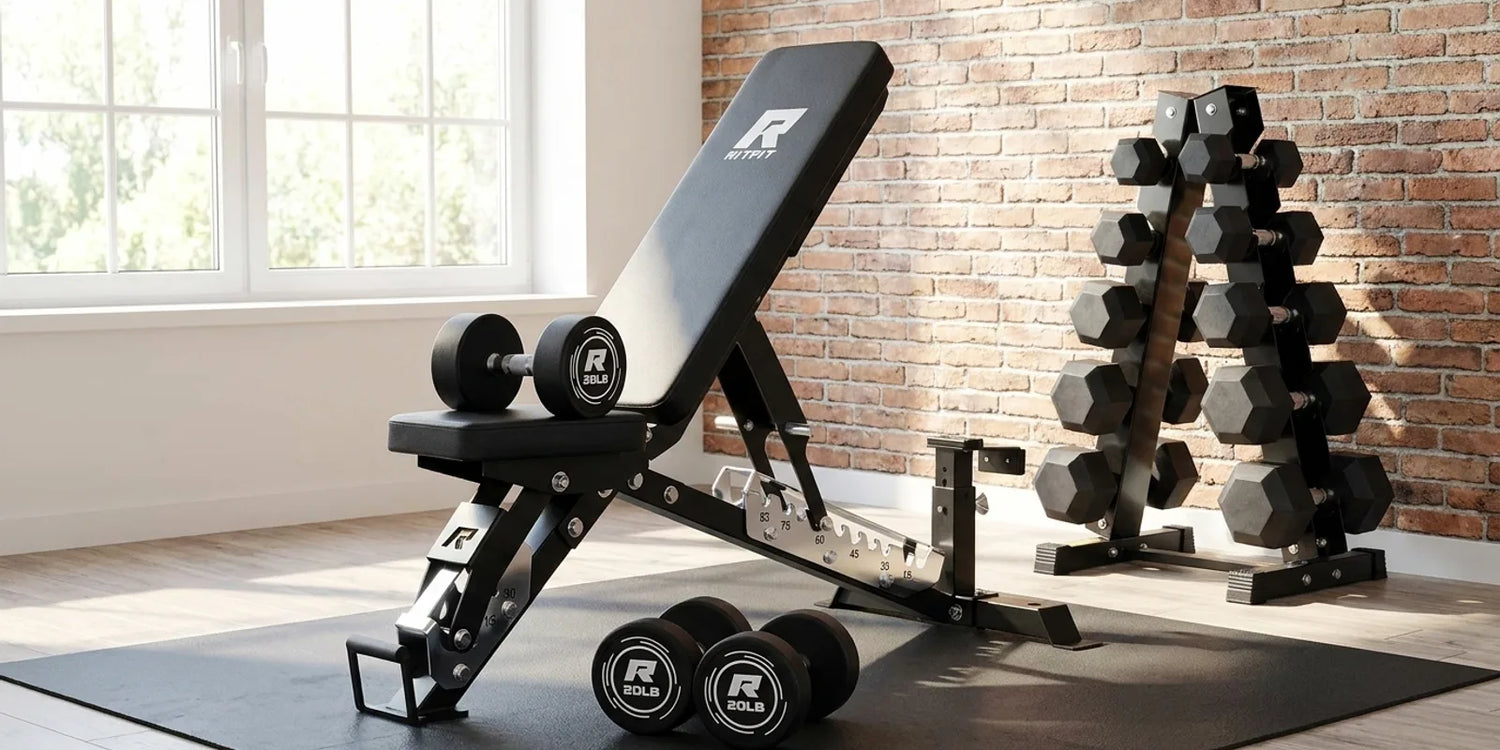
- Best home gym setup: A pair of RitFit dumbbells, an adjustable bench, and enough floor space can cover most back workouts.
- Best programming rule: Train your back 2 to 3 times per week with progressive overload, controlled reps, and enough recovery between hard sessions.
Why Train Your Back with Dumbbells?
Dumbbells are one of the most effective tools for building a stronger back at home because they allow unilateral pulling, a natural range of motion, and easy progression. They work especially well for rows, pullovers, shrugs, reverse flies, deadlifts, and core challenged pulling variations.
- Unilateral strength: Dumbbells let each side work independently, which helps correct strength imbalances that barbell and machine exercises can hide.
- Natural joint path: Dumbbells let your wrists, elbows, and shoulders move more freely than many fixed path machines.
- Better range of motion: Many dumbbell rows allow a deeper stretch and stronger squeeze than barbell rows.
- Weight range in one pair: Adjustable dumbbells cover light reverse fly work and heavy rows without turning a corner of your garage into a rack room.
- Progressive overload: Resistance training can improve strength and hypertrophy when load, volume, effort, and consistency are managed over time.[1]
Back Muscles Worked by Dumbbell Exercises
Dumbbell back exercises train the major pulling muscles of the upper and lower back, and each group needs a slightly different movement pattern. A complete program should include horizontal pulling, lat focused work, upper trap work, rear delt work, and hip hinge strength.
- Latissimus dorsi: The lats create much of the visual width of the back and help pull the upper arm down and back.
- Rhomboids: These muscles sit between the shoulder blades and help with scapular retraction during rows.
- Trapezius: The upper traps elevate the shoulders, while the middle and lower traps help control the shoulder blades.
- Erector spinae: These spinal muscles help hold a neutral torso position during dumbbell deadlifts and bent over rows.
- Rear deltoids: The rear delts support shoulder extension and help balance pressing heavy routines.
- Biceps and forearms: These assist most rowing exercises but should not dominate the movement.
| Muscle group | What it does for your back | Best dumbbell exercise in this guide |
|---|---|---|
| Lats | Creates back width and the v-taper line | Single arm dumbbell row and dumbbell pullover |
| Middle traps | Builds back thickness between the shoulder blades | Chest supported dumbbell row and batwing row |
| Rhomboids | Pulls the shoulder blades together and supports posture | Chest supported dumbbell row and dumbbell reverse fly |
| Upper traps | Builds the upper back and neck line | Dumbbell shrug |
| Rear delts | Balances pressing volume and supports shoulder extension | Dumbbell reverse fly |
| Erector spinae | Holds a neutral torso during hinging | Dumbbell deadlift and dumbbell bent over row |
Muscle roles follow standard anatomy descriptions for the pulling muscles of the back. Exercise pairings refer to the ten movements ranked below.
If you only keep one movement, the single arm dumbbell row is the best single back exercise for most lifters because it loads the lats, mid traps, and rhomboids in one pattern. The chest supported row is the better pick when your goal is upper back thickness with less lower back fatigue.
"RitFit Rubber Hex Dumbbell with Metal Handle For Free Weights Exercises|10-60 lbs Weights Range"
Romaine Hall, Verified Buyer, RitFit Rubber Hex Dumbbells Pairs and Sets
How to Choose the Right Dumbbell Back Exercise
Choose your dumbbell back exercises based on your goal, equipment, and lower back tolerance. Most lifters should combine one heavy row, one supported row, one lat focused move, and one rear delt or trap movement.
- For back thickness: Choose single arm dumbbell rows, chest supported rows, bent over rows, and batwing rows.
- For back width: Choose dumbbell pullovers, single arm rows pulled toward the hip, and any available pull up or lat pulldown variation.
- For lower back comfort: Choose chest supported rows, batwing rows, reverse flies, and controlled pullovers before heavy bent over rows.
- For core training: Choose renegade rows and deadstop rows, because they challenge rotation control while training the back.
- For home gym progression: Pair dumbbells with a stable bench such as the RitFit GATOR Adjustable Weight Bench to unlock chest supported rows, incline rows, and pullovers.
The 10 Best Back Exercises with Dumbbells
The best dumbbell back exercises cover rows, pullovers, shrugs, reverse flies, and hip hinge movements. Use these exercises to build a complete back workout with better muscle balance and home gym efficiency.
1. Single Arm Dumbbell Row
The single arm dumbbell row is one of the best dumbbell exercises for back thickness because it allows heavy loading with strong lat and mid back involvement.
- Primary muscles: Lats, rhomboids, middle traps, rear delts, biceps.
- Step 1: Place one hand and one knee on a bench, or place one hand on a rack for support.
- Step 2: Let the dumbbell hang under your shoulder while keeping your spine neutral.
- Step 3: Row the dumbbell toward your hip and drive your elbow back.
- Step 4: Pause briefly at the top, then lower the weight under control.
- Best rep range: 8 to 12 reps per side.
- Helpful next read: Review the full single arm dumbbell row guide for deeper form cues.
2. Chest Supported Dumbbell Row
The chest supported dumbbell row is the best row variation for lifters who want upper back focus without lower back fatigue.
- Primary muscles: Rhomboids, middle traps, rear delts, lats.
- Step 1: Set an adjustable bench to a low incline and lie face down with your chest supported.
- Step 2: Let the dumbbells hang straight down with your shoulders relaxed.
- Step 3: Row both dumbbells up and slightly back while squeezing the shoulder blades.
- Step 4: Lower slowly until you feel a full stretch across the upper back.
- Best rep range: 10 to 15 reps.
- Setup tip: A stable bench from the RitFit weight benches collection makes this move easier to set up at home.
3. Dumbbell Pullover
The dumbbell pullover is the best dumbbell option for training the lats through a long stretched position when cable pulldowns are not available.
- Primary muscles: Lats, serratus anterior, chest support muscles.
- Step 1: Lie on a bench with one dumbbell held above your chest using both hands.
- Step 2: Keep a slight bend in your elbows and lower the dumbbell behind your head.
- Step 3: Stop when you feel a strong lat stretch without shoulder discomfort.
- Step 4: Pull the dumbbell back over your chest by driving through the lats.
- Best rep range: 12 to 15 reps.
- Form tip: Keep your ribs down and avoid turning the move into a heavy chest press.
4. Dumbbell Bent Over Row
The dumbbell bent over row builds back thickness and hip hinge strength at the same time.
- Primary muscles: Lats, rhomboids, traps, erector spinae, biceps.
- Step 1: Stand with feet about hip width and hinge at the hips.
- Step 2: Keep your torso angled forward with your spine neutral and core braced.
- Step 3: Row both dumbbells toward your hips while keeping your neck relaxed.
- Step 4: Lower with control and reset your torso position before the next rep.
- Best rep range: 8 to 12 reps.
- Safety tip: Choose chest supported rows instead if your lower back limits the target muscles.
5. Renegade Row
The renegade row trains the back and core together by forcing your torso to resist rotation while one arm rows.
- Primary muscles: Lats, mid back, abs, obliques, shoulders.
- Step 1: Start in a push up position with your hands gripping stable dumbbells.
- Step 2: Set your feet wider than shoulder width to reduce unwanted hip rotation.
- Step 3: Row one dumbbell toward your hip while pressing the other dumbbell into the floor.
- Step 4: Lower under control and repeat on the other side.
- Best rep range: 6 to 10 reps per side.
- Equipment tip: Hex dumbbells are more stable than round dumbbells for floor based moves.
6. Dumbbell Shrug
The dumbbell shrug directly trains the upper traps, which helps build the upper back and neck line.
- Primary muscles: Upper traps, grip, forearms.
- Step 1: Stand tall with a dumbbell in each hand and your palms facing your body.
- Step 2: Shrug your shoulders straight up toward your ears without rolling them.
- Step 3: Pause at the top and squeeze your traps.
- Step 4: Lower slowly until your shoulders return to a relaxed position.
- Best rep range: 12 to 15 reps.
- Form tip: Keep the movement vertical and controlled instead of bouncing through the reps.
7. Dumbbell Reverse Fly
The dumbbell reverse fly targets the rear delts and upper back muscles that often lag behind pressing muscles.
- Primary muscles: Rear delts, rhomboids, middle traps.
- Step 1: Hinge at the hips and hold light dumbbells under your shoulders.
- Step 2: Raise the dumbbells out to the sides in a wide arc.
- Step 3: Stop when your arms are roughly in line with your torso.
- Step 4: Lower slowly and keep tension through the rear delts.
- Best rep range: 12 to 20 reps.
- Form tip: Use lighter weights than rows, because momentum quickly shifts tension away from the rear delts.
8. Dumbbell Deadlift
The dumbbell deadlift trains the posterior chain and helps develop the lower back, glutes, hamstrings, traps, and grip.
- Primary muscles: Erector spinae, glutes, hamstrings, traps, lats.
- Step 1: Stand with dumbbells at your sides or slightly in front of your thighs.
- Step 2: Push your hips back while keeping your spine neutral.
- Step 3: Lower until you feel a hamstring stretch without rounding your back.
- Step 4: Drive your hips forward and stand tall with control.
- Best rep range: 8 to 10 reps.
- Safety tip: Stop the set if your low back rounds or you lose your hip hinge position.
9. Batwing Row
The batwing row emphasizes upper back contraction by using a chest supported position and a hard pause at the top.
- Primary muscles: Rhomboids, middle traps, rear delts, lats.
- Step 1: Lie face down on a flat or low incline bench with dumbbells hanging under your shoulders.
- Step 2: Pull the dumbbells up until your shoulder blades squeeze together.
- Step 3: Hold the top position for 2 to 3 seconds.
- Step 4: Lower slowly and repeat without swinging.
- Best rep range: 8 to 12 reps.
- Training tip: Use this after heavier rows to improve upper back awareness and control.
10. Single Arm Deadstop Row
The single arm deadstop row builds strict pulling strength because each rep begins from a complete stop on the floor.
- Primary muscles: Lats, rhomboids, core, grip.
- Step 1: Set up in a supported row position with the dumbbell resting on the floor.
- Step 2: Brace your core and row the dumbbell from a dead stop toward your hip.
- Step 3: Lower the dumbbell back to the floor and briefly release tension.
- Step 4: Repeat each rep from the same controlled starting position.
- Best rep range: 5 to 8 reps per side.
- Strength tip: This variation works best when you prioritize force and control over high reps.
Dumbbell Alternatives to Barbell Rows, Cable Rows, and Lat Pulldowns
You can replace almost every barbell and cable back exercise with a dumbbell version that keeps the same pulling pattern. The movement stays the same while the stability demand goes up, so start lighter than you would on the machine or barbell version.
| Back exercise you cannot do | Dumbbell alternative | How to load it |
|---|---|---|
| Barbell bent over row | Dumbbell bent over row | Hinge at the hips and row both dumbbells toward your waist for 8 to 12 reps, using less weight than a barbell row because each side stabilizes on its own. |
| T bar row | Single arm dumbbell row | Row toward your hip with the elbow close to your ribs, then pause for a second before lowering. |
| Seated cable row | Chest supported dumbbell row | Set the bench to a low incline and row both dumbbells, which removes the fixed path of the cable. |
| Lat pulldown, including a wide grip lat pulldown | Dumbbell pullover | Use one dumbbell and lower it behind your head until you feel a lat stretch, then pull back over your chest. |
| Pull ups and chin ups | Dumbbell pullover plus a single arm row with a slow lower | Lower each row rep over three seconds to build the pulling strength that carries over to the bar. |
| Straight arm cable pulldown | Dumbbell pullover with long arms | Keep a slight elbow bend and drive the movement from the lats instead of bending the elbows further. |
| Single arm cable row | Single arm deadstop row | Let the dumbbell rest on the floor between reps so every pull starts from a strict position. |
| Face pull and band pull aparts | Dumbbell reverse fly | Use light dumbbells and stop when your arms reach torso level, then lower slowly. |
| Low row machine | Chest supported dumbbell row | Pick a weight you can hold at the top for two seconds without losing shoulder blade contact. |
| Barbell deadlift and Romanian deadlift | Dumbbell deadlift and dumbbell Romanian deadlift | Keep the dumbbells at your sides, hinge until you feel a hamstring stretch, and stand without rounding your back. |
This mapping pairs each common barbell, cable, or machine back exercise with the dumbbell movement that trains the same pattern at home.
- Match the pattern first: Pick the row or pullover that copies the path of the exercise you are replacing, then worry about load.
- Start lighter than the machine: Free weights ask more of your stabilizers, so the same rep range usually needs less weight at first.
- Add reps before weight: Work up to the top of the rep range with clean form, then move to the next dumbbell size.
- Use a slow lower: A controlled negative keeps tension on the back and makes lighter dumbbells productive.
Two popular machine alternatives are not back movements at all: hip abductor machines and lateral raises train the hips and the side delts, so no row replaces them. Vertical pulling also has no exact dumbbell match, which is why the pullover and the slow lower row appear together in the table above.
Can You Train Your Back When Your Shoulders Need a Break?
You can train your back with very little shoulder involvement when you keep your elbows close to your ribs, use a neutral grip, and support your chest on a bench. The pulling muscles still do the work while the shoulder joint stays in a comfortable position instead of reaching overhead.
- Elbow driven rows: The single arm dumbbell row and the chest supported dumbbell row keep the upper arm close to the torso, which limits how much the shoulders have to contribute.
- Neutral grip: A palms facing grip on rows often feels easier on the shoulders than a wide, palms down grip.
- Chest support first: Supported rows remove the need to hold a heavy hinged position, so the shoulder blades can move without your arms fighting the load.
- Rear delt work with light weight: The dumbbell reverse fly strengthens the muscles around the shoulder blades with a fraction of the load used in heavy rows.
- Pullovers with a shorter range: If reaching overhead is uncomfortable, stop the pullover before the position bothers you and keep your ribs down.
- Pressing goes last: A dumbbell shoulder press trains the shoulders rather than the back, so if you want a back and shoulder workout in one session, finish your rows and pullovers first.
- Stop when something hurts: Sharp pain, numbness, or joint discomfort that does not settle with lighter loads is a signal to stop and ask a qualified professional.
Back exercises that avoid the shoulders still train the lats, rhomboids, mid traps, and rear delts, because those muscles pull the upper arm down and back rather than up.
"Not only is the face pull an excellent movement to grow your upper back muscles, it can also improve poor posture. The rear shoulder muscles play a big role in preventing the bad posture so many people get from time spent sitting at desks jobs and hunched over their electronics."
Jeff Cavaliere, MSPT, CSCS, Physical Therapist and Strength Coach, former Head Physical Therapist for the NY Mets, Athlean-X, Upper Back Workout
Dumbbell Back Workouts by Goal and Level
The best dumbbell back workout depends on your training age, recovery, and equipment, and weekly volume is the main dial you can turn. Research suggests training volume can influence hypertrophy outcomes, so use enough weekly sets to progress without letting form break down.[2]
Beginner Dumbbell Back Workout
This workout is best for new lifters because it prioritizes support, control, and muscle awareness.
- Chest supported dumbbell row: 3 sets of 10 to 12 reps.
- Dumbbell pullover: 2 sets of 12 to 15 reps.
- Dumbbell reverse fly: 2 sets of 12 to 15 reps.
- Rest time: Rest 60 to 90 seconds between sets.
Intermediate Dumbbell Back Workout
This workout is best for lifters who can control their hinge position and need more volume for back growth.
- Single arm dumbbell row: 4 sets of 8 to 12 reps per side.
- Dumbbell bent over row: 3 sets of 8 to 12 reps.
- Dumbbell pullover: 3 sets of 12 to 15 reps.
- Dumbbell shrug: 3 sets of 12 to 15 reps.
- Rest time: Rest 90 to 120 seconds after heavy rows.
Advanced Dumbbell Back Workout
This workout is best for experienced lifters who want heavier pulling, strict reps, and more upper back density.
- Single arm deadstop row: 4 sets of 5 to 8 reps per side.
- Chest supported dumbbell row: 4 sets of 8 to 12 reps.
- Batwing row: 3 sets of 8 to 12 reps.
- Renegade row: 3 sets of 6 to 10 reps per side.
- Dumbbell pullover: 2 sets of 12 to 15 reps.
How to Program Dumbbell Back Workouts
Train your back 2 to 3 times per week if your recovery, sleep, and technique stay consistent. Use heavier rows for strength, moderate reps for hypertrophy, and lighter isolation work for rear delts and upper back control.
- Weekly frequency: Use 2 sessions per week for most home gym routines and 3 sessions if you split volume intelligently.
- Split structure: If you follow a 4 day or 6 day dumbbell split, keep two or three of those sessions as pulling days and let the others cover legs, chest, and shoulders.
- Back and biceps in one session: Rows already train the biceps, so a back and biceps workout works well when you finish the pulling work first and add two or three sets of curls at the end.
- Progressive overload: Add reps first, then add weight once you can complete the top of the rep range with clean form.
- Exercise order: Start with heavy rows or deadlifts, then use pullovers, shrugs, and reverse flies.
- Hinge variation: Swap the dumbbell deadlift for a dumbbell Romanian deadlift when you want hamstring and lower back work with a shorter range of motion.
- Tempo: Lower the weight under control and pause briefly where the target muscle is most engaged.
- Eccentric caution: Slow lowering can be useful, but unaccustomed eccentric work can increase soreness, so add it gradually.[3]
What Equipment Do You Need for Dumbbell Back Workouts at Home?
You can train your back with one pair of dumbbells, but a better setup gives you more exercise choices and safer progression. The most useful home gym additions are a dumbbell set with a wide weight range, an adjustable bench, and organized storage.
- Dumbbells: Choose a weight range that lets you row heavily and perform lighter reverse flies with control, and look at adjustable dumbbells if floor space is tight.
- Adjustable bench and dumbbells: An adjustable bench turns the same pair of dumbbells into chest supported rows, incline rows, batwing rows, and pullovers.
- Hex dumbbells: Choose RitFit Hex Rubber Dumbbells if you want stable floor contact for renegade rows and deadstop rows.
- PVC dumbbells: Choose RitFit PVC Coated Round Head Dumbbells if you prefer a smooth coated option for rows, pullovers, and lighter accessory work.
- Weight jumps: A range from about 10 lb (4.5 kg) up to 55 lb (25 kg) covers light reverse flies, moderate rows, and heavy single arm rows without needing a second set.
- Dumbbell storage: Use a dumbbell set with rack stand when you want multiple weight jumps without floor clutter, or a three tier dumbbell rack when you already own pairs and only need a place to keep them.
- Training upgrade: Add cable rows or pulldowns with a Smith machine setup when you want more vertical pulling options, especially after following this Smith machine back workout guide.
Two dumbbells, a bench, and a storage rack cover every exercise in this guide, and each addition after that widens the number of variations you can load.
Dumbbell Rows vs Pullovers vs Shrugs
Dumbbell rows, pullovers, and shrugs are not interchangeable because each one trains a different back function. Rows build thickness, pullovers train the lats through shoulder extension, and shrugs isolate the upper traps.
- Rows: Use rows as your main back builder because they load the lats, rhomboids, traps, rear delts, and arms.
- Pullovers: Use pullovers when you want a lat focused movement without cables or a pull up bar.
- Shrugs: Use shrugs when you want direct upper trap work that rows do not fully replace.
- Reverse flies: Use reverse flies to balance pressing volume and strengthen the rear delts.
Common Dumbbell Back Training Mistakes
Most dumbbell back training problems come from using too much load, too much momentum, or too little control. Fixing these mistakes usually improves muscle tension before you need more exercises.
- Using too much momentum: Swinging the weight turns rows into hip and lower back movements. Use a controlled lift, a brief squeeze, and a slow lower.
- Pulling with the hands: Thinking about your hands often shifts work into the biceps. Drive your elbows back and keep your hands as hooks.
- Ignoring supported rows: Bent over rows are useful, but chest supported rows often help lifters feel the target muscles better.
- Skipping lat focused work: Rows build thickness, but pullovers and vertical pulling variations support better width development.
- Training through pain: Stop if you feel sharp pain, nerve symptoms, or joint discomfort that does not improve with lighter loads.
- Poor recovery: Resistance training can be safe and beneficial for many adults, but programming should match health status, fitness level, and recovery capacity.[4]
Best Home Training Path for a Bigger Back
Start with dumbbells and a bench, then expand only when your training needs outgrow the setup. A simple progression is dumbbell rows first, chest supported rows second, pullovers third, and cable or Smith machine back work later.
- Step 1: Build the foundation with dumbbell rows, pullovers, reverse flies, and shrugs.
- Step 2: Add a quality bench for chest supported rows and better pullover setup.
- Step 3: Add more dumbbell weight jumps so your rows can progress without sacrificing form.
- Step 4: Add cable rows, lat pulldowns, or Smith machine rows if you want a more complete back station.
- Related guide: Use this best back workouts at home article to build a broader weekly training plan.
FAQs About Dumbbell Back Exercises
Can you build a strong back with dumbbells?
Yes. You can build a strong back with dumbbells when you use rows, pullovers, deadlifts, shrugs, and reverse flies consistently. Dumbbells allow heavy unilateral pulling, long range of motion, and progressive overload, which are the main training drivers for back strength and muscle growth.
What is the best dumbbell back exercise for beginners?
Chest supported dumbbell rows are usually the best starting point for beginners. They reduce lower back fatigue, limit body swing, and make it easier to feel the upper back working, while still training the lats, rhomboids, traps, rear delts, and biceps.
How heavy should dumbbells be for back exercises?
Choose dumbbells you can control for every rep while keeping your spine neutral and your shoulders stable. For rows, most lifters can use heavier weights, while pullovers, reverse flies, and renegade rows usually need lighter loads because form and joint control matter more.
Should I train back with dumbbells every day?
No. Most lifters should train back with dumbbells 2 to 3 times per week, with at least 48 hours between hard sessions. Your back muscles need recovery to grow, and frequent heavy rows can fatigue your grip, elbows, shoulders, and lower back.
How do I feel dumbbell rows in my back instead of my arms?
Drive your elbow toward your hip and think of your hand as a hook. Keep your torso stable, pause briefly at the top, and squeeze your shoulder blade back, because rushing the rep often shifts the work into the biceps and forearms.
Is a dumbbell pullover enough to replace pull ups?
No. A dumbbell pullover is a useful lat focused substitute when you do not have a pull up bar, but it does not fully replace vertical pulling. Add pull ups, lat pulldowns, or cable rows when possible for more complete back width and strength.
Which dumbbells are best for back workouts at home?
Hex dumbbells are the most practical choice for home back workouts because they stay stable on the floor. They work well for rows, renegade rows, deadstop rows, shrugs, and deadlifts, while a rack keeps the training area cleaner and safer.
How can I protect my lower back during dumbbell back exercises?
Use a neutral spine, brace your core, and choose chest supported rows when your lower back feels tired. Avoid twisting, bouncing, or chasing heavy weights before you can control the hinge position, because poor control increases stress on the spine and hips.
What can I use instead of a lat pulldown if I only have dumbbells?
Use the dumbbell pullover as your main substitute for a lat pulldown, then add a single arm dumbbell row with a slow lower for extra width. The pullover trains the lats through a long range of motion, and the row keeps a heavy pulling pattern in the session. No dumbbell movement fully replaces vertical pulling, so add pull ups or a lat pulldown later when you can.
Can I replace barbell rows with dumbbell rows?
Yes. Dumbbell bent over rows and single arm dumbbell rows train the same pulling muscles as a barbell row, and they let each side work on its own. Use a weight you can control for 8 to 12 reps, keep your spine neutral, and expect to start lighter than your barbell row because the dumbbells are harder to stabilize.
Conclusion
Dumbbells are enough to build a stronger, thicker, and more balanced back when your training includes rows, pullovers, shrugs, reverse flies, and progressive overload. Start with controlled rows, add supported variations when fatigue builds, and use a weight range that lets you train both heavy strength work and lighter isolation work with clean form.
If you are missing a barbell or cable machine, pick a dumbbell replacement from the mapping table, load it lighter, and progress one rep at a time.
Disclaimer
Disclaimer: This article is for general fitness education only and is not medical advice. If you have back pain, shoulder pain, a recent injury, a medical condition, or symptoms during exercise, consult a qualified health or fitness professional before starting or changing a strength training program.
References
1. Lopez P, Radaelli R, Taaffe DR, et al. Resistance Training Load Effects on Muscle Hypertrophy and Strength Gain: Systematic Review and Network Meta analysis. Med Sci Sports Exerc. 2021;53(6):1206 to 1216. doi:10.1249/MSS.0000000000002585.
2. Schoenfeld BJ, Contreras B, Krieger J, Grgic J, Delcastillo K, Belliard R, Alto A. Resistance Training Volume Enhances Muscle Hypertrophy but Not Strength in Trained Men. Med Sci Sports Exerc. 2019;51(1):94 to 103. doi:10.1249/MSS.0000000000001764.
3. Hody S, Croisier JL, Bury T, Rogister B, Leprince P. Eccentric Muscle Contractions: Risks and Benefits. Front Physiol. 2019;10:536. doi:10.3389/fphys.2019.00536.
4. Paluch AE, Boyer WR, Franklin BA, et al. Resistance Exercise Training in Individuals With and Without Cardiovascular Disease: 2023 Update: A Scientific Statement From the American Heart Association. Circulation. 2024;149(3):e217 to e231. doi:10.1161/CIR.0000000000001189.





