








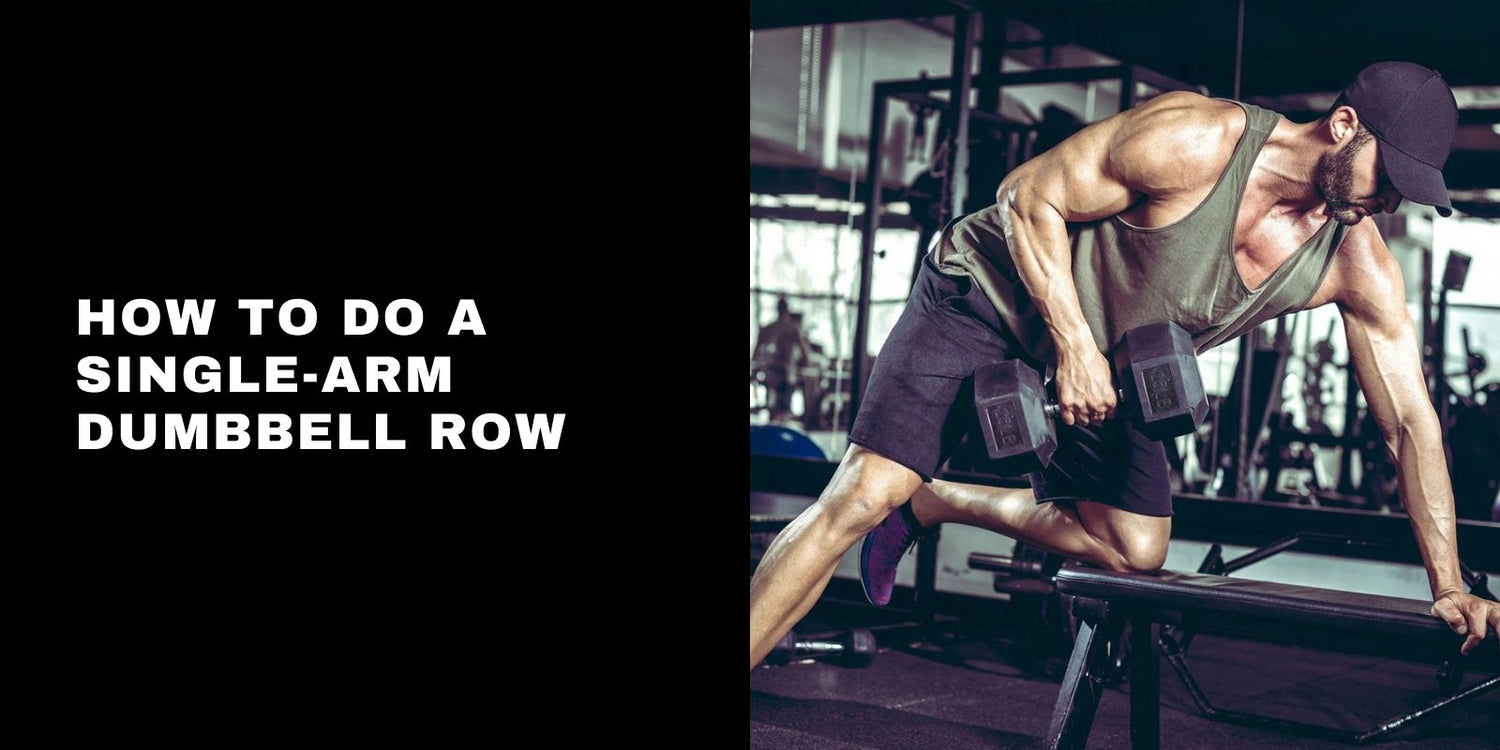
The single arm dumbbell row is one of the most effective upper body exercises you can do with one dumbbell, and it belongs in any home gym setup. It builds a stronger back, fixes the posture problems of desk work, and corrects side to side imbalances because each side works on its own.
This guide covers the setup, the pull, the cues, the common mistakes, and the programming that make the movement work, using the dumbbells you already own.
Quick Answer: The single arm dumbbell row is a back exercise performed with one hand braced on a bench, and it builds the lats, rhomboids, and rear delts while training the core to resist rotation. Row the dumbbell toward the hip pocket, lead with the elbow, and use 3 sets of 8 to 12 reps.
Key Takeaways
- Best Use: The single arm dumbbell row is one of the best dumbbell moves for building lats, mid back thickness, and side to side strength balance with minimal equipment.
- Setup: Your setup determines your results, so build a stable tripod, keep a flat neutral spine, and brace your core before you pull.
- Pulling Path: Row to your hip pocket for more lat emphasis, and row higher for more rear delt and upper back emphasis.
- Technique: Lead with the elbow, keep your hand as a hook, and pause for a brief squeeze at the top to improve control and muscle connection.
- Stop Signs: If you feel sharp pain, numbness, tingling, or worsening symptoms, stop and switch to a safer variation or get professional guidance.
Why This Move Is a Game Changer
The single arm dumbbell row counters the forward slump of modern life by strengthening the muscles that pull the shoulders down and back. Clinical studies confirm that this Upper Crossed Syndrome weakens the rhomboids and lower trapezius and leads to chronic shoulder pain, and rowing is the primary corrective intervention for this condition[1].
Pulling a weight toward the body trains the exact muscles responsible for posture, which makes the exercise a functional tool rather than only a vanity lift. Strong lats, the big muscles on the side of the back, and rhomboids, the muscles between the shoulder blades, act like a support system for the spine.
Research shows that unilateral loading forces the core to engage in Anti-Rotation, activating the obliques significantly more than bilateral barbell rows[2]. Done correctly, each rep stacks another block onto that tripod of strength.
Getting Your Gear Right
The gear that matters for the single arm dumbbell row is a pair of dumbbells that stay put and a handle your hand can hold once it sweats. A simple home setup works well, because the barrier to entry for this movement is low.
Why the Shape of Your Dumbbell Matters
Anyone shopping for home weights sees round, square, and the very popular hexagonal dumbbells. For a home gym, the hex shape is usually the smart pick.
Picture finishing a hard set of rows and setting the dumbbell down on the floor. A round dumbbell can roll into your foot, under a cabinet, or just out of reach.
Hex dumbbells such as the hexagon dumbbell sets from RitFit stay exactly where you put them. Six flat sides mean they do not roll, which adds a layer of safety to your workout space.
Grip and Materials
The material matters too, because old-school iron weights are loud and can scratch up wood floors or crack tiles. Rubber and PVC-coated dumbbells absorb impact, reduce noise so you do not wake the house, and protect the floor from dings.
Then there is the handle, and you want to look for something called knurling. That is the rough, cross-hatch texture etched into the metal handle.
Knurling may feel a little rough at first, but it is essential once your hands get sweaty. A smooth handle becomes a slippery bar of soap very quickly, while knurling acts like tire treads for your hands so you can focus on your back muscles instead of keeping the weight from flying out of your hand.
An ergonomic handle, slightly thicker in the middle, can also fit your palm better and make the lift more comfortable. Rubber-coated options such as RitFit hex rubber dumbbells pair that grip with heads that survive a drop.
A RitFit 3-tier dumbbell rack keeps the working pairs off the floor between sets. Adjustable dumbbells suit small spaces where a full set of fixed pairs is not practical.
The Setup: Building Your Base
The setup for the single arm dumbbell row is a three-point stance on a flat bench that keeps the spine flat and the hips level. A bad setup leads to a bad row, and a solid setup leads to a huge back.
The Tripod Position
Biomechanical analysis confirms that the supported Tripod Stance reduces lumbar shear force by up to 25%, making it the safest rowing variation for those with lower back sensitivity[3].
- The Knee: Place your knee on the bench. If you are rowing with your right hand, your left knee goes on the bench, directly under your hip rather than way back or way forward.
- The Hand: Place your left hand on the bench, where it acts as a pillar directly under your shoulder. Lock your elbow out so your arm is straight and strong, and push the bench away from you actively instead of sagging into the shoulder.
- The Foot: Your right foot, on the same side as the working arm, stays on the floor. Step it out wide comfortably, because it acts as an outrigger like on a canoe to keep you from tipping over.
Flattening the Back
This is the most critical part for safety, because your back needs to be flat like a coffee table. You should be able to rest a glass of water on your lower back without it spilling.
- Don't Round: Avoid hunching your upper back like a cat.
- Don't Sag: Avoid letting your belly droop toward the floor like an old horse.
- The Fix: Engage your core and tighten your stomach muscles slightly, as if someone is about to poke you in the belly button. Look at a spot on the floor about three feet in front of you to keep your neck straight, rather than looking up at the ceiling or tucking your chin to your chest.
The Movement: Step-by-Step
The single arm dumbbell row is performed in four phases, which are the reach, the pull, the squeeze, and the release. Each phase has one job, and the pull toward the hip pocket is the one that decides how much the lats contribute.

Now that you are solid as a rock, it is time to move the weight. A decagon or hex pair such as the ToughFit Decagon Shape Dumbbells sits flat on the floor between sets and never rolls out of position.
1. The Reach (The Stretch)
Grab the dumbbell with your right hand and let your arm hang straight down toward the floor. Take a second to let the weight pull your shoulder down slightly, until you feel a stretch along the side of your back right under the armpit.
2. The Pull (The Row)
Pull the dumbbell back toward your hip pocket. EMG studies show that pulling to the hip, which is shoulder extension, maximizes latissimus dorsi activation, while pulling high stimulates the rear delts[4].
- The Direction: This is where most people get it wrong. Do not pull the weight straight up to your shoulder, because that just uses the bicep and the upper traps. Instead, imagine you are pulling the dumbbell back toward your hip pocket, so the motion is backward and upward like a J-curve.
- The Elbow: Lead with your elbow, driving it up toward the ceiling and back toward the wall behind you.
- The Hand: Your hand is just a hook holding the weight, so do not squeeze the life out of the handle. Focus on moving the elbow and the hand will follow.
3. The Squeeze (The Top)
When the dumbbell reaches your hip area, stop instead of dropping it immediately. Squeeze your back muscles hard, as if you are trying to crush a grape between your shoulder blade and your spine.
That pause, even if it lasts only one second, is where you build control and muscle density.
4. The Release (The Lowering)
Slowly lower the weight back to the starting position and fight gravity rather than letting it crash down. Lowering the weight under control builds a lot of strength, so go all the way down until your arm is fully straight again.
Re-establish that stretch at the bottom before you start the next rep.
Mental Cues: How to Feel the Right Muscles
Mental cues fix the most common beginner complaint, which is feeling the single arm dumbbell row only in the arms. When the biceps burn and the back feels fresh, the pull is coming from the arms instead of the back.
| The Cue | What to Visualize | Why It Works |
|---|---|---|
| "Put it in your Pocket" | Pretend you are trying to shove the dumbbell into your back pocket. | This ensures you pull the weight low toward your hips, which engages the lats in the back rather than the traps in the shoulders. |
| "Elbow Someone Behind You" | Imagine there is someone standing right behind you and you want to elbow them in the stomach. | This shifts your focus from lifting up to driving back, which is exactly what the back muscles do. |
| "Squeeze an Orange" | Pretend there is an orange stuck in your armpit and you need to squeeze it to make juice. | This keeps your elbow tucked close to your ribs, because an elbow that flares out like a chicken wing loses power and safety. |
| "Hands as Hooks" | Imagine your fingers are just meat hooks, your arms are just ropes, and your back is the crane pulling the rope. | This helps you relax your biceps and forearms so the back has to do the work. |
| "Start the Lawnmower" | Picture pulling the starter cord on an old lawnmower. | This is a classic cue for the general motion, but use it carefully and do not jerk the cord, because smooth and steady wins the race. |
Cues are coaching language used to direct attention, not research findings.
Common Mistakes and How to Fix Them
Experienced lifters still make mistakes that cut back activation or overload the joints during the single arm dumbbell row. These four errors are the ones worth fixing first, and the full dumbbell row technique guide covers the same faults from a two arm angle.
The "Lawnmower Yank"
You know the guy who grabs the heaviest dumbbell on the rack and yanks it up by twisting his whole body, throwing his shoulder open and using momentum. It looks impressive, but it does very little for his back muscles.
- The Fix: Keep your chest pointing at the floor the entire time, as if you have headlights on your chest that must stay shining on the bench. If you have to twist your torso to get the weight up, the dumbbell is too heavy, so drop the weight and check your ego.
The "Chicken Wing"
This happens when you pull your elbow way out to the side, away from your body. It turns the exercise into a weird rear shoulder move and puts stress on the shoulder joint.
- The Fix: Remember the orange in the armpit and keep your arm brushing against your ribcage as you pull. It should feel tight and controlled.
The "Turtle Shrug"
Shoulders that creep up toward your ears mean you look like a turtle hiding in its shell at the top of the rep. That position uses the upper traps too much and leads to neck pain and tension headaches.
- The Fix: Pull your shoulders down and imagine tucking your shoulder blades into your back pockets. Keep a long neck throughout the movement.
The "Half Rep"
Many people stop halfway down because it is easier, so their arm never gets fully straight at the bottom. The stretch at the bottom is actually one of the most important parts of the exercise for muscle growth, and skipping it means skipping half the benefit.
- The Fix: Go all the way down on every rep and re-establish the stretch before pulling again.
Variations: No Bench? No Problem
A crowded gym or a living room with no bench is no barrier to the single arm dumbbell row. Three substitutions cover almost every situation, and one of them needs no furniture at all.
The "Rack Row" or "Table Row"
If you do not have a bench, find anything sturdy that is about hip height. That could be the dumbbell rack itself, a sturdy kitchen table, or the back of a sofa.
- The Setup: Stand in a split stance with one foot forward and one foot back, then place your non-working hand on the sturdy object. Keep your back flat and row just like normal, and note that this version is great for heavy weights because your legs are in a very athletic, stable position.
The "Knee-Propped Row"
You do not even need an object for this one.
- The Setup: Take a big step forward into a lunge position, lean forward, and rest your forearm on your own front thigh. Row with the other arm.
- The Catch: This requires more core strength because you do not have a solid bench holding you up. You have to work harder to keep your back flat, but it is a fantastic variation for minimal equipment workouts.
The "Deadstop Row"
This is a brutal variation for building pure strength.
- The Movement: Instead of keeping the weight in the air, lower it all the way to the floor after every single rep. Let it come to a complete dead stop, then pull it explosively from the floor.
- Why do it? This kills all momentum, so you cannot bounce the weight and you have to generate pure power from zero. It is harder, but it builds incredible starting strength.
The "Kroc Row"
Named after powerlifter Matt Kroczaleski, this is an advanced move.
- The Movement: You use a very heavy weight and do high reps, like 20 or more. You are allowed to use a little bit of body momentum to help get the weight moving.
- Warning: Save this for when you are an advanced lifter, because a beginner will likely just hurt the lower back. Master the strict form first.
Safety First: Pain vs. Soreness
Muscle soreness a day or two after training is normal and signals that the back is adapting. Sharp pain, especially in the lower back, is a different signal and means something is wrong.
If your lower back hurts during or after rows, work through the four checks below.
- Check your bracing: Are your abs tight? If your belly is loose, your spine is unsupported, so brace your core like you are preparing for a gut punch.
- Check your hips: Are your hips twisted? Try to keep your hip bones level with the floor.
- Check your support: Push hard into the bench with your stabilizing hand, because that creates tension that travels across your back and helps protect your spine.
- Stand up more: If being fully bent over is too much for your back, find a higher surface like a tall counter to lean on. Being more upright reduces the strain on your lower lumbar spine.
Programming: How to Fit This Into Your Routine
The single arm dumbbell row fits best as a second or third pulling exercise on a pull day, or in the middle of a full body session. Most people grow well on 3 sets of 8 to 12 reps.
The push-pull split: Many fitness plans divide days into pushing muscles, which are the chest, shoulders, and triceps, and pulling muscles, which are the back and biceps. Put rows on your pull day and do the biggest movements first, such as pull-ups or heavy barbell rows, before moving to single arm dumbbell rows as your second or third exercise.
Full body workouts: If you train your whole body in one session, place rows in the middle of the workout. Do heavy leg exercises such as squats or lunges first, when you have the most energy, then hit your back with rows.
Sets and reps: For most people, the sweet spot for muscle growth is 3 sets of 8 to 12 reps, which is a range that a dumbbells and rack package can cover from the start.
- Start with a weight you can lift cleanly for 8 reps.
- Over a few weeks, try to work up to 12 reps with that same weight.
- Once you can do 12 reps with perfect form, grab the next heaviest dumbbell, maybe 5 lbs heavier, and go back to 8 reps. This is called progressive overload, and it is the secret to getting stronger forever.
"The two largest reasons why people don't get results with their fitness training protocol is number one, adherence, and then number two, some sort of progressive overload."
Andy Galpin, PhD, Professor of Exercise Science and Human Performance, Parker University, Dr. Andy Galpin: Optimize Your Training Program for Fitness and Longevity
What is "The Pump"?
The pump is the tight, swollen feeling that comes when blood rushes into the muscle being worked. In a back workout it can be hard to judge, because the back muscles are harder to see and feel than the biceps.
If the back feels wide or tight after a set, or you are aware of your lats when you walk, you have achieved a great pump. If only the biceps throb, go back to the cues about hooks, elbows, and pockets, and lighten the weight until the blood flow lands in the right place.
FAQs About Single Arm Dumbbell Rows
What are the main benefits of one arm dumbbell rows?
One arm dumbbell rows build back strength, add thickness through the mid back, and fix side to side strength imbalances because each side works alone. They also train the core to resist rotation, need very little equipment, and fit a garage gym as easily as a commercial gym. For most lifters the biggest practical benefit is that one dumbbell and a bench cover an entire pulling session.
Which muscles does a single arm dumbbell row work?
The single arm dumbbell row works the latissimus dorsi, the rhomboids, the middle and lower trapezius, the rear deltoids, and the biceps. The obliques and deep core muscles work hard to stop the torso from twisting under load. Row to the hip pocket to bias the lats, or row higher toward the lower ribs to shift more of the work to the rear delts and upper back.
Does the single arm dumbbell row build muscle?
Yes, the single arm dumbbell row builds muscle when the sets are hard and the load climbs over time. The movement loads the lats and mid back through a long range of motion, which is the main driver of hypertrophy. Three sets of 8 to 12 reps taken close to failure, with a controlled lowering phase, is enough for most people to add back size, provided protein and total calories support the training.
Can you do a single arm dumbbell row without a bench?
Yes, a single arm dumbbell row works without a bench. Use any sturdy object at hip height, such as a dumbbell rack, a kitchen counter, or the back of a sofa, and stand in a split stance with the free hand braced on it. You can also rest your forearm on your own front thigh in a lunge position, though that version asks more of the core because nothing else supports the torso.
How heavy should the dumbbell be for a single arm row?
Start with a dumbbell you can row for 8 clean reps with a flat back and no torso twist. When 12 reps feel controlled, move up to the next pair, which is often a 5 pound jump, and drop back to 8 reps. If the hips rotate or the shoulder opens to finish a rep, the weight is too heavy.
Is a single arm dumbbell row better than a barbell row?
A single arm dumbbell row is the better choice when the goal is fixing side to side differences, sparing the lower back, or training with minimal equipment. A barbell row allows more total load and saves time because both arms work at once. Many programs use both, with the barbell row early in the session for heavy work and the single arm row later for balanced volume.
How is a single arm dumbbell row different from a seated cable row?
A seated cable row holds the torso upright and keeps constant tension on the back through the whole rep. A single arm dumbbell row loads one side at a time, which adds a stability and anti rotation demand that the cable row does not have. Choose the cable row when you want a supported pump at the end of a session, and the dumbbell row when one side is clearly weaker.
Are single arm rows better than two arm rows?
Single arm rows and two arm rows both build the back, and the difference is mostly about balance and load. Two arm rows let you move more total weight in less time, while single arm rows expose and correct a weaker side because each arm has to finish the rep alone. If one side lags, train single arm rows first and let the weaker side set the reps.
Can you build an arm row workout around single arm dumbbell rows?
Yes, a simple arm row workout can pair single arm dumbbell rows with a vertical pull, a curl, and a triceps movement. Do the dumbbell rows first while you are fresh, then add two or three arm exercises of 2 to 3 sets each. Keep the total session near 45 minutes and add reps or weight each week.
Conclusion
The single arm dumbbell row is a classic for a reason, because it is effective, it is safe when done right, and it requires very little equipment. It fixes the posture problems caused by modern seated lifestyles and builds a back that is both strong and good looking.
Start light, set up a solid tripod, pull to your hip pocket, and keep the elbow tucked while you prioritize feeling the muscle over lifting the heaviest weight. Check the RitFit discount guide before you build out your setup, then go grab that dumbbell and get to work.
Disclaimer
This article is for general educational purposes only and is not medical advice. If you have shoulder, neck, back, elbow, or wrist pain, a recent injury or surgery, numbness or tingling, unexplained weakness, or dizziness, consult a qualified clinician before starting, and stop any exercise that causes sharp pain.
References
1. Arumugam S, Ayyadurai P, Perumal S, Janani G, Dhillon S, Thiagarajan KA. Rowing Injuries in Elite Athletes: A Review of Incidence with Risk Factors and the Role of Biomechanics in Its Management. Indian J Orthop. 2020;54(3):246-255. Published 2020 Jan 31. doi:10.1007/s43465-020-00044-3
2. Saeterbakken A, Andersen V, Brudeseth A, Lund H, Fimland MS. The Effect of Performing Bi- and Unilateral Row Exercises on Core Muscle Activation. Int J Sports Med. 2015;36(11):900-905. doi:10.1055/s-0034-1398646
3. Fenwick CM, Brown SH, McGill SM. Comparison of different rowing exercises: trunk muscle activation and lumbar spine motion, load, and stiffness. J Strength Cond Res. 2009;23(2):350-358. doi:10.1519/JSC.0b013e3181942019
4. Muñoz-Garcés M, Peñailillo L, Mendez-Rebolledo G. Regional Activation of the Latissimus Dorsi Muscle by High-Density Surface Electromyography During Isometric Shoulder and Trunk Exercises. Sports Health. Published online December 4, 2025. doi:10.1177/19417381251393643





