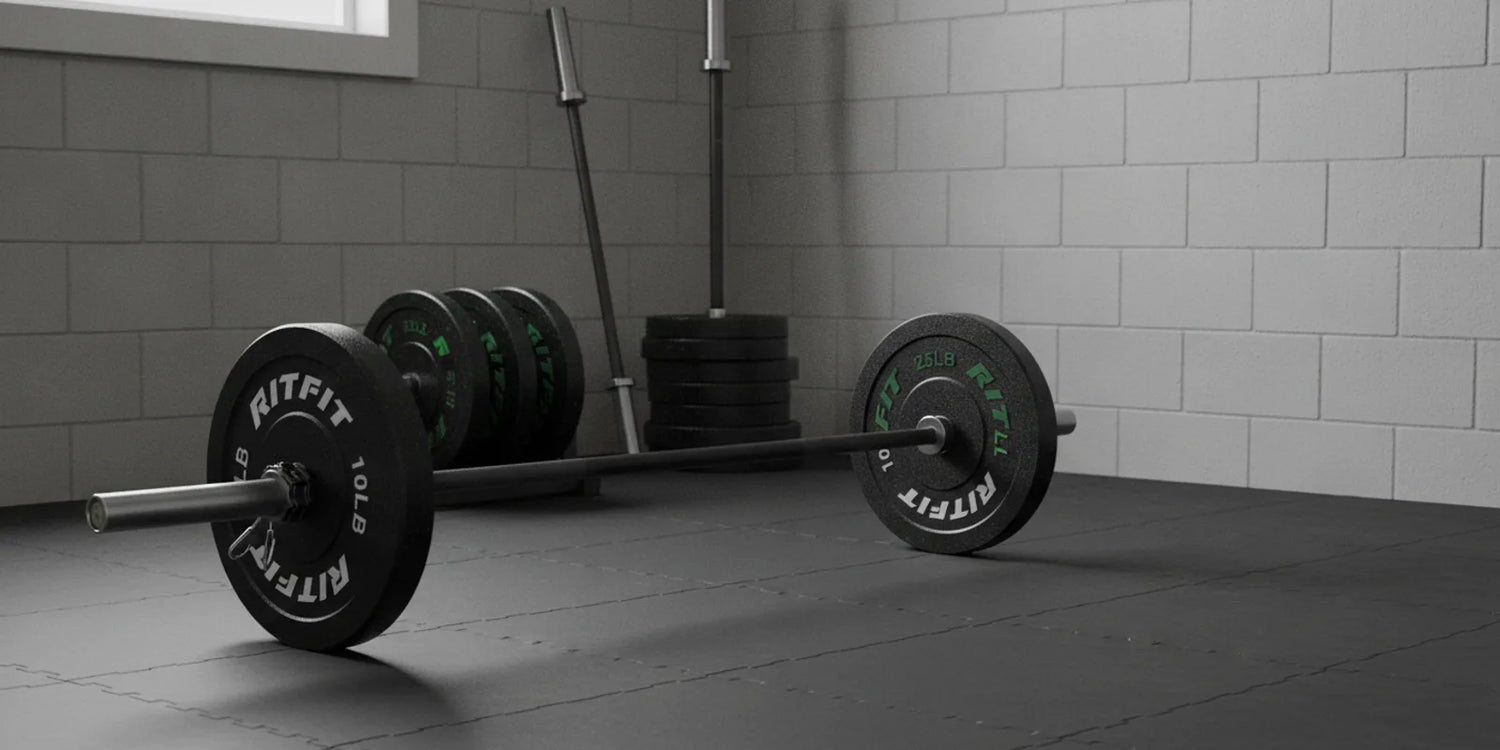
Finding the best budget bumper plates means knowing the difference between genuinely good value and plates that will crack, bounce erratically, or have inaccurate weight markings. Reddit communities like r/homegym and r/GarageGym have spent years stress-testing options at every price point, and the consensus is clear: a few key specs separate a smart buy from a frustrating waste.
This guide is for first-time home gym buyers with a $150 to $300 budget. You will learn what specs to prioritize, which RitFit options deliver long-term value, and the most common mistakes beginners make.
Quick Answer: The best budget bumper plates for first-time buyers are sets made from virgin rubber with steel inserts, a weight tolerance of within 1 to 2 percent, and a 450mm standard diameter, priced around $1 to $1.30 per pound. RitFit Black, Color, and Fleck bumper plates all meet these criteria and are well-suited for beginners building a home gym under $300.
Key Takeaways
- Price benchmark: Reddit's r/homegym community targets around $1 per pound as the threshold for budget bumper plates, with quality sets typically falling between $1 and $1.30 per pound.
- Rubber type matters: Virgin rubber delivers tighter weight tolerance (within 1 to 2 percent), lower dead bounce, and greater durability than crumb or recycled rubber blends.
- Starter set minimum: A 160 lb set (pairs of 10, 25, and 45 lb plates) covers most beginner movements and represents the practical starting point for a home gym.
- Floor protection is required: Budget bumper plates need at least 3/4 inch rubber flooring to protect concrete or hardwood surfaces from drop damage.
- RitFit options for beginners: RitFit Black, Color, and Fleck bumper plate lines all use virgin rubber with steel inserts and meet IWF-standard 450mm diameter requirements.
What Are Budget Bumper Plates and Why Does Quality Matter?
Budget bumper plates are rubber-coated Olympic weight plates designed to absorb impact when dropped from overhead, protecting both the floor and the barbell, while costing significantly less than competition-grade alternatives. The difference between a good budget plate and a poor one comes down to three specifications: rubber type, weight tolerance, and insert quality.
What Specs Actually Matter for Beginners?
The specifications that determine real-world performance for beginners are rubber compound, weight accuracy, and steel insert construction.
- Rubber type: Virgin rubber provides higher density and consistent dead bounce, while crumb or recycled rubber tends to feel springier and degrades faster under repeated drops.
- Weight tolerance: A within 1 to 2 percent tolerance means a 45 lb plate weighs between 44.1 lb and 45.9 lb. Plates exceeding a 3 percent tolerance can create imbalanced loading during bilateral movements.
- Steel insert: Stainless steel inserts prevent collar wear and keep the center hole at the standard 50mm diameter, ensuring a secure fit on any Olympic barbell sleeve.
- Plate diameter: The standard IWF-compatible diameter of 450mm positions the barbell at a consistent height off the floor for every weight increment, which matters for deadlifts and cleans.
Virgin Rubber vs. Recycled Rubber: What Reddit Says
Virgin rubber bumper plates consistently outperform recycled rubber alternatives on durability and bounce control, according to equipment reviewers who have drop-tested both types over extended use periods.
- Dead bounce: Virgin rubber's higher density absorbs impact without sending the barbell skipping across the floor, which is important for safety in a garage or basement gym.
- Longevity: One gear review site explains that virgin rubber retains its structural integrity longer under repeated drops compared to crumb rubber, which can crack or delaminate at the collar interface over time.
- Smell: Both rubber types have an initial rubber odor. Virgin rubber plates typically off-gas more quickly after a few weeks of use in a ventilated space.
The r/homegym community often cites rubber type as the single most important factor to verify before purchasing a budget set, ahead of price per pound. Any set that does not specify virgin rubber content should be approached with caution for regular drop use.
How Much Weight Does a Beginner Actually Need?
A 160 lb starter set, typically pairs of 10, 25, and 45 lb plates, is the practical minimum for beginners who plan to squat, deadlift, and perform basic barbell movements. This configuration puts 135 lb on the bar (two 45s plus the standard 45 lb Olympic barbell), which covers most beginner-level working sets across the main compound lifts.
Beginner Weight Recommendations by Training Goal
The right starting weight depends on what movements you plan to prioritize in your training.
- Strength training beginners: A 160 lb set (pairs of 10, 25, 45 lb) covers most beginner programming for 3 to 6 months before requiring additional plates.
- CrossFit or Olympic lifting: A 200 lb set or a 160 lb set plus a second pair of 45s is recommended from the start, since clean-and-jerk and snatch progressions add weight in larger increments.
- General fitness and conditioning: A 160 lb set works well for circuit-style training, with pairs of 25s and 45s covering the widest range of load options.
- Scaling up: Buying a 200 lb set upfront is more cost-effective per pound than ordering individual pairs later, and avoids separate shipping charges.
Decision Matrix: Which RitFit Set Is Right for You?
All three RitFit bumper plate lines use virgin rubber with steel inserts and 450mm standard diameter. The choice comes down to budget, desired tolerance, and whether color-coding matters for your setup.
| Product | Approx. $/lb | Rubber Type | Weight Tolerance | Insert | Best For |
|---|---|---|---|---|---|
| RitFit Black Bumper Plates | ~$1.10/lb | Virgin rubber blend | within 2 percent | Steel insert | Beginners on tight budget |
| RitFit Color Bumper Plates | ~$1.20/lb | Virgin rubber | within 2 percent | Steel insert | Color-coded sets, scaling up |
| RitFit Fleck Bumper Plates | ~$1.30/lb | Virgin rubber | within 1 percent | Stainless steel insert | Durability-focused beginners |
Source: RitFit product specifications. Prices approximate, subject to change.
Are RitFit Budget Bumper Plates Worth It for Beginners?
RitFit bumper plates are worth it for beginner home gym builders because they combine virgin rubber construction, IWF-standard diameter, and steel inserts at price points that align with Reddit's $1 per pound benchmark. Each product line targets a slightly different buyer profile within the same budget tier.
RitFit Black Bumper Plates: The No-Frills Starter Pick
The RitFit Black Bumper Plates deliver the core requirements for a beginner set at the lowest entry price in the RitFit lineup.
- Construction: Virgin rubber blend with steel inserts and 50mm center bore for Olympic barbell compatibility.
- Weight tolerance: within 2 percent, acceptable for progressive overload tracking at beginner loads.
- Best application: General strength training, deadlifts, squats, and overhead press at home gym volumes.
- Limitation: All-black finish means no visual weight identification at a glance, which can slow plate changes during circuit training.
RitFit Color Bumper Plates: For Beginners Who Want to Scale
The RitFit Color Bumper Plates add IWF-standard color coding, making it easy to identify plate weights quickly during workouts and when mixing pairs as your set grows.
- Color coding: Each weight denomination is a distinct color, matching international weightlifting standards (red=25kg, blue=20kg, yellow=15kg, green=10kg).
- Scalability: Color-coded sets are easier to expand incrementally, since individual pairs can be added without visual confusion.
- Best application: Beginners who plan to add plates over time, CrossFit-style training, and setups where multiple users share equipment.
RitFit Fleck Bumper Plates: Premium Feel on a Budget
The RitFit Fleck Bumper Plates stand out with a tighter within 1 percent weight tolerance and stainless steel inserts, making them the most durable option in the RitFit budget lineup for buyers who drop weights frequently.
- Tighter tolerance: within 1 percent accuracy is important for Olympic lifting progressions where precise load increments matter.
- Stainless steel insert: More resistant to corrosion in humid environments like garages, extending the plate's service life.
- Visual design: The speckled fleck pattern provides easy visual identification and hides surface scuffs over time.
- Technical specs: See the full Fleck Bumper Plates technical specifications for dimensional tolerances and material certifications.
Is Budget Price Worth It Long-Term?
Budget bumper plates with virgin rubber construction and steel inserts represent good long-term value for home gym beginners because they handle the drop frequency typical of garage gym training without premature deterioration. The price-per-pound benchmark and warranty terms are the two most practical metrics for evaluating longevity before purchase.
Price-Per-Pound Benchmarks the Reddit Community Uses
The r/homegym community often cites $1 per pound as the standard benchmark for budget bumper plates, with sets priced above $1.50 per pound typically considered mid-range.
- Under $1/lb: Usually indicates recycled rubber, lower tolerances, or no warranty. Worth scrutinizing specifications carefully before buying.
- $1 to $1.30/lb: The target zone for quality budget plates. Virgin rubber construction with steel inserts is standard at this price range.
- $1.30 to $1.50/lb: Overlap between budget and mid-range. Plates at this price often offer tighter tolerances near 1 percent or stainless steel inserts.
- Above $1.50/lb: Mid-range and competition territory. Performance improvements are marginal for general beginner strength training.
Warranty, Durability, and Long-Term Cost
Warranty length is a direct signal of manufacturer confidence in a plate's durability, and it determines your protection if a plate cracks or separates at the insert within normal training use.
- Minimum acceptable warranty: One year for standard use. Plates with a 6-month warranty on lighter plates (10 lb and 15 lb denominations) are common even among quality brands, since thin plates flex more under load.
- Long-term cost: A quality set that lasts 5 to 10 years under regular home gym use costs significantly less per year than replacing cheap plates every 2 to 3 years due to cracking or delamination.
- Resale value: Virgin rubber bumper plates from known brands retain resale value on the secondary market, which matters if you upgrade equipment over time.
What Mistakes Do First-Time Buyers Most Often Make?
First-time bumper plate buyers most often make three predictable mistakes: buying too little weight upfront, skipping floor protection, and choosing crumb rubber to save a small amount of money. Each mistake tends to cost more to correct later than it would have cost to avoid initially.
Buying Too Few Plates Early
Starting with only a single pair of 45s forces a reorder within weeks for most beginners, as working weights increase rapidly during the first 8 to 12 weeks of consistent training.
- Minimum starting set: Pairs of 10, 25, and 45 lb plates (160 lb total) for general strength training.
- CrossFit and Olympic lifting: Add a second pair of 45s from the start to accommodate heavier clean and jerk progressions.
- Savings tip: Full sets almost always cost less per pound than buying individual pairs, and consolidate shipping into one order.
Ignoring Floor Protection Needs
Dropping bumper plates onto bare concrete or hardwood without protective flooring can crack the concrete surface over time and will permanently damage hardwood.
- Minimum floor protection: Rubber gym tiles at least 3/4 inch thick under the lifting area.
- Budget solution: 4x6 ft horse stall mats (3/4 inch thick) from farm supply stores are a widely cited cost-effective option in the r/GarageGym community.
- Coverage area: Two mats placed end-to-end cover a standard deadlift stance plus drop zone on both sides of the barbell.
Choosing Crumb Rubber to Save $10
Crumb rubber plates may cost slightly less per pound upfront, but the performance tradeoffs are significant enough to offset the savings for most beginners.
- Higher dead bounce: Crumb rubber plates bounce more unpredictably after a drop, which is a safety concern in tight spaces.
- Weight inconsistency: Crumb rubber blends have looser weight tolerances, which affects progressive overload precision.
- Shorter lifespan: Crumb rubber is more prone to cracking at the collar interface under repeated drops at higher loads.
How Do You Set Up a First Home Gym With Budget Bumper Plates?
Setting up a first home gym with budget bumper plates requires four components: a rubber-floored lifting surface, an Olympic barbell, a starter set of bumper plates, and a storage solution. Getting these in the right order avoids the most common setup mistakes and keeps total costs within a beginner's budget.
Flooring Requirements and Safe Drop Height
Rubber gym flooring is a non-negotiable first purchase before the first drop in a home gym. Without it, concrete and hardwood surfaces absorb impact in ways that cause damage over time and can create safety hazards if a plate bounces unpredictably.
- Minimum thickness: 3/4 inch rubber for drop training on concrete. For hardwood floors, a second layer of 1/2 inch foam underlayment beneath the rubber adds additional protection.
- Drop height: Budget bumper plates are designed for drops from hip and shoulder height during Olympic movements. Avoid dropping from overhead without at least 3/4 inch rubber protection under the barbell.
- Coverage: Extend floor protection at least 2 feet beyond each end of the barbell to account for plates rolling after a drop.
Pairing With the Right Olympic Barbell
Bumper plates are designed specifically for use with 2-inch (50mm) Olympic barbells, and pairing them with a standard 1-inch barbell will result in plates that do not fit the sleeves correctly. One 2024 study found that recreationally trained adults achieve equivalent force output and perceived effort during back squats with a standard Olympic barbell setup, confirming it is fully adequate for home gym strength development.[3]
For a reliable starting setup, browse the full bars and plates collection to find compatible barbell options.
- Barbell sleeve diameter: Must be 50mm (2 inches) to accept bumper plates. Verify this before purchasing a barbell if you do not already own one.
- Barbell weight: Standard Olympic barbells weigh 45 lb (20 kg). Factor this into your working weight calculations when building your starting set.
- Collar compatibility: Most bumper plate sets include a pair of spring collars. Locking collars are a useful upgrade for Olympic lifting movements where drops occur frequently.
For additional context on how bumper plates differ from iron plates in construction and application, see our guide on the difference between bumper plates and weight plates. To explore the full range of weight plates for your home gym, including non-bumper options for accessory work, the weight plates collection covers standard and Olympic formats.
One study found that using weight plates for resistance training produces consistent progressive overload responses in trained individuals across a range of intensities, supporting the value of investing in accurately weighted plates from the start.[2]
"For most people, any major brand budget bumpers in a basic set of 25s and 45s will serve you well. The key is avoiding no-name Amazon brands with inconsistent weight tolerances."
r/homegym Community, Targeted Talk thread, Reddit r/homegym
FAQs About Budget Bumper Plates for Beginners
What is a good price per pound for budget bumper plates?
The Reddit home gym community targets around $1 per pound as the benchmark for budget bumper plates. A 160 lb starter set at or under $160 represents solid value. Sets priced above $1.50 per pound are generally considered mid-range, while anything under $0.90 per pound often signals quality compromises in rubber or weight accuracy.
How many pounds of bumper plates does a beginner need to start?
Most beginners start effectively with a 160 lb set, pairs of 10, 25, and 45 lb plates. This covers deadlifts, squats, and cleans at beginner loads. If you plan Olympic lifting or CrossFit, add a second pair of 45s early. A 200 lb set gives more room to progress without reordering plates within your first year.
Is virgin rubber better than recycled rubber for bumper plates?
Virgin rubber bumper plates offer tighter weight tolerance (typically around 1 percent), lower dead bounce, and greater durability than recycled or crumb rubber. For beginners, they protect floors more reliably when dropped and maintain consistent weight accuracy for progressive overload. Recycled rubber works for low-drop-frequency training but tends to bounce more and feel less precise over time.
Can I use budget bumper plates on a hardwood or concrete floor?
Budget bumper plates can damage hardwood or bare concrete without proper protection. Rubber gym flooring tiles at least 3/4 inch thick are the minimum recommended layer for home gyms where plates will be dropped. Without floor protection, even quality bumper plates can crack concrete and damage hardwood over time. Stall mats are a widely recommended cost-effective solution.
What weight tolerance should I look for in budget bumper plates?
For budget bumper plates, a weight tolerance of 1 to 3 percent is acceptable for general strength training. Tighter tolerances near 1 percent matter most if you track progressive overload precisely. Competition-grade plates require +/-10g tolerance, unnecessary for home gym beginners. Plates exceeding a 3 percent tolerance can create imbalanced loading, which is worth avoiding when comparing options.
Are bumper plates worth it for a beginner home gym?
Yes, bumper plates are worthwhile for beginners even on a tight budget. They protect your floor and barbell and allow safe drop training for Olympic lifts and CrossFit. Unlike iron plates, bumpers do not damage rubber flooring when dropped from waist height. For beginners learning deadlifts or cleans, the floor protection and safety margin far outweigh the small price premium.
Conclusion
The best budget bumper plates for first-time home gym buyers are sets built from virgin rubber with steel inserts, a 450mm standard diameter, and a weight tolerance within 2 percent, priced between $1 and $1.30 per pound. RitFit Black, Color, and Fleck bumper plates all meet these criteria across different budget points and use cases.
Start with a 160 lb set, secure your floor with at least 3/4 inch rubber, and pair your plates with a standard 50mm Olympic barbell. Browse the full Bumper Plates collection to find the right RitFit option for your training goals and budget.
Disclaimer
This article is intended for informational and educational purposes only and does not constitute professional fitness, medical, or safety advice regarding any specific exercise equipment or training program. Consult a qualified fitness professional before beginning any new training routine, particularly if you have existing injuries, health conditions, or limited experience with free weights.
Save on your next RitFit order
Tap the button to copy your code, then paste it at checkout.
References
1. Chigira Y, Kurihara K, Saida K, Takeuchi N. Comparison of muscle activities during bench press at different angles in beginners. J Phys Ther Sci. 2025;37(1):48-51. doi:10.1589/jpts.37.48. PMCID: PMC11700571
2. Calatayud J, Colado JC, Martin F, Casana J, Jakobsen MD, Andersen LL. The Use of Elastic Bands in Velocity-Based Training Allows Greater Acute External Training Stimulus and Lower Perceived Effort Compared to Weight Plates. Int J Environ Res Public Health. 2022;19(24):16616. doi:10.3390/ijerph192416616. PMCID: PMC9779371
3. Staheli N, Cowley JC, Lawrence MM. Comparison of Olympic and Safety Squat Bar Barbells on Force, Velocity, and Rating of Perceived Exertion During Acute High-Intensity Back Squats in Recreationally Trained Men. Int J Exerc Sci. 2024;17(7):1120-1133. doi:10.70252/QTXB6775. PMCID: PMC11385282