








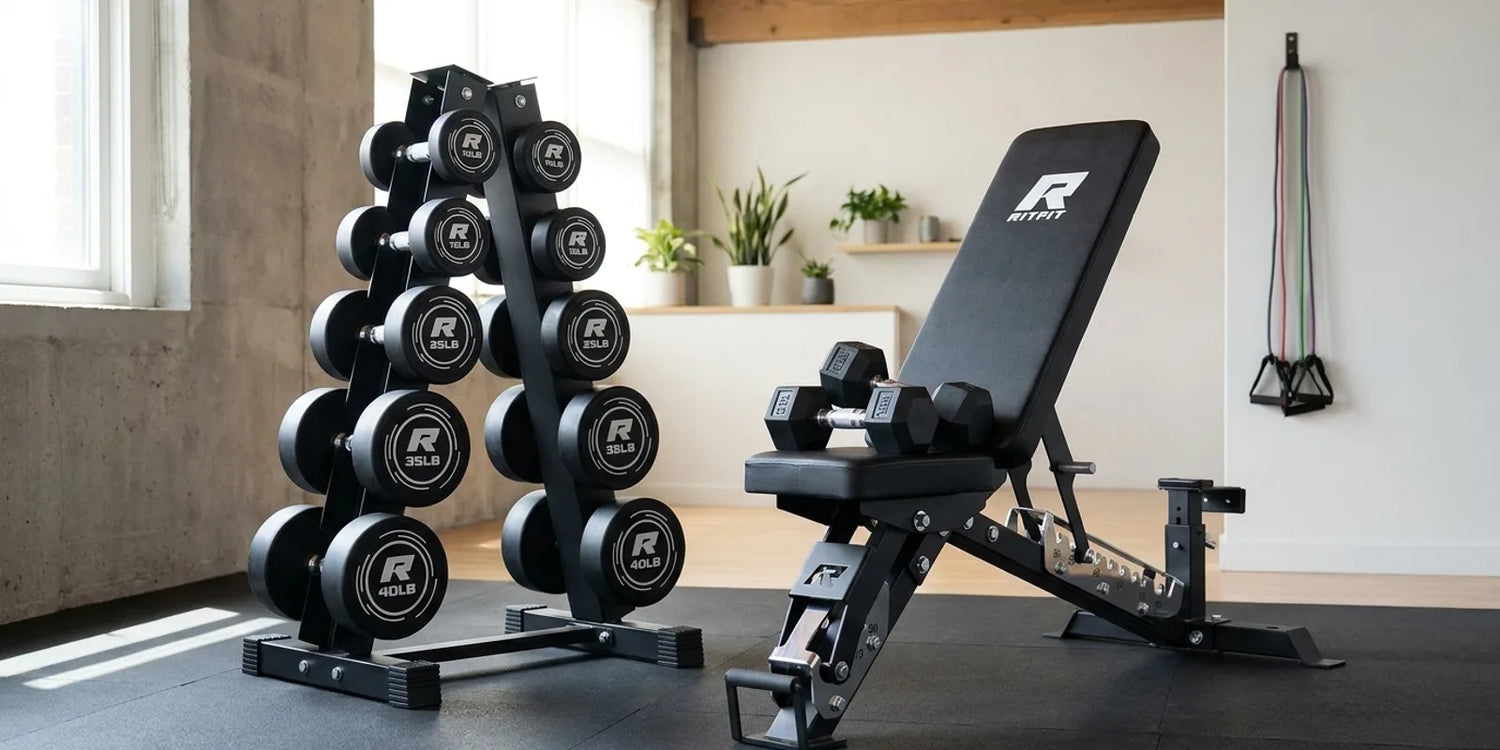
Building a home gym on a budget starts with one decision: choosing the right dumbbell set with rack. A well-chosen setup gives you the training variety of a full gym in as little as 10 to 15 square feet, at a fraction of gym membership costs.
This guide covers every price tier, rack style, and weight range so you can match the right setup to your space, budget, and training level and start training with confidence.
Quick Answer: The best budget dumbbell set with rack for most home gym users is a rubber hex dumbbell package paired with an A-frame or 3-tier rack, starting around $150 to $250 for a beginner-friendly setup. Rubber hex heads prevent rolling, protect your floor, and last for years, making them the most practical and durable choice for home training on a budget.
Key Takeaways
- Start Small, Scale Later: A beginner setup with 3 to 5 pairs of rubber hex dumbbells and a compact A-frame rack covers most exercises without overcommitting your budget.
- Rubber Hex Wins on Durability: Rubber hex heads prevent rolling, protect flooring, and hold up through years of daily use, making them the most practical fixed-weight option for home gyms.
- Rack Style Follows Space: A-frame racks fit apartments and tight spaces with 3 to 5 pairs, while 3-tier racks suit garage gyms or larger collections covering 5 to 50 lb ranges.
- Fixed Beats Adjustable for Multiple Users: Fixed rubber hex sets are faster to grab, more durable, and safer for households where more than one person trains.
- Train 2 to 3 Times Per Week: Research supports training frequency of 2 to 3 sessions weekly with progressive volume as the key driver of strength and muscle gains over time.
What Makes a Budget Dumbbell Set Actually Worth It
A budget dumbbell set earns its value when it is durable enough to last years, safe enough to train on daily, and organized enough to keep your space functional. An umbrella review of 44 systematic reviews found that resistance training consistently improves muscle mass, strength, and physical function across a wide range of adults.[1]
Material Quality
Rubber-coated dumbbells outlast bare iron in home environments because the rubber absorbs impact and prevents surface rust. Rubber hex heads prevent rolling, protect flooring, and reduce noise during use, which matters especially in apartments or shared spaces.
Handle Grip and Comfort
Knurled steel handles provide secure grip during sweaty training sessions without requiring gloves. Smooth chrome handles become slippery as loads increase, making knurling a practical priority for any set you plan to use regularly.
Rack Stability and Footprint
A stable rack prevents tip-overs and keeps your weights organized so you spend time training, not searching. Look for racks with rubber-tipped legs or non-slip feet that grip the floor on carpet or gym tile without wobbling under load.
Weight Range and Expandability
The right starting range covers your current strength level while leaving room to add pairs as you progress. Buying a rack with extra shelf capacity from day one is the most cost-efficient approach when growing your dumbbell collection.
Fixed vs. Adjustable Dumbbells: Which Saves More Money Long-Term
The fixed vs. adjustable question comes down to how many people train with you, how quickly you change weights during workouts, and how long you plan to keep the set.
| Type | Best For | Key Advantage | Key Limitation |
|---|---|---|---|
| Fixed Rubber Hex | Multiple users, circuit training | Grab-and-go speed, no moving parts | More floor space needed as collection grows |
| Adjustable Dumbbells | Solo user, tight space | Single footprint, wide weight range | Moving parts can wear, slower to change weight |
| PVC Coated Round Head | Quiet indoor spaces | Softer contact, reduced noise | Round shape can roll if dropped |
Fixed vs. Adjustable Dumbbell Comparison for Home Gym Buyers.
Fixed rubber hex dumbbells typically range from approximately $1.50 to $2.00 per pound. Check current product pages for accurate pricing before purchasing.
For most home gym users doing circuit workouts or training with a partner, fixed rubber hex dumbbells with a rack offer better long-term value than adjustable alternatives. Adjustable sets remain the right call for solo users with very limited floor space.
A-Frame vs. 3-Tier Rack: Which Storage Style Fits Your Space
Rack style is primarily a space decision. An A-frame rack holds 3 to 5 pairs in a compact vertical footprint, while a 3-tier rack fits larger sets with wider shelves and faster side-by-side access.
| Rack Style | Best For | Capacity | Typical Footprint |
|---|---|---|---|
| A-Frame | Apartments, starter sets | 3 to 5 pairs | 14 to 18 inches wide |
| 3-Tier | Garage gyms, full collections | 5 or more pairs | 48 to 60 inches wide |
A-Frame vs. 3-Tier Dumbbell Rack Comparison.
Footprint estimates are approximate. Confirm specific dimensions on each product page before purchasing.
For a true starter setup of 3 to 4 pairs, the RitFit A-Frame Dumbbell Rack Stand keeps your floor space clean without compromise. If you are starting with 5 to 8 pairs, a 3-tier rack eliminates the need to buy a second rack within the first year.
Budget Breakdown: What You Get at Every Price Point
Understanding what each price tier actually delivers helps you buy once and buy right. These ranges represent typical configurations, so always confirm on the current product page before purchasing.
Under $200: Starter Sets
At this budget, expect 3 to 5 pairs covering 5 to 25 lb paired with a compact A-frame rack. This tier suits beginners focused on upper body movements who need an organized starting point without committing to a full set.
$200 to $350: Mid-Range Complete Sets
This range typically delivers a rubber hex set covering 5 to 40 lb with a better rack and more pairs for lower body exercises like goblet squats and Romanian deadlifts. Most users at this tier can complete a full-body program without additional equipment right away.
$350 to $500: Full Progression Sets
At the upper end of the budget spectrum, a full rubber hex set covering 5 to 50 lb or more with a 3-tier rack gives intermediate lifters everything needed for progressive overload across both upper and lower body training. This complete long-term solution covers the 5 to 50 lb range most intermediate home gym users need without outgrowing the setup quickly.
RitFit Budget Dumbbell Sets With Rack: Our Picks
RitFit offers dumbbell set and rack combinations for different home gym budgets, spaces, and training levels. Each option below represents a specific use case so you can match the right setup to your situation.
Decision Matrix: Which RitFit Set Fits Your Situation
| Product | Best For | Weight Range | Rack Type |
|---|---|---|---|
| RitFit A-Frame Package | Beginners, small spaces, apartments | 60 to 300 lb range | A-frame rack |
| RitFit 550 lb Set with Rack | Intermediate lifters, garage gyms | 5 to 50 lb pairs | 3-tier rack |
| RitFit PWR05 3-Tier Set | Intermediate to advanced, larger collections | Rubber hex full range | 3-tier rack |
RitFit Dumbbell Set With Rack Decision Matrix.
Check current pricing and availability on individual product pages before purchasing.
RitFit A-Frame Dumbbell Rack Package (Starter)
The RitFit Rubber Hex Dumbbells Set with Rack is the most compact entry point for a home dumbbell station. It pairs rubber hex dumbbells with the space-efficient A-frame design, keeping your setup organized in under 2 feet of wall space.
RitFit Rubber Hex Dumbbell Set with Rack (550 lb)
The 550 lb package covers 5 to 50 lb in matching pairs and stores them on a 3-tier rack for fast, organized access during any workout. You can explore the full HSA/FSA Eligible Gym Racks collection if you plan to use healthcare savings funds toward your purchase.
RitFit PWR05 3-Tier Dumbbell Rack With Rubber Hex Set
The RitFit PWR05 3-Tier Dumbbell Rack with Rubber Hex Set is engineered for users building a larger home collection who want a durable, stable rack from day one. The 3-tier design provides faster weight access during circuit training and holds a full progressive set without taking over your floor plan.
If you already own dumbbells and only need storage, the RitFit 3-Tier Dumbbell Weight Rack is available as a standalone unit. For quieter indoor training, a PVC coated round head set with rack offers softer contact noise with a similar storage design.
How to Choose the Right Starting Weight Range
Choosing the right starting weights prevents two common beginner mistakes: buying too light and outgrowing the set in weeks, or buying too heavy and training with compromised form. Research on dumbbell biomechanics for novice lifters found that dumbbells are particularly suitable for beginners because they produce lower knee joint stress and greater stability compared to other loading types during foundational lower body movements.[2]
- Beginners (upper body focus): Start with 3 to 5 pairs covering 5 to 25 lb. This range handles curls, lateral raises, presses, and rows while leaving room to add weight within the same set.
- Beginners (lower body focus): For goblet squats, Romanian deadlifts, and lunges, extend your range to 10 to 35 lb. Lower body movements require heavier loads than most beginners expect.
- Intermediate lifters: Choose a set covering 10 to 50 lb. This range supports full-body progressive overload across compound and isolation movements without needing a second set within the first year.
- Mixed households: When two or more people with different strength levels train together, a wider range of 5 to 50 lb ensures everyone has appropriate options without doubling equipment costs.
- Rule of thumb: The correct starting weight lets you complete 3 sets of 12 to 15 reps with the last 2 to 3 reps feeling genuinely challenging but technically sound.
Space Planning for Your Home Gym Dumbbell Station
A poorly planned dumbbell station leads to cramped movement, equipment damage, and safety hazards. Measure your available floor area before purchasing, then plan around these clearance guidelines.
Minimum Clearance Guidelines
- A-frame rack footprint: Plan for approximately 14 to 18 inches wide and 26 inches tall. Allow 4 to 6 feet of clear floor in front to pick up and set down dumbbells safely.
- 3-tier rack footprint: Expect 48 to 60 inches of wall width and approximately 24 to 36 inches of depth. Add 6 feet of open floor in front for full range-of-motion access.
- Exercise zone clearance: Allow at least 6 feet wide and 6 feet deep of open floor adjacent to the rack for dumbbell exercises. For lying movements like dumbbell presses, clear the full 6-foot length of obstacles.
- Ceiling height: Most dumbbell exercises require 7 to 8 feet of clear ceiling height. Overhead press and lateral raise need full clearance to avoid injury.
- Apartment tip: Corner placement with the A-frame rack against one wall and the exercise zone extending diagonally uses floor space most efficiently in rooms under 150 square feet.
Check the RitFit home gym guide for full room layout diagrams and equipment placement recommendations by room size.

4-Week Starter Dumbbell Workout Plan
A structured 4-week plan gives you a clear progression framework so you build strength without guessing. Research indicates that training 2 to 3 times per week with progressive volume supports strength and muscle gains over time.[1] A pilot study also found that 8 weeks of home-based resistance training twice weekly improved fitness and mental health scores in middle-aged adults.[3]
- Week 1: 2 sessions, full body. Perform 3 sets of 12 reps per exercise. Focus on learning form for goblet squat, dumbbell row, dumbbell press, Romanian deadlift, and dumbbell curl.
- Week 2: 2 sessions, full body. Increase to 3 sets of 14 reps or add 5 lb where form allows. Add a lunge variation if Week 1 felt manageable throughout.
- Week 3: 3 sessions. Add a third session focused on upper body push-pull supersets. Perform 3 sets of 12 reps at a weight heavier than Week 1 on your primary movements.
- Week 4: 3 sessions. Increase load on at least 2 exercises from Week 1. Attempt 4 sets on your primary compound movements to establish your baseline for weight range expansion.
After completing this plan, review the best free weight set for home gym guide to plan your next equipment upgrade.
Common Budget Buying Mistakes to Avoid
Budget buying mistakes cost more money over time than spending slightly more upfront on the right setup. These are the most common errors first-time home gym buyers make with dumbbell sets and racks.
- Buying bare iron dumbbells to save money: Bare iron oxidizes, damages floors, and feels harder to grip than rubber-coated alternatives. The small upfront savings result in floor repairs and early replacement costs.
- Choosing a rack with no room to grow: An A-frame rack for 3 pairs sounds sufficient until you realize you need 5 within the first 3 months. Buying a rack with at least one tier of unused capacity is almost always worth the small price difference.
- Buying only light weights: Many beginners start with a 5 to 15 lb set and outgrow it within weeks. Lower body movements like Romanian deadlifts and goblet squats require significantly heavier loads than arm exercises.
- Ignoring floor protection: Hard dumbbells on hardwood or tile cause expensive damage when dropped. Pair your purchase with rubber gym flooring tiles, or choose rubber hex dumbbells that reduce impact force on contact.
- Skipping weight checks on the product page: Dumbbell set pricing and configurations change frequently. Always confirm the specific pairs included and the rack capacity on the current product page before adding to cart.
"If your space is limited, a good set of adjustable dumbbells might be your better option. They will allow you to progress to heavier weight as you get stronger."
Jeff Cavaliere, MSPT, CSCS, Strength Coach & Physical Therapist, Athlean-X
For a complete comparison of dumbbell styles and rack configurations, the best hex dumbbell set with rack for home gyms guide covers all formats in depth.
FAQs About Budget Dumbbell Sets With Rack
What is the best budget dumbbell set with rack for a home gym?
The best budget dumbbell set with rack for most home gym users is a rubber hex dumbbell package paired with an A-frame or 3-tier rack.
Rubber hex heads prevent rolling, protect flooring, and last for years.
RitFit offers complete sets starting with A-frame packages for small spaces and 3-tier rack sets for larger collections.
How much should I spend on a starter dumbbell set with rack?
Most beginners can build a functional starter setup for between $150 and $250, covering three to five pairs of rubber hex or PVC dumbbells and a compact A-frame rack. Start with the weight range you will actually use, then expand as your strength and training demands increase over time.
Is a rubber hex dumbbell set better than adjustable dumbbells for home gyms?
Rubber hex dumbbells are the better long-term choice for most home gyms because they are more durable, faster to grab, and safer on flooring.
Adjustable dumbbells cost less upfront for a wide weight range but have moving parts that can wear over time.
For multiple users or frequent weight changes, a fixed rubber hex set with a rack is more practical.
What weight range should a beginner buy for a home gym dumbbell set?
Beginners typically benefit from starting with three to five pairs covering 5 to 25 pounds for upper body work.
Lower body movements like goblet squats and Romanian deadlifts require 10 to 35 pounds.
Choose a range that challenges you at your current strength level without buying weights you cannot yet lift with safe form.
How much space does a dumbbell rack take up in a home gym?
A compact A-frame rack typically occupies 14 to 18 inches wide and 26 inches tall, ideal for apartments.
A 3-tier rack for larger sets requires roughly 48 to 60 inches of width.
Always plan for at least 6 feet of open floor in front of the rack for safe weight access during exercises.
Can I expand a budget dumbbell set with rack over time?
Yes, most budget rubber hex dumbbell sets can be expanded by adding individual pairs as your strength increases.
RitFit offers both standalone racks and complete set packages, so you can start small and scale without replacing everything.
Buying a rack with extra shelf capacity from the start is the most cost-efficient long-term approach.
Conclusion
The best budget dumbbell set with rack for your home gym matches your current strength level, fits your available space, and gives you room to grow without replacing the entire setup within a year. Rubber hex dumbbells with an A-frame or 3-tier rack cover most training goals at every budget from $150 to $500.
Start by measuring your available floor space and confirming your target weight range, then review the best dumbbell sets for home gym guide to find the right configuration for your space and budget.
Disclaimer
This article is intended for general fitness education and product guidance only and does not constitute medical, physical therapy, or personalized training advice. Always consult a qualified healthcare provider or certified fitness professional before beginning a new exercise program, especially if you have an existing injury or health condition.
Save on your next RitFit order
Tap the button to copy your code, then paste it at checkout.
References
1. Currier BS, Mcleod JC, Banfield L, et al. The influence of resistance exercise training prescription variables on skeletal muscle mass, strength, and physical function in healthy adults: An umbrella review. J Cachexia Sarcopenia Muscle. 2023. PMCID: PMC10818109
2. Li Y, Peng Q, Gu Y, et al. Influence of Different Load Conditions on Lower Extremity Biomechanics during the Lunge Squat in Novice Men. Int J Environ Res Public Health. 2022;19(14):8831. PMCID: PMC9311947
3. Kikuchi N, Ohta T, Hashimoto Y, et al. Effect of Online Home-Based Resistance Exercise Training on Physical Fitness, Depression, Stress, and Well-Being in Middle-Aged Persons: A Pilot Study. Int J Environ Res Public Health. 2023;20(3):1769. PMCID: PMC9914297





