








Cable back workouts build width and thickness with one machine, because a cable keeps tension on the lats through the entire rep instead of letting it drop at the ends. This guide covers five cable back exercises, the pulley heights and attachments that make each one work, and the sets, reps, and loads behind real back growth.
Every movement runs on a home cable machine, a power cage with a cable system, or a Smith machine with dual pulleys. You will see how to swap exercises when a machine is busy and how to keep your lower back safe.
Quick Answer: The best cable back workouts pair a vertical pull for width, like the cable lat pulldown, with a horizontal pull for thickness, like the seated cable row. Add straight-arm pulldowns, single-arm rows, and cable back extensions, then train each twice a week for 3 to 4 sets of 10 to 15 reps close to failure.
Key Takeaways
- Constant tension wins: Cable back workouts hold resistance on the lats and mid back at every joint angle, which free weights cannot match at the top and bottom of a pull.
- Two patterns cover the back: Pair one vertical pull for width with one horizontal pull for thickness in every session, then add isolation only if you still have energy.
- Setup beats load: Pulley height and the attachment decide which part of the back works, so fix those before you add another plate to the stack.
- Volume that works: Three to four sets of 10 to 15 reps taken close to failure is enough per exercise for most home lifters training back twice a week.
- Progress by reps first: Add load only after you hit the top of the rep range with clean form for two sessions in a row.
How Do Cable Back Workouts Build Width and Thickness?
Cable back workouts build width and thickness by keeping tension on the back at every joint angle. Free weights go light at the top and bottom of a row or pulldown, while a cable holds the load from the first inch of the stretch to the last inch of the squeeze.
- Width comes from the stretched position: A high pulley pull loads the latissimus dorsi while the arm is overhead, which is the joint angle where the muscle sits at its longest.
- Thickness comes from horizontal pulling: Rows keep the middle trapezius, rhomboids, and rear delts under load through a long range of motion.
- Constant tension: Time under tension is easy to control on a cable, so a set of 12 stays productive rather than fading in the middle.
- Small load jumps: A weight stack moves in smaller steps than a barbell, which makes progressive overload simpler to manage week to week.
- Low skill floor: A beginner can groove a cable row in one session, then carry that same pulling pattern into wider grips and heavier loads later.
That combination is why back cable workouts suit both first year lifters and experienced lifters who have stalled on barbell rows. The sections below cover the cable exercises for back growth, the pulley settings behind each one, and the mistakes that turn a good cable pull for back width into a shoulder shrug.
Cables for back width and cables for back thickness are the same tool, so the real decision is the angle of the pull rather than the equipment. A back exercise using a cable machine also lets you switch between those angles without leaving the frame.
5 Best Cable Back Workouts for Width and Thickness
Five cable back workouts cover the entire back when you pair vertical pulling with horizontal pulling. Each movement below lists the pulley height, the attachment, and the rep range that makes it work.
| Training goal | Exercise | Pulley height | Attachment | Rep range |
|---|---|---|---|---|
| Width | Cable lat pulldown | High | Wide lat bar | 8-12 |
| Width | Straight-arm cable pulldown | High | Straight bar or rope | 10-15 |
| Thickness | Seated cable row | Mid | V-handle or wide bar | 8-12 |
| Width and symmetry | Single-arm cable row | Mid | Single handle | 10-15 |
| Lower back | Cable back extensions | Low | Rope | 12-15 |
Pulley heights assume a rack or functional trainer with an adjustable trolley. Rep ranges are starting points for a 10 to 15 rep working set taken close to failure.
Cable machine back exercises in this guide all use the same frame, so a back workout using cables only takes about 40 minutes at this volume. Back exercises on cables also keep the load on the mid back at the top of the rep, where a dumbbell goes light.
Cable Lat Pulldown for Lat Width
The cable lat pulldown is the width driver because the lat works hardest while the arm is overhead and the muscle is lengthened. Set the pulley high, take a grip slightly wider than your shoulders on a lat bar, and bring the bar to the top of your chest without leaning back.
- Pulley height: Highest setting, which keeps the line of pull close to vertical.
- Attachment: A wide lat bar, or a multi-grip bar if your shoulders prefer a neutral grip.
- Reps: 8 to 12 with a controlled two second return, because the lengthened position is where the width stimulus lives.
- Evidence note: One eight-week trial found that lat pulldown training on an unstable cable setup improved pull-up endurance 45.5 percent more than the same work on a stable setup, which points to the value of controlling the pull rather than simply adding load.[1]
"I like it but now need a plate option for this machine"
Ronnie k. Verified Buyer, RitFit P3 Power Cage 1200lbs with Smooth Cable System & Aluminum Pulleys
Seated Cable Row for Mid Back Thickness
The seated cable row builds mid back thickness because a horizontal line of pull loads the middle trapezius and rhomboids through a long range. Sit tall, set the pulley at chest height, and drive your elbows past your ribs without rocking the torso.
- Pulley height: Mid setting, roughly nipple height, so the handle travels level with your sternum.
- Attachment: A V-handle for a neutral grip, or a wide bar when you want more rear delt involvement.
- Reps: 8 to 12 with a brief squeeze at the end of each rep.
- Cue: Keep the torso within about 10 degrees of vertical, since rocking back turns a back workout with cables into a lower back exercise.
Straight-Arm Cable Pulldown for Lat Isolation
The straight-arm cable pulldown takes the biceps out of the rep so the lats have to finish the work alone. Stand a step back from a high pulley, keep a soft bend in the elbows, and sweep the bar toward your thighs.
- Pulley height: High, so the cable angle stays slightly above your shoulder line.
- Attachment: A straight bar for a fixed grip or a rope when you want the hands to rotate naturally.
- Reps: 10 to 15 with a one second pause at the bottom of the sweep.
- Cue: Keep the rib cage down and the hips still, because cable pulls for back isolation only work when the torso stops moving.
Single-Arm Cable Row for Width and Symmetry
The single-arm cable row finds side to side differences because each side works without help from the other. Set the pulley at chest height, brace your free hand on the frame, and pull the handle toward your hip.
- Pulley height: Mid, at chest height, with the trolley lined up on the working arm.
- Attachment: A single handle or a D-handle that lets the wrist stay neutral.
- Reps: 10 to 15 per arm, starting with the weaker side and matching that number on the stronger side.
- Cue: Allow a small amount of torso rotation, but do not let the low back twist to finish the rep.
Cable Back Extensions for the Spinal Erectors
Cable back extensions load the spinal erectors with a low pulley and a rope instead of a back extension bench. Face the machine, hinge at the hips with a neutral spine, and stand tall against the cable.
- Pulley height: Low, near ankle height, so the resistance pulls you into the hinge.
- Attachment: A rope held at the sides of the head or across the chest.
- Reps: 12 to 15 with a slow eccentric and no bounce at the bottom.
- Cue: Finish the rep when the torso reaches a straight line, and never arch past neutral.
Any one of these works as a standalone back workout cable session, and back workouts with cable machines let you change the angle between sets without walking to another machine. If you only have room for two, keep the lat pulldown and the seated row, because those movements carry both the width and the thickness work.
How Do You Set Up a Cable Machine for Back Training at Home?
Setting up a cable machine for back training comes down to pulley height, attachment, and a stable stance. Get those three right and the same machine covers every movement on the list above.
Pulley Height: High, Mid, and Low
Pulley height decides the line of pull, and the line of pull decides which part of the back does the most work.
- High pulley: Pulldowns and straight-arm work, where the cable runs down and slightly forward.
- Mid pulley: Seated rows and face pulls, set near nipple height so the handle travels level.
- Low pulley: Cable back extensions, where a back workout on a pulley set this low keeps the load behind your hips.
Attachments: Wide Bar, V-Handle, Rope, and Single Handle
The attachment changes the grip width and the hand path, which changes how much of the work lands on the lats rather than the arms.
- Wide bar: Best for high pulley pulldowns, where a wide grip puts the lats in a longer position.
- V-handle: Best for seated rows, because the neutral grip keeps the elbows close to the body.
- Rope: A rope turns any back workout with a cable rope into a longer range movement, since the ends let the hands travel past the torso.
- Single handle: Required for one arm rows and any movement where you want each side to work alone.
Most home setups only need two attachments to start, a wide bar and a single handle. The RitFit lat pulldown attachments bundle and the RitFit exercise handles for cable machine cover the full range of grips used above, and the cable machine handles category lists the bar options that fit the same carabiner.
A cable machine for back workout sessions at home does not need a heavy stack if the pulley runs smoothly, and a 2:1 pulley ratio halves the effective resistance of every plate you load. That is why a light stack with aluminum pulleys often feels better on rows and face pulls than a heavy stack with plastic wheels.
Two attachments and one frame are enough to work out a cable back routine at home. A back exercise with a cable does not need a second machine, and the best cable back exercises for a home gym are usually the ones you can set up in under a minute.
The best back cable exercises are the ones you keep loading for months, not the ones that look impressive in a demo clip.
Which Upper Back and Mid Back Cable Exercises Belong in Your Routine?
Upper back cable exercises and mid back cable exercises split by line of pull rather than by machine. Wide, outward paths bias the upper back, while tight, inward paths bias the mid back.
Upper Back Cable Exercises for Posture and Thickness
Face pulls and high rows build upper back thickness because the arms travel outward and back, which is the path the middle trapezius and rhomboids own. Add one of these at the end of every back session, not the beginning.
- Face pull: Rope at eye height, pull toward the forehead, 12 to 15 reps with a two second hold.
- High row: Mid pulley angled upward, elbows at roughly 45 degrees from the torso, 10 to 15 reps.
- Angle note: One study found that pulling with the arm near 120 degrees of shoulder flexion shifted work toward the rhomboids and away from the upper trapezius, so an overhead path is worth keeping in the rotation.[3]
- Rotation note: Upper back exercises with cables cover both a bent elbow row and a straight arm path, so alternate them across weeks instead of running only one.
- Grip width note: A study on scapular retraction found that pulling with the shoulder rotated outward and the elbow extended raised middle trapezius activation and lowered rhomboid activity compared with a bent elbow row, so rotate between both positions instead of picking one forever.[2]
"Not only is the face pull an excellent movement to grow your upper back muscles, it can also improve poor posture. The rear shoulder muscles play a big role in preventing the bad posture so many people get from time spent sitting at desks jobs and hunched over their electronics."
Jeff Cavaliere, MSPT, CSCS, Physical Therapist and Strength Coach, former Head Physical Therapist for the NY Mets, Athlean-X, Upper Back Workout (Athlean-X)
Mid Back Cable Exercises for Row Strength
Mid back cable exercises keep the elbows close to the ribs so the work lands on the lower trapezius and rhomboids rather than the rear delts. The seated row and the single-arm row cover this pattern, and a RitFit W-shaped aluminum alloy handle adds a semi-neutral grip that many lifters find easier on the wrists.
For a wider grip option on the same pulley, the RitFit 5pcs lat pulldown bar combo gives you several bar widths to rotate through. If you would rather train the lower back on a dedicated bench, the RitFit BE01 adjustable back extension machine covers the same muscles without a cable setup.
How Many Sets and Reps Should You Do for Cable Back Workouts?
Most lifters get results from 3 to 4 sets of 10 to 15 reps per cable back exercise. Stop each set one or two reps short of failure, because effort matters more than total volume.
Choosing Load and Rep Range
Pick a load you can move with control for the whole rep range while still finishing the last rep with one or two reps left in reserve. Meta-analytic evidence shows that training loads at or above 60 percent of one rep max drive greater strength gains than lighter loads, while hypertrophy gains stay similar across a wide load range when sets are taken close to failure.[4]
- Strength focus: Stay near the bottom of the rep range, 8 to 10 reps, with at least 60 percent of one rep max on the stack.
- Growth focus: Work in the 10 to 15 rep range and finish each set with one or two reps left in the tank.
- Isolation work: Keep straight-arm pulldowns and cable back extensions in the 12 to 15 rep range, where the goal is control rather than load.
- Rest: Take 90 to 120 seconds on rows and pulldowns, and 60 seconds on isolation movements.
Frequency, Progression, and When to Add Weight
Train each pulling pattern twice a week, which lets you accumulate volume without making any single session long enough to hurt your form.
- Weekly split: One vertical pull and one horizontal pull on each of two back days, plus one isolation movement on the second day.
- Rep progression: Add one rep per set each week until you reach the top of the range on every set.
- Load progression: Add the smallest available increment only after you hit the top of the rep range with clean form in two consecutive sessions.
- Deload signal: If the same weight feels heavier two weeks in a row and your grip gives out first, cut volume by a third for one week before pushing again.
Write the numbers down. A cable stack makes it easy to repeat the exact setting next week, and that repeatability is what turns progressive overload from a theory into a plan.
What Cable Back Workout Mistakes and Substitutions Should You Know?
Four mistakes account for most stalled cable back work, and each has a simple fix. Every one of them also comes with a substitution you can run when a machine is busy or a joint is complaining.
Common Mistakes to Avoid in Cable Back Training
Check these four first, because each one quietly moves work away from the back.
- Mistake, using momentum: Rocking the torso to move the stack shifts work to the lower back. Fix it by dropping one plate and pausing for one second at the end of every rep.
- Mistake, shrugging: Letting the shoulders rise toward the ears hands the rep to the upper trapezius. Fix it by starting each rep by pulling the shoulder blade down and back before the elbow bends.
- Mistake, too much load: A stack that pulls you forward out of position trains nothing well. Fix it by cutting the load by roughly a quarter and rebuilding the full range of motion.
- Mistake, never changing the angle: The same pulley height for months stops providing a new stimulus. Fix it by rotating pulley height every four to six weeks.
Substitutions When a Machine Is Busy
Substitutions matter just as much when a machine is busy or a joint is complaining.
- Band swap: A resistance band anchored at the same height copies the cable path closely enough to keep the pattern, though the tension curve changes.
- Dumbbell swap: A chest supported dumbbell row replaces the seated cable row when a pulley is occupied, and a dumbbell pullover covers the straight-arm pulldown.
- Machine swap: A machine row or back extension bench covers the mid back and lower back when you want a fixed path.
- Single side swap: If one shoulder feels off during a two arm row, move to a single-arm cable row and let the comfortable side set the pace.
Stop the set immediately on sharp pain, numbness, tingling, or a loss of control in the lower back.
Regress to a supported variation, such as a chest supported row, and rebuild from a load you can control.
Sharp pain is a signal to change the movement, not a signal to push through.
Which RitFit P3 Power Cage Is Best for Cable Back Workouts?
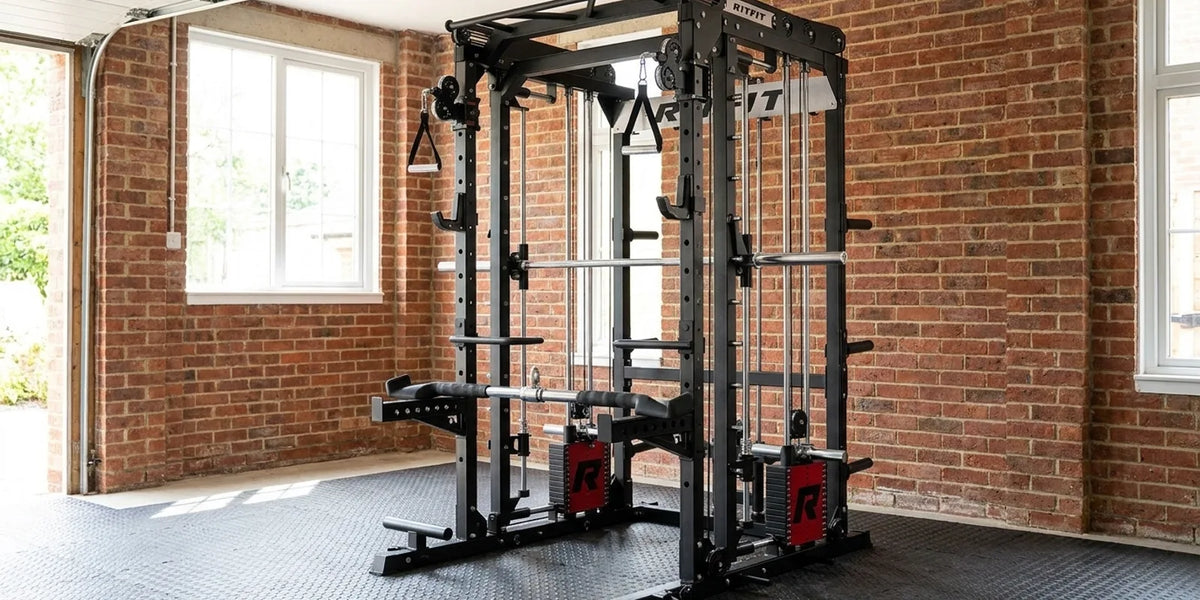
The RitFit P3 Power Cage is a strong fit for cable back workouts at home. It pairs a high and low pulley station with a rack that also supports heavy rowing and pulling from a stable frame, and the published spec sheet lists a 1200 lb static upright capacity on 2x2 in steel uprights.
- Durability: The product page lists 1200 lb of static upright capacity and a stainless steel rail for the cable system, which matters on rows where a flexing frame would change the line of pull.
- Versatility: A multi-grip pull-up bar and an adjustable dual pulley cover pulldowns, rows, face pulls, and cable back extensions from one footprint.
- Performance: The cage runs 21 aluminum pulleys on a 2:1 pulley ratio, and the aluminum wheels keep the cable quiet and smooth through a full rep.
- Footprint: The rack itself measures 67.2 in long, 59.1 in wide, and 81 in tall with a 17.53 sq ft footprint, which fits a two car garage without giving up the parking spaces.
- Warranty: RitFit covers the rack frame and welding for 3 years, bolts and pulleys for 1 year, and covers and upholstery for 90 days.
Choose this setup if you want one machine that can run a full back workout and still handle squats and bench presses. If you train in a taller space and want a wider cable spread for crossovers and high rows, the RitFit M3 power rack cable crossover Smith machine adds more pulley travel at a higher price.
Browse the full cable machine range if you only need a dedicated cable station.
Whichever frame you pick, the machine only matters if the programming holds up. Set the pulley height, pick your two attachments, and let the rep ranges above decide the load.
"It's stable and the pulley system is good"
Hue Chee T. Verified Buyer, RitFit P3 Power Cage 1200lbs with Smooth Cable System & Aluminum Pulleys
FAQs About Cable Back Workouts
Do cable back workouts build muscle as well as free weights
Yes. Muscle responds to tension and effort, not to the tool holding the resistance. A 2021 network meta-analysis found that hypertrophy gains are comparable across a wide load range when sets are taken close to failure, and cables let you reach that effort level with less balance demand. The trade-off is that cables remove some stabilization work, so keep at least one heavy free weight row or pull in the week.
How many cable exercises should one back workout include
Two to four cable exercises cover a full back session. Pick one vertical pull for width such as a cable lat pulldown, one horizontal pull for thickness such as a seated cable row, and one isolation movement such as a straight arm pulldown or a set of cable back extensions. More than four movements usually spreads your effort too thin to add load over time.
What is the best cable back exercise for upper back thickness
The seated cable row with a wide or neutral grip bar is the most direct upper back thickness builder, because the mid pulley line of pull lines up with the middle trapezius and rhomboids. Set the pulley at chest height, keep the torso still, and pull the handle to the bottom of the ribs instead of letting the elbows drift wide and the shoulders shrug.
Can a cable machine build a wider back at home
Yes. Width comes from training the latissimus dorsi in a stretched position, and a high pulley pulldown or a straight arm pulldown does that with far less ceiling clearance than a pull up bar. Any home cable machine with an adjustable high pulley position and a wide bar attachment can carry the width half of your back program on its own.
What is the difference between a cable back workout and a machine row
A cable back workout lets you change the line of pull, the grip width, and the stance between sets, while a fixed machine row locks you into one path and one angle. Cables also let you train one arm at a time, which is useful when one side lags. Machine rows are faster to set up and better when you want to push close to failure without thinking about balance.
How heavy should you go on cable back exercises
Pick a load you can move for 10 to 15 controlled reps with one to two reps left in the tank, which usually lands at or above 60 percent of your one rep max for strength work. If the stack pulls your torso forward or your shoulders rise toward your ears, the load is too heavy for that movement and you should drop one plate and rebuild the range of motion.
Are cable back extensions safe for the lower back
Cable back extensions are safe for most healthy lifters when the spine stays neutral and the movement stops before the lower back overextends. Set the pulley low, use a rope, hinge from the hips, and finish the rep when your torso reaches a straight line. Stop immediately on sharp pain, numbness, or tingling, and use a supported back extension machine instead if that happens.
Conclusion
Cable back workouts cover both halves of back development when you pair a vertical pull for width with a horizontal pull for thickness. A stable frame makes that pairing easier to load week after week.
Start with the lat pulldown and the seated row, then add one rep per set until you reach the top of the range. Read the RitFit discount guide before you buy, and explore the cable pulldown V taper workout plus the best back workouts at home to fill out the week.
Disclaimer
This article is general fitness information, not medical advice, and it does not diagnose or treat any condition. Consult a qualified physician or physical therapist before starting a new back training program, especially if you have a history of spine or shoulder injury.
References
1. Li Q, Yan J, Qiao M, et al. Eight-week lat pull-down resistance training with joint instability leads to superior pull-up endurance performance and reduced antagonist coactivation in recreationally active male college students. Eur J Sport Sci. 2025;25(1):e12243. doi:10.1002/ejsc.12243. PMCID: PMC11667758
2. Fennell J, Phadke CP, Mochizuki G, Ismail F, Boulias C. Shoulder Retractor Strengthening Exercise to Minimize Rhomboid Muscle Activity and Subacromial Impingement. Physiother Can. 2016;68(1):24-8. doi:10.3138/ptc.2014-83. PMCID: PMC4961314
3. Yoo WG. Effects of pulling direction on upper trapezius and rhomboid muscle activity. J Phys Ther Sci. 2017;29(6):1043-1044. doi:10.1589/jpts.29.1043. PMCID: PMC5468195
4. Lopez P, Radaelli R, Taaffe DR, et al. Resistance Training Load Effects on Muscle Hypertrophy and Strength Gain: Systematic Review and Network Meta-analysis. Med Sci Sports Exerc. 2021;53(6):1206-1216. doi:10.1249/MSS.0000000000002585. PMCID: PMC8126497





