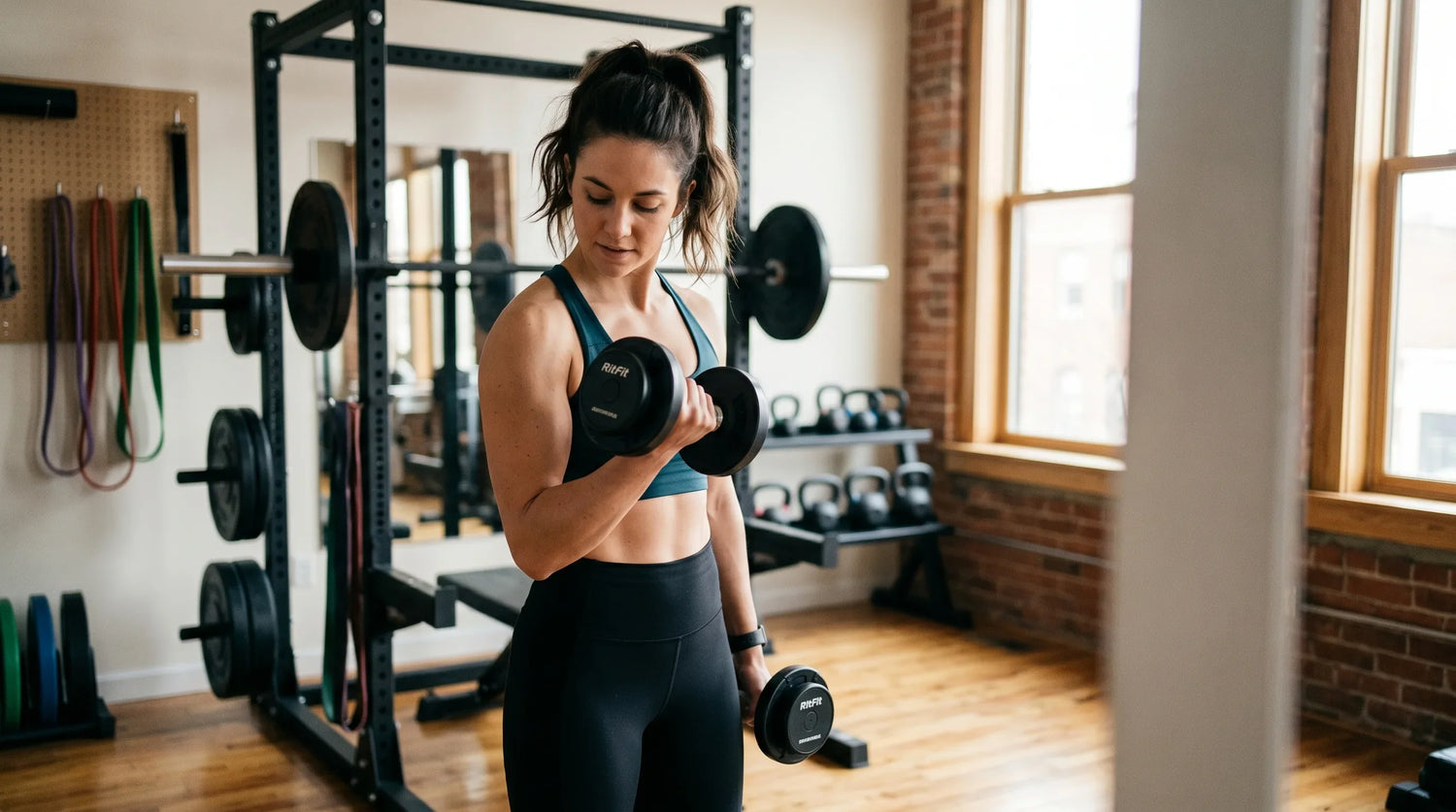
The best dumbbell weight for toning arms as a woman is one you can lift for 12 to 15 reps where the final few feel genuinely hard. Most beginners use lighter weights for isolation moves and heavier ones for presses and rows.
This guide gives you weight ranges by movement, a simple way to pick your starting load, and how to progress safely. It also clears up the biggest myth about toning.
Table of Contents
Key Takeaways
- Pick by feel, not by a fixed number: Choose a weight you can lift for 12 to 15 reps where the last 2 to 3 reps are challenging with good form.
- Light for isolation, heavier for compound: Curls and lateral raises often start around 2 to 5 lb, while presses and rows often use 8 to 15 lb.
- Toning is muscle plus lower fat: Visible definition comes from building lean muscle and reducing body fat, not from very light weights alone.
- Load is less critical than effort: Research suggests muscle growth is similar across loads when sets are taken close to failure.
- Adjustable sets save space: One adjustable pair covers both light isolation work and heavier compound moves in a compact footprint.
What Toning Arms Actually Means
Toning is mostly building lean muscle while reducing the body fat that sits over it. That combination is what makes arms look firm and defined.
Females have a similar relative potential to build muscle as males, so resistance training works just as well for arm definition[1].
- The toning myth: Very light weights for endless reps do not "lengthen" or "sculpt" muscle in a special way that heavier weights cannot.
- What drives definition: Progressive resistance builds the muscle, and overall activity plus nutrition reduces the fat layer above it.
This means your weight choice should challenge the muscle, not just keep your arms moving. Effort matters more than chasing the lightest possible dumbbell.
How To Pick Your Starting Dumbbell Weight
Pick a weight you can lift for 12 to 15 reps where the last 2 to 3 reps feel hard with good form. Trainers commonly recommend this rep feel method because it adapts to your strength.
- Too easy: If you breeze past 15 reps with no strain, the weight is too light to drive change.
- Too heavy: If your form breaks down before 10 reps or you swing the weight, drop down a size.
- Just right: The final reps slow down and feel demanding, but you still control the dumbbell through full range.
You will likely need more than one weight, since arms respond differently across exercises. Browse the full RitFit dumbbells collection to see the sizes available.
Dumbbell Weight Ranges By Exercise
Different arm movements call for different loads because each uses a different amount of muscle. Use the table as a starting point, then adjust by the rep feel test.
| Exercise | Typical Beginner Range | Why |
|---|---|---|
| Lateral raise | 2 to 5 lb | Small shoulder muscle, long lever, easy to overload |
| Bicep curl | 5 to 10 lb | Isolated single joint movement |
| Triceps extension | 5 to 10 lb | Isolated and easy to strain if too heavy |
| Shoulder press | 8 to 15 lb | Compound move using several muscles |
| Single arm row | 8 to 15 lb | Strong back muscles allow heavier loading |
Stronger lifters often go higher than these ranges. Treat them as a floor, not a ceiling.
Isolation Versus Compound Loads
Isolation moves work one joint, so they need lighter dumbbells. Compound moves recruit several muscles at once and usually allow heavier loads.
- Isolation examples: Bicep curls, triceps kickbacks, and lateral raises target a single area and tire quickly.
- Compound examples: Shoulder presses and rows share the load across the shoulders, back, and arms.
An umbrella review of resistance training found that load by itself does not determine how much muscle you build, but training volume does[2]. So focus on hard, controlled sets across both movement types. Learn the form for one staple move with this single arm dumbbell row guide.
A Simple Arm Toning Session To Follow
A balanced arm session hits shoulders, biceps, and triceps with a mix of loads. The standing dumbbell routine below shows clean form for each move.
- Shoulders: Shoulder press and lateral raise build the cap that frames toned arms.
- Biceps: Hammer curls and standard curls shape the front of the upper arm.
- Triceps: Overhead extensions and kickbacks address the back of the arm most women want firmer.
Aim for 2 to 3 sets of 12 to 15 reps per move, resting briefly between sets. Keep your weights within reach on a RitFit 3 tier dumbbell rack so you can switch loads fast.
How To Progress Without Plateauing
Progress means slowly increasing the challenge as your arms adapt. Without it, the same weight stops producing change.
- Add reps first: When 15 reps feel easy, push toward the top of your range before adding weight.
- Then add load: Move up to the next dumbbell size once you can complete all sets with control.
- Train close to effort: Take sets near the point where form would start to slip, since that effort drives results.
One study comparing moderate and lighter loads taken to failure found similar gains in strength and body composition[3]. That is good news because it means you can progress safely without always reaching for the heaviest dumbbell.
Choosing The Right Dumbbells To Buy
Because arm moves need different loads, owning a small spread of weights is more useful than one pair. Adjustable dumbbells solve this in a compact way.
- Fixed pairs: Buying separate light and medium pairs works well if you have storage space.
- Adjustable sets: Adjustable dumbbells let you change load in one compact set, which suits arm toning because isolation and compound moves need different weights.
For a space saving option, see the RitFit adjustable dumbbells collection, or browse all free weight choices in the weights collection.
FAQs About Dumbbell Weight For Toning Arms
What dumbbell weight should a woman start with to tone arms?
Most women start with a light pair around 2 to 5 lb for isolation moves like curls and lateral raises, and a medium pair around 8 to 15 lb for presses and rows. Choose loads where the last few reps of a set feel challenging with good form.
Are light weights better for toning arms?
No. Very light weights alone do not create a special toning effect. Toning comes from building lean muscle and lowering body fat, so your weights should challenge the muscle. Effort and consistency matter more than always choosing the lightest dumbbell.
How heavy should dumbbells be for bicep curls?
Many beginner women curl in the 5 to 10 lb range per dumbbell. Pick a weight you can lift for 12 to 15 controlled reps where the final 2 to 3 reps feel hard. Increase the load once those reps start to feel easy.
Will lifting dumbbells make my arms bulky?
No. Building large, bulky arms takes very high training volume, a calorie surplus, and usually years of dedicated effort. Typical arm toning routines build modest lean muscle that creates firmer, more defined arms rather than a bulky appearance, so most women have little reason to worry.
How do I know if my dumbbell is too heavy?
Your dumbbell is too heavy if your form breaks down, you swing the weight, or you cannot reach 10 clean reps. Drop to a lighter size and rebuild control. Good form through full range matters more than the number on the weight.
How often should I train arms with dumbbells?
Two to three sessions per week works well for most women toning their arms. Leave at least one rest day between sessions so muscles recover. Pair arm work with overall activity and balanced nutrition to reduce the fat layer above the muscle.
Should I use the same weight for every arm exercise?
No. Isolation moves like lateral raises use lighter dumbbells, while compound moves like shoulder presses and rows allow heavier loads. Using a single weight for everything either makes the presses too easy or makes the raises nearly impossible to do with good controlled form.
Are adjustable dumbbells worth it for toning arms?
Yes. Adjustable dumbbells let you change load in one compact set, which suits arm toning because isolation and compound moves need different weights. They save space compared to buying several fixed pairs and make it easy to add weight gradually as you progress over time.
How long until I see toned arms from dumbbells?
Results vary by training experience, consistency, and starting body composition. Many women notice firmer, more defined arms within several weeks of regular resistance training. Visible definition also depends on reducing the fat layer above the muscle through overall activity and balanced nutrition.
Can I tone my arms with just one pair of dumbbells?
Yes, but it is harder to load every move ideally. A single medium pair can work for many exercises by adjusting reps and tempo. A light pair plus a medium pair, or one adjustable set, lets you match the right weight to each movement.
Conclusion
The best dumbbell weight for toning arms is the one that challenges the target muscle for 12 to 15 controlled reps. Go lighter for isolation moves and heavier for presses and rows.
Remember that toning is lean muscle plus lower body fat, not endless light reps. Start with a light and medium pair or one adjustable set, train two to three times weekly, and add load as you get stronger.
Disclaimer
This article is for general educational purposes and does not replace personalized medical or fitness advice. Weight ranges are starting points and vary by individual strength and experience. Consult a qualified healthcare or fitness professional before beginning a new training program, especially if you have an injury or health condition.
References
- Refalo MC, Nuckols G, Galpin AJ, et al. Sex differences in absolute and relative changes in muscle size following resistance training in healthy adults: a systematic review with Bayesian meta-analysis. PeerJ. 2025;13:e19042. https://pmc.ncbi.nlm.nih.gov/articles/PMC11869894/
- Mcleod JC, Currier BS, Lowisz CV, Phillips SM. The influence of resistance exercise training prescription variables on skeletal muscle mass, strength, and physical function in healthy adults: an umbrella review. Journal of Sport and Health Science. 2024;13(1):47-60. https://pmc.ncbi.nlm.nih.gov/articles/PMC10818109/
- Lopes CR, Aoki MS, Crisp AH, et al. The effect of different resistance training load schemes on strength and body composition in trained men. Journal of Human Kinetics. 2017;58:177-186. https://pmc.ncbi.nlm.nih.gov/articles/PMC5548165/