








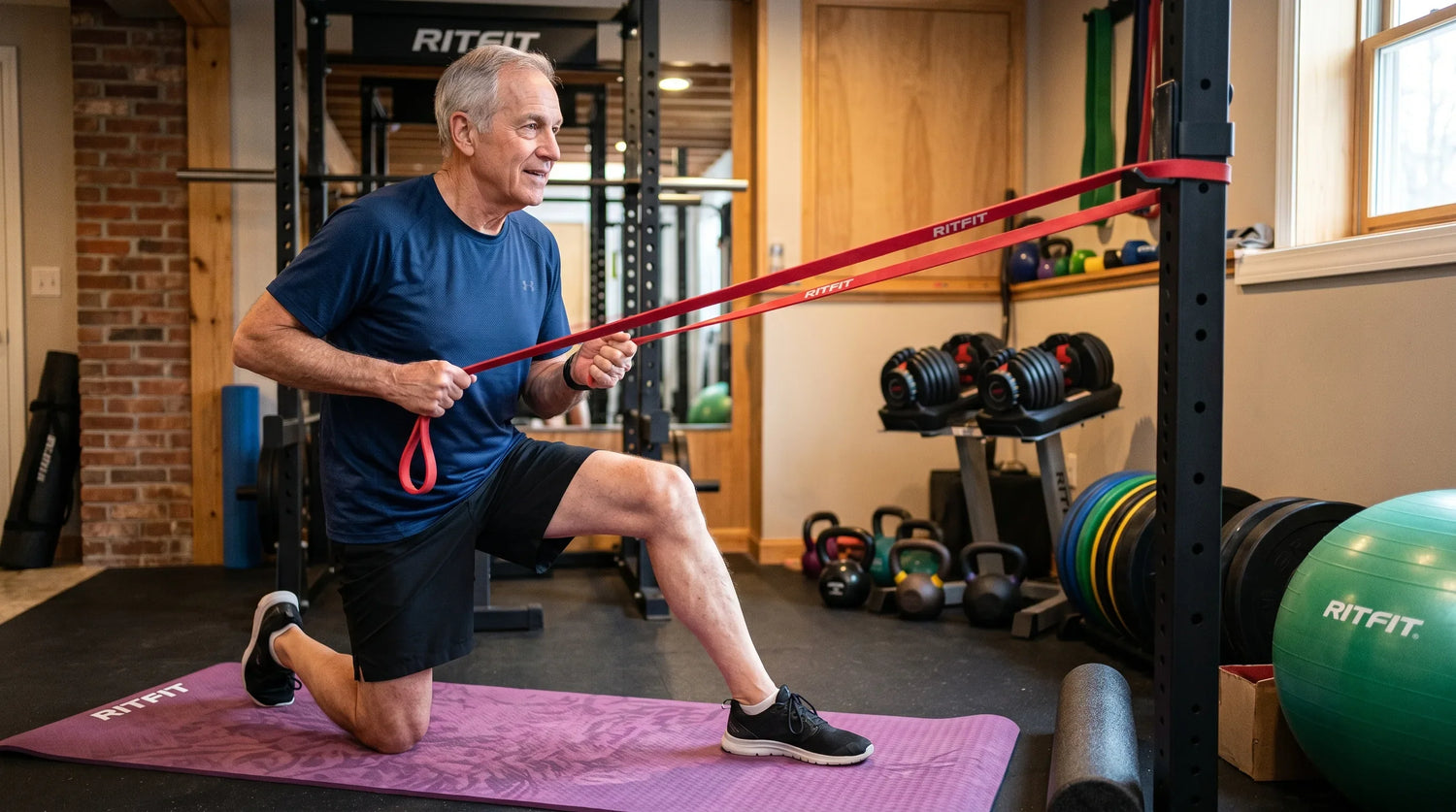
The right fitness accessories can help adults 60+ stay strong, mobile, and independent without the expense or complexity of large machines. Resistance bands, foam rollers, light dumbbells, stability balls, and yoga mats each serve a distinct purpose and can be combined into a safe, effective home routine.
This guide covers the best fitness accessories for seniors in 2026, what to look for when choosing each one, and how to build a starter kit on a realistic budget.
Quick Answer: The best fitness accessories for seniors are resistance bands, foam rollers, light dumbbells, stability balls, and yoga mats because they build strength and balance with low injury risk. A complete starter kit costs under $70, and two to three short sessions per week support independence.
Key Takeaways
- Accessories Over Machines: Portable accessories like resistance bands and foam rollers offer lower injury risk and are easier to store than large exercise machines for home use.
- Resistance Bands Lead: Research on older adults shows elastic band training may support improvements in balance, muscle strength, and reduced fear of falls when practiced consistently.
- Color-Coded Progression: Starting with light-resistance bands and advancing through color-coded levels is a proven approach for frail and deconditioned older adults.
- Budget-Friendly Entry: A complete starter kit of bands, a yoga mat, and a foam roller is available for under $70, according to senior fitness guides.
- Two to Three Sessions Weekly: Most seniors benefit from two to three accessory-based strength sessions per week, combined with daily light movement for best results.
Why Fitness Accessories Matter for Older Adults
Staying physically active after 60 helps maintain muscle mass, bone density, and balance, all of which decline naturally with age. Accessible accessories lower the barrier to regular exercise by removing the need for gym membership, complicated setup, or heavy equipment.
The Link Between Strength Training and Fall Prevention
A randomized controlled trial found that 12 weeks of elastic band resistance training improved balance, muscle strength, and reduced fear of falls in older women with a history of falls.[2] Consistent resistance work also builds proprioception, which is the body's sense of position, and this contributes to steadier movement in daily life.
Low-Impact Gear vs. Heavy Machines
A study of US emergency department data found that older adults aged 65 and above had significantly higher odds of hospital admission from home exercise equipment injuries compared with younger adults, with treadmills accounting for the majority of incidents.[1]
Lightweight accessories such as resistance bands, yoga mats, and foam rollers carry a much lower mechanical risk and are appropriate for unsupervised home use. For a broader view of home gym options, see our guide to the best home gym equipment for seniors.
"One of the two things that I would recommend just about everyone do is some sort of loaded carry. One of the main things so many older adults complain about is getting groceries out of their car and into their house, and I think that loaded carries are going to directly transfer to that."
Greg Nuckols, MA, Strength Researcher and Coach, holder of multiple powerlifting world records, Stronger By Science, "Strength Training Discussion (MTBR Forums)"
Best Fitness Accessories for Seniors in 2026
Each accessory below targets a specific fitness need and can be used independently or combined into a single session. Browse our full range of fitness accessories to find options suitable for every fitness level.
Resistance Bands: Most Versatile Choice
Fitness guides and trainers commonly recommend resistance bands over dumbbells for seniors beginning home strength training due to lower joint stress and no drop-injury risk. They can be used seated or standing and replace dozens of machine exercises at a fraction of the cost.
- What to look for: A set with at least three resistance levels, flat loop bands for lower body work, and a long flat band for upper body pressing and pulling.
- Best for: Seated upper body exercises, standing balance moves, and light lower body strengthening.
Light Dumbbells: Easy Strength Progression
Dumbbells provide familiar resistance for exercises like bicep curls, overhead presses, and lateral raises, and they are easier to control than barbells for older beginners. Our weight lifting accessories collection includes adjustable options that let seniors progress gradually without purchasing multiple sets.
- Starting weight: Begin with a weight that feels easy for 15 repetitions and feels moderately challenging by the last few reps.
- Safety tip: Sit on a sturdy bench or chair for pressing and curling exercises to reduce balance demands while building upper body strength.
Foam Rollers: Recovery and Flexibility
Self-myofascial release with a foam roller before or after exercise reduces muscle tightness and supports range of motion. Senior fitness guides recommend low-to-medium-density foam rollers for older adults, suggesting 10 to 15 minute sessions three to four times per week to support flexibility and recovery.
- Density: Choose a smooth-surface, softer-density roller rather than a high-ridged model, which can be uncomfortably intense for older muscles.
- Key areas: Calves, hamstrings, mid-back, and hip flexors respond well and are commonly tight in older adults who sit for long periods.
Stability Balls: Core and Balance Training
A stability ball adds an unstable surface to seated or floor exercises, recruiting core stabilizers and improving proprioception. It also serves as a low-profile chair replacement during light desk tasks to encourage active posture throughout the day.
This kind of balance work overlaps with broader coordination training, which you can explore in our guide to coordination in fitness.
- Sizing: Choose a ball size where your hips and knees form roughly 90-degree angles when seated, with feet flat on the floor. Most manufacturers include a height-to-ball-size chart to guide selection.
- Safety: Always ensure the ball is fully inflated and place it against a wall or sturdy surface when first learning seated exercises.
Yoga Mats: Foundation for Floor Work
A quality non-slip yoga mat provides cushioning for floor stretches, core work, and bodyweight exercises that would otherwise be uncomfortable on hard floors. For seniors with sensitive knees or wrists, look for mats with extra thickness rather than a thin travel mat.
- Material: TPE or natural rubber mats offer better grip than PVC and are easier to clean after sweaty sessions.
- Tip: A mat doubles as a defined exercise zone that helps seniors mentally separate workout time from rest time, encouraging consistency.
This full-body resistance bands class from Senior Fitness With Meredith shows how to use long bands and loop bands from both seated and standing positions, with chair modifications for every move.
How to Choose the Right Resistance Level
Selecting the correct starting resistance is the most important safety decision for older adults beginning a home exercise routine. Starting too heavy increases injury risk, while starting too light limits adaptation and motivation and can leave you stuck at a fitness plateau.
Color-Coded Systems Explained
Research on frail older adults found that a twice-weekly elastic band program over 16 weeks improved functional capacity and physical health when progressively advanced using color-coded resistance levels.[3] Most band sets follow a yellow-to-black scale from lightest to heaviest, making it simple to identify the right starting point and track progress objectively.
When to Progress (and When Not To)
Move to the next resistance level only when you can complete all prescribed sets and reps with controlled form and no joint pain. Seniors with recent illness, a joint replacement, or significant deconditioning should begin at the lightest available level regardless of past fitness history, and allow two to four weeks of adaptation before advancing.
Safety Tips for Using Fitness Accessories at Home
Most home accessory injuries are preventable with a few simple precautions, and establishing safe habits early builds the confidence to exercise consistently over time.
Set Up Your Space Correctly
Clear a floor area of at least six feet by six feet, remove loose rugs, and keep a sturdy chair within arm's reach for balance support during standing exercises. Exercise near a wall or counter when trying a new movement so you can steady yourself instantly if needed.
Signs You Need to Slow Down
Stop any exercise immediately if you experience sharp joint pain, dizziness, shortness of breath at rest, or numbness in the hands or feet. These are signs to consult a healthcare provider before resuming, not reasons to push through, and no fitness goal justifies working through acute symptoms.
Building a Starter Kit on a Budget
A complete entry-level set of accessories does not require a large investment. According to senior fitness guides, resistance bands, yoga mats, and foam rollers are among the most affordable starting points, collectively available for under $70, making them accessible to nearly any household budget.
| Accessory | Primary Benefit | Budget Range |
|---|---|---|
| Resistance Bands Set | Full-body strength, joint-friendly | Under $25 |
| Yoga Mat | Cushioning, floor work, stretching | Under $25 |
| Foam Roller | Recovery, flexibility, circulation | Under $20 |
| Stability Ball | Core, balance, posture | Under $30 |
| Light Dumbbells (pair) | Familiar resistance, upper body | Under $30 |
Budget ranges are typical retail estimates from senior fitness guides, not brand-specific pricing.
Start with the first three items for a core starter kit, then add dumbbells and a stability ball as your confidence and fitness level grow. For gift ideas built around these accessories, check out our curated lists of fitness gifts for her and fitness gifts for him.
Women 60 and above looking for a broader exercise framework will also find relevant programming and motivation at our fitness for women blog hub.
FAQs About Fitness Accessories for Seniors
What are the safest fitness accessories for seniors?
Resistance bands, yoga mats, and foam rollers are considered among the safest options because they carry no risk of dropping or mechanical malfunction. They are lightweight, adjustable to any fitness level, and can be used seated or on the floor, making them appropriate for adults with limited mobility or balance concerns.
How often should seniors use fitness accessories each week?
Most older adults benefit from two to three resistance-based sessions per week, with at least one rest day between sessions to allow recovery.
Daily light movement such as stretching or foam rolling is generally fine and supports circulation.
Consistency over weeks and months matters more than any single session intensity.
Are resistance bands better than dumbbells for seniors?
Resistance bands are commonly recommended as a starting point for seniors because they provide adjustable resistance without the risk of dropping a weight on a foot or joint.
Dumbbells remain useful for familiar movement patterns and may be preferable for seniors with good grip strength.
Many older adults benefit from using both tools in the same routine.
What size stability ball is best for older adults?
Choose a ball size where your hips and knees form roughly 90-degree angles when seated, with feet flat on the floor.
Most stability ball packaging includes a height-based sizing chart to guide your selection.
A properly sized, fully inflated ball provides the best balance challenge and seated support for older adults.
Can seniors with arthritis use fitness accessories safely?
Many seniors with arthritis can use light resistance bands, foam rollers, and yoga mats safely, as these accessories allow full control of range of motion and resistance. However, individual joint conditions vary widely, and a healthcare provider or physical therapist should be consulted before starting any new resistance program to confirm suitability.
What is the best fitness accessory for fall prevention?
Resistance bands are the most researched accessory for fall-related outcomes in older adults.
A stability ball used for seated core work also trains the stabilizing muscles that contribute to balance.
Both should be combined with regular walking and standing balance practice for the most comprehensive approach to reducing fall risk.
Conclusion
The best fitness accessories for seniors in 2026 are the ones used consistently: resistance bands, foam rollers, light dumbbells, stability balls, and yoga mats cover strength, flexibility, balance, and recovery in a compact, affordable package.
Start with a basic three-item kit, establish a routine of two to three sessions per week, and progress resistance gradually as your strength improves. Browse our full selection of fitness accessories to find senior-friendly options for every budget and fitness level.
Disclaimer
This article is for general informational purposes only and is not a substitute for professional medical or fitness advice. Consult a qualified healthcare provider before beginning any new exercise program, particularly if you have a chronic health condition, recent injury, or joint replacement, and remember that individual results vary based on health status and consistency.
References
1. Chow TL, Donaldson A, Finch CF, et al. Emergency department-reported injuries associated with home exercise equipment. Br J Sports Med. 2015. PMCID: PMC4306571
2. Synergistic effects of elastic band and vibration training on muscle strength, balance, and mobility in older women with a history of falls: a randomised controlled trial. Front Physiol. 2025. PMCID: PMC12003409
3. Empowering frail older adults: multicomponent elastic-band exercises and BCAA supplementation unleash physical health and preserve haematological biomarkers. Front Physiol. 2023. PMCID: PMC10502309





