








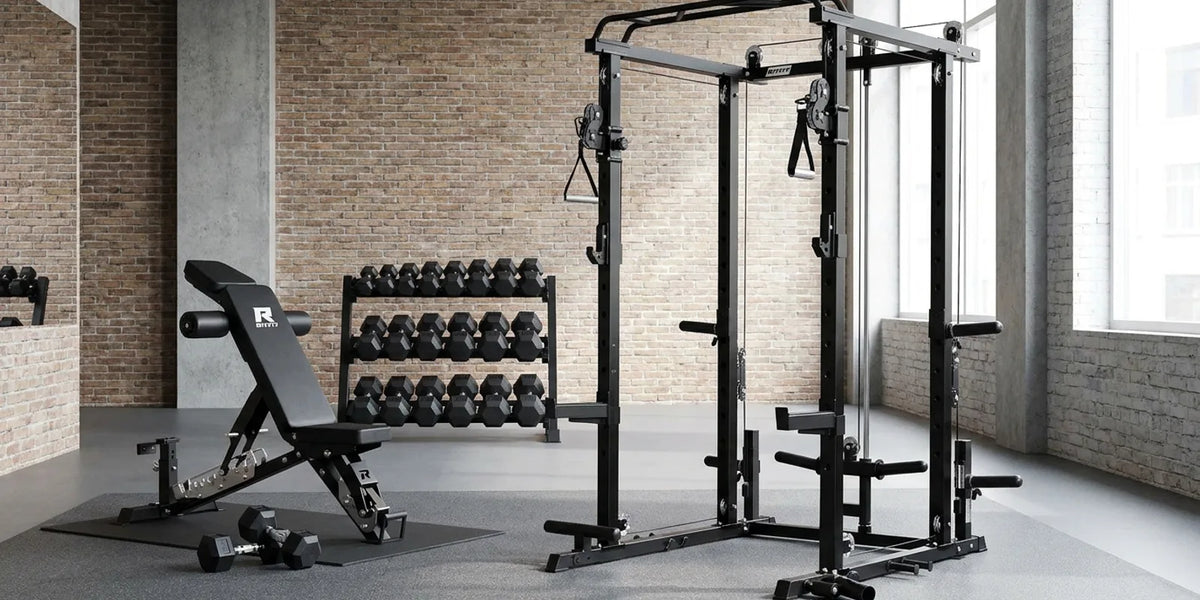
Choosing the best fitness equipment for a sports facility comes down to three numbers: floor space, load rating, and how many users share each station. A shared floor sees dozens of users a day, so spacing, steel, and maintenance planning matter more than the feature list.
This guide covers what a facility floor needs, how much room each station takes, which RitFit machines fit a studio, a school weight room, or a team center, and how to keep the room safe long after the invoice is paid.
Quick Answer: The best fitness equipment for a sports facility is a rack or cage, an adjustable bench, a cable system, and organized free weights, chosen by load rating and station footprint. NSCA standards allow 100 square feet per participant, so a 20 athlete floor needs about 2,000 square feet of usable space.
Key Takeaways
- Base stations first: rack or cage stations, adjustable benches, cable systems, and organized free weights carry almost every program on a shared floor.
- Space rule of thumb: NSCA standards plan a minimum average of 100 square feet per participant, which sets the room size before any brand is chosen.
- Load rating over marketing: a shared station should carry a stated load rating that covers your heaviest athletes with margin left over.
- Maintenance is part of selection: the NSCA checklist expects daily damage checks and removal of damaged equipment from use until it is repaired.
- RitFit fits the value segment: the P3 cage, M2 modular system, M3 Pro Smith machine, and GATOR bench cover studio, school, and team floors at a spec per dollar level.
What Equipment Does a Sports Facility Actually Need?
A sports facility needs rack stations, adjustable benches, cable systems, and organized free weights as its base. Flooring, storage, and signage are part of the same purchase plan, not an afterthought.
- Rack and cage stations: the anchor for squats, bench press, overhead press, and pull-ups, and the station that sets your spacing grid.
- Adjustable benches: flat, incline, and decline positions in one unit keep a busy bench station moving between users.
- Cable and pulley systems: rows, lat pulldown, and rotational work for athletes who are not ready to load a barbell.
- Free weights and storage: paired dumbbells, Olympic bars, plates, and racks that keep aisles clear during a team session.
- Flooring and signage: impact rated flooring under each station plus posted rules, inspection logs, and emergency procedures.
Program directors also carry written records for equipment selection, purchase, installation, inspection, and repair under NSCA professional standards[1]. That paperwork is why the equipment decision sits with the program, not with a single coach.
Team and athletic programs often run conditioning blocks beside strength blocks, which is why a CrossFit equipment zone earns its floor space in many facilities.
How Much Floor Space Does Each Training Station Require?
NSCA standards plan about 100 square feet of floor per participant. Every station type also has its own footprint inside that budget, and a rack station runs near 130 square feet once the bar and the safety cushion around it are counted.
| Station | Planning math | Footprint |
|---|---|---|
| Bench press station | 6 to 8 ft bench plus 3 ft safety cushion, by 7 ft user width plus 3 ft | About 90 ft² |
| Standing exercise | 4 to 7 ft bar plus 6 ft cushion, by 4 ft width | About 40 ft² |
| Standing exercise in a rack | 5 to 7 ft bar plus 6 ft cushion, by 8 to 10 ft width | About 130 ft² |
| Olympic lifting platform | 8 ft platform plus 4 ft walkway, by 8 ft plus 4 ft | About 144 ft² |
Station planning examples from the NSCA Strength and Conditioning Professional Standards and Guidelines. Measure usable floor only, without pillars, walls, or storage aisles.
The NSCA safety checklist also sets a minimum ceiling height of 12 feet (3.7 m) for overhead exercises, and asks for 2 feet of clearance between machines with 3 feet as the better target.
Lifting zones that take repeated dropped bars should sit on impact rated flooring, and a gym flooring layer is cheaper to replace than a cracked slab.
Why Do Steel Gauge and Load Ratings Matter More on a Shared Floor?
Steel gauge and load rating decide how long a shared station lasts, because dozens of users load it every day. A home unit can hide a thin frame behind light training loads, and a facility unit has no such cover.
- Steel gauge: a lower gauge number means thicker steel, and thicker uprights and frames flex less under a heavy bar path.
- Stated load rating: a rated frame gives you a documented ceiling instead of a guess, which matters when athletes train close to their maximum.
- Wear parts: cables, pulleys, pads, and selectorized pins take the first damage and should be serviceable rather than sealed.
- Anchor points: racks, benches, and storage must be secured to the floor or wall to survive a crowded session.
Anchoring matters in practice: the NSCA safety checklist asks that benches, weight racks, and standards be secured to the floor or wall, and that nonfunctional equipment be removed or locked out of service.
Treat every anchor point as a service item rather than a one time install, because a rack that works loose under a repeated bar path is a safety fault, not a wobble.
One review of the RitFit GATOR bench notes 14-gauge steel and a 1,600 pound weight capacity, which is the level of frame detail a buyer should be able to find before ordering. Rack and cage bundles in the same class are grouped in the power rack packages collection.
Which RitFit Setup Is Best for a Sports Facility: M2 or M3 Pro?
The right RitFit setup depends on floor size and how many athletes share each station. A small studio and a college weight room rarely want the same machine.
Facility Type to RitFit Pick: Decision Matrix
Use the table below to match your facility type to a starting machine, then add stations as your training groups grow.
| Facility type | RitFit pick | Why it fits |
|---|---|---|
| Small studio or rehab floor under 1,000 ft² | RitFit M2 Multi-Functional Smith Machine | One footprint holds a half rack, dual cable, and lat pulldown, so a single unit covers several stations. |
| School or college weight room at 1,500 to 2,000 ft² | RitFit P3 Power Cage with cable system | A 1200 lb rated cage adds rack stations and cable work without a second machine. |
| Team center with heavy barbell turnover | RitFit 7FT Olympic Barbell Bar | Bar capacity options of 500, 700, and 1000 lb let you match a bar to a training group. |
| Shared bench press stations | RitFit GATOR 1600LB Adjustable Weight Bench | A 1,600 pound rating and 14-gauge steel suit a bench that changes users every few minutes. |
RitFit picks only, matched on capacity, footprint, and station coverage. Ratings are the values published on the RitFit product listings.
Expand in the order the floor demands it: add benches before adding a second cage, and add free weights before adding a third machine, because free weights serve the widest range of programs per square foot.
"Absolutely love my RitFit M2 PRO 3D SERIES Multi-Functional Modular Home Gym Package. It's an all-in-one setup and allows a full-body workout experience in the comfort of your home."
Ethan J. Verified Buyer, RitFit M2 SERIES Multi-Functional Modular Home Gym Package
Best RitFit Power Cage for Shared Floors: P3 1200LB vs P9
The RitFit P3 Power Cage is the simpler facility pick when rack stations and cable work share one footprint. The P9 adds a 3D Smith machine and an adjustable dual cable system on a modular frame for programs that want more movement patterns at each station.
- Capacity: the P3 is listed at a 1200 lb rating, which covers the bar weight and the athlete load at a shared squat or bench station.
- Cable system: aluminum pulleys and a smooth cable run matter on a shared floor, because cable stations often carry the highest user count in the room.
- Modular growth: the P9 frame accepts Smith machine and dual cable configurations, so a growing program can add movement options without buying a second footprint.
- Choice rule: pick the P3 when floor space and budget are the constraint, and pick the P9 when movement variety per station is the constraint.
Pair either cage with a cable machines setup only if your accessory work outgrows the cage, since a second station such as a functional trainer is a large share of a small facility budget.
"Nice little setup. Great for home gym and basic needs. Easy to set up."
Abby B. Verified Buyer, RitFit P3 Power Cage 1200lbs Home Gym Package
Best Adjustable Bench for Facility Floors: GATOR 1600LB
The RitFit GATOR Adjustable Weight Bench carries a 1,600 pound rating and 14-gauge steel. That build suits a shared bench station that changes users every few minutes.
- Angle range: 10 back pad angles, three seat pad positions, and three decline settings cover flat, incline, and decline pressing from one bench.
- Capacity: a 1,600 pound rating leaves margin for a heavy presser plus the bar and plates at a shared station.
- Padding life: a bench sees more skin contact than any other station, so replaceable, well-padded upholstery cuts long term maintenance.
- Comparison inside the line: the RitFit GATOR 1600LB Adjustable Weight Bench carries the higher rating and gauge, while the lighter BWB01 bench fits a studio with lower loads.
Budget one bench per bench press station rather than sharing a single bench across the room, because bench stations are the highest turnover stop on most floors. More options sit in the adjustable benches collection.
Built with 14-gauge steel, the RitFit Gator Adjustable Weight Bench offers a robust weight capacity of 1,600 pounds. With 10 back pad angles, three seat pad positions, three decline settings, and a five-way adjustable head rest, you have ample options to support your strength and muscle building goals.
Stephen Sheehan, CPT, CNC, Certified Personal Trainer and Nutritionist, Garage Gym Reviews, RitFit Gator Adjustable Weight Bench Review (2026)
"The gator bench is SOLID! Very sturdy and heavy. You will feel very safe on this bench with any heavy workouts. The wheels make it easy to scoot around the gym when needed. This is money well spent and much better than the basic ritfit bench. Good quality product for the price!"
Christopher O. Verified Buyer, RitFit GATOR 1600LB Adjustable Weight Bench
How Many Stations Do You Need for Your Athlete Count?
Station count follows your largest training group, not your roster size. NSCA guidance pairs one strength and conditioning practitioner with about 5 training stations and 1,500 square feet in high school settings.
- Throughput rule: plan one rack or bench station for every 3 athletes if you expect them to lift at the same time.
- Worked example: a group of 15 athletes working in threes needs 5 stations, which fits the NSCA high school ratio of 5 stations per practitioner.
- Floor check: at 100 square feet per participant, those 15 athletes need about 1,500 square feet of usable floor before storage and walkways.
- Dumbbell supply: paired sets matter as much as rack count, and a RitFit Rubber Hex Dumbbell Set with Rack keeps the free weight zone stocked and organized in one purchase.
If your athlete count is still growing, buy the floor plan for the final number and fill stations in phases, so you do not rebuild the spacing grid a year later.
What Maintenance Schedule Keeps a Shared Weight Room Safe?
The NSCA checklist puts damage checks daily and guide rod lubrication at two to three times per week. Records of repair and inspection belong in the same file as the purchase paperwork.
- Daily: inspect flooring, padding, upholstery, fixed equipment connections, and loose hardware, and treat skin contact surfaces.
- Two to three times per week: clean and lubricate selectorized guide rods and the moving parts that carry cable loads on resistance training machines.
- As needed: replace damaged pads, clean bar knurling, and remove or lock out any equipment that fails inspection.
- Hard stop: NSCA standards require equipment in need of repair to be taken out of use until it is serviced, repaired, and re-inspected[1].
Assign one named person to the log, because an unsigned checklist does not protect anyone when a cable fails during a team session.
Is Commercial-Grade Equipment Worth It for a Small Facility?
Commercial grade equipment earns its cost when one station serves many users each day. The math changes for a one on one studio where a single athlete uses each machine a few times a day.
- Worth it when: a station carries 30 or more users a day, because downtime costs you a full training slot, not a single session.
- Skip it when: your studio runs small groups with light loads, where a mid range machine with a stated rating covers the work.
- Upgrade path: start with one modular system such as the M2, then add stations as groups grow, instead of buying the final floor in one order.
- Total cost: price the frame, the replaceable wear parts, and the station footprint together, because a cheap station that blocks a second user costs floor space every session.
A 1200 lb rated cage or a 1,600 pound rated bench costs more up front than an unbranded frame, and it gives you a documented number to weigh against your heaviest athletes.
FAQs About Best Fitness Equipment for a Sports Facility
What equipment should a sports facility buy first?
A sports facility should buy rack stations, adjustable benches, and free weights first, because those cover squats, presses, and pulls for every athlete on the floor. NSCA station planning gives a rack station about 130 square feet, so the base stations decide the room size. Add cable work, storage, and flooring after the base stations are set.
How much floor space does a weight room need per athlete?
NSCA standards recommend a minimum average of 100 square feet per participant, and that number covers the station itself plus the safety space around the bar. A room with 20 athletes training at once therefore needs roughly 2,000 square feet of usable floor, and you should measure usable space without pillars, walls, or storage aisles.
What ceiling height does a school weight room need?
The NSCA safety checklist calls for a minimum ceiling height of 12 feet for overhead exercises, and the ceiling should also be free of beams, pipes, and light fixtures that hang into the bar path. If a room falls short of 12 feet, keep overhead pressing and full pull-ups out of the plan rather than squeezing them in.
How often should facility gym equipment be inspected?
The NSCA checklist puts flooring, upholstery, padding, and general equipment damage on a daily inspection, and it puts lubricating selectorized machine guide rods on a two to three times per week schedule. Anything found in need of repair should be removed from use until it is serviced, repaired, and re-inspected.
Is home gym equipment strong enough for a sports facility?
Home gym equipment is not the right class of product for a shared floor, because a facility station can see dozens of users a day instead of one. Look for stated load ratings on the frame, such as a 1200 lb rated cage or a 1600 lb rated bench, and match that rating to the heaviest work your athletes actually do.
How many racks does a team weight room need?
Match rack count to your largest training group, not your roster. NSCA guidance pairs one practitioner with about 5 training stations in a high school setting, so a group of 15 athletes working in threes needs about 5 rack or bench stations to keep everyone lifting instead of waiting.
Conclusion
The best fitness equipment for a sports facility is the equipment your floor plan, your largest training group, and your maintenance log can actually support. Start with rack and bench stations, confirm the load rating and station footprint of every piece, and add machines only when the program demands them.
Measure your room against the 100 square feet per participant figure, then check the RitFit discount guide before you send a purchase request.
Disclaimer
This article gives general facility planning guidance and is not a substitute for a licensed engineer, architect, or safety inspector. Confirm all load ratings, floor capacities, and local requirements with the manufacturer and your facility safety officer before purchase or installation.
References
1. National Strength and Conditioning Association. NSCA strength and conditioning professional standards and guidelines. Strength Cond J. 2017;39(6).
2. National Strength and Conditioning Association. NSCA safety checklist for exercise facility and equipment maintenance. In: Haff GG, Triplett NT, eds. NSCA's Essentials of Strength Training and Conditioning. 4th ed. Champaign, IL: Human Kinetics; 2016.





