








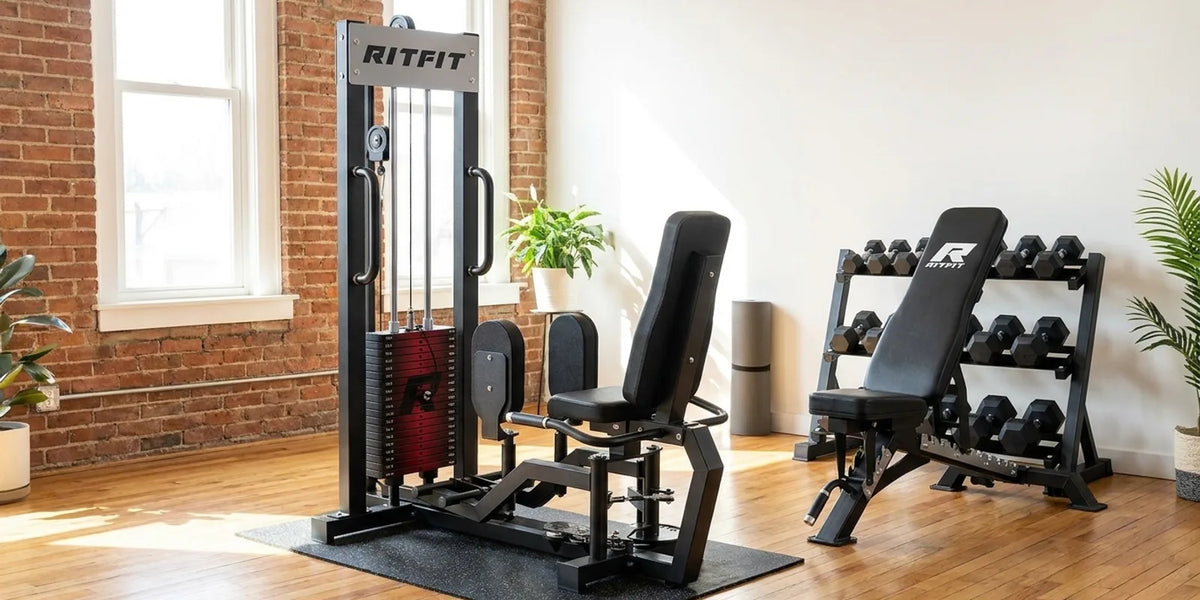
The best hip abductor and adductor machine around $1,000 is the one whose movement pattern, specifications, and setup fit your home gym. The RitFit Panther trains hip abduction and hip adduction on one seated frame with a listed 209 lb pin stack.
This guide explains what the Panther trains, what each listed specification means in practice, and which training scenarios justify giving a specialty station permanent floor space. It is written for a garage or basement lifter who already squats, hinges, and hip thrusts.
Quick Answer: The RitFit Panther is a dedicated hip abductor and adductor machine for a home gym, covering hip abduction and hip adduction in one seated station. Its listed 209 lb stack, 1:1 pulley ratio, 70 degree abduction and 96 degree adduction ranges, and 60.2 by 30.3 inch footprint define what the machine delivers at around $1,000.
Key Takeaways
- Dual function: The RitFit Panther covers hip abduction and hip adduction in one seated station, so outer hip work and inner thigh work share a single fixed setup instead of a rebuilt cable configuration.
- Declared resistance: The listed 19 plate stack totals 209 lb on a 1:1 pulley system, which gives repeatable load steps for overload instead of guessed band tension.
- Measured range: The Panther lists a 70 degree abduction arc and a 96 degree adduction arc, adjusted through an 8 hole rotating dial and 360 degree knee pads.
- Frame build: The frame is listed as Q235 steel with key sections in 2 by 2.8 inch and 2 by 2 inch tube, and RitFit publishes 3 years of coverage on frame and welding for strength equipment.
- Value placement: At around $1,000 the Panther is best bought after the compound lower body equipment you already train, because it is a specialty hip station rather than a complete leg gym.
What does a hip abductor and adductor machine actually train?
A hip abductor and adductor machine trains two opposing hip movements from one seated position. Hip abduction drives the knee away from the midline and loads the gluteus medius, gluteus minimus, and tensor fasciae latae on the outer hip, while hip adduction drives the knee toward the midline and loads the adductor longus, adductor brevis, adductor magnus, gracilis, and pectineus on the inner thigh.
- Abduction side: The outer hip muscles control pelvic position during single leg support, which is why runners and field sport athletes train them directly.
- Adduction side: The adductor group pulls the knee inward and contributes to pelvic and knee alignment, not only inner thigh appearance.
- Seated fixation: A fixed torso and hip angle removes the balance demand of standing drills, so the target muscles take the load.
On the RitFit Panther both movements share one frame, so you switch between outer and inner thigh work by changing your seated position instead of rebuilding a cable setup. That keeps an accessory block practical, because the transition takes seconds.
The practical difference from bands or side lying leg raises is measurable load, because a band's tension changes as it stretches while a pin selected stack gives you an exact resistance number you can repeat in fixed steps.
That does not make bands obsolete. One comparison of elastic resistance and machine exercises found higher gluteus medius activity with elastic resistance, so bands remain useful for activation sets.[1]
Lifters still mapping the two movement patterns can start with this hip abductor and adductor machine guide for beginners before assigning floor space.
What do the Panther's specifications mean for your training?
The Panther's listed specifications describe a compact seated station with a 209 lb stack and a 1:1 pulley ratio. Each number below changes how the machine behaves in a home gym.
| Listed Panther specification | What it means for your training |
|---|---|
| 60.2 by 30.3 inch footprint, 63.7 inch height | It fits along a garage or spare bedroom wall, but seat entry and leg travel still need clearance, so plan roughly 65 by 60 inches of open floor. |
| 19 plates totaling 209 lb, pin selected | Fixed increments let you add a small step and keep the log comparable between sessions. |
| 1:1 pulley ratio | The pin setting stays close to the resistance you feel, so logged load and perceived load stay aligned on both movements. |
| 70 degree abduction and 96 degree adduction ranges | The adduction arc travels further, which suits inner thigh work that keeps tension deep in the range. |
| 8 hole rotating dial, 360 degree knee pads | Different hip widths, leg lengths, and comfortable start angles each get a repeatable start position. |
| Q235 steel frame, 2 by 2.8 inch and 2 by 2 inch tube at key sections | Heavy abduction sets stay stable because the frame resists flex instead of letting you brace against movement. |
| RitFit strength equipment warranty: 3 years frame and welding, 1 year bushings and bearings, 6 months parts and pads | Ownership cost is bounded for a station you intend to keep for years. |
Specifications are from the RitFit Panther product page checked in 2026, and warranty terms are from the RitFit warranty page checked in 2026.
A 209 lb stack matters most for the lifter who is already strong on compound work, because you might begin around a third of it and add plates over months. The 1:1 pulley ratio keeps that progression honest, since the pulley does not multiply or reduce the load and both movements stay comparable in one log.
The 60.2 by 30.3 inch footprint decides placement, and a garage bay that also holds a rack still needs room to step in and swing the leg pads. Treat roughly 65 by 60 inches as the working envelope.
Frame rigidity shows up in the heaviest abduction sets, where the 2 by 2.8 inch tube sections keep the station planted instead of letting you brace against flex.
"Absolutely love this machine! Perfect fit for my home gym!"
Andrea S. Verified Buyer, RitFit Panther Home Hip Abductor and Adductor Machine
Broader lower body needs usually come first, so browse the RitFit leg machine collection before adding a specialty station.
How do the adjustment dial and knee pads change your setup?
The 8 hole rotating dial sets your start angle, and the 360 degree knee pads set how your knees meet the machine. Together they decide whether every session starts from the same position or from a slightly different one.
The dial changes the starting position of the movement arm, so a shorter or longer leg does not force the same hip angle. The pads rotate to sit against the outside or the inside of the knee depending on whether you are abducting or adducting.
- Match your hip width: Rotate the pads so they contact each knee evenly instead of digging into one side.
- Set the start angle: Pick the dial hole where the first inch of travel feels controlled, not the hole where the pads already feel pinned together.
- Control the end range: Stop before the pads collapse inward or the hips roll back, then let that same endpoint define every repetition.
- Switch movements deliberately: Adduction and abduction use different seat and pad alignments, so change both together instead of only one.
All of this adjustability buys repeatability. Once you note the dial hole and pad orientation, a strength change reflects your training rather than a different starting position.
Because the listed ranges differ, 70 degrees of abduction against 96 degrees of adduction, one pad position will not serve both movements equally well. Readers who want a plainer definition can read what a hip abductor and adductor machine does first.
Which training scenarios get the most from a dedicated hip station?
A dedicated hip station earns floor space as hip accessory work, hip stability work, superset filler, and a compact fixed station. Each scenario below names the training purpose and the RitFit option that covers it.
| Scenario | Training purpose | Which RitFit option fits |
|---|---|---|
| After squats, hinges, or hip thrusts | Direct outer hip and inner thigh volume that compound work underloads, with a load you can log every week | The Panther as the accessory station, with a GAZELLE 3 in 1 leg press and hack squat machine covering the compound pattern instead |
| Runners and field sport athletes | Hip abductor strength that supports the pelvis during single leg support, trained with controlled loading rather than sprint volume | The Panther for seated loading, paired with band walks from a cable machine collection for warm up work |
| Lower body supersets | Alternating a hip dominant and a knee dominant station so one area recovers while the other works | A Mustang PRO leg extension curl machine or a PLC01 leg extension curl machine pairs with the Panther in one circuit |
| Compact home gym | Two hip movements from a single stationary footprint, with no cable conversion between exercises | The Panther as the fixed hip station, with compound leg work handled by a separate leg machine |
Product options are limited to RitFit equipment, and scenario fit describes programming logic rather than individual results.
Single leg hip control is why runners appear twice on this list. One study of distance runners compared hip muscle activity across three side lying hip strengthening exercises, the pattern that seated abduction loads with heavier, trackable resistance.[2]
The Panther is not a substitute for compound training. A first purchase that still has to cover squat, hinge, and press patterns comes first, which is why the hip station usually arrives after the leg machines.
Anyone still deciding how a specialty station fits a home setup can read this home gym hip machine comparison for a second view of the same decision.
How should you set up and use a hip abductor and adductor machine?
Set up a hip machine with a light load, a dial position you can hold, and a range that stays pain free. Torso support and a controlled return matter more than resistance at first.
- Step 1: Set the seat height and the dial hole before you touch the stack, then rotate the knee pads so they contact each knee evenly.
- Step 2: Sit with your back against the pad and choose a light pin setting that lets you complete the full arc without the hips rolling.
- Step 3: Press the knees outward for abduction or squeeze them inward for adduction, keeping the torso still against the back pad.
- Step 4: Pause briefly at your controlled end range, then return slowly and let the stack settle instead of snapping back.
- Step 5: Stop and get qualified guidance if you feel pinching, numbness, or a sharp catching sensation in the hip.
Keep the return phase as deliberate as the press, because a controlled eccentric is where much of the useful hip work happens.
The knee joint itself is a consequential joint. That means it is simply a hinge joint that is at the mercy of what is going on at the ankle below and the hip above.
Jeff Cavaliere, MSPT, CSCS, Athlean-X, How to Fix Knee Valgus
What progression plan keeps hip abduction and adduction productive?
Progress a hip station by adding a small amount of stack weight or a few repetitions, not both at once, because a single changing variable keeps a training log readable.
- Placement: Keep abduction and adduction after squats, hinges, or hip thrusts so compound work is not compromised by a pre fatigued hip.
- One variable: Log either the pin setting or the repetition count as your progress marker so a later session can be compared directly.
- Frequency: Two to three sessions per week with at least one rest day between them gives the adductors and gluteals time to recover.
- Range before load: Only add resistance once the full dial range stays controlled on every repetition of both movements.
- Keep bands in the plan: Elastic resistance produced higher gluteus medius activity than the machine in one comparison, so band walks and side lying drills still serve as activation work.[3]
The goal is a repeatable accessory block rather than a second leg day. Hip abduction and adduction progress well when the setup stays identical and one variable moves at a time.
FAQs About the Best Hip Abductor and Adductor Machine for Home Gym
What muscles does a hip abductor and adductor machine work?
The abductor side targets the gluteus medius, gluteus minimus, and tensor fasciae latae along the outer hip. The adductor side works the adductor longus, adductor brevis, adductor magnus, gracilis, and pectineus on the inner thigh, supporting pelvic stability, knee alignment, and balanced lower body strength.
How much space does the RitFit Hip Abductor and Adductor Machine need?
The RitFit machine has a listed footprint of 12.7 sq ft, measuring 60.2 in long by 30.3 in wide. You should also leave clearance on each side for entering, exiting, and the leg range of motion during abduction, so plan for roughly 65 in by 60 in of total floor space in your garage or basement gym.
Is a hip abductor and adductor machine better than resistance bands?
Both are effective tools. The machine offers stable seated positioning, precise load increments, and repeatable progressive overload, which makes load tracking simple and objective. Bands can elicit somewhat higher gluteus medius activation during abduction, so use them for warm-up drills and activation sets.
How often should you train on a hip abductor and adductor machine?
Two to three sessions per week is a practical starting point, with at least one rest day between sessions to allow recovery. If you pair this machine with squats or leg press, treat it as accessory volume performed after your main compound lifts are complete.
What weight should a beginner use on the hip abductor and adductor machine?
Start at a load where you can complete 3 sets of 12 to 15 reps with full control and no hip pinching, which is typically lighter than most beginners expect. Control the return phase on every rep rather than letting the weight snap back.
Can you build glutes with a hip abductor machine?
Hip abduction trains the gluteus medius and gluteus minimus, which shape the outer glute and contribute to hip width. This machine does not replace hip thrusts or squats for overall glute mass, but it adds targeted accessory work that compound movements tend to underload, making it a useful addition to a complete lower body program.
What is the weight capacity of the RitFit Hip Abductor and Adductor Machine?
The RitFit Home Hip Abductor and Adductor Machine has a listed weight capacity of 200 lb. This covers the loading range most users work in for hip isolation exercises, which typically require less resistance than leg press or squat movements. The 0.88:1 abduction and 0.66:1 adduction resistance ratios mean the felt load differs slightly between movements.
What does the RitFit Panther give you in an around $1,000 home gym budget?
The Panther puts two hip movements on one seated frame, with a listed 209 lb pin stack, a 1:1 pulley ratio, a 70 degree abduction arc and a 96 degree adduction arc. The frame is listed as Q235 steel with 3 years of frame and welding coverage. At around $1,000, the value sits in repeatable hip accessory loading from one fixed station rather than in a multi purpose leg machine.
Who should prioritize a dedicated hip abductor and adductor machine?
A dedicated machine makes the most sense for a home gym that has enough floor space and already covers primary leg movements. It gives you a seated way to add repeatable hip abduction and adduction work after squats, hinges, or hip thrusts. Buyers building a first gym should weigh that specialty role against their broader training needs.
What is the pulley ratio on the RitFit Panther and why does it matter?
The RitFit Panther uses a listed 1:1 pulley ratio, which means the pin setting stays close to the resistance you feel through the movement arm. A 1:1 ratio keeps logged load and perceived load aligned, so a small increase on the stack is a predictable increase in training stress rather than a multiplied jump. That also makes an abduction entry and an adduction entry in the same log directly comparable.
Conclusion
The best hip abductor and adductor machine for a home gym is one that fits both your training plan and your available floor. The RitFit Panther earns its place through dual hip function, a 209 lb stack, a 1:1 pulley ratio, and a listed 60.2 by 30.3 inch footprint.
Measure the working envelope, confirm the current listing, and place the station after your compound lower body equipment. Review the RitFit discount guide before you commit to a final checkout decision.
Disclaimer
This article provides general equipment and training information, not medical diagnosis or individualized exercise advice. Consult a qualified health or fitness professional before starting a new program, especially if you have pain, injury, or a health condition.
References
1. Brandt M, Jakobsen MD, Thorborg K, Sundstrup E, Jay K, Andersen LL. Perceived loading and muscle activity during hip strengthening exercises: comparison of elastic resistance and machine exercises. Int J Sports Phys Ther. 2013;8(6):811-9. PMCID: PMC3867074
2. McBeth JM, Earl-Boehm JE, Cobb SC, Huddleston WE. Hip muscle activity during 3 side-lying hip-strengthening exercises in distance runners. J Athl Train. 2012;47(1):15-23. doi:10.4085/1062-6050-47.1.15. PMCID: PMC3418110
3. Gonzalez-de-la-Flor A. Optimizing hip abductor strengthening for lower extremity rehabilitation: a narrative review on the role of monster walk and lateral band walk. J Funct Morphol Kinesiol. 2025;10(3). doi:10.3390/jfmk10030294. PMCID: PMC12372021





