The best hip exercises at home train hip strength, hip stability, and hip mobility with simple movements you can repeat consistently. This guide shows how to build stronger glutes, loosen tight hips, and progress from bodyweight training to RitFit home gym equipment safely.
Safety note: This article is for general fitness education, not medical diagnosis or physical therapy. If you have sharp hip pain, recent surgery, numbness, swelling, or pain that worsens during exercise, stop and consult a qualified healthcare professional.
Key Takeaways
- Best beginner move: Glute bridges are the easiest starting point for learning hip extension at home.
- Best side glute moves: Clamshells, fire hydrants, lateral band walks, and cable hip abductions help train hip abduction and pelvic control.
- Best strength builders: Hip thrusts, Bulgarian split squats, and high foot leg press work create stronger progression once bodyweight work becomes easy.
- Best mobility work: 90 90 stretches, couch stretches, frog stretches, and hip circles can improve usable range of motion when performed consistently.
- Best equipment upgrade: A bench, cable system, hip thrust attachment, dumbbells, or leg press machine helps make home hip training easier to load over time.
Why Hip Strength and Mobility Matter
Hip strength matters because the hips connect your trunk to your lower body and help control walking, squatting, hinging, lunging, and climbing stairs. Stronger hips can also support better knee tracking, pelvic control, and force transfer during lower body training.
Hip mobility matters because strength is most useful when you can move through a controlled range of motion. A balanced home program should include both strength work and mobility work instead of only stretching tight areas.
Hip Muscles Worked During Home Hip Exercises
Home hip exercises should train hip extension, hip abduction, hip rotation, and hip flexion control. Research on hip muscle strength suggests that hip abductors play an important role in balance and mobility across age groups.[1]
- Gluteus maximus: This is the main hip extension muscle and is heavily involved in glute bridges, hip thrusts, squats, lunges, and deadlift patterns.
- Gluteus medius and minimus: These side glute muscles help move the leg away from the body and stabilize the pelvis during single leg movement.
- Hip flexors: These muscles help lift the knee toward the torso and can feel tight after long sitting periods.
- Adductors: These inner thigh muscles help bring the leg toward the midline and support lower body control.
- Deep hip rotators: These smaller muscles help control hip rotation and stability during walking, lunging, and single leg work.
Hip Strength vs Hip Mobility
Hip strength is your ability to produce and control force through the hip joint, while hip mobility is your ability to move through a useful range of motion. You need both because flexible but weak hips and strong but stiff hips can both limit training quality.
| Goal | Best Exercise Type | Best Home Examples | Equipment Needed |
|---|---|---|---|
| Glute strength | Hip extension | Glute bridge, hip thrust, leg press | None, bench, barbell, machine |
| Side glute control | Hip abduction | Clamshell, fire hydrant, lateral band walk | None or resistance band |
| Single leg stability | Unilateral strength | Bird dog, Bulgarian split squat | None, bench, dumbbells |
| Tight hip relief | Mobility and stretching | 90 90 stretch, couch stretch, hip circles | Floor space, wall, bench, mat |
Best Hip Exercises at Home Without Equipment
No equipment hip exercises are the best place to start because they teach control before adding load. Use these moves to build baseline strength, warm up for heavier training, or add short mobility breaks during the day.
1. Glute Bridges
Glute bridges train hip extension and help beginners feel the glutes without loading the spine. They are useful before progressing to hip thrusts, Romanian deadlifts, or leg press variations.
- Step 1: Lie on your back with knees bent and feet flat on the floor.
- Step 2: Brace your core and press through your heels.
- Step 3: Lift your hips until your shoulders, hips, and knees form a straight line.
- Step 4: Pause briefly at the top and squeeze your glutes.
- Step 5: Lower with control and stop if your lower back takes over.
- Sets and reps: Perform 3 sets of 12 to 15 reps.
2. Clamshells
Clamshells target the side glutes and help train hip abduction without standing balance demands. They are especially useful before squats and lunges if your knees tend to cave inward.
- Step 1: Lie on your side with knees bent and feet stacked.
- Step 2: Keep your hips stacked and your feet together.
- Step 3: Lift the top knee without rolling your pelvis backward.
- Step 4: Pause briefly and lower slowly.
- Step 5: Add a light band above the knees when the move becomes too easy.
- Sets and reps: Perform 3 sets of 15 reps per side.
3. Fire Hydrants
Fire hydrants train the gluteus medius and deep hip rotators while challenging trunk control. Keep the movement slow so the hip does the work instead of the lower back.
- Step 1: Start on all fours with hands under shoulders and knees under hips.
- Step 2: Brace your core and keep your spine neutral.
- Step 3: Lift one knee out to the side while keeping it bent.
- Step 4: Stop before your pelvis rotates open.
- Step 5: Lower slowly and repeat on the other side.
- Sets and reps: Perform 3 sets of 12 reps per side.
4. Bird Dogs
Bird dogs build hip stability and core control at the same time. They are a good option for beginners who need better coordination before progressing to loaded lower body training.
- Step 1: Start on all fours with a neutral spine.
- Step 2: Extend one arm forward and the opposite leg backward.
- Step 3: Keep your hips level and avoid arching your lower back.
- Step 4: Hold for 2 seconds and return with control.
- Step 5: Switch sides and keep each rep slow.
- Sets and reps: Perform 3 sets of 10 reps per side.
5. Standing Hip Circles
Standing hip circles improve active hip mobility and help warm up the joint before training. Hold a wall or rack upright if balance limits your control.
- Step 1: Stand tall and hold a stable surface for support.
- Step 2: Lift one knee toward hip height.
- Step 3: Circle the knee outward through a comfortable range.
- Step 4: Reverse the direction without rushing.
- Step 5: Repeat on the other leg.
- Sets and reps: Perform 10 circles in each direction per leg.
Best Hip Exercises at Home with Bands and Dumbbells
Bands and dumbbells are useful when bodyweight hip exercises become too easy. They add resistance without requiring a full machine setup.
6. Lateral Band Walks
Lateral band walks target the gluteus medius and help train side to side hip control. They work well before squats, lunges, and leg press sessions.
- Step 1: Place a resistance band above your knees or around your ankles.
- Step 2: Bend your knees slightly and keep tension on the band.
- Step 3: Step sideways without letting your feet snap together.
- Step 4: Keep your toes facing forward and hips level.
- Step 5: Reverse direction with the same control.
- Sets and reps: Perform 3 sets of 10 to 15 steps per side.
7. Dumbbell Bulgarian Split Squats
Bulgarian split squats train the glutes, quads, hamstrings, and hip stabilizers with one leg working at a time. A stable bench from the RitFit benches collection makes the setup easier to repeat.
- Step 1: Stand in front of a bench and place one foot behind you on the bench.
- Step 2: Keep your front foot far enough forward to control knee position.
- Step 3: Lower until your front thigh approaches a comfortable depth.
- Step 4: Drive through the front foot to stand tall.
- Step 5: Hold dumbbells when bodyweight reps become easy.
- Sets and reps: Perform 3 sets of 8 to 12 reps per side.
If you want more bench based lower body ideas, the RitFit guide to leg workouts at home with a bench can help you build a complete lower body routine.
Best Hip Exercises with RitFit Equipment
RitFit equipment helps you progress hip training when bands and bodyweight exercises no longer create enough challenge. Choose equipment based on whether your main goal is glute strength, side glute isolation, or complete lower body development.
8. Barbell Hip Thrust with RitFit PAT01
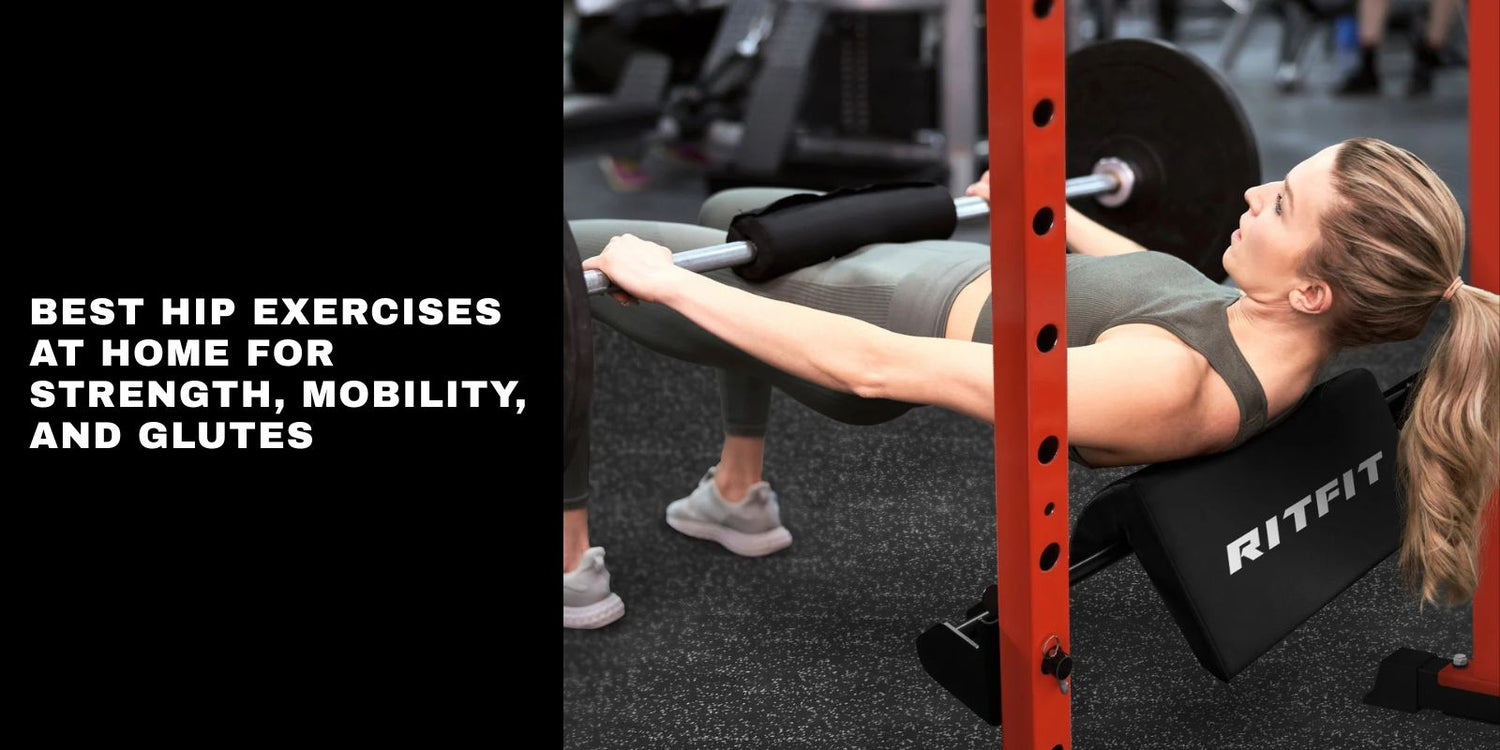
The hip thrust is a strong loaded option for training hip extension and glute strength. Research on gluteus maximus activation shows that hip thrusts, squats, deadlifts, lunges, and related strength exercises can create high glute demand when performed correctly.[2]
- Step 1: Set up a stable hip thrust position with your upper back supported.
- Step 2: Place the barbell across the hips with padding for comfort.
- Step 3: Drive through your heels and extend your hips.
- Step 4: Stop when your torso and thighs form a straight line.
- Step 5: Lower with control and keep your ribs down.
- Sets and reps: Perform 4 sets of 8 to 12 reps.
For a dedicated rack based setup, consider the RitFit PAT01 hip thrust attachment. You can also review the RitFit tutorial on how to do Smith machine hip thrusts for more glute training setup guidance.
9. Cable Hip Abduction
Cable hip abduction trains the side glutes with smooth resistance and a clear movement path. It is useful for lifters who want more targeted gluteus medius work than clamshells or band walks provide.
- Step 1: Attach an ankle strap to a low cable.
- Step 2: Stand sideways to the cable with the working leg farthest from the machine.
- Step 3: Move the leg away from the body without leaning.
- Step 4: Pause briefly at the outer range.
- Step 5: Return slowly and keep tension on the cable.
- Sets and reps: Perform 3 sets of 12 to 15 reps per side.
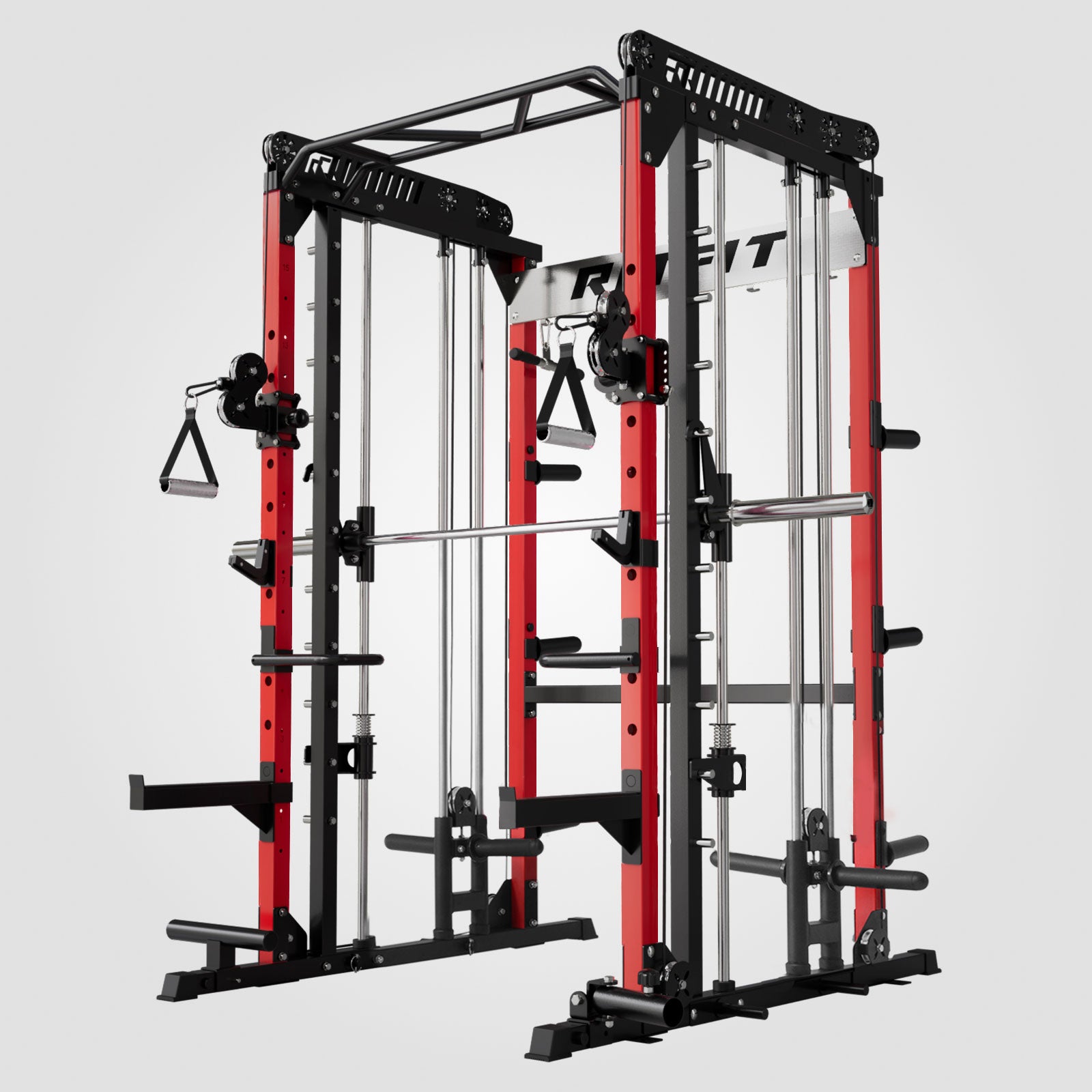
A cable station or Smith machine with cable system can make hip abduction and kickback variations easier to load. Browse the RitFit Smith machine collection if you want one station for lower body, upper body, and cable accessory training.
10. Cable Kickbacks
Cable kickbacks train hip extension with continuous resistance through the working range. They are best used as an accessory after heavier hip thrusts, split squats, or leg press work.
- Step 1: Attach an ankle strap to a low cable.
- Step 2: Face the machine and hold the frame for balance.
- Step 3: Lean forward slightly while keeping your back flat.
- Step 4: Drive the working leg back by squeezing the glute.
- Step 5: Return slowly without swinging the leg.
- Sets and reps: Perform 3 sets of 12 to 15 reps per side.
11. Bulgarian Split Squats with a RitFit Bench
A stable adjustable bench helps make Bulgarian split squats repeatable in a home gym. The RitFit GATOR adjustable weight bench is a relevant option for bench based lower body and full body strength work.
- Step 1: Place one foot behind you on the bench.
- Step 2: Keep your front foot planted and torso controlled.
- Step 3: Lower into a split squat without bouncing.
- Step 4: Press through the front foot to stand.
- Step 5: Add dumbbells only after your balance is consistent.
- Sets and reps: Perform 3 sets of 8 to 12 reps per leg.
12. High Foot Leg Press with RitFit Gazelle Pro
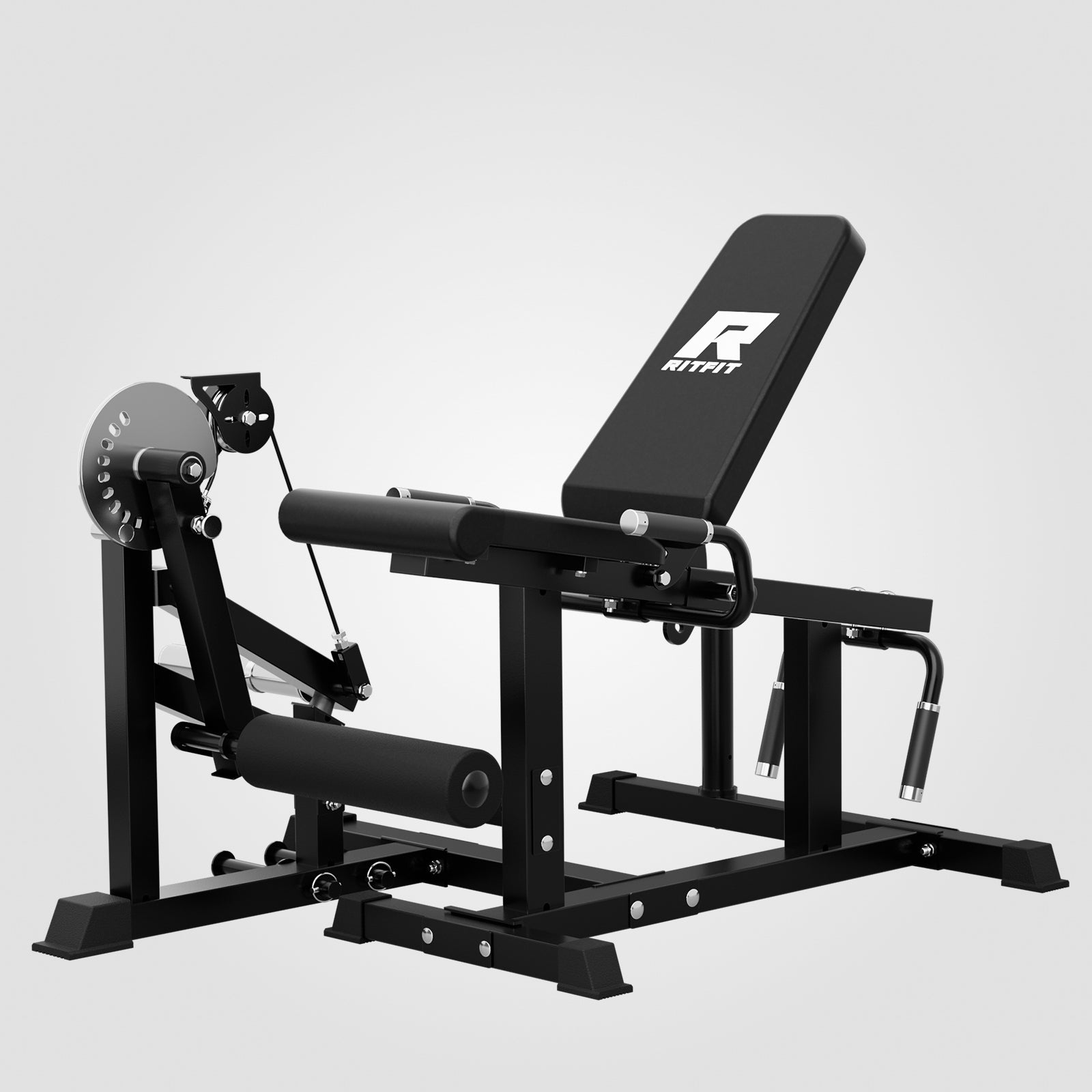
A higher foot position on a leg press generally shifts more work toward the glutes and hamstrings compared with a lower quad focused position. The RitFit Gazelle Pro leg press and hack squat machine is a strong upgrade for home lower body training.
- Step 1: Set up the machine in leg press mode according to the product manual.
- Step 2: Place your feet high on the platform and slightly wider than hip width.
- Step 3: Lower with control through a comfortable range.
- Step 4: Press through your full foot and avoid locking the knees hard.
- Step 5: Start light and increase load gradually.
- Sets and reps: Perform 4 sets of 8 to 12 reps.
For more equipment based glute training, read the RitFit guide to the best gym machines for glutes. You can also explore the RitFit strength machines collection for lower body and full body training options.
Hip Mobility Stretches for Tight Hips
Hip mobility work should improve comfortable range of motion without forcing painful positions. A systematic review on hip flexor stretching found that stretching can influence performance related measures, which supports using mobility work as part of a broader training plan rather than as the only solution.[3]
90 90 Hip Stretch
The 90 90 stretch targets hip rotation and helps improve control in seated hip positions. Sit with one leg in front and one leg behind, both bent near 90 degrees, then lean forward gently over the front leg.
Pigeon Pose
Pigeon pose stretches the outer hip and glute region when performed within a comfortable range. Bring one knee forward, extend the opposite leg behind you, and keep pressure mild rather than forcing the hip down.
Couch Stretch
The couch stretch targets the hip flexors and front thigh after long sitting periods. Keep the ribs down and glutes gently engaged so the stretch stays in the front of the hip instead of the lower back.
Frog Stretch
The frog stretch targets the inner thighs and hip adductors. Keep your knees wide, feet in line with the knees, and shift backward only as far as you can control.
Sample Home Hip Workout Routines
The best hip routine depends on your current strength, available equipment, and recovery. Start with 2 sessions per week, then add a third session if your hips feel recovered and your lower body training volume allows it.
Beginner Hip Workout at Home
This routine is best for new lifters, desk workers, and anyone rebuilding hip control with no equipment. Move slowly and stop any exercise that causes sharp pain.
- Warm up: Hip circles, 10 each direction per leg.
- Exercise 1: Glute bridges, 3 sets of 12 reps.
- Exercise 2: Clamshells, 3 sets of 15 reps per side.
- Exercise 3: Fire hydrants, 3 sets of 12 reps per side.
- Exercise 4: Bird dogs, 3 sets of 10 reps per side.
- Cool down: 90 90 stretch and couch stretch, 30 seconds per side.
Glute Strength Workout with Equipment
This routine is best for users who already control bodyweight hip exercises and want stronger progressive overload. Use controlled reps and increase weight only when form stays consistent.
- Warm up: Lateral band walks, 2 sets of 12 steps per side.
- Exercise 1: Hip thrusts, 4 sets of 8 to 12 reps.
- Exercise 2: Bulgarian split squats, 3 sets of 8 to 10 reps per side.
- Exercise 3: Cable hip abductions, 3 sets of 12 to 15 reps per side.
- Exercise 4: Cable kickbacks, 3 sets of 12 reps per side.
- Cool down: Couch stretch and frog stretch, 30 to 45 seconds each.
Hip Mobility Routine for Desk Workers
This short routine is best for hips that feel stiff after long sitting periods. Use it as a movement break rather than a hard workout.
- Move 1: Standing hip circles, 10 each direction per leg.
- Move 2: Glute bridges, 2 sets of 12 reps.
- Move 3: 90 90 hip switches, 8 slow reps per side.
- Move 4: Couch stretch, 30 seconds per side.
- Move 5: Easy bodyweight squats, 10 controlled reps.
How to Progress Hip Exercises at Home
Progress hip exercises by adding resistance, range of motion, reps, or control, not by rushing through harder variations. Hip focused neuromuscular training has been reviewed as a way to address dynamic lower extremity valgus, which makes controlled progression especially important for knee and hip mechanics.[4]
- Level 1: Start with glute bridges, clamshells, fire hydrants, and bird dogs.
- Level 2: Add bands to glute bridges, clamshells, and lateral walks.
- Level 3: Add dumbbells to split squats and step based movements.
- Level 4: Add barbell hip thrusts, cable abductions, and cable kickbacks.
- Level 5: Add machine based training such as leg press and hack squat variations.
Common Hip Exercise Mistakes to Avoid
Most hip training mistakes come from moving too fast, loading too soon, or letting the lower back replace the glutes. Fixing these errors usually makes the same exercises feel more effective without adding more movements.
- Arching the lower back: Keep your ribs down and stop hip extension when the glutes finish the rep.
- Skipping side glute work: Include clamshells, band walks, fire hydrants, or cable abductions for gluteus medius training.
- Only stretching tight hips: Pair hip flexor stretches with glute strengthening so the hips build both mobility and control.
- Using momentum: Move slowly during abduction and kickback exercises to keep tension on the target muscles.
- Training through pain: Modify or stop exercises that create sharp hip, knee, or lower back pain.
When to Stop or Modify Hip Exercises
Stop or modify hip exercises if pain becomes sharp, nerve like, or worse as the set continues. A systematic review on hip strengthening for non specific low back pain suggests hip strengthening can be relevant in broader exercise plans, but it should not replace individualized medical care when symptoms are significant.[5]
- Use a smaller range: Shorten the movement if the end range feels pinchy or unstable.
- Reduce the load: Choose bodyweight or band work before returning to heavier hip thrusts or machine training.
- Slow the tempo: Controlled reps often reveal whether you are using the target hip muscles or momentum.
- Change the exercise: Swap painful variations for simpler options such as bridges, bird dogs, or supported split squats.
- Seek support: Consult a qualified professional if pain persists or affects daily movement.
Recommended RitFit Equipment for Home Hip Training
The right equipment depends on your goal and space. Start simple, then add equipment when you need smoother progression, more resistance, or a more complete home gym setup.
- For hip thrusts: Use the RitFit PAT01 hip thrust attachment with a compatible rack setup.
- For split squats: Use an adjustable bench such as the RitFit GATOR bench for rear foot support.
- For cable work: Use a RitFit Smith machine with cable system for abductions and kickbacks.
- For heavier lower body training: Use the RitFit Gazelle Pro for leg press and hack squat patterns.
- For free weight progressions: Browse the RitFit dumbbells collection for split squats, RDLs, and step based movements.
FAQs
What are the best hip exercises at home for beginners?
The best beginner hip exercises at home are glute bridges, clamshells, fire hydrants, bird dogs, and standing hip circles. These moves build basic hip extension, side glute control, core stability, and mobility without requiring heavy equipment or advanced balance skills.
Can hip exercises at home help tight hips from sitting?
Yes. Hip exercises at home can help tight hips from sitting when they combine mobility work with glute strengthening. Hip circles, couch stretches, 90 90 stretches, and glute bridges can improve movement quality, but persistent pain should be assessed by a qualified professional.
How often should I do hip exercises at home?
Most people can train hips at home 2 to 3 times per week. Beginners should start with shorter sessions and controlled reps, while stronger lifters can add loaded hip thrusts, split squats, cable abductions, or leg press work as recovery allows.
Which hip exercises target the side glutes?
The best hip exercises for side glutes are clamshells, fire hydrants, lateral band walks, and cable hip abductions. These exercises train the gluteus medius and gluteus minimus, which help stabilize the pelvis and support better knee tracking during lower body movement.
Are hip thrusts better than glute bridges?
Hip thrusts are better for progressive glute strength once glute bridges become too easy. Glute bridges are still useful for beginners, warm ups, and bodyweight activation, while hip thrusts allow more load through a larger training progression using a bench, barbell, or rack attachment.
Should I stretch or strengthen tight hips first?
You should usually combine stretching and strengthening rather than choosing only one. Stretching can improve short term comfort and range, while glute bridges, clamshells, and split squats help your hips control that range during real movement and strength training.
What RitFit equipment is best for home hip training?
The best RitFit equipment depends on your goal. The PAT01 supports hip thrusts, the GATOR bench supports split squats, Smith machines with cables support abductions and kickbacks, and the Gazelle Pro supports heavier leg press and hack squat lower body training.
How long does it take to strengthen hips at home?
Most beginners can feel better hip control within a few weeks of consistent practice. Visible strength and muscle changes usually require longer training, progressive resistance, enough recovery, and a balanced routine that includes hip extension, hip abduction, mobility, and single leg work.
Conclusion
The best hip exercises at home combine glute strength, side glute stability, single leg control, and hip mobility. Start with bodyweight basics, progress to bands and dumbbells, then use RitFit equipment when you need heavier loading and smoother progression.
Consistency matters more than exercise variety. Choose a routine you can repeat 2 to 3 times per week, move with control, and build resistance gradually.
Disclaimer: This article is for general fitness education only and is not medical advice. If you have hip pain, lower back pain, recent injury, surgery, numbness, or symptoms that worsen during exercise, stop training and consult a licensed healthcare professional before continuing.
References
- Lanza MB Arbuco B Ryan AS Shipper AG Gray VL Addison O. Systematic review of the importance of hip muscle strength, activation, and structure in balance and mobility tasks. Arch Phys Med Rehabil. 2022;103(8):1651-1662. doi:10.1016/j.apmr.2021.12.008.
- Neto WK Soares EG Vieira TL Aguiar R Chola TA Sampaio VDL Gama EF. Gluteus maximus activation during common strength and hypertrophy exercises. A systematic review. J Sports Sci Med. 2020;19(1):195-203.
- Konrad A Močnik R Titze S Nakamura M Tilp M. The influence of stretching the hip flexor muscles on performance parameters. A systematic review with meta analysis. Int J Environ Res Public Health. 2021;18(4):1936. doi:10.3390/ijerph18041936.
- Ford KR Nguyen AD Dischiavi SL Hegedus EJ Zuk EF Taylor JB. An evidence based review of hip focused neuromuscular exercise interventions to address dynamic lower extremity valgus. Open Access J Sports Med. 2015;6:291-303. doi:10.2147/OAJSM.S91271.
- Santamaría G Rodríguez I Matani Chimnani R Cobreros Mielgo R Lantarón Caeiro E Fernández Lázaro D. Effect of hip muscle strengthening exercises on pain and disability in patients with non specific low back pain. A systematic review. Sports. 2023;11(9):167. doi:10.3390/sports11090167.