Choosing the best home gym lat pulldown machine transforms your upper-body training by providing dedicated vertical pulling resistance for back width and posture. A dedicated cable pulldown system allows controlled eccentric loading and multiple grip angles that standard pull-up bars cannot replicate.
Whether you need a compact plate-loaded rack attachment or a heavy-duty all-in-one cable station, this guide evaluates the top options for home lifters. Discover how different cable ratios, pulley setups, and attachment bundles maximize your workout space and training ROI.
Quick Answer: The best home gym lat pulldown machine is a versatile multi-functional power rack or Smith machine setup with an integrated high-low cable pulley system. It provides superior back hypertrophy, space efficiency, and long-term training versatility compared to bulky single-purpose selectorized lat pulldown towers.
Key Takeaways
- Hypertrophy Advantage: Lat pulldown machines allow scalable vertical pulling resistance with targeted latissimus dorsi isolation that pull-up bars cannot match.
- Multi-Function Efficiency: All-in-one Smith machine and rack systems offer high-low pulleys that replace multiple single-station gym machines in a single home footprint.
- Smooth Cable Ratios: Dual 2:1 and 1:1 pulley systems deliver optimal resistance curves for both explosive athletic work and heavy compound pulldowns.
- Attachment Versatility: Using varied cable attachments like wide bars, close-grip triangles, and straight bars enables complete upper-back and arm development.
- Floor & Space Planning: Ensure at least 84 to 90 inches of vertical ceiling clearance and adequate lateral bench room before installing your station.
Why Does a Home Lat Pulldown Machine Matter?
A home lat pulldown machine provides constant tension and incremental load adjustments across the entire vertical pulling range of motion. This mechanical advantage allows lifters of any strength level to systematically build back width and spinal stability[1].
Unlike bodyweight pull-ups where leverage is fixed, cable pulldowns let you modify torso angles, grip widths, and resistance curves[2]. Integrating dedicated cable pulling into your home gym Smith machines and power racks ensures balanced muscular development across the latissimus dorsi, rhomboids, and lower trapezius.
- Targeted Lat Isolation: Emphasizes the lats through full shoulder adduction and depression without grip fatigue limiting your set.
- Progressive Overload Control: Fine-tune weights in small increments rather than relying solely on bodyweight jumps.
- Joint-Friendly Mechanics: Reduces shoulder impingement and elbow tendon strain by accommodating neutral and rotating grip attachments.
For lifters recovering from injury or building baseline pulling strength, cable machines offer controlled eccentric phases that maximize muscle hypertrophy safely.
Who Should Buy a Home Lat Pulldown Station?
Anyone aiming to build back strength, improve posture, or supplement compound barbell lifts benefits from a dedicated home lat pulldown station. It is especially valuable for trainees who cannot perform high-volume pull-ups or need targeted rehab movements.
Bodybuilders, powerlifters, and general fitness enthusiasts can all leverage cable systems for specialized accessory work. Exploring the RitFit M1 Multi-Functional Home Gym Smith Machine gives lifters a versatile platform combining heavy barbell work with smooth overhead pulling.
- Beginner Lifters: Build foundational vertical pulling strength before mastering full bodyweight pull-ups.
- Hypertrophy Trainees: Deliver high-volume back workouts with drop sets and extended sets without fatiguing the core.
- Home Gym Owners: Maximize equipment utility by selecting stations that combine high and low pulleys with rack safety catches.
Whether you train in a compact garage gym or a dedicated basement workout room, a high-pulley setup elevates back training versatility.
Standalone Lat Pulldown vs Smith Machine: Which Is Better?
A Smith machine with an integrated lat pulldown is superior for most home gyms because it combines rack training, guided barbell exercises, and dual cable crossovers in one footprint. Standalone lat pulldown towers only excel when commercial-grade single-purpose isolation is the sole priority.
Choosing an all-in-one system eliminates the need for multiple bulky frames, freeing up valuable floor space for benches and weight storage.
| Feature | Standalone Lat Pulldown Machine | All-in-One Smith Machine & Cable System |
|---|---|---|
| Footprint & Space | Dedicated 15-20 sq ft for a single exercise station | Consolidated 35-45 sq ft replacing 5+ commercial stations |
| Exercise Variety | Limited to lat pulldowns and seated low rows | Lat pulldowns, low rows, cable crossovers, squats, and presses |
| Cost Efficiency | Moderate cost per single exercise function | High overall investment value per available training movement |
| Weight System | Plate-loaded peg or single selectorized stack | Dual weight stacks or heavy-duty plate-loaded carriages |
Comparison reflects standard home gym footprint requirements and movement versatility across commercial and residential fitness equipment.
Weight Stack vs Plate Loaded: Which Is Better?
Weight stack lat pulldown machines offer rapid pin-select adjustments for supersets and drop sets, whereas plate-loaded systems provide cost efficiency by utilizing your existing Olympic weight plates. Both deliver exceptional muscle stimulus when engineered with smooth guide rods.
If budget and plate reuse are your top priorities, plate-loaded carriages deliver high weight capacities at an accessible price point. If seamless workflow and quick family adjustments matter most, selectorized pin stacks provide unbeatable convenience.
- Pin-Selected Weight Stacks: Enable instantaneous resistance changes with zero manual plate loading, ideal for high-intensity training.
- Plate-Loaded Carriages: Cost-effective engineering that scales infinitely with standard 2-inch Olympic bumper and cast iron plates.
- Cable Feel & Friction: Precision bearings and nylon-coated aircraft cables ensure a smooth stroke on both system types.
Reviewing your existing plate inventory will help determine whether a selectorized package or plate-loaded setup aligns best with your training goals.
What Should You Look for in the Best Home Gym Lat Pulldown Machine?
Key factors include steel frame gauge, smooth pulley bearing systems, adjustable thigh hold-down rollers, and high weight capacity. Prioritizing robust structural engineering ensures stability during heavy rows and pulldowns.
Look for commercial-grade 2x2 or 2x3-inch steel tubing with electrostatic powder coating to resist corrosion and wear over years of rigorous daily use.
- Thigh Hold-Down Pads: Multi-position adjustable foam rollers prevent your body from rising during heavy working sets.
- Aircraft-Grade Steel Cables: Rated for at least 1,000 to 2,000 lbs tensile strength with wear-resistant nylon coatings.
- Dual High-Low Pulley Access: Enables seamless switching between overhead lat pulldowns and ground-level seated cable rows.
- Smooth Guide Rod Alignment: Solid chrome-plated guide rods ensure minimal friction and silent travel under full load.
Investing in reliable build quality guarantees safety and performance across thousands of training repetitions.
What Are the Best RitFit Lat Pulldown Setups for Home Gyms?
RitFit offers comprehensive Smith machines and power rack cable packages engineered specifically for residential ceiling heights and heavy lifting demands. From the all-in-one BUFFALO to the compact M1 series, each platform delivers smooth vertical pulling mechanics.
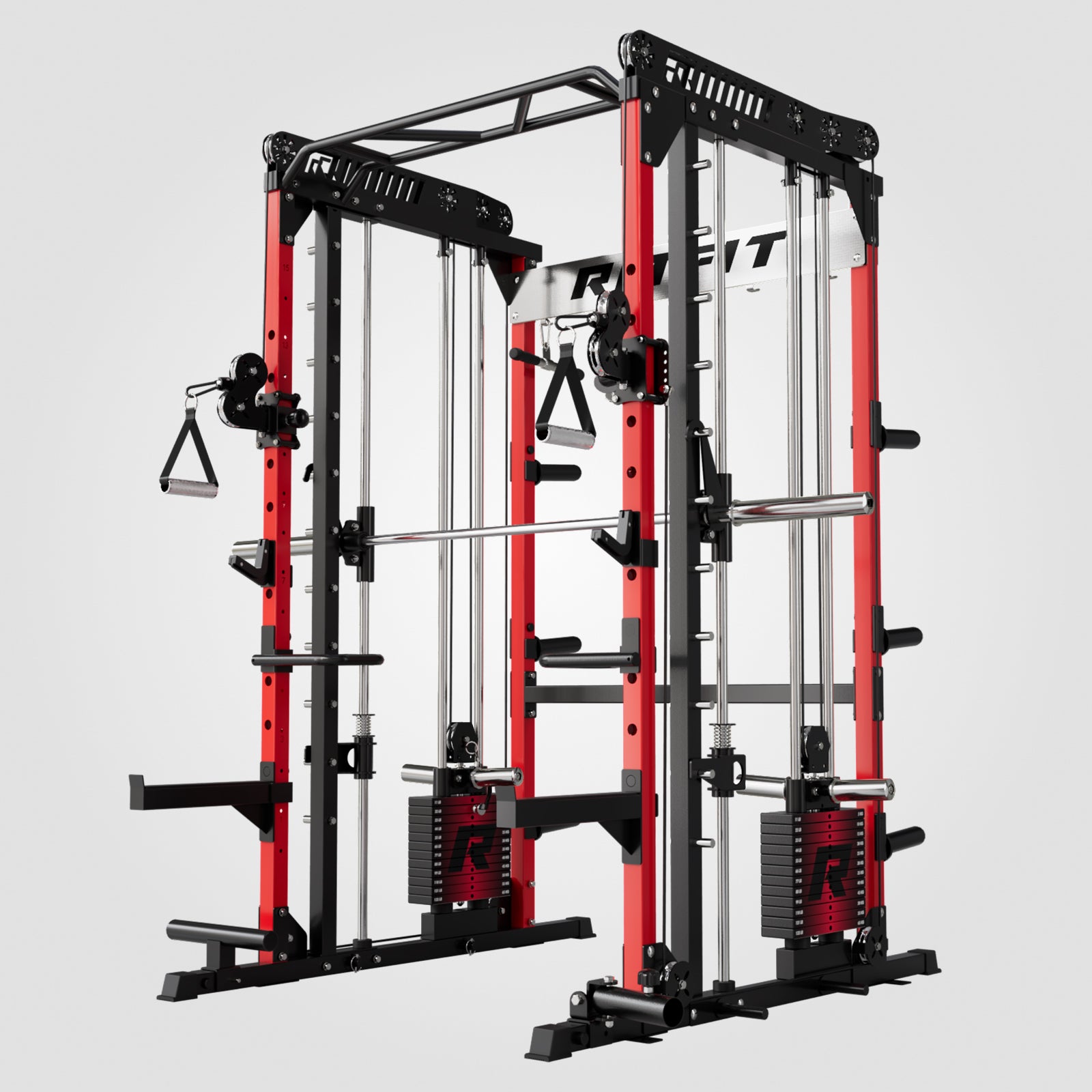
The flagship RitFit BUFFALO Smith Machine Home Gym Package with Lat Pull Down and Cable Crossover features heavy-gauge uprights, smooth linear bearings, and an integrated high-low pulley system for complete full-body training.
- RitFit BUFFALO Series: Combines a commercial Smith bar, dual 2:1 cable crossovers, dedicated lat pulldown station, and multi-grip pull-up handles in one rugged structure.
- RitFit M1 & M1 PRO Series: Available in both plate-loaded and dual weight stack configurations, such as the RitFit M1 Pro Smith Machine Weight Stack Home Gym Package, featuring compact footprints and precision pulleys.
- RitFit BPC06 All-In-One: The RitFit BPC06 All-In-One Smith Machine Home Gym Package provides dual 260 lb weight stacks for effortless pin adjustments during intense back workouts.
- Versatile Cable Bundles: Upgrade your setup with the RitFit Lat Pulldown Attachments and Cable Machine Attachments bundle to target every angle of your back and arms.
"For $1,800, this machine delivers a combination of build quality, stability, and versatility that is rare at this price. The BUFFALO is not a machine that excels at one thing. It is a platform that lets you program an entire training week without ever stepping off the frame."
— BJ Nelson, Head of Field Testing at The Iron Clinic
What Are the Best Lat Pulldown Exercises for Home Back Training?
The best lat pulldown exercises include wide-grip pulldowns, close-grip neutral pulldowns, reverse-grip pulldowns, and straight-arm cable pullovers. Varying your hand position and grip width recruits distinct regions of the lats and upper back musculature[3].
Rotating through these variations prevents overuse plateaus and builds comprehensive back thickness, width, and shoulder girdle stability.
- Wide-Grip Lat Pulldowns: Targets the upper lat fibers and teres major to create a prominent V-taper silhouette.
- Close-Grip Neutral Pulldowns: Places the shoulders in a biomechanically strong position to heavily load the mid and lower lats.
- Underhand Reverse-Grip Pulldowns: Increases biceps recruitment while emphasizing the lower lat attachments near the lumbar spine.
- Standing Straight-Arm Pullovers: Isolates the lats through pure shoulder extension without biceps involvement.
- Seated Cable Low Rows: Develops mid-back density across the rhomboids, middle trapezius, and posterior deltoids.
To complement upper-body pulling with lower-back and posterior chain stability, incorporating movements on the RitFit BE01 Adjustable Back Extension Machine reinforces spinal erector health.
What Are Good Home Back Workouts With a Lat Pulldown Machine?
A balanced back workout incorporates both vertical and horizontal pulling movements paired with targeted isolation finishers. Structuring your sets with progressive overload yields optimal muscle hypertrophy and strength gains[4].
Perform the following sample routines 1 to 2 times weekly, allowing at least 48 hours of recovery between intensive back sessions.
| Workout Routine | Exercise Sequence | Sets & Reps | Primary Target |
|---|---|---|---|
| Hypertrophy V-Taper | Wide-Grip Lat Pulldown Seated Cable Low Row Straight-Arm Cable Pullover |
4 x 8-10 3 x 10-12 3 x 12-15 |
Lat Width, Mid-Back Thickness, Lat Isolation |
| Strength & Density | Smith Machine Bent-Over Row Close-Grip Neutral Pulldown Face Pulls with Rope |
4 x 6-8 3 x 8-10 3 x 15-20 |
Overall Back Power, Lower Lats, Rear Deltoids |
| Time-Efficient Circuit | Lat Pulldown Superset with Low Row Straight-Arm Pulldown Finisher |
3 x 10-12 each 2 x 15-20 |
Back Conditioning and Rapid Metabolic Pump |
Rest 90 to 120 seconds between compound working sets, and 60 seconds between isolation and superset movements.
What Space and Setup Does a Home Lat Pulldown Machine Need?
Most home lat pulldown stations require a ceiling height of at least 84 to 90 inches and a dedicated floor footprint of roughly 6 feet by 7 feet. Leaving adequate clearance ensures full range of motion during overhead pulldowns and unhindered plate loading.
Proper room planning prevents frustrating installation obstacles and creates a safe, comfortable lifting environment.
- Ceiling Clearance: Measure your ceiling height accurately, accounting for overhead joists, lighting fixtures, and garage door tracks.
- Floor Protection: Install high-density rubber stall mats (3/8 or 1/2 inch) to protect your subfloor and reduce vibration.
- Perimeter Working Space: Maintain at least 2 feet of open clearance around the machine sides and rear for smooth plate changes.
- Bench Positioning: Ensure your adjustable weight bench can slide freely into the center of the station for seated cable movements.
Taking accurate room measurements prior to delivery ensures seamless assembly and immediate training readiness.
How Do You Keep a Home Lat Pulldown Machine Safe?
Regular maintenance involves inspecting cable tension, checking carabiner integrity, and lubricating chrome guide rods with silicone spray. Routine upkeep ensures silent pulley glide and prevents premature mechanical wear.
Follow a simple monthly inspection checklist to ensure your home gym equipment remains in peak operational condition.
- Monthly Guide Rod Lubrication: Wipe down solid chrome guide rods and apply 100% silicone lubricant to maintain smooth carriage travel.
- Cable Wear Inspection: Inspect nylon cable coatings for any fraying, kinks, or stripping, replacing worn cables immediately.
- Hardware Tightening: Periodically check all frame bolts, locknuts, and pulley brackets with a socket wrench to prevent loose joints.
- Carabiner & Attachment Checks: Ensure all locking snap hooks and attachment weld points are secure before loading heavy weight.
Proper equipment care guarantees decades of reliable performance and maximum training safety in your home space.
What Buying Mistakes Should You Avoid With a Lat Pulldown Machine?
Common mistakes include ignoring ceiling height limits, overlooking cable pulley ratios, buying low-capacity frames, and skipping adjustable thigh hold-downs. Avoiding these pitfalls ensures you choose a machine tailored to your exact physical and spatial requirements.
Investing in a high-quality multi-functional platform prevents costly equipment replacements down the road.
- Ignoring Cable Ratios: Be aware of 2:1 versus 1:1 pulley systems so you understand the true effective resistance felt at the handle.
- Underestimating User Height: Lifters over 6 feet tall need adequate vertical cable travel to achieve a full overhead stretch without bottoming out.
- Settling for Cheap Plastic Pulleys: Insist on heavy-duty nylon or aluminum pulleys with sealed ball bearings for fluid gliding motion.
- Overlooking Expandability: Choose modular power racks and Smith machines that accept future attachments like dip bars and leg presses.
Carefully auditing equipment specifications guarantees that your home gym investment matches your long-term fitness aspirations.
FAQs About the Best Home Gym Lat Pulldown Machine
What is the best home gym lat pulldown machine for most users?
The best home gym lat pulldown machine for most users is a multi function setup that combines lat pulldowns, rows, cable work, and rack training. This gives better long term value than a single purpose station, especially when space, budget, and exercise variety all matter.
Is a Smith machine with lat pulldown better than a standalone lat machine?
Yes. A Smith machine with lat pulldown is usually better for a complete home gym because it supports more training patterns in one footprint. A standalone lat machine can still work well if your only priority is vertical pulling and you already own other strength stations.
Can a home lat pulldown station build a wider back?
Yes. A home lat pulldown station can help build a wider back when you train consistently, use full control, and progress resistance over time. Include wide grip pulldowns, close grip pulldowns, rows, and straight arm pulldowns to train the lats and upper back from multiple angles.
What attachments do I need for lat pulldowns at home?
You need a lat bar first, then a close grip handle, rope, straight bar, and D handles if you want more variety. These attachments let you train pulldowns, seated rows, face pulls, curls, pushdowns, and straight arm pulldowns without buying separate machines.
Is plate loaded or weight stack better for a home lat pulldown machine?
Weight stack is better for fast changes and shared use, while plate loaded is better if you already own Olympic plates. Choose weight stack for convenience, drop sets, and cleaner transitions, and choose plate loaded if you want lower upfront cost and already have a plate collection.
How much ceiling height do I need for a home lat pulldown machine?
Most home lat pulldown machines require between 84 and 90 inches of vertical ceiling clearance. You should also ensure adequate space for your head and hands during pull-ups, as well as clear overhead room away from lighting fixtures and ceiling fans.
Conclusion
Selecting the best home gym lat pulldown machine elevates your upper-body training with consistent vertical pulling tension and unmatched muscle isolation. An all-in-one cable and rack setup delivers lasting training versatility while conserving valuable home gym floor space.
Equip your workout space with the right cable attachments and progressive programming to maximize your back hypertrophy. Explore the RitFit discount guide to find the best current savings on high-performance home gym packages.
Disclaimer
This article provides general fitness and strength training information for educational purposes only and is not a substitute for professional medical or exercise advice. Always consult a qualified physician or certified trainer before beginning any new training program or using heavy gym equipment.
References
1. Buonsenso A, Di Fonza D, Di Claudio G, Carangelo M, Centorbi M, di Cagno A, Calcagno G, Fiorilli G. Electromyographic analysis of back muscle activation during lat pulldown exercise: effects of grip variations and forearm orientation. J Funct Morphol Kinesiol. 2025;10(3):345. doi:10.3390/jfmk10030345. PMCID: PMC11933215.
2. Padovan R, Toninelli N, Longo S, Tornatore G, Esposito F, Cè E, Coratella G. High density electromyography excitation in front vs back lat pull down prime movers. J Hum Kinet. 2024;91:47-60. doi:10.5114/jhk/185211. PMCID: PMC10928913.
3. Krzysztofik M, Wilk M, Wojdała G, Gołaś A. Maximizing muscle hypertrophy, a systematic review of advanced resistance training techniques and methods. Int J Environ Res Public Health. 2019;16(24):4897. doi:10.3390/ijerph16244897. PMCID: PMC6950543.
4. Paluch AE, Boyer WR, Franklin BA, Laddu D, Lobelo F, Lee DC, et al. Resistance exercise training in individuals with and without cardiovascular disease, 2023 update, a scientific statement from the American Heart Association. Circulation. 2024;149(3):e217-e231. doi:10.1161/CIR.0000000000001189. PMCID: PMC10800123.