








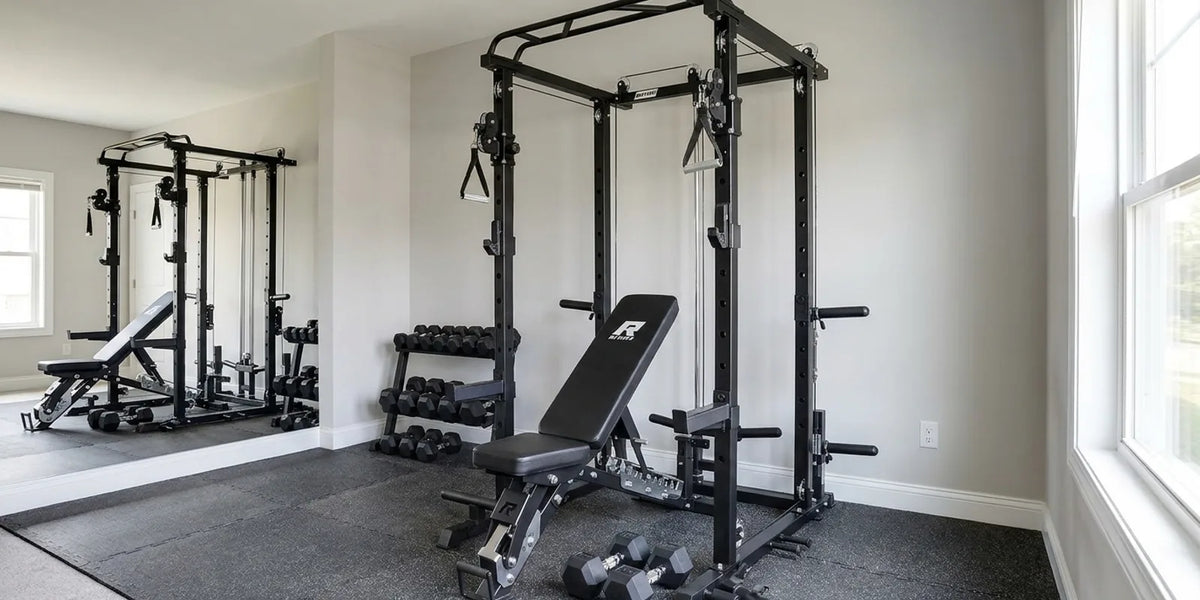
Determining the ideal dimensions for your home workout space is the critical first step before buying equipment. This home gym size guide covers exact square footage requirements, clearance zones, and ceiling height rules for spaces ranging from spare bedrooms to multi-car garages.
Whether configuring a compact 50-square-foot corner or a dedicated 200-square-foot training facility, proper planning prevents costly layout mistakes and safety hazards.
Quick Answer: A functional home gym requires between 50 square feet for compact dumbbell setups and 150 to 200 square feet for a full barbell squat rack and cable station. Safe lifting demands at least 8 to 9 feet of vertical ceiling height along with 2 to 3 feet of perimeter walking clearance.
Key Takeaways
- Minimum Footprint: Basic dumbbell and bench setups need a minimum of 50 to 100 square feet of dedicated floor space.
- Full Barbell Clearance: Standard 7-foot Olympic barbells demand at least 120 to 150 square feet for safe loading and movement.
- Vertical Heights: Standard ceiling heights of 8 to 9 feet accommodate pull-ups and overhead pressing movements comfortably.
- Perimeter Spacing: Maintaining 2 to 3 feet of open perimeter around power cages ensures smooth loading and unencumbered walking paths.
- Modular Solutions: All-in-one functional trainers and multi-station cages combine several machines into a single compact footprint.
How Much Space Is Needed for a Home Gym?
A functional home gym requires anywhere from 50 to 200 square feet depending entirely on the type of equipment you intend to house. Compact training setups with dumbbells and an adjustable bench operate comfortably within an 8-by-10-foot footprint.
A US study of emergency department visits found mechanical home exercise equipment injuries are common and that unsupervised children are at higher risk, emphasizing the need for designated safety perimeters around machines[1]. When upgrading to comprehensive barbell training and multi-station equipment, your layout must provide enough room for movement execution and safety buffers.
To plan your space systematically, explore the detailed blueprints in our comprehensive Home Gym Guide and browse creative layouts in our Home Gym Ideas gallery.
What Are the Standard Dimensions for Common Gym Footprints?
Standard home gym footprints generally fall into three tiers: compact rooms under 100 square feet, mid-sized spare rooms of 100 to 150 square feet, and large garage bays spanning 200 square feet or more. Choosing the correct footprint ensures you maintain adequate movement mechanics without feeling restricted during heavy lifts.
Reviews of resistance training injuries identify improper technique and excessive loading as common contributing factors and recommend progressive overload management in an unrestricted environment[2]. The comparison table below highlights typical square footage, dimensions, and optimal setups across standard residential room sizes.
| Space Category | Room Dimensions | Total Area | Recommended Equipment Setup | Best Suited For |
|---|---|---|---|---|
| Compact Corner | 7 ft × 8 ft | 56 sq ft | Adjustable Dumbbells, Foldable Flat Bench, Resistance Bands | Apartments, Studio Living |
| Small Spare Room | 10 ft × 10 ft | 100 sq ft | Compact Half Rack, Barbell, Adjustable Bench, Weight Plates | Dedicated Bedroom Gym |
| Medium Multi-Use | 10 ft × 14 ft | 140 sq ft | All-in-One Smith Machine, Full Bench, Cable Attachments | Master Bedroom, Home Office |
| One-Car Garage | 10 ft × 20 ft | 200 sq ft | Full Power Cage, Plate Tree, Dumbbell Rack, Cardio Station | Garage Gym Enthusiasts |
| Two-Car Garage | 20 ft × 20 ft | 400 sq ft | Dual Racks, Full Cable Crossover, Deadlift Platform, Specialty Bars | Comprehensive Training Facility |
Dimensions represent clear usable floor space excluding permanent architectural obstructions such as doors, water heaters, and structural pillars.
Investing in pre-engineered packages like our curated Home Gym Packages eliminates dimensional guesswork by pairing compatible machines with matched footprints.
Which Equipment Fits Best in Small, Medium, and Large Spaces?
Selecting equipment tailored to your room dimensions maximizes training versatility while preserving vital open floor space. Mid-sized and large training spaces benefit immensely from multi-functional stations that consolidate racks, cables, and smith bars into a unified framework.
A study published in PMC found that both squat and deadlift training produced significant lower body strength gains over 6 weeks of training, proving that foundational multi-joint lifts remain the core driver of progress regardless of footprint size[3]. For dedicated strength spaces, high-capacity systems from our Power Cages collection and versatile units from our Smith Machines lineup deliver total-body workout capability.
Top equipment recommendations grouped by available room footprint include:
- Compact Spaces (50-100 sq ft): The RitFit P3 Power Cage Home Gym Package provides robust 1200-lb structural capacity while utilizing a space-efficient vertical profile.
- Medium Spaces (100-150 sq ft): The M1 Multi-Functional Home Gym Smith Machine or complete RitFit Home Gym Package M1 Smith Machine incorporates integrated dual cable pulleys and fixed safety spotters within a single footprint.
- Large Garage Spaces (150+ sq ft): The premium RitFit Buffalo Smith Machine Package features commercial-grade integrated pin-loaded weight stacks for instant resistance transitions.
"Somehow, someway, REP packed a free-weight rack (for bench presses and squats), a pullup bar, and a cable row into a unit that fits in a bedroom-sized home gym. And yes, I love it."
— Ebenezer Samuel, C.S.C.S. Fitness Director, Men's Health
How Much Ceiling Height and Clearance Are Required for Safe Lifting?
A minimum vertical ceiling height of 8 feet is required for standard power racks and pull-up clearance, with 9 to 10 feet being optimal for overhead barbell presses. Horizontal clearance demands at least 2 feet along each sleeve of a 7.2-foot Olympic barbell to allow plate loading without striking adjacent walls.
A study found that both lighter and heavier loads produced comparable squat strength gains when total volume was matched, meaning a compact rack setup is sufficient for meaningful progress as long as proper clearance is maintained[4]. Measuring your space with safety margins guarantees fluid workouts and prevents collisions during explosive lifts.
FAQs About Home Gym Size
What is the absolute minimum room size for a functional home gym?
A functional home gym requires a minimum footprint of 50 to 100 square feet for basic strength training. An area measuring 8 feet by 10 feet provides sufficient room for an adjustable bench, dumbbells, and essential floor exercises. If you plan to add a standard barbell and power rack, aiming for at least 120 square feet prevents cramped movements and plate loading collisions.
How much ceiling clearance is needed for overhead pressing and pull-up bars?
A standard home gym requires a minimum ceiling height of 8 feet, while 9 to 10 feet is ideal for full standing movements. Overhead barbell presses demand your standing reach plus the radius of weight plates, typically around 8.5 to 9 feet. Pull-up bars require at least 12 to 18 inches of clearance between the bar and ceiling to prevent head contact during top contractions.
How much perimeter walking space should you leave around a power rack?
You should maintain a minimum perimeter clearance of 2 to 3 feet around all accessible sides of a power rack. Standard 7-foot Olympic barbells measure 86 inches in total width, demanding at least 1.5 to 2 feet of side clearance on each end for effortless plate loading. Leaving 3 feet in front ensures safe barbell walkouts and unobstructed bench adjustments.
Can a 10x10 bedroom fit a full barbell squat rack and bench setup?
Yes, a 10-foot by 10-foot bedroom offering 100 square feet comfortably accommodates a compact power rack and adjustable bench. Because a standard Olympic barbell spans 7.2 feet across, positioning the rack along a central wall leaves approximately 1.4 feet of loading space per sleeve. Utilizing space-saving wall-mounted plate pegs or compact weight trees preserves open walking aisles.
What is the best compact gym setup for tight apartment spaces under 50 sq ft?
For spaces under 50 square feet, the best setup combines quick-lock adjustable dumbbells, a foldable workout bench, and wall-mounted suspension straps or resistance bands. An adjustable bench with a vertical folding frame occupies less than 2 square feet of floor space when stored upright. This versatile configuration delivers progressive full-body resistance training without consuming valuable living square footage.
Does gym flooring thickness affect home gym ceiling height calculations?
Yes, heavy-duty rubber gym flooring and deadlift lifting platforms reduce usable vertical clearance by 0.5 to 2.25 inches. Standard commercial-grade rubber stall mats add 0.75 inches of thickness, while specialized multi-layer noise-dampening drop pads can consume over 2 inches. Always measure ceiling height from the top surface of your installed rubber flooring rather than bare subfloor.
Conclusion
Measuring your dimensions and planning equipment layouts accurately ensures your training space remains safe, versatile, and motivating. Following this home gym size guide helps you optimize square footage and ceiling clearance for lifetime fitness gains.
Explore equipment dimensions and save on your setup using our official RitFit discount guide today.
Disclaimer
Consult a certified structural professional and fitness expert before installing heavy strength equipment or modifying residential layouts. Ensure adequate floor load capacity and wall clearances prior to beginning intense physical exercise routines.
References
1. Graves JM, Iyer KR, Willis MM, Ebel BE, Rivara FP, Vavilala MS. Emergency department-reported injuries associated with mechanical home exercise equipment in the USA. Inj Prev. 2014;20(4):281-5. doi:10.1136/injuryprev-2013-040833. PMCID: PMC4306571
2. Kawa O, Zywiec W, Czyzewski B, et al. Most Common Injuries in Resistance Training: Mechanisms, Therapeutic Interventions, and Preventive Strategies. Cureus. 2025;17(10):e94035. doi:10.7759/cureus.94035. PMCID: PMC12591260
3. Nigro F, Bartolomei S. A Comparison Between the Squat and the Deadlift for Lower Body Strength and Power Training. J Hum Kinet. 2020;73:145-152. doi:10.2478/hukin-2019-0139. PMCID: PMC7386153
4. Valenzuela-Barrero C, et al. Effects of light- vs. heavy-load squat training on velocity, strength, power, and total mechanical work in recreationally trained men and women. Biol Sport. 2024;41(2):3-11. doi:10.5114/biolsport.2024.132989. PMCID: PMC10955750





