








Lower back weakness is one of the most overlooked performance limiters in home gym training. Squats and deadlifts demand a strong posterior chain, but most lifters spend hours under a barbell without ever directly training the erector spinae, glutes, and hamstrings through their full hip-hinge range of motion. A hyperextension machine fills that gap by isolating the posterior chain in a controlled, bodyweight-friendly movement that builds the foundation for heavier compound lifts and helps protect against lower back strain from long hours of sitting.
Choosing the right hyperextension machine, however, means navigating a sea of fixed-angle Roman chairs, flimsy budget benches, and overbuilt commercial units that eat up garage space. This guide breaks down what to look for, how to progress safely, and why an adjustable, locking-thigh-pad design like the RitFit BE01 Adjustable Back Extension Machine covers the most training scenarios in a single compact frame.
Quick Answer: The best hyperextension machine for most home gyms is an adjustable 45-to-90-degree back extension bench with a locking thigh pad, such as the RitFit BE01 Adjustable Back Extension Machine, because it supports beginner-friendly angles, plate-loaded accessory work, and reverse-hyper-style training in a single compact frame that fits a garage corner.
Key Takeaways
- Movement: A hyperextension machine trains the posterior chain through a hip-hinge, targeting the erector spinae, glutes, and hamstrings in a single movement pattern.
- Angle choice: A 45-degree bench suits beginners and rehab work; a 90-degree Roman chair adds range of motion for experienced lifters with solid trunk control.
- Best overall: The RitFit BE01 Adjustable Back Extension Machine covers both angle ranges and doubles as a sit-up and reverse-hyper-style station.
- Key feature: A locking thigh pad that stabilizes the pelvis is linked to greater back-extensor muscle activity in at least one EMG study.
- Safety: Start with bodyweight reps and a flat-back position before adding load or moving to a steeper angle.
What Is a Hyperextension Machine and Why Does Your Lower Back Need One?
A hyperextension machine, often called a Roman chair or back extension bench, anchors your hips and legs so you can lower and raise your torso through a controlled hip-hinge. This movement trains the erector spinae, glutes, and hamstrings together, a muscle group that standard squat and deadlift sessions often leave under-worked because the spinal erectors act primarily as stabilizers rather than prime movers in those lifts.
The core muscle groups involved:
- Erector spinae: The muscles running along your spine that keep your torso upright under load and resist spinal flexion during heavy lifts.
- Glutes and hamstrings: The primary hip extensors that drive the movement and generate the posterior-chain power that carries over to deadlifts, squats, and athletic performance.
- Posterior chain: The umbrella term for these muscles working together to support your lower back, stabilize your pelvis, and transfer force from your lower body to your upper body.
Building this chain through dedicated hyperextension work can improve glute activation during compound lifts, reduce the risk of lower back fatigue during long training sessions, and provide a low-impact accessory movement that complements heavier posterior-chain exercises like Romanian deadlifts and good mornings.
"It is my opinion that a weak posterior chain and weak glutes in particular are largely responsible for the alarming number of low back pain in the U.S. Anything that strengthens the posterior chain might lead to less low back pain and injury."
Bret Contreras, PhD, PhD in Sports Science, known as "The Glute Guy", Contreras Strength Institute
How Do We Evaluate the Best Hyperextension Machines for Home Gyms?
We judge hyperextension machines on five criteria that determine whether a bench will actually get used week after week instead of becoming a clothes rack: frame stability, angle adjustability, pad comfort, footprint, and multi-exercise versatility. A machine that wobbles under load, forces an awkward hip angle, or takes up too much floor space rarely earns a permanent spot in a home gym.
- Frame stability: No lateral wobble or rocking when holding a plate at your chest during full-range reps. A stable base with non-slip feet is non-negotiable for safe loaded training.
- Angle adjustability: A usable range between 45 and 90 degrees that lets you progress from beginner-friendly supported angles to a full Roman-chair challenge on the same frame.
- Pad comfort: Thick, dense hip padding that doesn't bottom out under bodyweight, plus ankle rollers with sufficient foam to prevent digging during longer sets.
- Footprint: A compact single-station footprint that fits a garage or basement corner without dominating the floor plan.
- Multi-exercise value: The ability to double as a sit-up bench and reverse-hyper-style station, stretching the machine's utility beyond a single exercise.
Machines that check every box tend to replace two or three single-purpose pieces, which matters in a home gym where every square foot counts.
What Is the Best Hyperextension Machine Overall for a Home Gym?
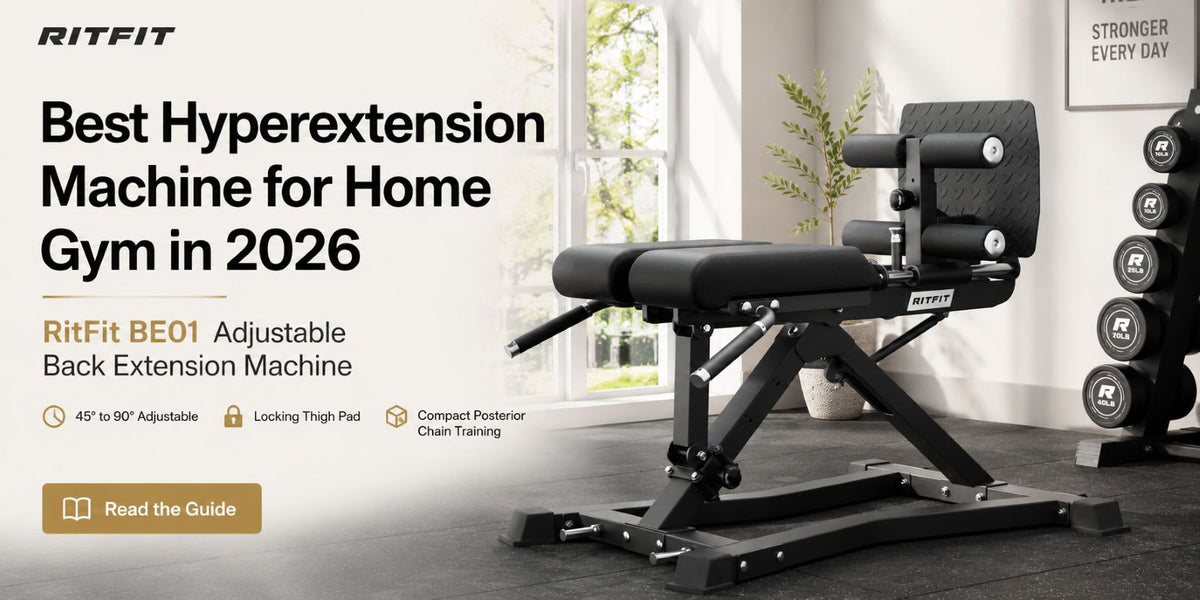
The RitFit BE01 Adjustable Back Extension Machine is the best overall pick because its adjustable 45-to-90-degree angle range and locking thigh pad let one frame cover beginner-friendly extensions, plate-loaded accessory work, and reverse-hyper-style training without buying separate benches.
- Adjustable angle: Shifts between 45 and 90 degrees to match beginner progression or advanced accessory work, so you don't outgrow the machine as your trunk control improves.
- Locking thigh pad: Restrains the pelvis so your lower back does the intended work rather than letting your hips compensate and reduce muscle activation in the target area.
- Multi-exercise frame: Supports standard back extensions, reverse-hyper-style work for glute and hamstring emphasis, and decline sit-ups for core training, all on one compact steel frame.
The BE01 is also available in a Pink colorway with the same frame specifications and full adjustability, so color preference doesn't force a performance trade-off.
Should You Choose a 45-Degree or 90-Degree Hyperextension Bench?
A 45-degree bench supports more of your body weight and is easier to control, making it the better starting point for beginners or anyone easing back into training after a lower-back issue. A 90-degree Roman chair increases range of motion and core demand, suiting experienced lifters who already own solid trunk control and want a more challenging bodyweight stimulus before adding external load.
- 45-degree setting: Supported angle with a controlled range of motion, best for learning the hip-hinge pattern and building confidence before progressing to steeper angles.
- 90-degree setting: Fuller range of motion and a harder bodyweight challenge, best for advanced lifters who can maintain a neutral spine through the entire rep without rounding.
- Adjustable frame advantage: Lets you progress from 45 to 90 degrees on the same machine over months of training instead of buying a second bench when you outgrow the beginner angle.
Most beginners spend several months at the lower angle before working up to a steeper setting with consistent control, and an adjustable frame means that progression happens on one machine rather than in two separate purchases.
Which RitFit BE01 Setup Fits Your Training Goals?
The right BE01 setup depends on your training stage, not on buying a different machine, since the same frame adjusts to cover beginner, rehab, and advanced use cases. The table below maps common training goals to the recommended angle and loading approach.
| User Type | Recommended BE01 Setup | Why It Fits |
|---|---|---|
| Beginner starting posterior-chain training | 45-degree angle, bodyweight only | Supported range builds the hip-hinge pattern with control before adding load |
| Lifter easing back after a lower-back issue | 45-degree angle, thigh pad locked snug | Pelvic stabilization keeps the movement in the hips, not the lumbar spine |
| Athlete adding accessory work after squats or deadlifts | 90-degree angle, holding a plate at the chest | Greater range of motion and load for advanced hip-hinge strength and hypertrophy |
| Home gym owner who wants a personalized look | RitFit BE01 Pink, any angle setting | Identical frame and adjustability in a different colorway with no performance trade-off |
Setup recommendations are general guidance; adjust angle and load to your own comfort and experience level. Pair the BE01 with a leg extension curl machine for a fuller lower-body and posterior-chain routine in the same footprint.
Is a Hyperextension Machine Worth the Investment?
A hyperextension machine is worth the investment for anyone who squats, deadlifts, or sits for long hours, because it gives the posterior chain direct, dedicated training that few other home-gym pieces provide. While a barbell and rack can train the posterior chain indirectly, they lack the isolated hip-hinge loading that a hyperextension bench delivers.
- Multi-exercise value: One adjustable frame replaces a back extension bench, a reverse-hyper station, and a sit-up bench, consolidating three pieces into one.
- Durability: A steel frame with a locking thigh pad is built to hold up under years of bodyweight and plate-loaded use without the wear-and-tear that foam-heavy budget benches show after a few months.
- Space efficiency: A single-station footprint fits into a garage or basement corner that other machines cannot, making it one of the few posterior-chain tools that works in compact home gyms.
- Training frequency: Because the movement is low-impact and bodyweight-scalable, you can train the posterior chain more frequently than with heavy deadlift variations, leading to more total weekly volume for the erector spinae and glutes.
If your goal is a stronger, more resilient lower back without adding a full commercial rack or dedicated reverse hyper, the cost tends to pay for itself in reduced missed training days and improved performance on your primary lifts.
What Features Should You Check Before Buying a Hyperextension Machine?
The most important feature to check is a locking thigh or hip pad, because a 2015 EMG study found that stabilizing the pelvis during a lumbar extension exercise increased muscle activity in the back extensors compared to the same movement without stabilization.1 Beyond that, several design details separate a machine you'll use for years from one that collects dust.
- Adjustable angle: A 45-to-90-degree range covers beginner through advanced training on one machine, so you don't need to buy a second bench when you progress.
- Locking thigh pad: Stabilizes the pelvis so the movement targets your back extensors correctly rather than letting your hips shift and reduce muscle activation.
- Foam roller pads: Thick padding at the ankles prevents discomfort and bruising during longer sets, which matters for the higher rep ranges common in posterior-chain accessory work.
- Steel frame and capacity: A frame rated well above your bodyweight plus any added load, with a wide base and non-slip feet that prevent rocking during dynamic reps.
- Footplates and handles: Textured, non-slip surfaces that make getting on and off the bench safer, especially when you're fatigued at the end of a session.
Once these core features are covered, a cable machine or leg press machine can round out a posterior-chain-focused home gym by adding loaded hip-hinge variations and isolated leg work.
How Do You Use a Hyperextension Machine Safely?
Using a hyperextension machine safely starts with setting the hip pad correctly, because a pad placed too low turns the movement into a spinal flexion exercise instead of a hip-hinge, which can stress the lower back rather than strengthening it.
- Set the pad: Position it just below your hip crease so you can hinge freely at the hips without the pad restricting your range of motion or forcing spinal rounding.
- Keep a soft knee bend: A slight bend in the knees protects the hamstrings through the full range of motion and prevents hyperextension at the knee joint.
- Stop at flat-back: Lower your torso only to a flat-back position instead of rounding your spine into deep flexion, which can place unnecessary stress on the intervertebral discs.
- Add load gradually: Hold a plate at your chest only once bodyweight reps feel controlled and pain-free across the full set, and increase weight in small increments of 2.5 to 5 lbs.
- Control the tempo: Use a 2-second lowering phase and a 1-second pause at the top to maximize time under tension and reduce momentum-based reps.
Stop the set and reset your form if you feel any sharp or pinching pain in your lower back rather than the deep muscular fatigue that signals effective posterior-chain work.
How Can You Expand Your Posterior-Chain Training Over Time?
You can expand posterior-chain training over time by adding load, adjusting the BE01 toward 90 degrees, and pairing accessory tools like a cable machine attachment for pull-through and hip-hinge variations that complement the hyperextension movement pattern.
- Progressive overload: Add small plate increments of 2.5 to 5 lbs once form stays consistent across every rep, and track your working weight over weeks to ensure steady progress.
- Angle progression: Shift from 45 to 90 degrees as trunk control improves, which increases the range of motion and bodyweight demand without adding external load.
- Exercise variety: Use the same frame for reverse-hyper-style work to emphasize glute and hamstring recruitment, and decline sit-ups for core training to avoid plateauing on a single movement pattern.
- Complementary tools: A Smith machine or leg press adds loaded squat and deadlift variations alongside a stronger posterior chain, creating a complete lower-body training system.
For more context, read our guide on choosing the best leg extension curl machine to pair with your hyperextension bench for full lower-body coverage.
FAQs About Best Hyperextension Machine
What is a hyperextension machine used for?
A hyperextension machine, also called a Roman chair or back extension bench, trains the erector spinae, glutes, and hamstrings through a hip-hinge movement. It supports your hips and legs while your torso lowers and raises, letting you strengthen the posterior chain and support squat and deadlift performance without loading a barbell on your spine.
Is a 45-degree or 90-degree hyperextension bench better?
A 45-degree bench supports more of your body weight and is easier to control, making it the better starting point for beginners or anyone easing back into training after a lower-back issue. A 90-degree Roman chair increases range of motion and core demand, suiting experienced lifters with solid trunk control. An adjustable frame like the RitFit BE01 covers both.
Can a hyperextension machine help with lower back pain?
Strengthening the erector spinae and glutes can support a healthier lower back, and a 2015 EMG study found that stabilizing the pelvis during a lumbar extension exercise increased muscle activity in the back extensors versus the same movement without stabilization. Start light with bodyweight only, and consult a doctor or physical therapist if you have an existing injury or chronic pain condition.
What features matter most when buying a hyperextension machine?
Look for an adjustable angle in the 45-to-90-degree range, a locking thigh or hip pad that stabilizes your pelvis during reps, thick foam rollers for ankle comfort, a steel frame rated well above your bodyweight plus any added load, and non-slip footplates or handles for getting on and off safely between sets.
How do I use a hyperextension machine safely?
Set the hip pad so your hips can hinge freely at the top of the pad just below your hip crease, keep a slight bend in your knees, and lower your torso only to a flat-back position instead of rounding your spine. Start with bodyweight reps, control the tempo on every rep, and only add a plate at your chest once your form stays consistent across full sets.
Is the RitFit BE01 worth buying over a cheaper hyperextension bench?
The RitFit BE01 adds a wider adjustable angle range from 45 to 90 degrees, a locking thigh pad for pelvic stabilization, and multi-exercise versatility including back extensions, reverse-hyper-style work, and decline sit-ups, all in one frame. For lifters who train posterior-chain accessories weekly and want long-term durability, that added adjustability and build quality typically justifies the higher price over a basic fixed-angle chair that you may outgrow within months.
Conclusion
The best hyperextension machine for most home gyms is an adjustable, locking-thigh-pad design like the RitFit BE01 Adjustable Back Extension Machine, since it covers beginner, rehab, and advanced posterior-chain training in one frame that fits a garage corner.
Start with bodyweight reps at a 45-degree angle, progress toward 90 degrees as your trunk control improves, and explore the Smith machine collection next to round out your squat and deadlift accessory work with a complete lower-body training system.
Disclaimer
This article is for general fitness education only and does not constitute medical advice, diagnosis, or treatment. Consult a doctor or physical therapist before starting a new exercise program, especially if you have an existing back injury, chronic pain condition, or history of spinal issues.
Save on your next RitFit order
Tap the button to copy your code, then paste it at checkout.
References
1. Lee HS. Enhanced muscle activity during lumbar extension exercise with pelvic stabilization. J Exerc Rehabil. 2015;11(6):372-377. doi:10.12965/jer.150249. PMCID: PMC4697788.





