








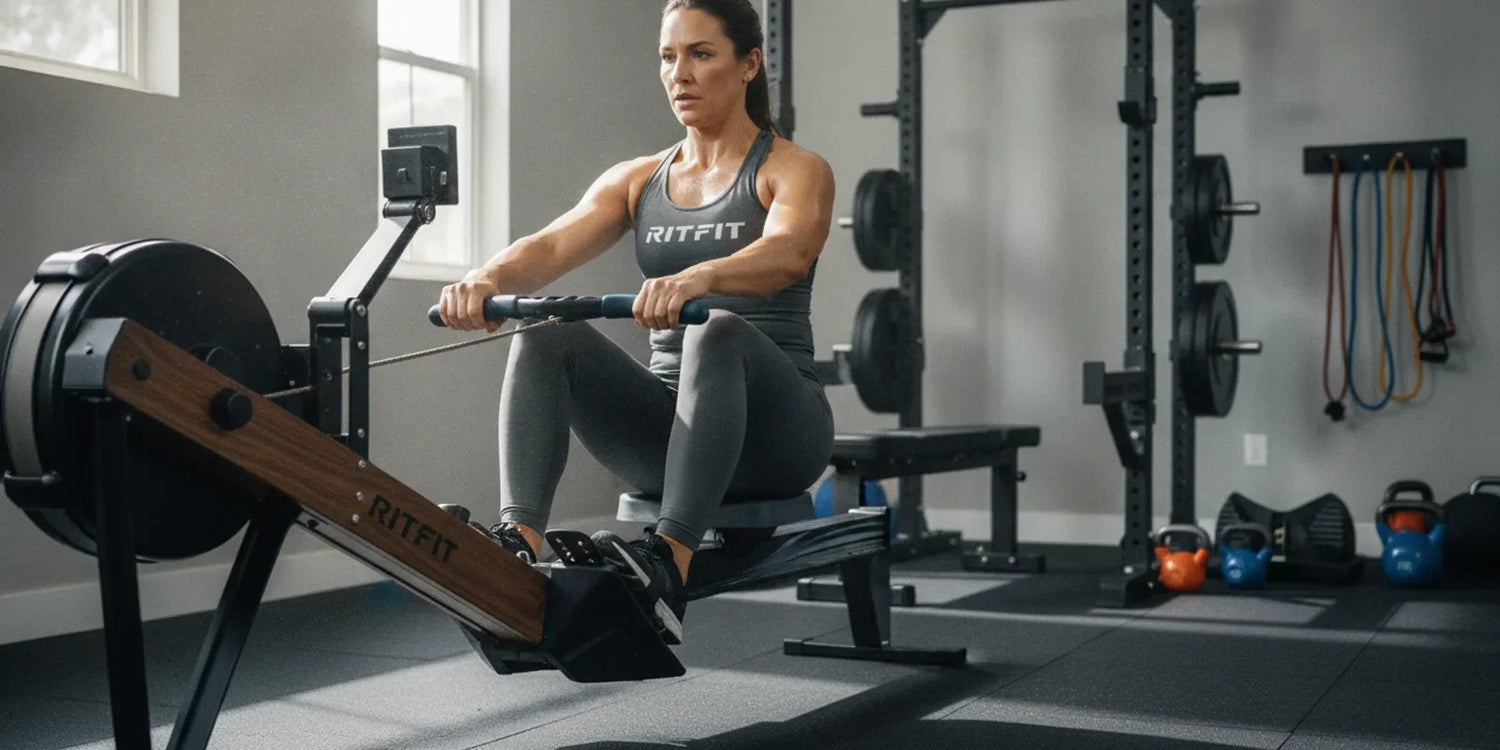
The best indoor rower for your home gym is not one specific model, but the resistance type and spec profile that match your space, budget, and training goals. Air, magnetic, water, and hydraulic rowers each row differently, and picking the wrong type is the most common regret among first-time buyers.
This guide breaks down resistance types, key specs, real ownership costs, and beginner technique so you can choose confidently and start training safely from week one.
Quick Answer: The best indoor rower depends on your space and goals, since air resistance rowers suit serious cardio training, magnetic and hydraulic models suit quiet apartments, and water resistance offers the smoothest stroke feel, so match resistance type, footprint, and weight capacity to your situation rather than chasing one single best rowing machine.
Key Takeaways
- Resistance type first: Air, magnetic, water, and hydraulic rowers feel different day to day, and that difference matters more than brand for long-term comfort and space fit.
- Apartments favor quiet types: Magnetic or hydraulic resistance keeps noise low and often folds upright for small rooms.
- Capacity and rail length matter: Aim for 250 to 300 lbs weight capacity minimum, and check rail length if you are over 6 feet tall.
- Subscriptions add up: Premium connected rowers can carry an ongoing monthly fee on top of the purchase price.
- Technique comes before intensity: Learning the catch, drive, and recovery sequence at low resistance prevents most beginner strain and regret.
Why should you consider adding a rowing machine to your home gym?
A rowing machine delivers a full body cardio and strength workout in one continuous motion, engaging the legs, back, arms, and core more completely than most single joint cardio machines. A reliability study of 52 trained rowers found rowing ergometer power testing stays highly consistent between sessions, so the numbers on the monitor reflect real fitness changes rather than noise.[1]
- Full-body engagement: legs, back, arms, and core work together on every stroke.
- Low-impact cardio: no impact on the ankles, knees, or hips at any resistance level.
- Efficient calorie burn: continuous full-body motion burns more per minute than many single-joint machines.
- Scalable intensity: dial effort from an easy warm-up spin to an all-out sprint interval.
- Reliable progress tracking: consistent monitor feedback lets you compare workouts session to session.
Rowing complements strength training well, and pairing it with a broader routine, like the exercises covered in what a rower workout does for your body, helps build balanced conditioning. It also works alongside a full cardio corner, such as the picks in the best rowing machine for home gyms roundup.
How do air, magnetic, water, and hydraulic rowers actually differ?
Air, magnetic, water, and hydraulic rowers differ mainly in resistance feel, noise level, and price, and each type suits a different training priority. Air resistance scales directly with your effort, magnetic and hydraulic models run quieter for shared living spaces, and water resistance mimics the smooth pull of rowing on open water.
| Resistance Type | Feel | Noise Level | Best For | Typical Price Range |
|---|---|---|---|---|
| Air | Increases with effort | Moderate to loud | Serious cardio training | $300-$900 |
| Magnetic | Fixed adjustable levels | Quiet | Apartments and small spaces | $400-$1,500 |
| Water | Natural, smooth feel | Quiet, soothing | Closest to on-water feel | $600-$1,300 |
| Hydraulic | Piston based, compact | Quiet | Budget buyers, tight storage | $150-$400 |
Price ranges are approximate market ranges, not fixed retail prices, and vary by retailer and features.
If you plan to alternate rowing days with strength sessions, browsing the cable machine collection can round out a more complete weekly program.
Which type of rower fits your specific space and training goal?
The right rower for you depends on floor space, noise tolerance, and training intent more than brand reputation. Apartment dwellers do best with foldable magnetic or hydraulic models, serious cardio trainers benefit from air resistance's unlimited effort scaling, and anyone chasing a natural stroke feel should prioritize water resistance.
- Apartment or shared living space: magnetic or hydraulic, folds upright and runs near silent.
- Serious interval or endurance training: air resistance, effort-based scaling handles sprints and steady rows alike.
- Smooth, on-water feel: water resistance, natural deceleration between strokes.
- Tight budget or first rower: hydraulic, lowest entry price and smallest footprint.
- Tall users over 6 feet: any type with a rail length rated for taller frames and a higher weight capacity.
If floor space is tight, pairing your rower with space-saving picks from small home gym equipment essentials keeps the room usable for other movements. For a strength-training partner that folds away just as easily, the multifunctional Smith machine covers squats, presses, and rows in one frame.
What specs matter most when buying an indoor rower?
The specs that matter most are footprint and fold size, weight capacity, rail length, and monitor accuracy, since these determine daily comfort and long-term usability more than price alone. A 2021 test-rig study on an air-resistance rowing ergometer found monitor power accuracy improved to within 0.2 to 1.9 percent once stroke rate stabilized, though the very first strokes of a session showed errors up to 4.3 percent.[2]
- Footprint when in use: most rowers measure 8 to 9 feet long, so measure your room first.
- Fold size: check the folded height and whether the frame stands upright on wheels for storage.
- Weight capacity: look for at least 250 to 300 lbs for average adults, 350 lbs or more for taller or heavier users.
- Rail length: longer rails suit users over 6 feet 2 inches comfortably.
- Monitor accuracy: a consistent stroke rate improves the accuracy of power and calorie readouts.
- Noise level: air rowers get louder at high effort, magnetic and hydraulic models stay quieter.
If your goal is building leg strength alongside cardio, browsing the leg machine collection can round out lower-body training on non-rowing days.
Is a premium connected rower worth the extra cost?
A premium connected rower is worth the extra cost mainly if you value guided coaching, on-screen data, and community accountability enough to also pay an ongoing subscription. Budget and mid-range rowers deliver the same core cardio and strength benefits without the recurring fee, so the decision comes down to how much structure you actually use.
- Entry-level, $150-$400: manual resistance and a basic display, best for budget-focused buyers who just want to move.
- Mid-range, $400-$900: a sturdier frame and better monitor, suited to consistent home training without extras.
- Premium connected, $1,000+: streaming classes and app tracking, plus a monthly or annual subscription.
If you are working with a tighter budget, the picks in best home gym equipment under $500 show how far a modest budget can stretch across a full setup, not just one machine.
What ongoing costs come with owning an indoor rower?
Ongoing costs typically include an optional subscription for connected models, occasional replacement of the chain or strap, and periodic seat roller or rail maintenance. Budgeting for a possible monthly subscription plus occasional parts gives a more realistic total cost of ownership than the sticker price alone.
- Connected class subscriptions: commonly billed monthly, and cancel anytime once you stop using them.
- Chain or strap wear: nylon straps and belts may need replacement after a few years of regular use.
- Seat rollers and rail: wipe down and lubricate periodically to keep the slide smooth.
- Monitor batteries: budget for occasional battery swaps on wireless displays.
Before adding a rower to a growing setup, the checklist in minimum home gym equipment can help you prioritize what actually earns its floor space.
What mistakes do first-time rower buyers commonly make?
First-time buyers most often skip measuring their available floor length, underestimate weight capacity needs, and pick a resistance type based on price alone instead of noise tolerance or training goal. These few mistakes account for most of the regret and return requests reported around entry-level rowers.
- Skipping the floor-length measurement: an 8 to 9 foot rower will not fit every room even when folded upright.
- Ignoring weight capacity: an undersized capacity rating shortens the machine's usable lifespan.
- Choosing by price only: the cheapest option may be too loud or too limited for your actual training plan.
- Rowing with poor form from day one: incorrect sequencing raises strain risk before good habits form.
- Overlooking storage plans: buying a non-folding model for a small room creates a permanent obstacle.
Buyers assembling a broader home gym often make the same measurement mistakes with strength equipment. The guide on what is a Smith machine covers similar space-planning questions for anyone adding more than one machine.
How should beginners learn proper rowing machine technique?
Beginners should learn the catch, drive, and recovery sequence at low resistance before adding intensity, since poor sequencing is the main cause of early rowing machine strain. Expert coaches rely on ergometers as a standard tool to evaluate this exact technical sequence, which is why getting the order right matters from the first session.[3]
- Set the damper low: around 3 to 5 while you learn the sequence.
- Drive with your legs first: then lean back slightly, then pull the arms in.
- Reverse the order on recovery: arms out, body forward, then knees bend.
- Start with 2 to 3 sessions a week: at 15 to 20 minutes each while building the habit.
- Reset your form if it hurts: stop and check technique if you feel pulling or strain in the lower back.
This technique walkthrough from British Rowing covers the same catch, drive, and recovery sequence described above, demonstrated by an Olympic rowing coach on an indoor machine.
"It's not the exercise per se that determines the adaptation, it's the application."
Andy Galpin, PhD, Professor of Exercise Science and Human Performance, Parker University
FAQs About the Best Indoor Rower
What type of resistance is best for a home indoor rower?
Air resistance rowers feel most realistic and scale with effort, making them ideal for serious cardio training, while magnetic and hydraulic models run quieter and suit apartments. Water resistance offers a smooth, natural stroke feel, so choose based on your noise tolerance, space, and training goals rather than price alone.
How much space do I need for an indoor rowing machine?
Most indoor rowers measure 8 to 9 feet long when in use, though many magnetic and hydraulic models fold upright for storage in as little as 2 feet of floor space. Measure your available length before buying, and check whether the frame folds or disassembles for small apartments.
Is a rowing machine better than a stationary bike for cardio?
Rowing engages more muscle mass per stroke, working the legs, back, and arms in one continuous motion, so it can burn more calories in the same time versus cycling. A stationary bike is gentler on the lower back, but the better choice still depends on your joint health and training goals.
How often should beginners use a rowing machine?
Beginners typically benefit from 2 to 3 rowing sessions per week of 15 to 20 minutes, focusing on proper stroke sequence before adding intensity or duration. Building consistency first helps develop the legs-body-arms technique safely, reducing the risk of lower back strain as workouts get longer and harder.
What weight capacity should I look for in a rowing machine?
Look for a weight capacity of at least 250 to 300 pounds if you are an average-sized adult, and closer to 350 pounds or more for taller or heavier users. Checking the rail length and seat height alongside capacity ensures the machine stays comfortable and stable through a full stroke.
Do rowing machines build muscle or just cardio fitness?
Rowing machines deliver both, since each stroke uses the legs, glutes, back, and arms against resistance, building strength and muscular endurance while elevating heart rate for cardio benefits. It will not replace heavy strength training for maximum muscle growth, but it builds functional, full-body conditioning more efficiently than most single-joint cardio machines.
Conclusion
The best indoor rower for your home is the one whose resistance type, footprint, and weight capacity actually match your space and training goals, not necessarily the most expensive option. Start with the resistance type that fits your noise tolerance and space, then confirm specs before you buy.
Learn proper catch-drive-recovery technique early, budget for any ongoing subscription costs, and browse RitFit's home gym guide for beginners to round out the rest of your setup.
Disclaimer
This article is for general informational purposes and does not replace personalized fitness or medical advice. If you have a pre-existing injury, back condition, or other health concern, consult a qualified healthcare professional before starting a new rowing routine.
Save on your next RitFit order
Tap the button to copy your code, then paste it at checkout.
References
1. Held S, Rappelt L, Donath L. Reliable Peak Power Assessment During Concentric and Flexion-Extension-Cycle Based Rowing Strokes using a Non-Modified Rowing Ergometer. J Sports Sci Med. 2022;21(1):131-136. doi:10.52082/jssm.2022.131
2. Treff G, Mentz L, Mayer B, Winkert K, Engleder T, Steinacker JM. Initial Evaluation of the Concept-2 Rowing Ergometer's Accuracy Using a Motorized Test Rig. Front Sports Act Living. 2021;3:801617. doi:10.3389/fspor.2021.801617
3. Baumann E, Schmid MJ. Insights from expert coaches on technical performance evaluation in rowing: a pilot study. Front Sports Act Living. 2024;6:1448797. doi:10.3389/fspor.2024.1448797





