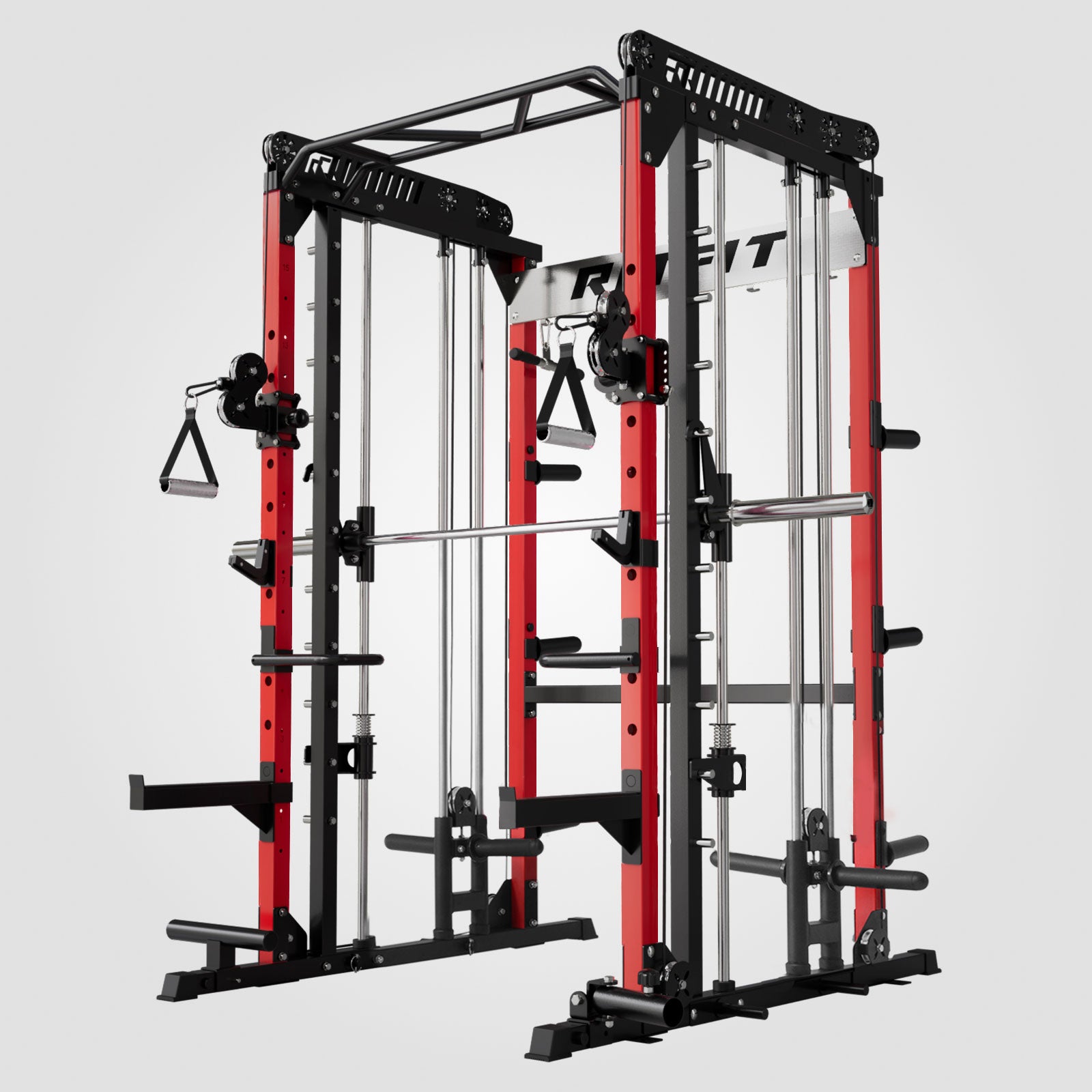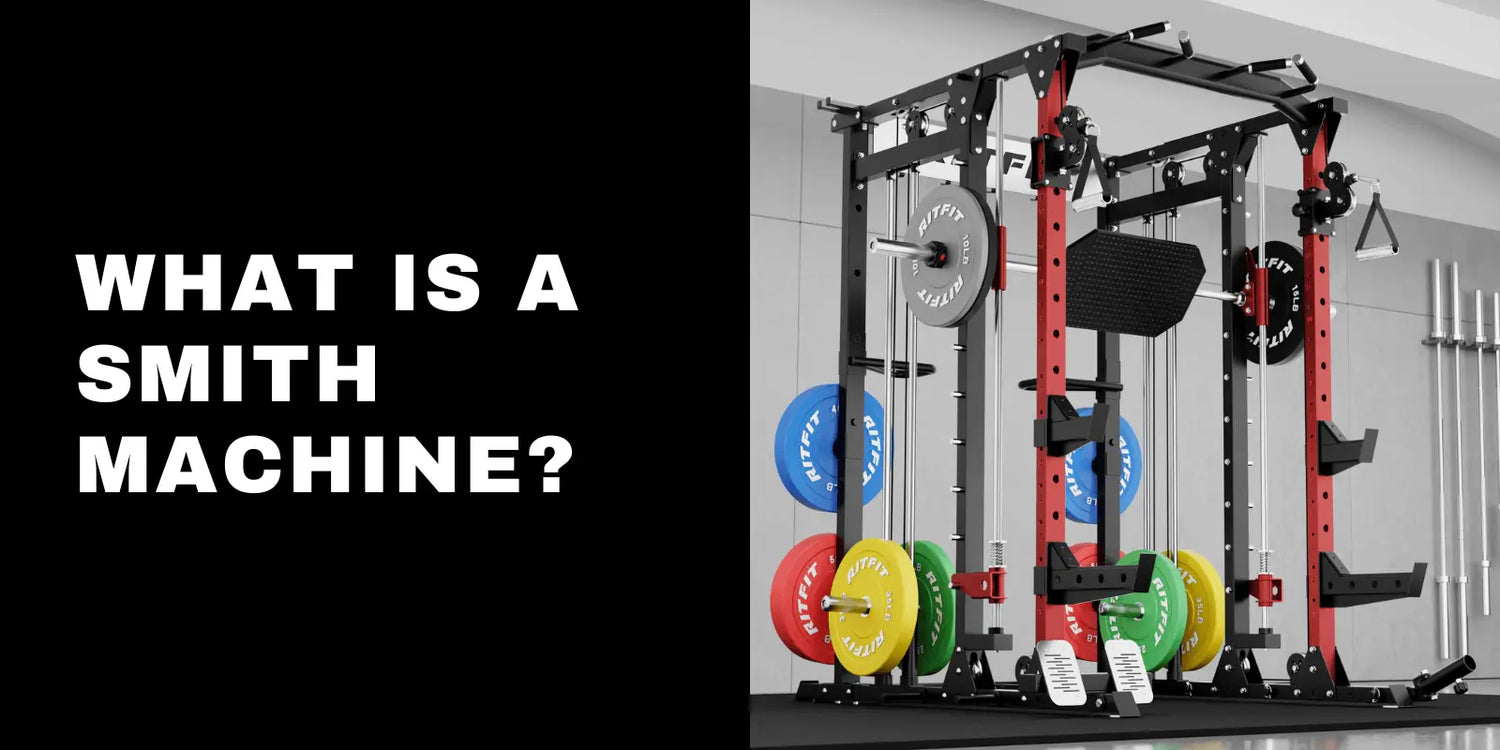
A Smith machine is a guided barbell system that makes solo lifting more controlled, repeatable, and approachable than a free barbell. It can be excellent for hypertrophy, setup-sensitive lower body work, and home gym convenience, but it is not a perfect replacement for every free weight lift.
If you are comparing a Smith machine with a squat rack, a functional trainer, or an all-in-one rack, this guide explains what it does well, where it falls short, and how to choose the right setup for your goals.
Quick Answer: A Smith machine is a barbell fixed to guide rails that moves on a controlled vertical or angled path, reducing balance demands and making solo training safer and more repeatable. It is especially useful for hypertrophy-focused presses, squats, split squats, calf raises, and hip thrusts, though free weights remain better for developing unrestricted bar control and stabilization skill.
Key Takeaways
- Guided Bar Path: A Smith machine guides the bar on rails, which reduces balance demands and makes solo training easier to manage.
- Best Use Cases: It is especially useful for presses, split squats, calf raises, hip thrusts, Romanian deadlifts, and other movements where setup consistency matters.
- Real Results: A Smith machine can build real muscle and strength, but free weights usually provide more bar control practice and more open movement freedom.
- Setup Sensitivity: Rail direction, foot placement, bench position, and safety setup all affect how comfortable a Smith machine feels.
- Home Gym Decision: The best Smith machine for home use depends on space, training style, attachment needs, and whether you want versatility, compact efficiency, or heavier-duty stability.
What Is a Smith Machine?
A Smith machine is a barbell fixed to guide rails so the bar travels on a controlled path instead of moving freely in space. That fixed path reduces stabilization demands and makes reracking easier, which is why many lifters use it for solo training, hypertrophy work, and home gym efficiency.
Main Components of a Smith Machine
The core parts are the guided bar, the rails, the locking hooks, and the adjustable safeties. Some models also add a counterbalanced starting feel, cable stations, pull-up bars, storage horns, and rack features that turn one footprint into a broader training station.
- Guided bar and rails: The bar moves on a fixed track, which changes balance demands and setup strategy.
- Locking hooks and safeties: These let you rerack quickly and stop the bar at a chosen height during any set.
- Rack points and adjustments: More height options usually make the machine easier to fit to different lifters and exercises.
- Counterbalance and starting resistance: Some Smith machines feel lighter than a standard 45 lb barbell, so the unloaded starting feel varies by model.
If you want a product overview before comparing models, start with the RitFit Smith Machine collection and then compare footprint, attachments, and training priorities.
Where Did the Smith Machine Come From?
The Smith machine was developed to make barbell training more controlled and more accessible without requiring a spotter for every hard set. Over time, it evolved from a simple guided bar into a broader home gym format that can include cables, pull-up stations, storage, and rack features in one unit.
How Does a Smith Machine Work?
A Smith machine works by guiding the bar on a fixed track, so your body must organize itself around the machine instead of freely steering the bar. Across matched programs, both free-weight and machine-based training can build strength and muscle, but carryover is often strongest to the style of lifting you practice most.[1]
Vertical vs. Angled Smith Machines
Vertical rails usually let you set up closer to a traditional straight up-and-down bar path, while angled rails can change where your feet or bench need to sit. If a Smith machine feels awkward, the issue is often the setup relative to the rail path, not the machine category alone.
- Vertical rails: Often easier to map to standard squats, presses, rows, and split squats.
- Angled rails: May feel better for some movements, but usually require more deliberate foot placement or bench adjustment.
- Quick test: Unlock the empty bar and guide it through the path before loading plates, then position yourself to match the path instead of forcing a free barbell setup.
Common Uses of the Smith Machine
The Smith machine is most useful when you want controlled barbell-style loading without the full balance demand of a free bar. It shows up often in hypertrophy blocks, solo home workouts, and mixed equipment programs that also use cables and dumbbells.
Lower Body Exercises
Lower body Smith machine work is usually most effective when the lift benefits from stability, repeatable stance, and easy reracking. It is especially popular for variations where setup quality matters more than bar path freedom.
- Smith machine squats, including back squats, front squats, and box squats
- Smith machine split squats and lunges
- Smith machine Romanian deadlifts and stiff-leg deadlifts
- Smith machine calf raises
- Smith machine hip thrusts and glute bridges
For exercise-specific tutorials, see how to do the Smith machine front squat, the Smith machine hip thrust, and the Smith machine Romanian deadlift.
Upper Body Exercises
Upper body Smith machine work is often best when you want a more stable press or row that lets you push effort without worrying as much about balancing the bar. This makes the machine especially useful for home lifters training without a spotter.
- Smith machine bench press, including flat, incline, and decline variations
- Smith machine shoulder press
- Smith machine bent-over row
- Smith machine upright row
- Smith machine shrug
For movement-specific setup help, read how to do the Smith machine shoulder press.
Other Smith Machine Exercises
Some of the best Smith machine movements are not classic barbell lifts, but modified exercises that benefit from the fixed rail. These often include accessory or bodyweight-assisted patterns that are easy to repeat and easy to progress.
- Smith machine inverted rows
- Close-grip bench press
- Overhead triceps extensions
What Are the Pros of Using a Smith Machine?
The biggest advantages of a Smith machine are solo training confidence, faster setup, and more controlled muscle-focused work. It can reduce decision fatigue in the home gym because one station can cover guided lifts, accessory work, and high-effort sets with less setup friction.
- Safer feeling solo training: The hooks and safeties make it easier to train hard without relying on a spotter.
- More repeatable setup: The fixed path makes it easy to reproduce stance, bench position, and working range from session to session.
- Stronger hypertrophy use case: Stability lets many lifters focus more directly on the target muscle during presses, split squats, calf raises, and hip thrusts.
- Faster exercise transitions: Home gym users often value speed and convenience as much as load potential, especially in mixed full-body sessions.
- Broader station coverage: A Smith machine with cables can replace several accessory stations in one footprint, which is one reason the RitFit M1 Smith Machine home gym package is popular among home gym owners.
"The smith machine is great because it's going to take a lot of the pressure out of your shoulders because it's supporting itself and you can do a little bit more weight on here. So it can help you break some barriers too, and also if you don't have a spotter you can utilize the tabs, put that right here so if you drop it it'll just bounce and then you won't hurt yourself."
Jeff Cavaliere, MSPT, CSCS, Physical Therapist and Strength Coach, former Head Physical Therapist for the NY Mets, Athlean-X
What Are the Cons of Using a Smith Machine?
The main limitations are reduced bar path freedom, lower stabilization demands, and weaker carryover to free barbell skill. A Smith machine can also feel awkward when the rail path does not match your natural proportions, squat style, or pressing angle.
- Less stabilizer demand: The machine helps guide the bar, so your body does less balance work than it would with a free barbell.
- Less free weight specificity: If you want better free barbell skill, you still need to practice free barbell skill.
- Not every squat pattern fits well: Some lifters feel great on Smith squats, while others prefer split squats, front squats, or free weight options.
- Model differences matter: Rail feel, starting resistance, and overall smoothness vary more than many buyers expect, so testing the RitFit PSR05 Smith machine or a comparable model before buying is recommended.
How Do You Choose the Right Smith Machine?
The right Smith machine is the one that matches your space, training style, and upgrade needs, not just the one with the most attachments. Focus first on rail feel, stability, safety design, cable usefulness, rack integration, and whether the machine supports the lifts you actually perform.
- Rail style: Vertical rails usually feel more neutral, while angled rails may require more setup adjustment.
- Frame stability: A wider base, stronger uprights, and smoother carriage travel usually feel better under load.
- Safety system: Easy hooks and usable safeties matter more than flashy extras.
- Cable value: A Smith machine with cables can replace more accessories and make the footprint work harder, so a cable machine integration is worth prioritizing.
- Space planning: Measure height, width, depth, and plate storage clearance before you buy, especially if you are comparing options for low-ceiling home gyms.
If your main goal is broad versatility in one footprint, compare a Smith machine with cables before you compare finish colors or extra accessories. Many home buyers care more about exercise coverage, space efficiency, and solo usability than about any single headline feature.
RitFit M1 Pro
The M1 Pro is the most complete all-around option for lifters who want a Smith machine, rack function, and cable training in one station. It suits home users who want broad exercise coverage without buying separate major machines.
- Best for: General home gym training, mixed goals, and buyers who want one station to cover most weekly sessions.
- Key features: Integrated pull-up station, landmine attachment, and a 2:1 cable system for broader accessory work.
- Best use case: Choose the RitFit M1 Pro Smith machine when you want one setup to handle guided lifts, free weight work, and cable work with minimal compromise.
RitFit M2
The M2 puts more emphasis on modularity, cable work, and smooth exercise transitions for users who want efficient accessory training. It is a strong fit for lifters who care about supersets, isolation work, and compact functional coverage.
- Best for: Intermediate trainees, physique-focused users, and home lifters who want a more accessory-friendly setup.
- Key features: Stable Smith bar, dual pulley functionality, and a layout designed to make cable work more central to the experience.
- Best use case: Choose it when you want guided barbell work plus a stronger accessory and cable training emphasis, especially if you are comparing RitFit M1 vs M2 Smith machine differences.
RitFit Buffalo
The Buffalo is built for lifters who care most about rigidity, heavier loading, and a more robust rack feel. It is the better fit when sturdiness and heavier strength-focused training matter more than compactness.
- Best for: Advanced lifters, heavier trainees, and users who want a more solid platform under bigger loads.
- Key features: More robust frame construction, smooth linear bearing travel, and higher capacity storage and support feel.
- Best use case: Choose it when your priority is a more planted, heavier-duty feel for repeated high-load sessions.
Quick Comparison
The best model depends less on hype and more on what kind of training friction you want to remove from your week. If you want the broadest all-around answer, M1 Pro is the safest starting point, while M2 leans accessory-friendly and Buffalo leans heavier-duty.
| Feature | RitFit M1 Pro | RitFit M2 | RitFit Buffalo |
|---|---|---|---|
| Primary Focus | Maximum versatility | Functional accessory coverage | Stability and heavier loads |
| Footprint Feel | Moderate | Compact and efficient | Robust |
| Ideal User | General home gym lifter | Bodybuilding and accessory-focused lifter | Advanced strength-focused lifter |
| Hybrid Capability | Smith plus rack plus cables | Smith plus functional trainer feel | Smith plus heavy-duty rack feel |
Comparison based on RitFit product specifications and intended use cases.
Who Is the Smith Machine Best For?
The Smith machine is best for beginners, home gym owners, physique-focused lifters, and anyone who values controlled solo lifting. Novice trainees can improve with machines, free weights, or a mix of both when the plan is progressive, which is why a Smith machine can be a useful entry point instead of a dead end.[2]
- Beginners: A Smith machine lowers the coordination barrier and can make first barbell-style sessions feel less intimidating.
- Home gym owners: It covers a lot of exercises in one station and helps solo training feel more practical, especially when paired with a leg machine for lower body variety.
- Hypertrophy-focused lifters: It is strong for repeatable setup, controlled tempo, and near-failure sets.
- Busy lifters: It shortens setup time and helps one station do more work per session.
- Less ideal as a complete replacement: If your main goal is unrestricted barbell skill, a Smith machine should complement, not replace, free weights.
What Smith Machine Workouts Can You Do?
A Smith machine workout should match your goal, your experience level, and the exercises that actually feel natural on the rail path. The best routines use the machine where it adds control and convenience, then use other tools where they offer more freedom.
Full Body Smith Machine Workout
This beginner-friendly format works well when you want simple exercise flow, stable setup, and broad muscle coverage in one session. Run it 2 to 3 times per week on nonconsecutive days and keep 1 to 3 reps in reserve on early sets.
- Smith machine squat or box squat: 3 sets of 8 to 12 reps
- Smith machine flat bench press: 3 sets of 8 to 12 reps
- Smith machine bent-over row: 3 sets of 8 to 12 reps
- Smith machine shoulder press: 3 sets of 10 to 15 reps
- Smith machine Romanian deadlift: 3 sets of 10 to 15 reps
- Smith machine standing calf raise: 3 sets of 15 to 20 reps
Upper Lower Smith Machine Workout Plan
This split works well when you want slightly more weekly volume without turning every workout into a long full-body session. Alternate upper and lower days once or twice each per week depending on your recovery and schedule.
- Upper Day: Incline bench press, shoulder press, bent-over row, shrug or upright row, then arm work if your setup allows it.
- Lower Day: Squat variation, split squat or lunge, Romanian deadlift, hip thrust, then standing calf raise.
- Target volume: Use 3 to 4 work sets on primary lifts and 2 to 3 work sets on secondary lifts.
Smith Machine Accessory Day
This format works best for lifters who already do free barbell work and want the Smith machine to make accessory work more efficient. Use it after your main strength day or on a separate hypertrophy-focused day with shorter rest periods.
- Front foot elevated split squat: 3 sets of 10 to 12 reps per leg
- Close-grip bench press: 3 sets of 8 to 12 reps
- Inverted row: 3 sets close to technical failure
- Hip thrust or glute bridge: 3 sets of 12 to 15 reps
- Standing calf raise: 3 sets of 15 to 20 reps
How Do You Train Safely on a Smith Machine?
Setup matters more on a Smith machine than many lifters realize because stance, torso angle, and rail direction all change how the lift feels. Squat mechanics are sensitive to stance width, depth, trunk inclination, and knee travel, so small adjustments can meaningfully change comfort and loading demands.[3]
General Setup Guidelines
Following a consistent setup routine helps you get the most out of every Smith machine session while reducing unnecessary joint stress.
- Set the bar height first: You should be able to unrack and rerack without tiptoeing, shrugging, or twisting awkwardly.
- Match your body to the rail path: Do not force a free barbell setup if the rails ask for a different foot or bench position.
- Use the safeties every time: A Smith machine is only safer when the safety setup is actually in place.
- Test the empty bar: Run one or two unloaded reps before you commit to working weight.
Exercise-Specific Cues
The best cue is usually the one that improves joint comfort while keeping tension on the target muscle. If a variation keeps feeling wrong after setup changes, switch the variation instead of forcing the rep pattern.
- Squats: Keep your feet where the rail path lets you descend smoothly without collapsing forward or jamming the knees.
- Bench press: Set the bench so the bar descends to a comfortable line over the chest, not just wherever the bench first lands.
- Shoulder press: Use a grip width that lets the elbows move naturally and avoid painful top-end positions.
- Rows: Keep your torso set, pull with the back, and avoid turning the movement into a loose shrug.
How Should You Program Smith Machine Training?
A Smith machine works best inside a broader strength plan, not as your only training tool. Muscle can be built across a broad loading range when sets are challenging and technique stays consistent, which is why the Smith machine can serve both moderate-rep hypertrophy work and heavier controlled sets.[4]
- Use the machine where it adds value: Choose it for stable presses, split squats, calf raises, hip thrusts, and other lifts where repeatable setup helps.
- Keep some free movement in the week: Dumbbells, cables, bodyweight work, or barbells help fill the gaps that a fixed rail path leaves behind.
- Progress with intent: Add load, reps, or cleaner execution over time instead of chasing random fatigue.
- Manage weekly volume: Higher weekly hard set volume can support more hypertrophy in trained lifters, although strength gains do not always rise in the same proportion.[5]
- Avoid common mistakes: Do not assume all Smith machines feel the same, do not copy free barbell setup blindly, and do not skip safeties because the machine feels controlled.
FAQs About Smith Machines
What is a Smith machine best used for?
A Smith machine is best used for controlled barbell-style training, especially when you want more stability, repeatable setup, and safer solo lifting. It works especially well for hypertrophy-focused presses, squats, split squats, calf raises, and hip thrusts, where setup consistency matters.
Is a Smith machine good for beginners?
Yes.
A Smith machine can be very good for beginners because the guided bar path reduces balance demands and makes setup easier to learn.
It still requires good positioning, controlled range of motion, and proper safety setup, so it should support learning, not replace basic technique awareness.
Why do Smith machine squats feel awkward for some lifters?
Smith machine squats can feel awkward because the fixed rail path may not match your natural squat pattern, limb lengths, or torso angle. Small changes in foot placement, stance width, and bar position often improve comfort, but some lifters still prefer free weight or split squat variations.
Can a Smith machine build real muscle and strength?
Yes.
A Smith machine can build real muscle and meaningful strength when you train hard, progress over time, and use exercises that fit your structure.
It is especially effective for hypertrophy work, but free weights may still be better if your main goal is maximum coordination and bar control.
How much does a Smith machine bar weigh?
A Smith machine bar does not have one universal starting weight because designs vary by manufacturer and counterbalance system. Some bars feel much lighter than a standard barbell, so you should always check the product specifications or test the unloaded bar before tracking your training load.
Should you buy a Smith machine or a power rack first?
You should buy a Smith machine first if you value guided lifting, solo training confidence, and all-in-one convenience. You should buy a power rack first if your priority is unrestricted barbell practice, broader free weight carryover, and a more traditional strength training setup.
What should you check before buying a Smith machine for a home gym?
You should check the Smith machine footprint, height, rail style, pulley system, safety design, and attachment options before buying. You should also confirm ceiling clearance, storage layout, starting resistance, and how well the machine supports the lifts you actually plan to use.
Does a Smith machine work for lower body exercises like leg presses?
A Smith machine can support many lower body exercises, but it does not replace a dedicated leg press. If you want a machine designed specifically for lower body isolation, consider adding a leg press machine to your home gym for exercises the Smith machine cannot replicate.
Conclusion
The Smith machine is best seen as a practical training tool, not as a magic fix and not as a lesser version of free weights. It shines when you want stability, solo training confidence, and efficient muscle-focused work in a home gym.
If you match the machine to your body, your goals, and your space, it can become one of the most productive pieces of equipment in your program. Use it strategically and let it complement the other tools that round out your training.
Disclaimer
This article is for general educational purposes only and is not medical advice. If you have pain, recent injury, surgery, numbness, weakness, or dizziness, consult a qualified clinician or coach before training.
References
1. Haugen ME, Vårvik FT, Larsen S, Haugen AS, van den Tillaar R, Bjørnsen T. Effect of free-weight vs. machine-based strength training on maximal strength, hypertrophy and jump performance - a systematic review and meta-analysis. BMC Sports Sci Med Rehabil. 2023;15(1):103. doi:10.1186/s13102-023-00713-4. PMCID: PMC10426227
2. Aerenhouts D, D'Hondt E. Using Machines or Free Weights for Resistance Training in Novice Males? A Randomized Parallel Trial. Int J Environ Res Public Health. 2020;17(21). doi:10.3390/ijerph17217848. PMCID: PMC7662789
3. Straub RK, Powers CM. A Biomechanical Review of the Squat Exercise: Implications for Clinical Practice. Int J Sports Phys Ther. 2024;19(4):490-501. doi:10.26603/001c.94600. PMCID: PMC10987311
4. Schoenfeld BJ, Grgic J, Van Every DW, Plotkin DL. Loading Recommendations for Muscle Strength, Hypertrophy, and Local Endurance: A Re-Examination of the Repetition Continuum. Sports (Basel). 2021;9(2). doi:10.3390/sports9020032. PMCID: PMC7927075
5. Schoenfeld BJ, Contreras B, Krieger J, et al. Resistance Training Volume Enhances Muscle Hypertrophy but Not Strength in Trained Men. Med Sci Sports Exerc. 2019;51(1):94-103. doi:10.1249/MSS.0000000000001764. PMCID: PMC6303131