








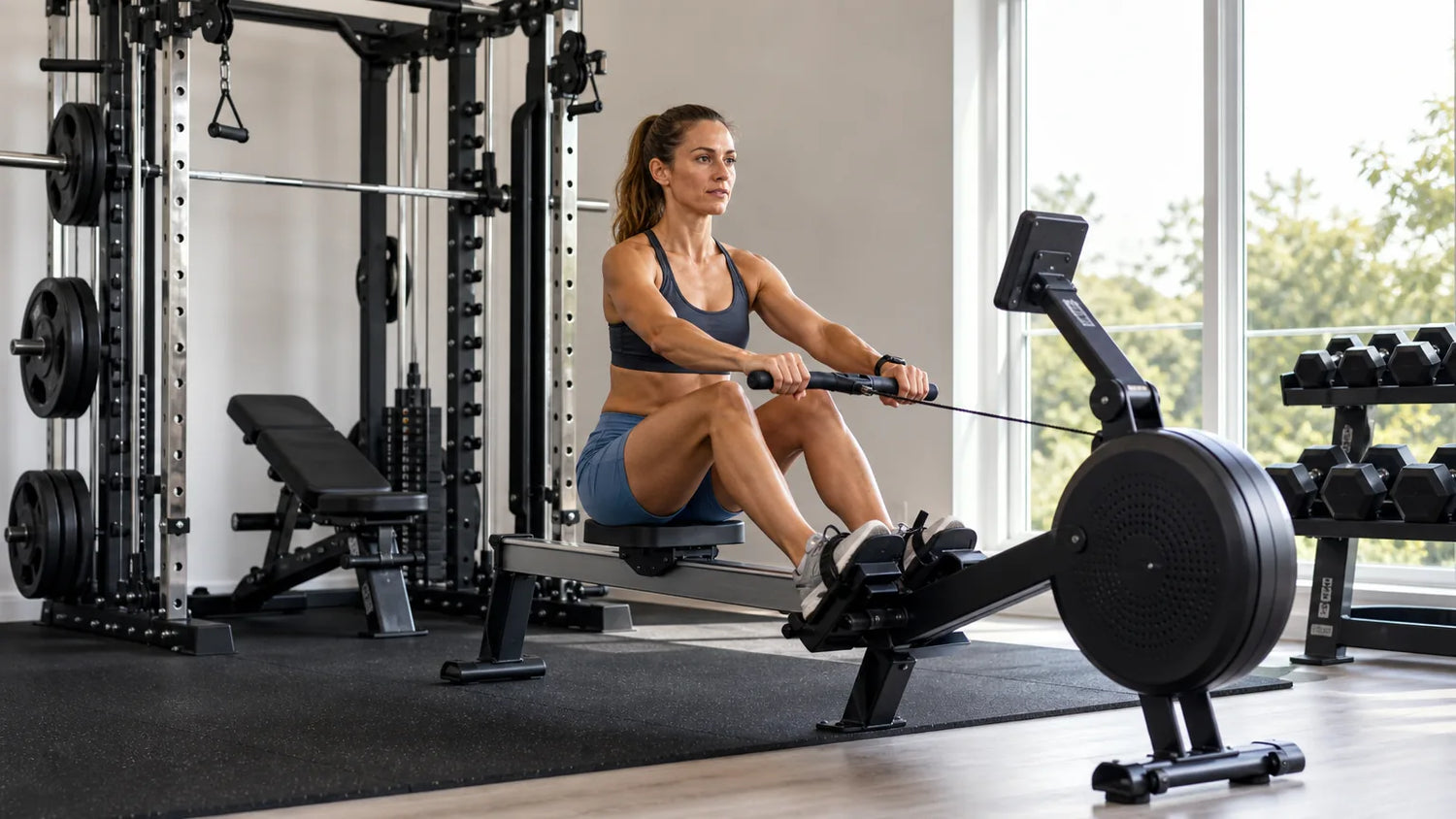
Finding the best magnetic rower for your home gym means balancing quiet operation, resistance range, and the footprint that actually fits your space. Magnetic rowing machines have become the go-to cardio option for apartment dwellers and small-space fitness enthusiasts precisely because they run at a whisper and fold down into a closet corner.
This guide covers what makes magnetic resistance different, how to match your buyer profile to the right spec tier, and how to use proper rowing form so you get the most from every session.
Quick Answer: The best magnetic rower for most home gym users prioritizes 16 or more resistance levels for long-term progression, a belt-drive system for near-silent operation, and a vertical fold-storage design that fits in tight spaces. Magnetic rowers run at roughly 45-52 dB, quieter than normal conversation, making them the top choice for apartments and shared living spaces.
Key Takeaways
- Noise advantage: Magnetic rowers operate at 45-52 dB, dramatically quieter than air rowers that can exceed 70 dB at hard effort, making them the only practical cardio machine for early-morning apartment workouts.
- Resistance ceiling matters: Equipment reviewers note that fit athletes can max out an 8-level machine within about 6 months of consistent training. Choose 16 or more levels if you plan to use the rower as your primary cardio tool.
- Space-first design: Most folding magnetic rowers have an in-use footprint of roughly 80-96 inches long by 18-22 inches wide, and fold vertically to under 24 by 24 inches for storage.
- Full-body cardio backed by research: A 2024 study in Sensors confirmed that rowing ergometers produce comparable oxygen uptake across all intensity levels, validating rowing as a legitimate cardiorespiratory training tool at any fitness level.[2]
- Form is the performance multiplier: The four-phase stroke, catch, drive, finish, and recovery, relies on legs-first sequencing. Pulling with the arms before the legs straighten is the most common form error and the primary cause of lower back strain.
What Is a Magnetic Rowing Machine and How Does It Work?
A magnetic rowing machine uses a flywheel and a magnetic braking system to create resistance, with no physical friction between moving parts. The stronger the magnetic field applied to the flywheel, the greater the resistance on the handle, giving you precise, consistent pull from the first stroke to the last.[1]
How Does Magnetic Resistance Differ from Air and Water Resistance?
Magnetic resistance stays constant at each setting regardless of how hard you pull, while air and water resistance scale with your effort. Each approach suits a different type of user.
- Magnetic resistance: Fixed resistance at each level, near-silent operation, zero maintenance, ideal for steady-state cardio and interval training at home.
- Air resistance: Resistance increases automatically with stroke force, more dynamic feel, but can exceed 70 dB at hard effort, which is close to vacuum-cleaner volume.
- Water resistance: Natural feel that mimics on-water rowing, quiet but not silent, heavier and harder to relocate once placed.
- Hydraulic resistance: Most compact form factor, very affordable, but often limited range of motion and inconsistent feel across the stroke.
For apartment dwellers and home gym builders focused on low-impact daily conditioning, magnetic resistance consistently delivers the quietest, lowest-maintenance experience of the four types. Learn more about what a rower workout does for your body to understand why rowing fits so well into a home routine.
Why Are Magnetic Rowers Ideal for Home Gyms?
Magnetic rowers are ideal for home gyms because they combine near-silent operation, low maintenance, and space-saving folding designs into a single piece of equipment that does not disrupt neighbors or housemates. These three practical advantages address the real objections most people face when adding cardio equipment to a shared living space.
How Quiet Are Magnetic Rowing Machines for Apartment Use?
Magnetic rowing machines operate at approximately 45-52 dB during active use, which is quieter than a normal conversation. One in-depth equipment review notes that the mechanical noise during rowing, primarily the pull cord over the pulley and the seat on the rail, runs at roughly 45-55 dB, making it safe for sessions at 5 AM without waking sleeping family members.
Equipment reviewers report that pure magnetic models average 45-52 dB, while air rowers can exceed 70 dB during hard pulls. That gap represents a roughly four-times difference in perceived loudness, making a magnetic rower the only realistic apartment-safe cardio machine at peak effort.
What Space and Folding Specs Should You Measure Before Buying?
Most folding magnetic rowers have an in-use footprint of roughly 80-96 inches long by 18-22 inches wide. When folded vertically, many models reduce to a footprint under 24 by 24 inches and stand about 50-55 inches tall, small enough to stand in a closet corner or against a wall.
- Measure your available floor space before ordering, including ceiling height for vertical fold storage if you plan to store it upright.
- Check the folded dimensions on the spec sheet, not just the assembled footprint. Manufacturers often list both, and the difference is significant in tight rooms.
- Leave 18-24 inches of clearance at the foot end during use so your feet do not hit a wall at the catch position.
- Account for flooring protection: Pairing your rower with interlocking gym floor mats protects hardwood and tile from seat wheel wear and dampens any residual vibration.
Reviewing your home gym setup guide before purchasing helps you map out equipment placement and ensure the rower fits without crowding other gear.
What Should You Look for in a Magnetic Rower?
Choosing the best magnetic rower comes down to five spec categories: resistance range, drive system, console features, weight capacity, and storage design. Getting these right for your fitness level and living situation prevents costly regret within the first year.
How Many Resistance Levels Do You Actually Need?
The number of resistance levels determines how long the machine stays challenging as your fitness improves. Equipment reviewers note that fit athletes can reach the ceiling of an 8-level machine within about 6 months of consistent training, while 16 levels provides meaningful progression for most home users.
- 8 levels: Sufficient for beginners, seniors, or users doing light steady-state cardio two to three times per week. Expect to plateau within 6-12 months of consistent use.
- 16 levels: The recommended minimum for anyone training four or more days per week or using the rower as their primary cardio tool. Provides enough granularity to run both easy zone-2 sessions and harder intervals.
- 32 levels: Best for intermediate-to-advanced users who want fine-grained control over workout intensity without switching to an air rower.
What Is the Difference Between Belt Drive and Chain Drive?
Belt-drive systems use a reinforced rubber or poly-V belt to connect the handle cord mechanism to the flywheel, producing a smoother, quieter stroke than chain-driven designs. Chain drives are more common on rowing ergometers built for high-load training, but they introduce metallic noise during the pull that belt-drive units eliminate.
What Console and Connectivity Features Matter?
Most magnetic rowers include an LCD console that tracks time, distance, stroke count, and estimated calories. Higher-tier models add Bluetooth connectivity, heart rate telemetry, and app integration for workout logging.
- Basic LCD monitor: Adequate for most home users tracking workout duration and effort level.
- Bluetooth and app sync: Worth prioritizing if you follow structured training programs or use a fitness tracking app.
- Tablet holder: A practical feature for entertainment during longer steady-state sessions, especially if the machine lacks a built-in screen.
What Weight Capacity and Frame Durability Should You Look For?
Most mid-range magnetic rowers support 300-350 lb user weight, with premium models rated up to 400 lb. Frame material matters more for long-term durability: steel frames with powder-coat finishes outlast aluminum frames in humid environments like garages and basements.
For a complete home gym that pairs strength and cardio, the strength machines for home gyms collection offers a range of options that complement a magnetic rower setup.
Which Magnetic Rower Fits Your Buyer Profile?
Matching your buyer profile to the right magnetic rower spec tier saves you from overspending on features you will not use or underspending on a machine you will outgrow. The table below uses the five buyer profiles most common among home gym users.
| Buyer Type | Recommended Resistance Levels | Key Feature Priority | Space Need |
|---|---|---|---|
| Beginner / Casual | 8-16 levels | Quiet operation, easy storage | Folding design, under 85 in footprint |
| Apartment Dweller | 16+ levels | Under 52 dB noise, vertical fold | Compact footprint, upright storage |
| Intermediate Fitness User | 16-32 levels | Progressive resistance, dual-rail stability | Standard footprint acceptable |
| Small-Space Home Gym | 8-16 levels | Folding and vertical storage | Must confirm folded dimensions before buying |
| Advanced / Performance | 32+ levels or air-magnetic hybrid | Resistance that scales with effort | Dedicated gym space preferred |
Resistance ranges are general guidance based on equipment reviewer consensus. Individual progression timelines vary.
- Value at each tier: An 8-level entry model delivers roughly 80-85% of the rowing machine experience for steady-state cardio at a fraction of the cost of a premium connected rower, according to one detailed equipment review. The trade-off is a resistance ceiling that fit athletes can reach within 6 months.
- Long-term upgrade path: Users who start on an 8-level machine and want to stay in rowing should plan to upgrade to a 16-level model when they consistently train at the top two resistance settings. Waiting until the machine feels effortless saves you from buying a mid-tier model you will outgrow just as quickly.
- Pairing with strength training: A magnetic rower works best as a cardio complement to a strength-focused home gym. An adjustable weight bench and a home gym smith machine with cable system give you a complete push-pull-cardio setup without requiring a second room.
How Do You Use Correct Rowing Form on a Magnetic Machine?
Correct rowing form on a magnetic machine follows a four-phase stroke: the catch, drive, finish, and recovery. Each phase has a specific body position, and the most critical rule across all four phases is that the legs initiate the drive before the arms pull.
What Are the Four Phases of the Rowing Stroke?
The rowing stroke breaks into four distinct positions that flow continuously into each other during a session.
- The Catch: Start with shins vertical, arms extended, and hinge forward from the hips with a flat back. Your weight should be balanced over the balls of your feet, not collapsed onto your heels.
- The Drive: Push through both legs simultaneously, keeping your arms straight until your legs are nearly extended. Only then do you begin to lean back slightly and draw the handle to your lower ribs. Legs first, then body, then arms, in that sequence.
- The Finish: At the finish your legs are fully extended, your torso leans back about 10-15 degrees past vertical, and the handle rests at your lower chest or upper abdomen. Elbows stay at your sides, not flared out.
- The Recovery: Reverse the drive sequence exactly. Arms extend first, then your torso hinges forward, then the seat slides up the rail toward the catch. The recovery is intentionally slower than the drive.
What Are the Most Common Rowing Form Mistakes to Avoid?
Form errors on a rowing machine almost always trace back to sequencing problems, specifically pulling the arms before the legs have driven through.
- Early arm pull: Bending the elbows before the legs fully extend shifts the workload to the smaller biceps and shoulders, reducing power output and stressing the lower back. Fix: keep arms straight until your legs are nearly extended before beginning the pull.
- Hunched upper back: Rounding the spine at the catch or during the drive compresses the lumbar vertebrae under load. Fix: set your back flat and shoulders down before every catch.
- Overreaching at the catch: Sliding too far forward collapses the ankles and rounds the lower back. Fix: stop when shins are vertical, no further.
- Jerky stroke rhythm: Yanking hard on the handle creates an uneven acceleration that strains tendons and reduces cardio efficiency. Fix: aim for a 2:1 recovery-to-drive ratio, spending twice as long on the return as on the pull.
- When to stop: Stop the session immediately if you feel sharp lower back pain, hip clicking under load, or wrist tingling. These signals indicate a form breakdown that rest and a technique reset will fix faster than pushing through.
If you are also building out your upper back with pulling movements, the best home gym lat pulldown machine guide covers the complementary pulling patterns that reinforce the rowing muscles between sessions.
What Muscles Does a Rowing Machine Work?
Rowing works every major muscle group in a single continuous stroke, engaging the lower body during the leg drive, the core throughout for spinal stabilization, and the upper body during the pull. Industry sources note that rowing can activate more than 65% of the body's muscle groups per stroke, making it one of the most time-efficient full-body conditioning tools available.
- Quadriceps and hamstrings: Drive the leg push phase at the catch. The quads produce the primary force, while the hamstrings stabilize the knee and assist the hip hinge on recovery.
- Glutes: Fire at hip extension during the drive phase, contributing significant power output especially when hips are fully open at the finish.
- Erector spinae and core: Work continuously to maintain a neutral spine and transfer force between the lower and upper body throughout the stroke.
- Rhomboids and trapezius: Retract the scapulae during the pull, driving the handle toward the torso in the finish position. These muscles are a key differentiator from lower-body-only cardio like cycling.
- Latissimus dorsi: Assist shoulder extension and adduction during the pull, making rowing a meaningful back-building cardio option. Pairing it with a back extension machine targets the posterior chain from two angles.
- Biceps and rear deltoids: Finish the pull in the final phase as the elbows draw back. These are secondary movers, not primary power generators.
A 2024 study in Sensors found similar oxygen uptake values across rowing ergometer types at all intensity levels, confirming that rowing produces a genuine cardiorespiratory stimulus regardless of machine design.[2] A study in the Journal of Sports Science and Medicine further found that rowing at race pace generated significant cardiopulmonary demand in collegiate rowers, supporting rowing as effective cardiovascular conditioning for both men and women.[3]
For users building a complete strength-and-cardio home gym, the home gym racks and cage systems collection pairs well with a magnetic rower as the resistance training anchor of your setup. Explore building a complete home gym to plan a balanced program around your new rower.
"It's not the exercise per se that determines the adaptation, it's the application."
Andy Galpin, PhD, Professor of Exercise Science and Human Performance, Parker University
How Do You Maintain a Magnetic Rowing Machine?
Magnetic rowing machines require less maintenance than any other resistance type because they have no water to treat, no chain to oil, and no air flywheel cage to clean. A consistent five-minute post-session routine keeps the machine performing like new for years.
Wipe down the rail after every session: The seat wheels deposit trace sweat and dust onto the aluminum or steel rail over time. A quick wipe with a damp cloth prevents buildup that can make the seat feel sticky or jerky.Check seat wheel bolts monthly: Plastic seat wheels on a budget rower can loosen after regular use. A 30-second check with the included Allen wrench prevents wobble during the drive.Inspect the foot strap buckles: Foot straps bear repeated tension load and the buckle hardware can fatigue over time. Replace straps if you notice cracking or if the buckle no longer locks securely.Store folded away from direct sunlight: UV exposure degrades plastic components, rubber cord guides, and foam handle grip faster than mechanical wear.Listen for changes in sound: A new metallic clicking or grinding noise from the flywheel housing is the earliest signal of a bearing issue. Catching it early is far cheaper than replacing the entire drive system.If you want to complement your rower with strength work that targets the same posterior chain, the home gym equipment benefits guide walks through how to structure a combined strength-and-cardio program.
FAQs About Best Magnetic Rower
Are magnetic rowing machines quiet enough for apartment use?
Yes. Magnetic rowers typically operate at 45-52 dB during active use, roughly the level of a quiet conversation, making them one of the few cardio machines suitable for early-morning sessions in apartments with thin walls. Air rowers can exceed 70 dB during hard pulls, which is closer to vacuum-cleaner volume.
How many resistance levels do I need on a magnetic rower?
Beginners and casual users do well with 8 levels, but equipment reviewers note that fit athletes can reach the ceiling of an 8-level machine within about 6 months of consistent training. Choose a model with at least 16 resistance levels if you plan to use the rower as your primary cardio tool and want meaningful progression room.
Can a magnetic rower replace a treadmill for cardio?
Yes, for most home gym users, a magnetic rower delivers full-body low-impact cardio engaging legs, core, back, and arms simultaneously, unlike a treadmill which is primarily lower-body. A 2024 study in Sensors confirmed that rowing ergometers produce comparable oxygen uptake values across all intensity levels, validating rowing as a legitimate cardiorespiratory training modality.[2]
What is the correct rowing form on a magnetic machine?
The stroke has four phases, the catch, drive, finish, and recovery, and the most common error is pulling with the arms before extending the legs. Correct sequencing is legs first, then a slight back lean, then arm pull to lower ribs, keeping shins vertical at the catch and a flat back throughout to protect the lower spine.
How much space does a folding magnetic rower take up?
Most folding magnetic rowers have an in-use footprint of roughly 80-96 inches long by 18-22 inches wide. When folded vertically for storage, many models reduce to a footprint under 24 by 24 inches and stand about 50-55 inches tall, small enough to fit in a closet corner or against a wall.
Do magnetic rowers require maintenance?
Magnetic rowing machines are among the lowest-maintenance cardio options available. There is no water to treat, no chain to oil, and no air flywheel cage to clean. Routine upkeep involves wiping down the rail after each session and checking that foot strap bolts and seat wheels stay tight, a task that takes under five minutes.
What muscles does a rowing machine work?
Rowing engages the quadriceps, hamstrings, and glutes during the leg drive, the erector spinae and core throughout for spinal stabilization, and the rhomboids, trapezius, lats, biceps, and rear deltoids during the pull. Industry sources note that rowing can activate more than 65% of the body's muscle groups per stroke, making it a time-efficient full-body conditioning tool.
Conclusion
The best magnetic rower for your home gym is the one that matches your space, your noise constraints, and your fitness timeline. Start with at least 16 resistance levels if you are serious about using it as your primary cardio machine, verify the folded dimensions before you order, and choose a belt-drive model for the quietest long-term experience.
Explore the best rowing machine for home gyms overview for a deeper look at how magnetic compares across all resistance types before making your final purchase.
Disclaimer
The information in this article is intended for general fitness education only and does not constitute medical advice, diagnosis, or a personalized training prescription. Consult a qualified healthcare professional or certified strength and conditioning specialist before beginning any new exercise program, particularly if you have a history of back, joint, or cardiovascular conditions.
Save on your next RitFit order
Tap the button to copy your code, then paste it at checkout.
References
1. Grigas V, Dziedzic K, Zaveckas V, et al. Development of magnetorheological resistive exercise device for rowing machine. Comput Math Methods Med. 2016;2016:8979070. doi:10.1155/2016/8979070. PMC4887648
2. Cardoso R, Rios M, Fonseca P, et al. Assessment of angular and straight linear rowing ergometers at different intensities of exercise. Sensors (Basel). 2024;24(17):5686. doi:10.3390/s24175686. PMC11397995
3. Benson A, Abendroth J, King D, et al. Comparison of rowing on a Concept 2 stationary and dynamic ergometer. J Sports Sci Med. 2011;10(2):267-273. PMC3761858





