








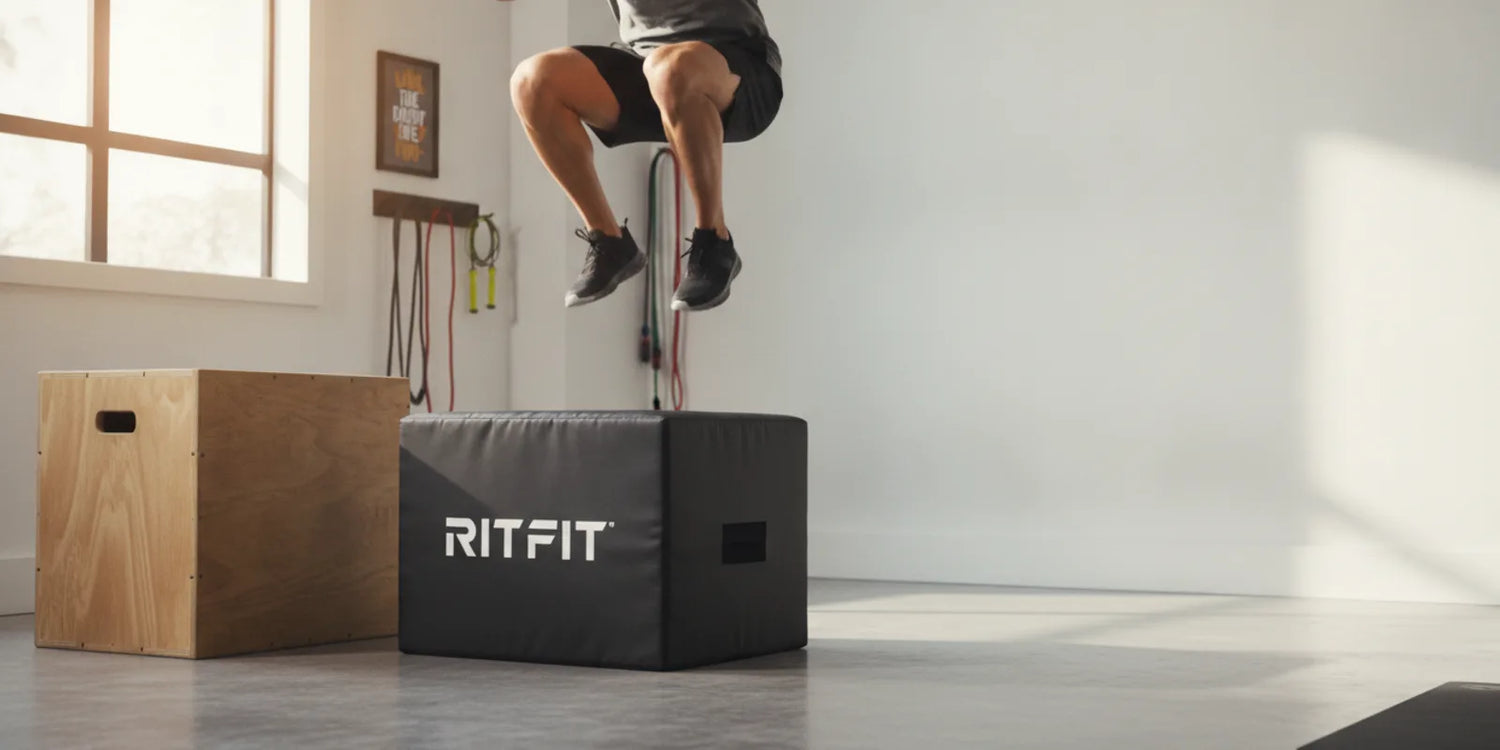
Choosing the best plyobox for your home gym comes down to three decisions: material, height, and whether a single box can grow with your training. Get those three right and you'll add explosive power, conditioning, and unilateral strength to any garage or basement setup.
This guide walks you through foam vs. wood vs. metal construction, how box height actually affects your performance, and which RitFit options deliver the most value for beginners and intermediate athletes alike.
Quick Answer: The best plyobox for most home gym owners is a 3-in-1 wood or soft wood-core design starting at 20 inches, offering stable landings for step-ups and box jumps across three height settings in one purchase. Foam boxes suit true beginners who need a shin-forgiving surface while building jump confidence.
Key Takeaways
- Material matters most: Wood and soft wood-core boxes are more stable for weighted step-ups and last 5-10 years vs. 1-3 years for foam-only options.
- Start at 20 inches: A 20-inch starting height builds proper landing mechanics before you progress to 24 or 30 inches with a 3-in-1 design.
- Box jumps reduce impact: A 2023 study found that box jumps cut peak impact force by approximately 51% compared to countermovement jumps, making them joint-friendly for power training.
- 3-in-1 delivers triple value: One box provides three usable heights by flipping and repositioning, replacing what would otherwise require purchasing three separate boxes.
- Foam has a specific use case: Foam plyo boxes are the right choice only if you are a true beginner with genuine anxiety about shin contact that is preventing consistent training.
Why Every Home Gym Needs a Plyo Box
A plyo box trains the stretch-shortening cycle, the rapid loading and releasing of muscle and tendon energy that drives explosive athletic movement. A 2023 study published in the Journal of Functional Morphology and Kinesiology found that box jumps reduce peak impact force by approximately 51% compared to countermovement jumps, making them one of the most efficient ways to develop power while managing joint stress.[1]
- Explosive power development: Box jumps train fast-twitch muscle fibers and the neuromuscular coordination needed for athletic performance and sport-specific movement.
- Lower-impact conditioning: Landing on a raised surface absorbs energy, reducing the ground-reaction force on ankles, knees, and hips compared to repeated floor jumps.
- Strength and stability: Weighted step-ups, single-leg step-ups, and Bulgarian split squats on a plyo box build unilateral leg strength and hip stability in ways bilateral squats cannot replicate.
- Space efficiency: A single plyo box serves as a jump platform, step-up bench, incline push-up surface, and depth-jump launch pad, delivering multiple training functions in minimal floor space.
- Beginner accessibility: Bilateral box jumps require no special equipment, no spotter, and no prerequisite strength level, making them one of the most accessible starting points for home gym beginners.
For home gym owners looking to build a complete setup, a plyo box pairs naturally with strength equipment to create a well-rounded conditioning program. Explore the full RitFit home gym setup guide for equipment pairing ideas.
Foam vs. Wood vs. Metal: Which Plyo Box Material Is Right for You?
Each plyo box material serves a different athlete profile, and choosing the wrong one for your training stage and goals is the most common buying mistake. The table below summarizes the key trade-offs across the three main construction types.
| Material | Shin Safety on Miss | Surface Stability | Height Options | Durability | Price Range | Best For |
|---|---|---|---|---|---|---|
| Foam | Best (collapses on contact) | Good | Up to 30 in (single height) | 1-3 years | $80-$180 | Beginners, shin-anxious athletes |
| Wood / Soft Wood-Core | Moderate (sand edges) | Excellent | 20/24/30 in (3-in-1) | 5-10 years | $60-$160 | Most home gym owners |
| Metal / Steel | Worst (hardest edge) | Excellent | Varies by model | 10-20 years | $200-$400+ | Commercial facilities |
Price and durability ranges based on industry buying guide averages. Individual product specs vary.
Foam Plyo Boxes
Foam plyo boxes use high-density polyurethane cores wrapped in vinyl or nylon covers that collapse on shin contact instead of cutting skin. The trade-off is performance: foam compresses slightly on landing, creating a less stable surface for heavy step-ups, and the core develops permanent compression spots after months of daily use.
- Buy foam if: You are a true beginner with genuine anxiety about shin contact that is actively preventing you from training consistently.
- Skip foam if: You plan to do weighted step-ups, need a stable surface for single-leg work, or want one box that grows with your training over multiple years.
- Key limitation: Foam boxes are single-height only, meaning you need to buy multiple units or stack them to access different training heights, increasing both cost and floor space over time.
Wood and Soft Wood-Core Plyo Boxes
Wood and soft wood-core plyo boxes have been the standard in athletic training for decades because they offer rigid, reliable surfaces for both jumping and loaded exercises. Soft wood-core designs add a padded outer layer that reduces the shin-shredding risk of raw wood while preserving the firmness and stability that foam cannot match.
- Stability advantage: Wood and wood-core surfaces do not compress under load, making them ideal for weighted step-ups, box squats, and progressive loading over time.
- 3-in-1 versatility: Most wood and wood-core boxes use a rectangular design that provides three heights, typically 20, 24, and 30 inches, by flipping and repositioning, covering the full range from beginner to advanced training.
- Long-term value: A well-built wood-core box at $60-$160 delivers 5-10 years of durability, making it the most cost-effective option for the vast majority of home gym owners.
- Edge safety tip: Lightly sand the edges of raw wood boxes before first use to reduce sharpness without compromising structural integrity.
Metal and Steel Plyo Boxes
Metal plyo boxes are engineered for commercial gym environments where dozens of athletes train daily at high volume. They are not designed for home use and the price premium rarely makes sense for individual athletes.
- Durability: Steel and aluminum boxes last 10-20 years and survive the repetitive impact of commercial-level training volume without wobbling or deteriorating.
- Shin risk: Metal edges are the hardest and least forgiving of all three options. A missed jump on a metal box is significantly more painful and injury-prone than on wood or foam.
- Price reality: Quality steel options start around $200 and reach $400 or more for adjustable commercial configurations, offering no meaningful advantage over wood for home gym use.
What Height Plyo Box Should You Start With?
Beginners should start with a 20-inch box height to build proper landing mechanics and jump confidence before progressing. A 2024 study in the International Journal of Exercise Science found that box height variations, from 0 to 80% of an athlete's maximum jump height, did not significantly affect propulsive performance when athletes were instructed to jump maximally, meaning varied heights can be used for technique teaching without sacrificing training quality.[2]
- 20 inches (beginner): Allows you to focus on soft, athletic landings in a quarter-squat position rather than fighting to reach the box. The goal of box jumps is height off the floor, not the height of the box.
- 24 inches (intermediate): Move to 24 inches once you can consistently land softly with proper hip and knee alignment on a 20-inch box across multiple sets.
- 30 inches (advanced): Reserved for athletes who have mastered landing mechanics and are training for sport-specific explosive power demands.
- Height selection principle: Choose a height where you can land in an athletic base position, not folded up with knees deeply compressed. If you must tuck your knees high to reach the box, it is too tall.
- Avoid jumping for height: A taller box does not equal a harder or more effective jump. Proper technique and maximal effort at any height produces the training stimulus, not the box height itself.
A 3-in-1 plyo box removes height selection anxiety entirely, giving you all three standard heights in one purchase. See the RitFit jump box technical specifications for exact dimensions and weight capacity details.
Is a 3-in-1 Plyo Box Worth the Investment?
A 3-in-1 plyo box is worth the investment for virtually every home gym owner because it replaces three separate boxes by providing 20-inch, 24-inch, and 30-inch training heights through a single rectangular design that flips and repositions into three orientations. One purchase at $60-$160 covers beginner, intermediate, and advanced training stages without requiring additional equipment.
- Three heights in one box: The standard wood 3-in-1 box measures 20 x 24 x 30 inches. Each face of the box becomes a different height depending on which side faces up.
- Cost comparison: Buying three separate single-height foam or wood boxes to cover the same height range costs significantly more and takes up three times the floor space.
- Progressive training path: Starting at 20 inches and advancing to 24 and 30 as your jump confidence and landing mechanics improve is the safest and most effective approach to plyo box training.
- Weighted exercise compatibility: The 3-in-1 wood-core design supports weighted step-ups, Bulgarian split squats, and box squats with weight capacities typically ranging from 350 to 500 lb, covering the full range of home gym training loads.
- Long-term value: A single well-built 3-in-1 box at the $60-$160 price point used across 5-10 years costs less per training session than foam alternatives that need replacement every 1-3 years.
For home gym owners building on a budget, a 3-in-1 plyo box is consistently ranked among the highest-value additions you can make. Pair it with other essential equipment in our guide to best home gym equipment under $500.
What Exercises Can You Do with a Plyo Box Beyond Basic Box Jumps?
A plyo box supports a wide range of training movements that develop unilateral leg strength, hip stability, reactive power, and upper-body conditioning, making it one of the most versatile pieces of equipment you can add to a home gym. The 6 must-do box jump workouts to build strength cover many of these in a structured format.
- Weighted step-ups: Load a barbell or hold dumbbells while stepping up onto the box, targeting the glutes and quads unilaterally with a stability demand that bilateral squats cannot replicate.
- Lateral box jumps: Stand beside the box and jump laterally onto it, training frontal-plane power and hip abductor strength that directly carries over to cutting and agility movements.
- Depth jumps: Step off the box, absorb the landing quickly, and immediately rebound into a vertical jump, training the reactive stretch-shortening cycle at the highest plyometric intensity level.
- Bulgarian split squats: Elevate your rear foot on the box and perform single-leg squats with a barbell or dumbbells, building quad and glute strength with significant hip flexor stretch under load.
- Single-leg step-ups: Step up one leg at a time with controlled tempo to develop knee stability, hip strength, and proprioception across each leg independently.
- Box squats: Use the box as a depth guide by sitting back onto it at the bottom of a squat, reinforcing proper hip-hinge mechanics and teaching consistent squat depth.
- Incline push-ups: Place your hands on the box to perform decline push-ups targeting the lower chest, or place your feet on the box for incline push-ups hitting the upper chest and shoulders.
- Seated box jumps: Start seated on a chair or bench facing the box, then explosively stand and jump onto the box, removing the countermovement and isolating pure concentric power output.
The video below walks through seven plyometric drills from beginner to advanced, with clear explanations of how to progress each movement and where box jumps fit within a complete power training sequence.
For a broader look at plyometric training principles, the plyometric workout guide on the RitFit blog explains the stretch-shortening cycle and how to structure sessions for your training level.
Which RitFit Plyo Box Should You Choose?
RitFit offers two distinct plyo box designs that address different training needs and comfort levels, both available as 3-in-1 units providing 20, 24, and 30-inch heights. The right choice comes down to your training experience and how much landing confidence you have going in.
- RitFit Patriotic Color 3-in-1 Foam Plyo Box: Designed for athletes who prioritize shin safety and a forgiving landing feel. The foam core collapses on contact, removing the skin-shredding risk of missed jumps entirely. Best choice for true beginners who want to build box jump confidence without the fear factor. Check current dimensions and weight capacity on the RitFit Patriotic Color 3-in-1 Foam Plyo Box product page.
- RitFit Classic 3-in-1 Extra Firm Soft Plyo Box: Built around a firm wood core with a padded outer shell that reduces edge sharpness while preserving the stable, non-compressing surface athletes need for weighted step-ups and loaded training. This design bridges the gap between raw wood firmness and foam safety, making it the better long-term option for most home gym owners. Full details are available on the RitFit Classic 3-in-1 Extra Firm Soft Plyo Box page.
| Priority | RitFit Patriotic Foam Box | RitFit Classic Soft Wood-Core Box |
|---|---|---|
| Landing feel | Soft, forgiving, shin-safe | Firm, stable, precise |
| Weighted step-ups | Limited (foam compresses) | Excellent (rigid wood core) |
| Best for | Beginners, confidence building | Most home gym owners |
| Height options | 20, 24, 30 inches (3-in-1) | 20, 24, 30 inches (3-in-1) |
Both models provide three usable heights via 3-in-1 design. Check individual product pages for current weight capacity and dimensions.
Browse the complete RitFit plyo box collection linked above to compare current models and pricing. For a broader look at functional training equipment, explore the functional training equipment collection for complementary home gym additions.
What Are the Most Common Mistakes to Avoid with Plyo Box Training?
Most plyo box training mistakes come from choosing the wrong height, prioritizing box height over jump mechanics, or skipping the foundational technique work that makes plyometrics safe and effective. A foundational review in the International Journal of Sports Physical Therapy classifies bilateral box jumps as a lower-level plyometric exercise, meaning they are accessible to beginners, while single-leg jumps from a box are significantly more intense and should be introduced progressively.[3]
- Jumping for height instead of power: The training benefit of a box jump comes from the explosive effort off the ground, not from how high the box is. Start at 20 inches and focus on generating maximum force, not clearing the tallest box in the room.
- Landing with a fully upright stance: Proper landing mechanics require absorbing into a quarter-squat position with soft knees, not landing stiff-legged. A stiff landing transfers ground-reaction force to the joints rather than the muscles.
- Skipping the step-down: Step down from the box after each jump rather than jumping down, especially in high-rep sets. Repeated jump-downs add significant eccentric loading and increase fatigue and injury risk unnecessarily.
- Buying a box that is too tall too soon: A box that forces you into an overly compressed landing position means it is too tall for your current jump height. Use a height where you land in an athletic base, then progress when your mechanics are solid.
- Buying foam out of fear instead of need: Fear of shin contact is legitimate, but starting on a foam box and later switching to wood costs more in total. Start on a wood or wood-core box, sand the edges, begin at 20 inches, and build confidence progressively. The fear disappears quickly with successful repetitions.
- Skipping warm-up before high-intensity jumps: Depth jumps and max-effort box jumps require the nervous system to be primed. Always complete dynamic warm-up movements, including pogo hops, before progressing to high-intensity plyometric work.
"Plyometrics are in fact not dangerous. If you've ever watched a kid, you realize they do this all the time every day."
Andy Galpin, PhD, Professor of Exercise Science and Human Performance, Parker University
For strength training programming that complements plyo box work, the home gym strength training guide covers how to integrate explosive and strength training across a weekly training structure. If you are building a complete home gym, see the guide on minimum home gym equipment essentials to identify the highest-priority purchases alongside your plyo box.
FAQs About the Best Plyobox
What size plyo box should a beginner start with?
Beginners should start with a 20-inch box to build proper landing mechanics and jump confidence before progressing. A 3-in-1 plyo box gives you the flexibility to advance to 24 or 30 inches as your power and technique improve over weeks of consistent training without buying additional equipment.
Is a foam plyo box or wood plyo box better for home gyms?
For most home gym owners, a wood or soft wood-core plyo box offers better long-term value, with greater stability for weighted step-ups and 5-10 years of durability. Foam boxes are the better choice only if you are a true beginner with genuine anxiety about shin contact that is actively preventing consistent training.
How do box jumps help with explosive power?
Box jumps train the stretch-shortening cycle, the rapid loading and releasing of muscle and tendon energy that powers explosive movement. A 2023 study found that box jumps produce similar propulsive forces to countermovement jumps while reducing peak impact force by approximately 51%, making them efficient for power development with lower joint stress.
What exercises can I do with a plyo box besides box jumps?
A plyo box supports weighted step-ups, lateral box jumps, depth jumps, single-leg step-ups, box squats, incline push-ups, Bulgarian split squats, and seated box jumps. These exercises develop unilateral leg strength, hip stability, and reactive power, making the plyo box one of the most versatile pieces of equipment in a home gym.
Can I use a plyo box if I have never done plyometric training before?
Yes. Bilateral box jumps are classified as a lower-level plyometric exercise, making them appropriate for beginners who want to start plyo box training safely. Start with a 20-inch box and master soft, controlled landings before advancing to higher heights or single-leg variations.
How much weight can a plyo box hold?
Weight capacity varies by construction, and most wood and wood-core plyo boxes support 350 to 500 lb, covering the vast majority of training use cases. Always check the manufacturer's stated weight capacity for your specific model before performing weighted step-ups.
Conclusion
The best plyobox for your home gym is almost always a 3-in-1 wood or soft wood-core design starting at 20 inches. It delivers the stability, height versatility, and long-term durability that foam-only alternatives cannot match, and it supports everything from beginner box jumps to loaded step-ups as your training progresses.
Start at 20 inches, master your landing mechanics, then advance to 24 and 30 inches when your form is solid. Browse the RitFit plyo box collection and choose the model that matches your training level and budget today.
Disclaimer
The information in this article is intended for general educational purposes and does not constitute medical or professional training advice. Consult a qualified fitness professional or healthcare provider before beginning any new exercise program, particularly if you have a pre-existing injury or medical condition.
Save on your next RitFit order
Tap the button to copy your code, then paste it at checkout.
References
1. Janikov MT, Pádecký J, Doguet V, Tufano JJ. Countermovement, Hurdle, and Box Jumps: Data-Driven Exercise Selection. J Funct Morphol Kinesiol. 2023;8(2). doi:10.3390/jfmk8020061. PMC10204452
2. Dos Santos ML, Shields J, Berton R, et al. Does Box Height Matter? A Comparative Analysis of Box Height on Box Jump Performance in Men and Women. Int J Exerc Sci. 2024;17(1):720-729. doi:10.70252/MTLS9089. PMC11166134
3. Davies G, Riemann BL, Manske R. CURRENT CONCEPTS OF PLYOMETRIC EXERCISE. Int J Sports Phys Ther. 2015;10(6):760-86. PMC4637913





