








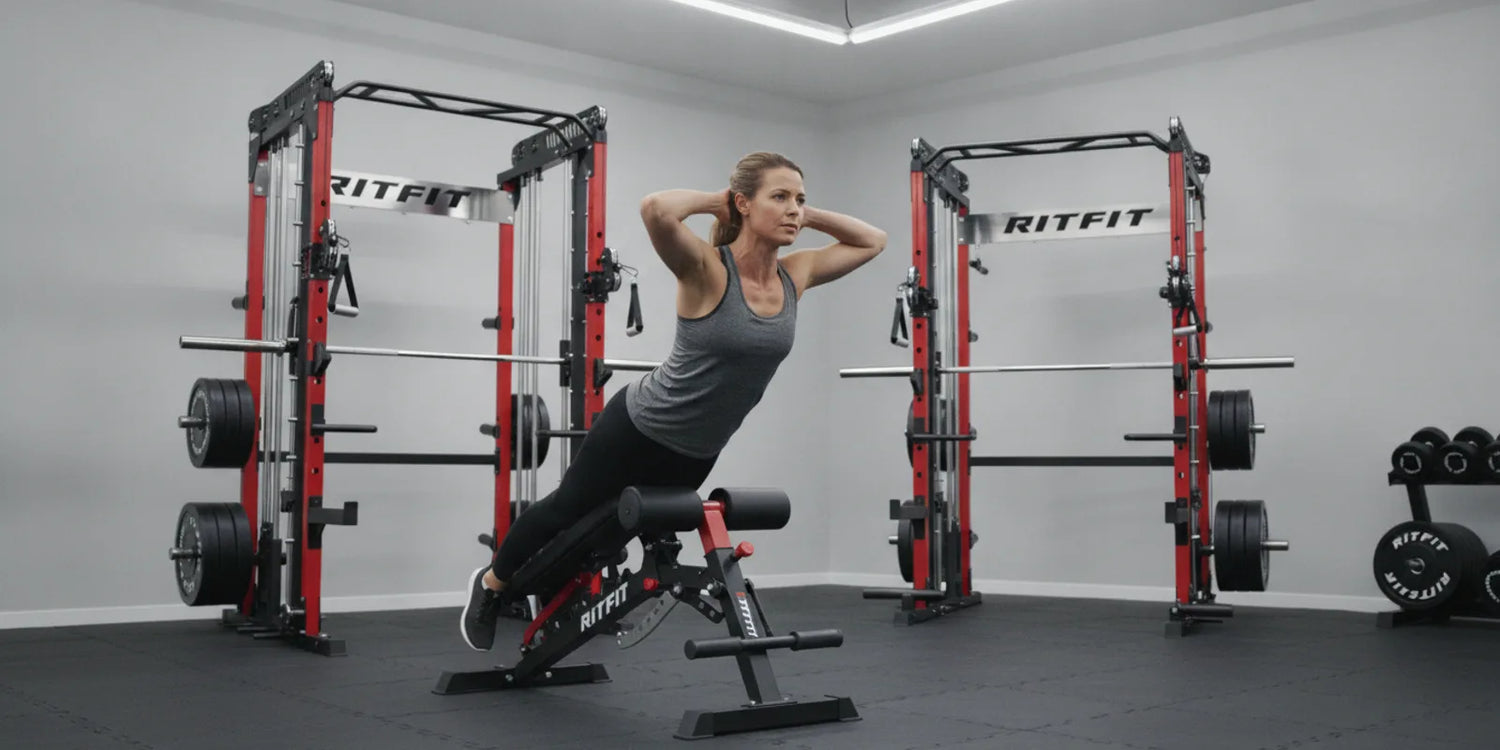
A roman chair is a compact posterior chain training station for home gyms, built to train the lower back, glutes, hamstrings, and trunk stabilizers through controlled hip extension and back extension patterns.
This guide explains 45 degree and 90 degree roman chair styles, the key features to check before buying, the difference between a roman chair and a GHD, and the safest way to use one in a home gym.
Quick Answer: The best roman chair for most home gyms is a 45 degree hyperextension bench in the $100 to $200 range. It is beginner friendly, compact, adjustable, and suitable for bodyweight or moderately loaded back extensions, making it the most practical posterior chain station for solo home training.
Key Takeaways
- Best style for most users: A 45 degree roman chair is easier to control, easier to store, and better suited to beginner and intermediate home gym training.
- Main training value: Roman chair exercises train the erector spinae, glutes, hamstrings, and trunk stabilizers through a repeatable posterior chain pattern.
- Most important safety spec: Weight capacity matters more than price, especially if you plan to hold a plate or dumbbell during extensions.
- Best value tier: The $100 to $200 range usually gives home gym users the best balance of stability, padding, adjustability, and footprint.
- Best upgrade path: A roman chair should come before a GHD for most home gyms because it gives strong posterior chain value in less space.
What Is a Roman Chair and Why Does Your Home Gym Need One?
A roman chair is a lower body supported exercise station that lets the torso hinge and extend against gravity. Home gym users choose it because it trains the posterior chain with a compact setup that is easier to control than many heavy barbell accessories.
A roman chair supports your hips and ankles while leaving your upper body free to hinge. The main movement pattern trains the posterior chain, which includes the erector spinae, glutes, hamstrings, and smaller stabilizers that help control the pelvis and spine.
"It is my opinion that a weak posterior chain and weak glutes in particular are largely responsible for the alarming number of low back pain in the U.S. Anything that strengthens the posterior chain might lead to less low back pain and injury."
Bret Contreras, PhD, Sports Scientist and Author of Glute Lab, Contreras Strength Institute
Compared with heavy barbell deadlifts, bodyweight roman chair extensions are easier to scale for solo home training. A dedicated unit can fit in a small training area, while still adding a focused movement pattern that many home gyms miss.
Roman Chair vs Hyperextension Bench
The terms roman chair and hyperextension bench are often used interchangeably in product listings, but the angle matters. A 45 degree hyperextension bench angles the hip pad downward so the torso moves through a more controlled arc, while a 90 degree roman chair positions the user more upright and allows a larger range of motion.
- 45 degree hyperextension bench: Easier to control, better for beginners, compact footprint.
- 90 degree roman chair: Larger range of motion, harder trunk stability demand, better for experienced lifters.
Muscles Worked by a Roman Chair
The roman chair trains the lower back, glutes, hamstrings, adductor magnus, and trunk stabilizers. In one electromyography study, the horizontal roman chair position produced 96.3 percent erector spinae activation during maximal voluntary isometric contraction testing, compared with 70.1 percent in the 45 degree position.[1]
A separate hamstring exercise study reported high peak muscle forces in the biceps femoris long head and semimembranosus during the roman chair hold.[2] Another study found that static and dynamic roman chair protocols could reliably assess lumbar extension endurance, with intraclass correlation coefficients of 0.92 and 0.96.[3]
- Erector spinae: The primary lower back muscle group used in most back extension variations.
- Gluteus maximus: A major hip extensor that becomes more involved when you hinge from the hips instead of the lumbar spine.
- Hamstrings: The biceps femoris, semimembranosus, and semitendinosus help stabilize and extend the hip during roman chair work.
- Adductor magnus: This deep hip extensor assists during glute focused hyperextension patterns.
- Core stabilizers: The multifidus, quadratus lumborum, and obliques help resist unwanted rotation and lateral flexion.
Which Style Is Right for You, 45 Degree or 90 Degree Roman Chair?
A 45 degree roman chair is the better choice for most home gym users because it is easier to control and more beginner friendly. A 90 degree roman chair is better for experienced users who want a larger range of motion and a harder trunk stability challenge.
| Feature | 45 Degree Hyperextension Bench | 90 Degree Roman Chair |
|---|---|---|
| Starting position | Torso angled downward | Torso vertical or near vertical |
| Range of motion | Moderate | Larger |
| Difficulty | Beginner to intermediate | Intermediate to advanced |
| Trunk control demand | Lower | Higher |
| Typical footprint | 3 to 4 ft wide, 4 to 5 ft long | 2 to 3 ft wide, 3 to 4 ft long |
| Foldable options | Common in budget models | Less common |
| Best for | Beginners, small spaces, glute and hamstring focused training | Advanced lifters who want a harder spinal erector challenge |
This comparison shows how roman chair angle affects difficulty, control, storage, and user fit.
45 Degree Hyperextension Bench
The 45 degree hyperextension bench is the safest default choice for most home gyms because the angled support makes the movement easier to control. The user can build erector spinae, glute, and hamstring strength without starting from a highly demanding vertical position.
If you are new to posterior chain training, returning after lower back discomfort, or building a first compact home gym, the 45 degree style is usually the right call.
90 Degree Roman Chair
The 90 degree roman chair places the hips higher and asks the torso to travel through a larger arc. This increases the demand on trunk stability, hip mobility, hamstring control, and spinal erector strength.
For experienced lifters who already squat, deadlift, and hinge well, the 90 degree roman chair can be a useful accessory. For most beginners, it is not the first unit to buy.
What Key Features Should You Evaluate Before Buying?
The best roman chair for a home gym should have enough weight capacity, a stable frame, adjustable pads, comfortable foam, and a footprint that fits your room. These features matter more than small cosmetic differences between models.
Weight Capacity and Frame Stability
Weight capacity is the most important safety specification. Budget foldable roman chairs often support around 250 to 300 lbs, while heavier fixed frame or combination units may be rated much higher.
If you plan to hold a weight plate during back extensions, add your body weight plus the external load and choose a unit rated at least 50 lbs above that combined number. A wide base and heavier steel frame will usually feel more stable during loaded reps.
Adjustability
Adjustable hip pad height is essential for shared home gyms because different users need different positions. The hip pad should sit just below the hip bones, leaving the hips free to flex and extend without the pad pressing into the stomach.
Tool free adjustment knobs are more convenient than hardware that requires extra tools, especially if several people use the same unit.
Footprint and Storage
Most roman chairs need about 3 to 4 feet of width and 4 to 6 feet of length for comfortable use. Foldable models can reduce storage demands by folding flat or standing near a wall.
Always check the in use dimensions and the folded dimensions before buying, especially for apartment gyms, garage gyms, and shared rooms.
Padding Quality
High density foam on the hip pad and ankle rollers makes a major difference during longer sets. Thin foam compresses quickly and creates pressure points that make proper form harder to maintain.
Look for firm padding, a durable vinyl style cover, and enough hip pad surface area to support the pelvis without restricting movement.
Stability at Full Extension
The most demanding point is the top of a loaded extension, where the body and external load are extended from the hip pad. Rubber feet, wide floor contact points, and frame levelers can all improve stability.
Narrow base designs may feel acceptable during bodyweight reps but can wobble when you add a plate or dumbbell.
Roman Chair vs GHD, Which Is the Better Home Gym Buy?
A roman chair is the better home gym buy for most users because it costs less, takes less floor space, and covers the core posterior chain exercises most people need. A GHD is better only when you specifically need glute ham raises and have the space and budget for a larger machine.
| Factor | Roman Chair or 45 Degree Bench | GHD Machine |
|---|---|---|
| Price range | $80 to $350 | $400 to $700 or more |
| Typical machine weight | 25 to 55 lbs | 100 to 180 lbs |
| Floor footprint | 3 to 4 ft by 4 to 6 ft | 4 to 5 ft by 5 to 6 ft |
| Back extensions | Yes | Yes |
| Glute ham raise | No | Yes |
| Decline sit ups | Yes | Yes |
| Beginner friendly | Yes | Lower, because the glute ham raise is demanding |
This table compares roman chairs and GHD machines for home gym cost, footprint, and exercise value.
Verdict for home gym owners: A roman chair delivers most of the posterior chain value a beginner or intermediate home gym user needs, while costing less and taking less room than a GHD. Build your posterior chain on a roman chair first, then upgrade only if you need true glute ham raise training.
For a complete strength setup, pair a roman chair with the M1 multi functional home gym system or explore the RitFit strength machines collection to build a full body home training layout.
What Should You Expect at Each Roman Chair Price Tier?
Most home gym users should expect the best value in the $100 to $200 roman chair tier. Entry level models work for bodyweight training, while higher priced units usually improve frame rigidity, padding, stability, and multifunction use.
| Tier | Price Range | Typical Capacity | Common Style | Best For |
|---|---|---|---|---|
| Entry Level | Under $100 | Around 250 lbs | 45 degree foldable | Beginners, small spaces, bodyweight only training |
| Mid Range | $100 to $200 | Around 300 lbs | 45 degree fixed frame | Regular home gym use, moderate loading, better stability |
| Multi Function Combo | $150 to $250 | Varies by model | Bench and hyperextension combination | Small spaces that need one unit for multiple movements |
| Heavy Duty | $200 to $350 | Around 300 to 500 lbs | 45 degree heavy frame | Loaded extensions, powerlifting accessories, advanced users |
This price tier guide helps match roman chair cost to realistic home gym use cases.
Under $100
Entry level foldable roman chairs are useful for bodyweight extensions and small spaces. Their tradeoff is usually frame rigidity, lighter tubing, thinner padding, and less confidence under added load.
If you weigh well below the stated capacity and plan to use only bodyweight reps, a budget unit can be a reasonable starting point.
$100 to $200
This is the sweet spot for most home gym users. Mid range fixed frame units usually feel more stable, use thicker padding, and handle moderate loading better than budget foldable designs.
This tier is especially practical for lifters who want to hold a 10 to 45 lb plate during back extensions.
$200 and Up
Higher priced roman chairs and combination benches usually offer wider bases, heavier frames, better foam, and more training options. Some units double as an adjustable weight bench, which can save space in a compact gym.
For broader home gym planning, see the RitFit home gym guide, the home gym ideas page, and the RitFit M1 home gym package.
Which Roman Chair Matches Your Training Goal?
The right roman chair depends on your main training goal, available space, current strength level, and loading plan. Beginners should start with a stable 45 degree unit, while advanced lifters may choose heavier frames or 90 degree designs.
| Training Goal | Recommended Style | Price Tier | Key Notes |
|---|---|---|---|
| Lower back conditioning | 45 degree foldable or fixed | Under $100 to $200 | Start with bodyweight and strict control |
| Glute development | 45 degree fixed frame | $100 to $200 | Use a hip hinge cue and higher rep sets |
| Deadlift accessory work | 45 degree heavy duty fixed | $200 to $350 | Choose a wider base for loaded extensions |
| Small space home gym | Foldable or multi function combo | $100 to $250 | Check folded dimensions before buying |
| Advanced trunk stability | 90 degree roman chair | $80 to $200 | Requires more mobility and control |
| Complete home gym build | 45 degree mid range plus strength system | $100 to $200 plus system | Pair with a Smith machine or power cage |
This decision matrix connects roman chair style, price tier, and training goal.
For home gym owners building beyond one accessory station, the RitFit PSR05 home gym package pairs naturally with a roman chair because it covers compound barbell style training while the roman chair handles focused posterior chain accessory work.
What Are the Best Exercises to Do on a Roman Chair?
The best roman chair exercises are back extensions, glute focused hyperextensions, reverse hypers, decline sit ups, oblique side bends, and isometric roman chair holds. Together, these movements train lower back endurance, glute strength, hamstring control, and trunk stability.
Back Extensions
Position the hip pad just below your hip bones, cross your arms over your chest, and lower your torso under control. Extend back up until your body forms a straight line from heels to shoulders.
Do not force the spine past neutral at the top. Start with 3 sets of 12 to 20 bodyweight reps, then add a plate only when your form stays controlled.
Glute Focused Hyperextensions
Use the same setup as a standard back extension, but drive the movement through the hips instead of the lower back. Think about pressing the hips into the pad and squeezing the glutes as you rise.
This variation shifts more emphasis toward hip extension and can work well as a glute finisher after squats, deadlifts, or lower body machine work.
Reverse Hypers
Face the opposite direction and lie across the pad with your upper body supported. Hold the frame for stability and raise both legs together until they reach roughly horizontal.
Reverse hypers can be used as a light posterior chain movement, especially when you want a lower load option after heavy lower body training.
Decline Sit Ups and Oblique Side Bends
For decline sit ups, face upward and secure your feet under the rollers. Lower your torso under control, then return without pulling aggressively on the neck.
For oblique side bends, position the body sideways and move through a controlled lateral flexion pattern. Keep the movement slow and avoid twisting under momentum.
Isometric Roman Chair Hold
Hold the top position of a back extension with your body parallel to the floor. Roman chair holds can create high posterior chain demand and were used in research examining hamstring muscle forces during exercise.[2]
Start with 3 sets of 20 seconds and progress toward 60 second holds. Add load only after you can hold the position without shaking or lumbar discomfort.
How Do You Set Up and Use a Roman Chair Safely?
Set up a roman chair by placing the hip pad just below the hip bones, securing the ankle rollers, checking the frame for wobble, and moving only through a controlled range. Stop each rep when the body reaches a straight line.
- Step 1, adjust the hip pad: Place the hip pad just below your hip bones so the pelvis is supported but the hips can still move freely.
- Step 2, secure the ankle rollers: Position the rollers at the lower shin or ankle area, not directly across the Achilles tendon.
- Step 3, check frame stability: Rock the unit lightly before mounting it and adjust the feet or floor position if it moves.
- Step 4, set your start position: Begin with a neutral spine and a controlled lower position, not a relaxed hanging position.
- Step 5, control the top position: Rise until the body forms a straight line, then pause briefly before lowering again.
Common Setup Mistakes
- Hip pad too high: A pad pressing into the stomach restricts hip movement and can make the exercise uncomfortable.
- Ankle rollers too loose: Loose rollers allow the feet to shift and can create uneven loading.
- Hyperextending past neutral: Repeated aggressive extension can irritate the lower back, especially under load.
- Using momentum: Swinging reduces the training effect and increases stress at the end ranges.
When to Add Weight
Add a plate or dumbbell only after you can complete 3 sets of 20 clean bodyweight reps without lower back pain, form breakdown, or loss of control. Start with a light plate held at the chest and increase gradually.
For room planning, place the unit where you have clear space to mount, dismount, and move safely. The home gym size guide, best chest machines for home gyms, best dumbbell sets for home gym, and best home gym barbell guide can help you round out the rest of your layout.
FAQs About Roman Chairs
What is the difference between a roman chair and a hyperextension bench?
A roman chair and a hyperextension bench are often similar, but the angle is the main difference. A 45 degree hyperextension bench supports a more controlled movement, while a 90 degree roman chair allows a larger range of motion and usually feels harder for beginners.
Is a roman chair good for lower back training?
Yes.
A roman chair can train the erector spinae and supporting posterior chain muscles when used with controlled form.
It should not be treated as medical treatment for back pain, and people with existing injury should speak with a qualified healthcare professional before using one.
How much space does a roman chair need in a home gym?
Most roman chairs need about 3 to 4 feet of width and 4 to 6 feet of length for safe use. Foldable models can reduce storage space, but you still need clear room behind and around the unit for mounting, movement, and dismounting.
What weight capacity should a roman chair have?
Most home gym users should choose a roman chair rated for at least 250 to 300 lbs for bodyweight training. If you plan to hold plates or dumbbells, add your body weight and external load, then choose a unit with at least 50 lbs of extra margin.
Can a roman chair build glutes?
Yes.
A roman chair can build glutes when you focus on hip extension instead of lifting mainly through the lower back.
Keep the movement controlled, drive the hips into the pad, squeeze the glutes at the top, and use higher rep sets before adding load.
Which roman chair is best for beginners?
A 45 degree roman chair is usually best for beginners because it feels more supported and easier to control. Choose an adjustable model with stable feet, firm padding, and enough weight capacity for your body weight plus any future light plate loading.
Should I buy a roman chair or a GHD for a home gym?
Most home gym users should buy a roman chair first because it is cheaper, smaller, and easier to use. A GHD is a better choice only if you specifically need glute ham raises, have more floor space, and already have strong posterior chain control.
Can you do back extensions every day on a roman chair?
Back extensions can be done more frequently than heavy compound lifts because the load is lower, but daily training is not recommended for most users. Two to three sessions per week with at least 48 hours of rest between sessions allows sufficient recovery for the posterior chain muscles.
Conclusion
The best roman chair for most home gym lifters is a stable 45 degree hyperextension bench in the $100 to $200 range. It gives a strong mix of posterior chain training value, compact storage, beginner friendly setup, and enough progression for bodyweight and moderate loaded extensions.
Start with controlled back extensions, progress gradually, and choose a unit that fits your body weight, training space, and future loading plan. For exclusive deals and savings on your home gym setup, check out the RitFit discount guide.
Disclaimer
This article is for general fitness education only and does not provide medical advice. If you have a current back injury, chronic pain, neurological symptoms, or a diagnosed medical condition, consult a qualified healthcare professional before starting roman chair or back extension exercises.
Save on your next RitFit order
Tap the button to copy your code, then paste it at checkout.
References
1. Biviá Roig G, Lisón JF, Sánchez Zuriaga D. Determining the optimal maximal and submaximal voluntary contraction tests for normalizing the erector spinae muscles. PeerJ. 2019,7,e7824. doi:10.7717/peerj.7824. PMCID: PMC6802582
2. Van Hooren B, Vanwanseele B, van Rossom S, et al. Muscle forces and fascicle behavior during three hamstring exercises. Scand J Med Sci Sports. 2022,32,6,997,1012. doi:10.1111/sms.14158. PMCID: PMC9314024
3. Udermann BE, Mayer JM, Graves JE, Murray SR. Quantitative Assessment of Lumbar Paraspinal Muscle Endurance. J Athl Train. 2003,38,3,259,262. PMCID: PMC233181





