The best Smith machine exercise for glutes is the Smith machine hip thrust because it loads hip extension directly and helps you focus on peak glute contraction. This guide also covers glute focused squats, Romanian deadlifts, split squats, lunges, programming tips, and safety cues for building stronger glutes at home.
Table of Contents
- Quick Anatomy and Function of the Glutes
- Why Use the Smith Machine for Glute Training
- The Best Smith Machine Exercise for Glutes
- How to Do the Smith Machine Hip Thrust
- Other Effective Smith Machine Glute Exercises
- Smith Machine Glute Exercise Comparison
- How to Program Smith Machine Glute Exercises
- Sample Smith Machine Glute Workout
- Safety, Warm Up, and Recovery
Key Takeaways
- The Smith machine hip thrust is the top glute exercise: It targets heavy hip extension and makes it easier to keep tension on the gluteus maximus.
- Glute growth needs more than one movement: Squats, Romanian deadlifts, split squats, and reverse lunges help train the glutes through different angles.
- Form controls muscle focus: Foot placement, shin angle, torso position, and pelvic control determine whether the glutes or quads do most of the work.
- Progressive overload drives results: Add weight, reps, sets, pauses, or control only when your technique stays stable.
- A complete home setup matters: A stable Smith machine, adjustable bench, weight plates, and safe flooring make glute training more repeatable.
Quick Anatomy and Function of the Glutes
The glutes are the primary muscles that shape hip extension, hip stability, and lower body power. For effective Smith machine glute training, your program should load both heavy hip extension and single leg control.
- Gluteus maximus: This is the largest glute muscle and the main driver of hip extension. Hip thrusts, glute biased squats, Romanian deadlifts, and reverse lunges all train this muscle strongly.
- Gluteus medius: This muscle helps stabilize the pelvis and control the knee during single leg movements. Bulgarian split squats and controlled lunges can help train this function.
- Gluteus minimus: This smaller muscle supports hip stability and helps control leg position. It becomes especially important when you train with one leg or a wider stance.
- Hamstrings and adductors: These muscles assist hip extension and lower body control. They support the glutes during Romanian deadlifts, lunges, and deep squat patterns.
Why Use the Smith Machine for Glute Training?
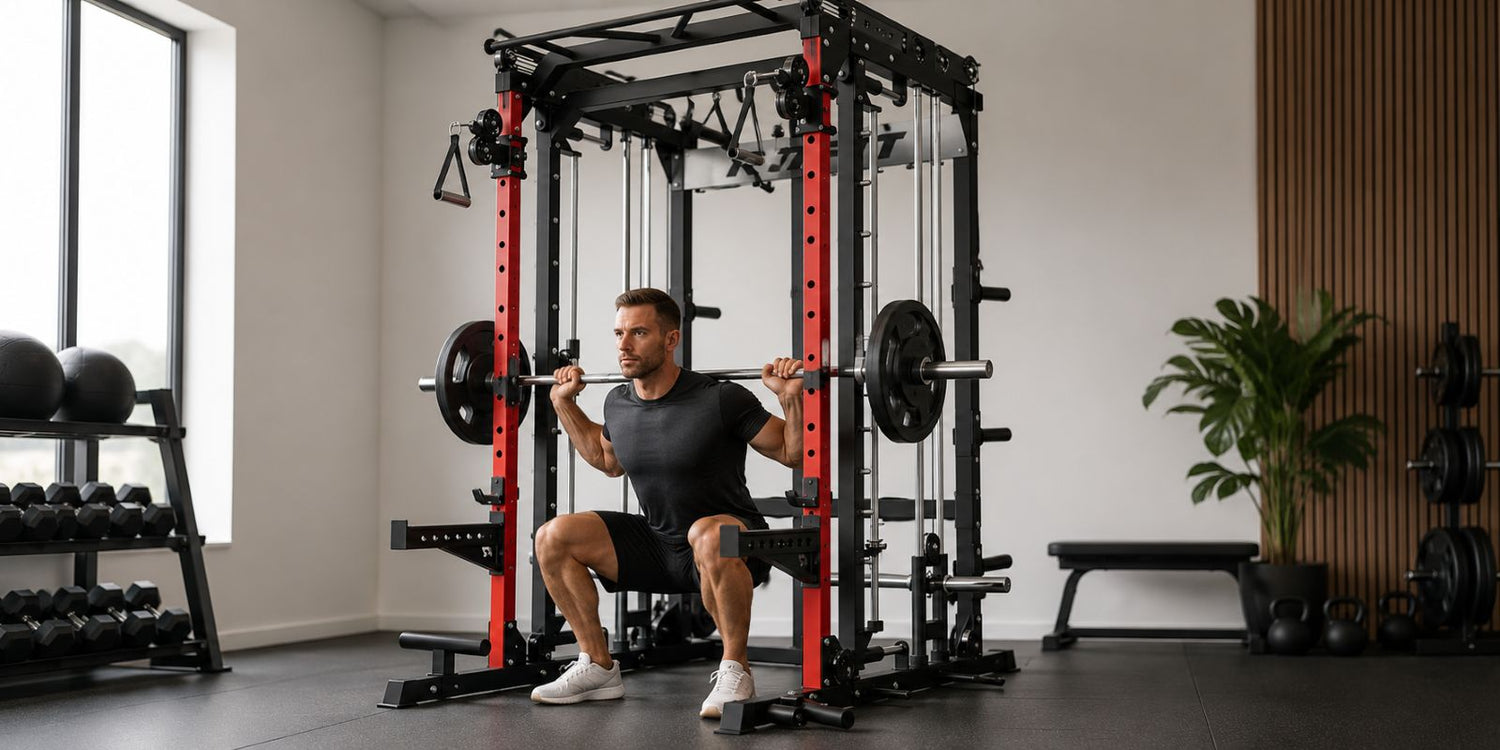
A Smith machine is useful for glute training because the guided bar path reduces balance demands and helps you focus on the target muscles. It is especially practical for lifters who train alone, train at home, or want more controlled lower body loading.
- Stability: The fixed bar path helps you stay consistent from rep to rep. This makes it easier to learn hip thrusts, split squats, and glute biased squats.
- Safety: Built in hooks and stops can make solo lifting more manageable. You should still test the hook position and use controlled reps before adding heavy weight.
- Glute focus: The machine helps reduce balance limitations so you can focus on hip drive and glute squeeze. Research on loaded hip extension exercises shows that hip thrusts, lunges, squats, and deadlifts can all produce high gluteus maximus activation when performed correctly.[1]
- Home gym efficiency: One guided bar station can support hip thrusts, squats, lunges, RDLs, calf raises, and upper body work. For a complete setup, explore Smith machines for home gym glute training.
The Best Smith Machine Exercise for Glutes: Smith Machine Hip Thrust
The Smith machine hip thrust is the best overall Smith machine glute exercise because it emphasizes hip extension with high stability. It lets you load the glutes heavily while keeping the movement easier to control than many free weight setups.
Why the Smith Machine Hip Thrust Works
The hip thrust trains the gluteus maximus through a powerful lockout position where you can focus on squeezing the hips forward. A training study comparing hip thrust and squat programs found similar gluteal hypertrophy outcomes, while squat training produced greater thigh hypertrophy, which supports using both patterns for complete lower body development.[2]
Best Equipment for Setup
You need a Smith machine, a stable flat or adjustable bench, weight plates, and a thick bar pad. A stable adjustable bench such as the RitFit GATOR adjustable weight bench helps support the upper back during hip thrusts.
Who It Is Best For
The Smith machine hip thrust is best for home gym lifters who want targeted glute loading without needing to balance a free barbell. It is also helpful for beginners who need a stable setup before progressing to heavier loads.
How to Do the Smith Machine Hip Thrust
Proper setup matters because small changes in bench height, bar position, and foot placement can shift tension away from the glutes. Use a controlled tempo and keep each rep consistent before increasing the load.
- Step 1: Set the bench: Place the bench perpendicular to the Smith machine and position it so the bar sits over your hip crease. The bench should not slide when you press your upper back into it.
- Step 2: Position your upper back: Rest the lower part of your shoulder blades on the bench edge. Keep your ribs down so the movement comes from hip extension instead of lower back arching.
- Step 3: Place the bar: Use a thick bar pad and center the bar across the crease of your hips. The bar should feel secure before you unrack it.
- Step 4: Set your feet: Place your feet flat and slightly wider than hip width. At the top, your shins should be close to vertical for better glute focus.
- Step 5: Drive and squeeze: Push through your heels and midfoot until your hips reach full extension. Pause briefly at the top, squeeze the glutes, then lower under control.
Form Cues
Keep your chin slightly tucked, ribs down, pelvis controlled, and feet flat. Avoid pushing through your toes because that often shifts more work toward the quads.
Common Mistakes
The most common mistakes are using too much weight, arching the lower back, cutting the range of motion short, and letting the knees cave inward. Reduce the load if you cannot lock out with a strong glute squeeze.
Other Effective Smith Machine Glute Exercises
The hip thrust can be your main glute builder, but supporting exercises make the program more complete. Use a mix of squat, hinge, and single leg patterns to train the glutes through different joint positions.
Smith Machine Glute Biased Squat
A Smith machine squat becomes more glute focused when you step slightly forward, use a controlled descent, and drive through the hips. Keep your knees tracking over your toes and avoid turning the movement into a shallow knee bend.
Smith Machine Bulgarian Split Squat
The Bulgarian split squat trains one glute at a time and helps correct side to side strength differences. Use a longer stance, slight forward torso lean, and pressure through the front heel for more glute emphasis.
Smith Machine Reverse Lunge
The reverse lunge is a strong glute option because the long backward step creates more hip demand on the front leg. Keep the front shin relatively vertical and control the bottom position.
Smith Machine Romanian Deadlift
The Romanian deadlift trains the glutes and hamstrings through a hip hinge. Keep the bar close to your thighs, push your hips back, and stop when you feel a strong stretch without rounding your back.
Smith Machine Curtsy Lunge
The curtsy lunge can target the side glutes when performed slowly and within a comfortable range. Skip this movement if it causes knee or hip discomfort.
Smith Machine Glute Exercise Comparison
The best Smith machine glute program uses different exercises for different purposes. Hip thrusts load peak hip extension, squats train a deeper lower body pattern, RDLs train the hinge, and split squats improve single leg control.
| Exercise | Main Glute Benefit | Best Rep Range | Best Use |
|---|---|---|---|
| Smith Machine Hip Thrust | Peak glute contraction and heavy hip extension | 6 to 12 reps | Main glute strength movement |
| Glute Biased Smith Squat | Glutes, quads, and lower body strength | 8 to 12 reps | Compound lower body builder |
| Smith Machine RDL | Glute and hamstring stretch under load | 8 to 12 reps | Hip hinge development |
| Smith Machine Bulgarian Split Squat | Single leg glute control | 10 to 15 reps per leg | Balance and side to side strength |
| Smith Machine Reverse Lunge | Glute and hamstring focused stride pattern | 10 to 15 reps per leg | Unilateral accessory work |
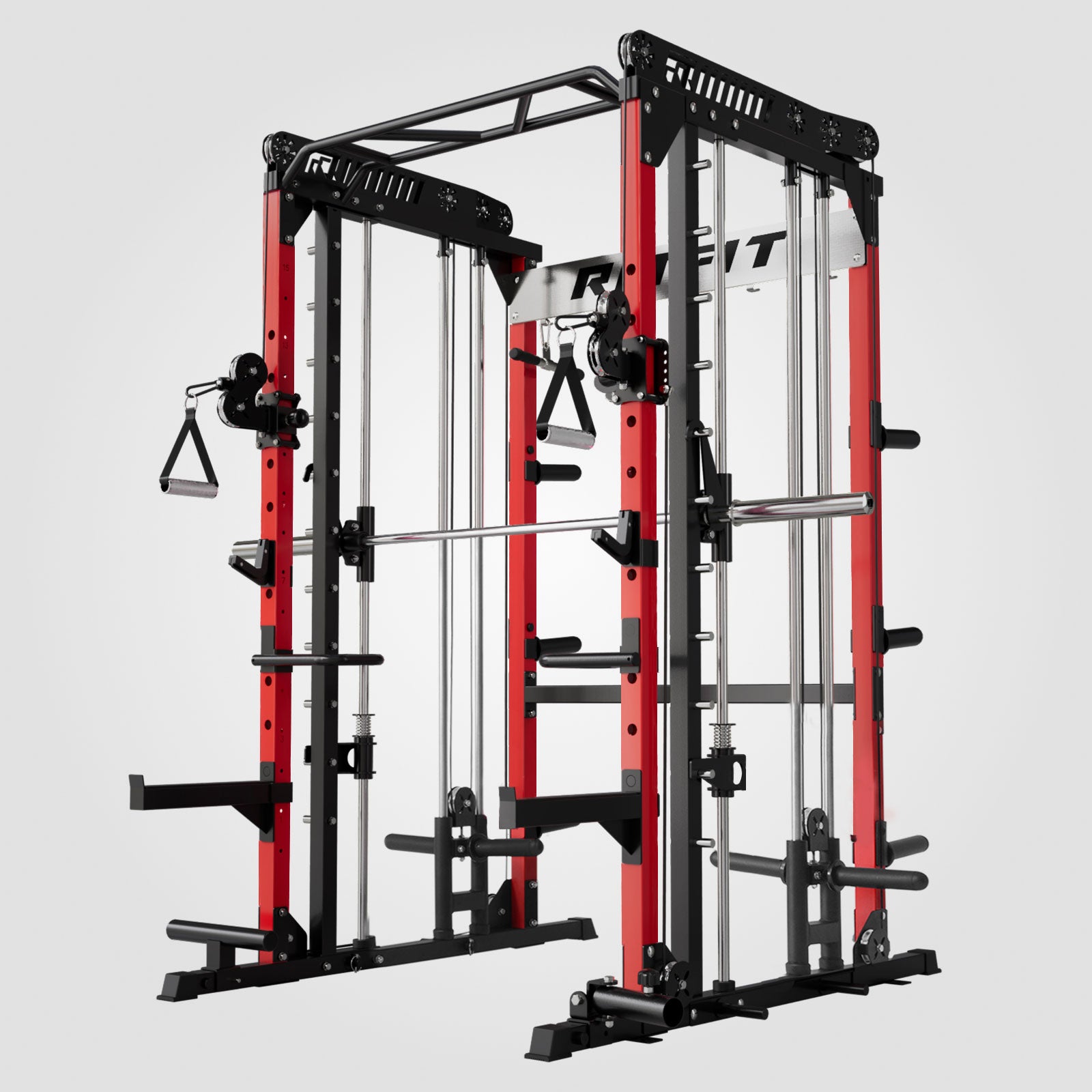
For a more versatile setup that supports Smith work, cable exercises, and rack training, the RitFit M1 PRO Smith machine home gym package is a strong option for building a complete lower body station. If you prefer a modular home gym system, compare it with the RitFit M2 modular Smith machine.
How to Program Smith Machine Glute Exercises
Glute programming should balance hard sets, recovery, and progressive overload. Most lifters can start with 2 glute sessions per week and adjust based on soreness, performance, and schedule.
- Main lift: Start each session with Smith machine hip thrusts or glute biased squats. Use this movement when your energy and focus are highest.
- Accessory lift: Add one hinge or one single leg movement after the main lift. Good options include Smith machine RDLs, reverse lunges, and Bulgarian split squats.
- Sets and reps: Use 3 to 5 sets for main movements and 2 to 4 sets for accessories. Evidence on resistance training suggests hypertrophy can be achieved across a range of loads, as long as effort and progression are managed well.[3]
- Weekly volume: Aim for 10 to 20 hard glute sets per week when recovery is good. Systematic review evidence suggests training volume can influence hypertrophy, but more volume is not always better if performance drops.[4]
- Progression: Add weight only after you can complete the target reps with clean form. You can also progress by adding reps, sets, pauses, or slower lowering phases.
- Rest periods: Rest 2 to 3 minutes after heavy hip thrusts, squats, or RDLs. Rest 60 to 90 seconds after lighter accessories or finishers.
To support progressive overload at home, pair your Smith machine with RitFit high grade color bumper plates. For plate loaded training, consistent weight jumps make tracking glute progress easier.
Sample Smith Machine Glute Workout
This sample workout uses one thrust, one squat, one hinge, and one single leg movement. Perform it 1 to 2 times per week depending on your recovery and total lower body training volume.
- Smith Machine Hip Thrust: 4 sets of 8 to 12 reps. Pause for 1 second at the top of each rep.
- Smith Machine Glute Biased Squat: 3 sets of 8 to 10 reps. Keep the stance slightly forward and control the lowering phase.
- Smith Machine Romanian Deadlift: 3 sets of 8 to 12 reps. Focus on pushing the hips back and keeping the bar close.
- Smith Machine Bulgarian Split Squat: 3 sets of 10 to 12 reps per leg. Use a long stance and controlled depth.
- Optional Finisher: 2 sets of 20 bodyweight glute bridges or banded lateral walks. Use this only if your form is still clean.
If you want a compact add on for hip thrust focused rack training, consider the RitFit hip thrust and bicep curl attachment. It can help expand lower body options in a home gym setup.
Safety, Warm Up, and Recovery
Smith machine glute training should start with a warm up and finish with enough recovery between hard lower body sessions. The goal is to train hard without letting fatigue break your technique.
- Warm up first: Start with 5 to 10 minutes of easy cardio or dynamic mobility. Add bodyweight glute bridges, hip hinges, or light warm up sets before heavy work.
- Protect the hips: Use a bar pad for hip thrusts. The bar should sit in the hip crease, not on the stomach or hip bones.
- Control the lower back: Keep the ribs down and avoid arching to finish a rep. If the lower back feels more active than the glutes, reduce the load and reset your foot position.
- Use stable flooring: A bench or feet that slide can make hip thrusts unsafe. For better traction, use rubber interlocking gym flooring mats.
- Recover between sessions: Leave at least 48 hours between hard glute sessions if performance or soreness is still high. Muscle growth depends on training stimulus, protein intake, sleep, and recovery.
- Stop sharp pain: Stop immediately if you feel sharp pain in the knees, hips, or lower back. Adjust technique or consult a qualified professional before continuing.
Recommended Home Gym Setup for Smith Machine Glute Training
A strong Smith machine glute setup should support stable hip thrusts, safe loading, and enough floor space for split squats and lunges. You do not need a crowded gym, but you do need equipment that stays stable under repeated lower body loading.
- Smith machine: Choose a unit that fits your ceiling height, training style, and space. A Smith machine with rack and cable options can support both lower body and full body training.
- Adjustable bench: Use a stable bench for hip thrusts and supported accessory work. Bench height should let your shoulder blades rest securely without sliding.
- Olympic plates: Use plates that allow small and consistent jumps in load. This makes progressive overload easier to manage.
- Floor protection: Use rubber flooring to improve traction and protect the training area. This is especially important for garage gyms and shared home spaces.
- Accessories: Consider bands, ankle straps, cable handles, and rack attachments if your program includes extra abduction or cable glute work. You can explore RitFit rack attachments for expanding your setup.
FAQs
What is the best Smith machine exercise for glutes?
The best Smith machine exercise for glutes is the Smith machine hip thrust. It loads hip extension directly, keeps the bar path stable, and makes it easier to focus on a strong glute squeeze at the top of each rep.
How do you set up a Smith machine hip thrust for glutes?
Set the bench across the Smith machine, place your shoulder blades on the bench edge, and position the padded bar in your hip crease. Keep your feet flat, shins near vertical at the top, and hips moving with control.
Can Smith machine squats grow your glutes?
Yes. Smith machine squats can grow your glutes when you use a glute biased stance, enough depth, and progressive overload. Step the feet slightly forward, control the descent, and drive through the hips instead of turning every rep into a quad dominant squat.
Is the Smith machine good for beginner glute training?
Yes. The Smith machine is useful for beginner glute training because the guided bar path reduces balance demands. Beginners should start light, learn foot placement, use controlled reps, and increase weight only when hip, knee, and back position stay consistent.
Which Smith machine exercise targets glutes more than quads?
The Smith machine hip thrust usually targets the glutes more directly than the quads. Smith machine Romanian deadlifts and reverse lunges can also emphasize the glutes when you use a hip hinge, longer stride, and controlled range of motion.
How often should you train glutes on a Smith machine?
Most lifters can train glutes on a Smith machine 2 to 3 times per week. Keep total hard sets, soreness, and performance in balance, and leave enough recovery between heavy hip thrust, squat, lunge, and Romanian deadlift sessions.
Can you build glutes with only Smith machine exercises?
Yes. You can build glutes with only Smith machine exercises if your program includes hip thrusts, squats, hinges, and single leg work. Progress comes from consistent overload, full range of motion, enough weekly sets, protein intake, and recovery.
Should you go heavy on Smith machine hip thrusts?
Yes, but only when your form stays clean. Heavy Smith machine hip thrusts can build strength and size, but the load should never force lower back arching, short reps, knee collapse, or a loss of control at the bottom.
Conclusion
The best Smith machine exercise for glutes is the Smith machine hip thrust, but the best glute program also includes squats, RDLs, split squats, and lunges. Build your routine around stable setup, clean form, progressive overload, and enough recovery, then use your Smith machine as a repeatable home gym tool for stronger glutes.
Disclaimer
This article is for general educational purposes only and is not medical advice. Stop any exercise that causes sharp pain, numbness, joint instability, or unusual discomfort, and consult a qualified healthcare or fitness professional if you have hip, knee, back, pelvic, or post surgery concerns.
References
- Neto WK Soares EG Vieira TL Aguiar R Chola TA Sampaio VL Gama EF. Gluteus maximus activation during common strength and hypertrophy exercises. J Sports Sci Med. 2020;19(1):195-203. PMCID: PMC7039033.
- Plotkin DL Rodas MA Vigotsky AD et al. Hip thrust and back squat training elicit similar gluteus muscle hypertrophy and transfer similarly to the deadlift. Front Physiol. 2023;14:1279170. PMCID: PMC10593473.
- Schoenfeld BJ Grgic J Van Every DW Plotkin DL. Loading recommendations for muscle strength, hypertrophy, and local endurance, a re examination of the repetition continuum. Sports. 2021;9(2):32. PMCID: PMC7927075.
- Baz Valle E Balsalobre Fernandez C Alix Fages C Santos Concejero J. A systematic review of the effects of different resistance training volumes on muscle hypertrophy. J Hum Kinet. 2022;81:199-210. PMCID: PMC8884877.