








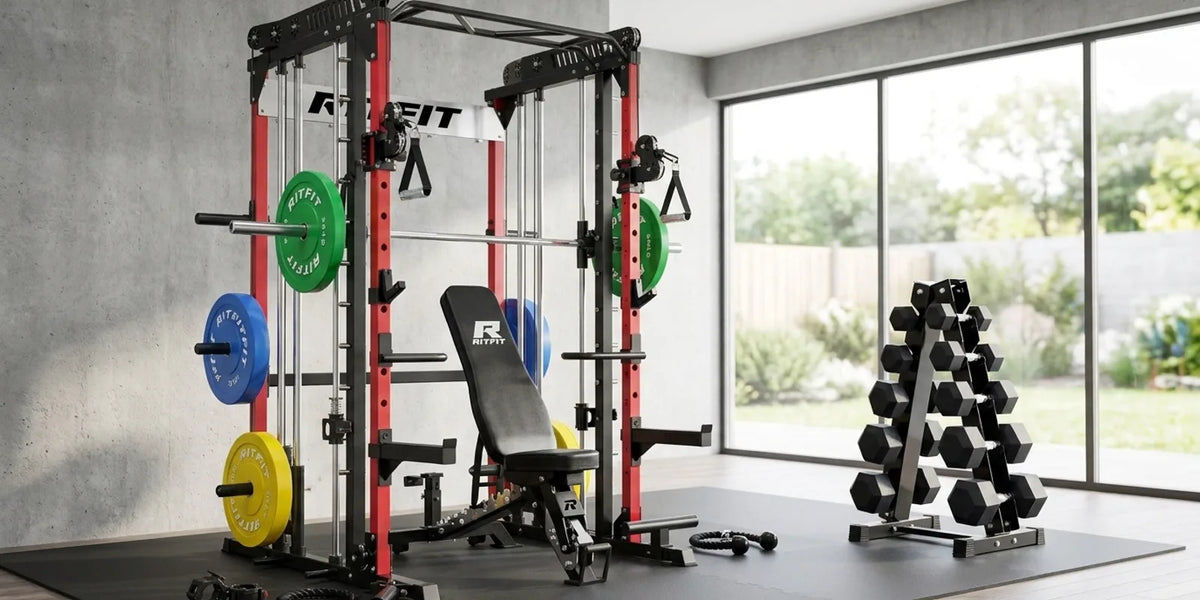
The best Smith machine for runners at home has to do two jobs: load the calf and soleus complex that carries most of your running stance phase, and let you lift heavy alone without a spotter. The RitFit M1 PRO covers both on a 20.9 sq ft footprint.
This guide shows how to load calves and the Achilles tendon on a guided bar path, how to schedule heavy work around weekly mileage and race week, and which of the three M1 PRO configurations to order. Every figure below comes from RitFit's listed product data.
Quick Answer: The RitFit M1 PRO is the strongest fit for a runner's home gym because its fixed bar path lets you take calf raises, heel drops, and heavy squats to a hard set alone, and the 20.9 sq ft footprint fits a garage bay. Order the plate package if you already own bumper plates, and the weight stack package if you want fast load changes.
Key Takeaways
- Machine choice comes first: The M1 PRO's fixed bar path is what makes repeated hard sets on calves and squats practical when you train alone, and the listed footprint is 20.9 sq ft.
- Calf work is the differentiator: Standing and seated Smith machine calf raises reach the gastrocnemius and the soleus, the two heads that carry the stance phase load.
- Program around mileage: Two heavy sessions a week on easy days, in the three to six rep range, is the pattern the running economy evidence supports.
- Block length matters: Running economy gains were larger when heavy resistance training ran for 10 to 14 weeks rather than a short block.
- Package decision: The bare frame suits runners who already own a bench and plates, the plate package suits a first setup, and the weight stack package suits fast load changes.
Why Do Runners Need a Smith Machine at Home?
A Smith machine helps a runner train alone because the fixed bar path removes the balance and spotting demands of a free barbell. That one change makes hard sets on the calf complex, the posterior chain, and the squat pattern repeatable week to week, even when nobody is around to spot you.
- Repeatable bar path: the carriage locks the load into one line, so the last rep of a set looks like the first and you can judge effort honestly instead of managing a drifting barbell.
- Spotter free: the J-hooks and safety arms catch a failed rep, which is what makes a genuine hard set realistic in a garage at 6 a.m.
- One machine, several jobs: Smith squats, split squats, standing and seated calf raises, and cable work all run off the same frame.
- What it does not do: a guided path removes some of the balance and stabilizer demand a free barbell creates, so keep single leg work and hill running in the plan.
The calf complex is the part most home setups skip, and it is also the part that decides how the final miles of a race feel. A guided bar path gives you a way to load it hard without a training partner.
If you are still weighing a guided path against a free barbell, Smith machine vs squat rack walks through the tradeoffs. Runners who already know they want a machine can browse the RitFit Smith machine collection before committing to a frame.
Taking a set close to failure gets safer when the bar cannot fall on you, which is why training to failure safely at home is realistic on this frame and much less so on a bare barbell.
Why Does a Guided Bar Path Beat a Free Barbell for a Runner?
The carriage on a Smith machine removes the balance requirement that a free barbell adds, so a runner can push the last two reps of a hard set without the bar drifting forward or stalling on a stabilizer. The tradeoff is real, because a free barbell trains that stabilizer work and a guided path does not, so keep single leg and hill work in the plan.
"Next, I do Smith machine squats for the quads and glutes. Here I get as deep as I can and explode out of the hole. Doing these on the Smith allows me to push my last set to failure without worrying about dumping the bar."
Jeff Nippard, Science-Based Natural Bodybuilder and Powerlifter, JeffNippard.com, in Jeff Nippard's Science-Backed Leg Workout for Massive Quads
"This smith machine is amazing. Everyone uses it. The ease of going from 1 excesize to the next is great. The weight storage is great. You don't need an extra rack to store the weights. The size was perfect for the location in our home. Thank you for making a great smith machine"
Linda R. Verified Buyer, RitFit M1 PRO Smith Machine Home Gym Package Comprehensive All-In-One Workout System
How Do Runners Load Calves and Achilles on a Smith Machine?
A Smith machine loads the calf complex in two positions. The standing calf raise puts the bar across your shoulders with the balls of your feet on a plate, and the seated version puts the bar across your knees.
- Standing calf raise: set the bar on your traps, stand with the balls of your feet on a weight plate or on the base frame, let the heels sink into dorsiflexion, then drive up to full plantarflexion.
- Seated calf raise: sit on a bench inside the frame, rest the bar across your knees over a pad, and hold a 90 degree knee angle so the soleus does the work.
- Eccentric control: take three seconds to lower, pause for one second in the stretched position, then drive up.
- Single leg progression: once 12 clean reps with the bar are easy, move to one leg at a time and use a hand on the frame for balance only.
The gastrocnemius responds to the straight leg position, while the soleus takes over once the knee is bent, which is why the standing and seated versions are not interchangeable. The triceps surae and quadriceps together produce more than 70% of the total mechanical work during the stance phase of running, so both positions earn a place in the week.[1]
Progressive overload on a calf raise means adding load before adding reps. Once you control 12 reps with the bar and plates, a single leg set at the same load is the next step, not a set of 30 fast reps.
A heavier load is what drives adaptation here, and a training block that increased Achilles tendon stiffness changed how the tendon strained during running.[2] The ankle also has to reach dorsiflexion before the calf can be trained through a full range, so ankle mobility work for deeper squats is worth ten minutes a week.
Volume is easy to get wrong. How many calf raises to program covers the set and rep math, and the best calf exercises at home gives you variations to rotate through when the same two positions get stale.
Which Setup Fixes Heel Drop and Foot Position?
Foot position decides which part of the calf does the work, and a small wedge under the toes buys range.
Turning the toes slightly inward biases the medial gastrocnemius, turning them outward biases the lateral head, and standing on a plate with the heel hanging free gives a longer dorsiflexion stretch than a flat floor.
Use the same wedge every session so load and range progress together.
A loaded heel drop that produces a sharp, pinpoint ankle sensation rather than a stretch is a signal to end the set and shorten the range.
Form on the standing version is worth one review before you load it heavy, and how to do Smith machine calf raises covers the setup in detail.
How Should Runners Program Smith Machine Work Around Weekly Mileage?
A runner should put Smith machine strength work on easy or moderate days and keep it clear of the hardest running session of the week. That spacing protects the quality workout while still letting you lift heavy.
- Frequency: two sessions a week covers the stimulus, with the heavy compound work first and the calf raises last.
- Load: three to five sets of three to six reps on the Smith squat pattern, leaving one or two reps in reserve on every set except the last.
- Block length: plan the block across 10 to 14 weeks, then take a lighter week before you rebuild.
- Calf volume: three to five sets of 8 to 15 reps twice a week, placed after the main lifts so a tired calf never changes your squat mechanics.
One systematic review of strength training in middle- and long-distance runners found running economy improved by 2 to 8% and time trial performance over 1.5 to 10 km tended to improve, while maximal oxygen uptake, blood lactate, and body composition were typically unaffected.[3]
A meta-analysis found heavy resistance training with nearly maximal loads around 90% of 1RM produced larger running economy and time trial gains than plyometric training, and that a 10 to 14 week block produced larger effects than a short one.[4]
Worries about strength work canceling out endurance work are mostly misplaced. A meta-analysis found endurance adaptations such as maximal oxygen uptake were not impaired when the two were combined, although lower body strength gains were blunted in males and not in females.[5]
Complex training and heavy resistance training both improved running economy and 5 km performance in well trained distance runners, so the exact loading method matters less than doing the work consistently.[6]
Race week is the exception. Keep one session, hold the load, and cut the working sets to two or three reps at the same weight, finished at least four days before the race.
If you are building the running side at the same time, how to train for a 10K gives you the weekly structure to hang the strength sessions on, and the 8 week home gym leg strength plan maps onto the Smith squat slot. For extra movement ideas, the Smith machine leg workouts list covers split squats, step ups, and hip work that all fit the same frame.
A loaded plantarflexion that produces a sharp, pinpoint ankle sensation rather than a stretch is a signal to end the set and shorten the range, not something to push through.
Which RitFit M1 PRO Package Fits a Runners Home Gym?
Three M1 PRO configurations cover most runners: the bare frame listed at $1,299.99, the plate and bench package at $2,099.99, and the weight stack package at $2,399.99.
| Configuration | Listed price | What comes with it | Who it fits |
|---|---|---|---|
| Bare M1 PRO Smith machine frame | $1,299.99 | Frame, Smith bar, cable crossover, squat rack, no bench and no plates | Runners who already own an adjustable bench and bumper plates |
| RitFit M1 PRO Smith Machine Home Gym Package | $2,099.99 | Frame plus the BWB01 adjustable bench and a plate package in 260LB, 320LB, or 370LB | Runners starting from nothing who want plates they can also load on a barbell |
| M1 PRO Smith Machine Weight Stack Home Gym Package | $2,399.99 | Frame plus a 264 lb selectorized stack instead of loose plates | Runners who superset calf work with cable work and want instant weight changes |
Prices and package contents as listed by RitFit in September 2026 and subject to change.
- Footprint and height: 20.9 sq ft, with an 85.3 inch height including the pull-up bar, a 63 inch width, and a 79.1 inch length including the Smith bar.
- Frame: 2 by 2 inch steel uprights listed at a 1,600 lb frame capacity, with 1 inch holes spaced 4.33 inches apart and 12 usable holes per side.
- Cables: a 2 to 1 pulley ratio on both the high and low pulley, 420 lb of single side pulley capacity, 15 cable adjustment positions, stainless steel rails, and aluminum pulleys.
- Smith bar and safety: a 33 lb bar, 287 lb per side J-hook capacity, and 575 lb safety arm capacity.
- Warranty and delivery: 3 years on the frame and welding with 1 year on bolts and pulleys, and the non weight stack version ships in 3 boxes against 6 boxes for the weight stack version.
How Much Floor Space Does the M1 PRO Need?
The listed footprint is 20.9 sq ft at 63 inches wide and 79.1 inches long, so a 6 by 8 foot corner covers the frame with room left to load plates. A low duct, joist, or garage door track can rule the machine out before price enters the conversation, so measure the lowest obstruction against the 85.3 inch height first.
Value on this frame comes from what you no longer have to buy. A runner who wants heavy squats, loaded calf raises, and cable trunk work would otherwise need a rack, a bench, a plate set, and a cable tower, and the M1 PRO covers all of that inside one 20.9 sq ft footprint.
The listed height is the honest limit. A basement with a low duct, joist, or garage door track can rule the machine out before price ever enters the conversation, so measure the lowest obstruction first.
What the Weight Stack Package Adds for a Runner
The weight stack package swaps loose plates for a 264 lb selectorized stack, which matters most when you superset a calf raise with cable work or share the machine with a training partner.
A pin change takes a second, so a session that alternates a cable exercise with a Smith bar exercise stops stalling on plate math.
The tradeoff is that you cannot sneak a small micro plate onto a stack that already sits between pins, and the stack itself is a fixed ceiling.
"I used to compete in bodybuilding, and I love this machine. The RitFit M1 PRO is sturdy, smooth, and lets me hit every muscle group without needing a spotter. For the price, it's hard to beat solid home gym setup that actually delivers."
Arturo V. Verified Buyer, RitFit M1 PRO Smith Machine Home Gym Package Comprehensive All-In-One Workout System
FAQs About Smith Machine Training for Runners
Can a runner train calves on a smith machine?
Yes. A smith machine holds the bar on a fixed track, so you can stand under it with the balls of your feet on a plate or on the base frame and drive straight up into plantarflexion without balancing a free barbell. The same track lets you set the bar across your knees for a seated calf raise that biases the soleus, which takes most of the load when the knee is bent.
How often should runners do smith machine strength work?
Two sessions a week is enough for most runners, placed on easy or moderate days rather than the day before a hard workout. Keep the heavy work in the two to six rep range and add the calf and lower leg work after the main lifts. A twelve week block matches the training window where running economy gains show up.
Does the RitFit M1 PRO fit an eight foot ceiling?
It is close. RitFit lists the M1 PRO at 85.3 inches tall with the pull-up bar in place, so an eight foot ceiling leaves roughly eleven inches of clearance for a standing press or a pull-up rep. Measure your lowest beam or duct first, because the bar path and the pull-up bar both sit at the top of the frame.
Should runners buy the M1 PRO with a weight stack or with plates?
Plate loading costs less and matches barbell training, so it suits a runner who mainly squats, split squats, and calf raises. The selectorized stack changes weight in seconds, which matters if you superset calf raises with cable work or share the machine with a partner. Choose the stack when speed of switching drives your session design.
Will lifting heavy make runners slower or bulkier?
A systematic review of strength training in distance runners found running economy improved by roughly 2 to 8% while body composition was typically unaffected, so the heavy work did not add mass in the studies reviewed. Training volume matters more than load. Two heavy sessions a week sit comfortably next to a normal running week.
What cable work should runners add on the M1 PRO?
Cable work covers the single leg and trunk control a runner cannot get from the bar path. Add a hip pull through or a single leg deadlift variation for the posterior chain, and a pallof press or a split stance anti rotation press for the trunk. Two or three sets of each at the end of a session is plenty.
What build, capacity, and warranty does the RitFit M1 PRO come with?
RitFit lists a 1,600 lb frame capacity on the 2 by 2 inch steel uprights and backs the frame and welding for 3 years, with 1 year on bolts and pulleys. The Smith machine itself carries the same listed capacity, and the safety arms are listed at 575 lb. That covers a runner loading heavy squats and calf raises without wondering how much the frame will take.
Conclusion
The best Smith machine for runners at home is the one you will actually load calves on, and the RitFit M1 PRO makes that easy because the bar path does the balancing for you. Pick the plate package if you are starting from nothing and the weight stack package if fast load changes matter more than a lower price.
Start with two sessions a week on easy days, add calf raises last, and hold the load through race week. For current promotions before you order, check the RitFit discount guide.
Disclaimer
This guide covers training and equipment selection only and is not medical advice. If you have an ongoing ankle, calf, or Achilles problem, or any concern about whether loaded strength training is right for you, consult a qualified medical professional before you start.
References
1. Machado E, Lanferdini FJ, da Silva ES, et al. Triceps Surae Muscle-Tendon Properties as Determinants of the Metabolic Cost in Trained Long-Distance Runners. Front Physiol. 2021;12:767445. doi:10.3389/fphys.2021.767445. PMCID: PMC8764303
2. Werkhausen A, Cronin NJ, Albracht K, et al. Training-induced increase in Achilles tendon stiffness affects tendon strain pattern during running. PeerJ. 2019;7:e6764. doi:10.7717/peerj.6764. PMCID: PMC6486809
3. Blagrove RC, Howatson G, Hayes PR. Effects of Strength Training on the Physiological Determinants of Middle- and Long-Distance Running Performance: A Systematic Review. Sports Med. 2018;48(5):1117-1149. doi:10.1007/s40279-017-0835-7. PMCID: PMC5889786
4. Eihara Y, Takao K, Sugiyama T, et al. Heavy Resistance Training Versus Plyometric Training for Improving Running Economy and Running Time Trial Performance: A Systematic Review and Meta-analysis. Sports Med Open. 2022;8(1):138. doi:10.1186/s40798-022-00511-1. PMCID: PMC9653533
5. Huiberts RO, Wust RCI, van der Zwaard S. Concurrent Strength and Endurance Training: A Systematic Review and Meta-Analysis on the Impact of Sex and Training Status. Sports Med. 2024;54(2):485-503. doi:10.1007/s40279-023-01943-9. PMCID: PMC10933151
6. Li F, Wang R, Newton RU, Sutton D, Shi Y, Ding H. Effects of complex training versus heavy resistance training on neuromuscular adaptation, running economy and 5-km performance in well-trained distance runners. PeerJ. 2019;7:e6787. doi:10.7717/peerj.6787. PMCID: PMC6487184





