








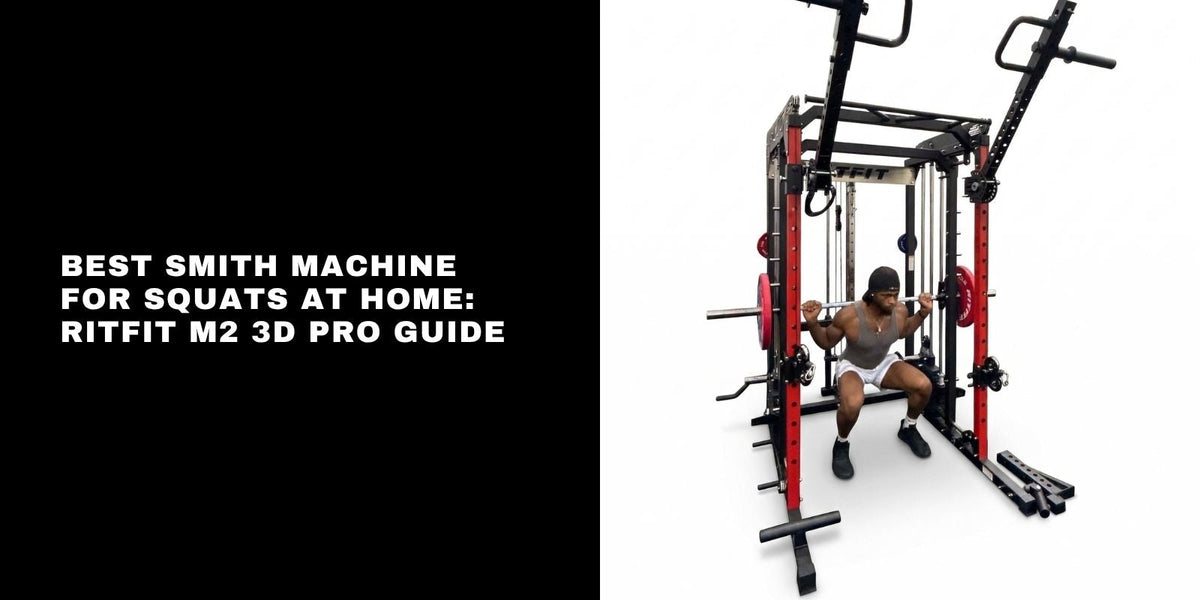
A Smith machine makes heavy squats safer and more practical at home, and the RitFit M2 3D Pro is one of the best Smith machines for squats because its 3D bar path keeps guided safety while allowing a more natural movement than a fixed track. For home lifters who want serious lower body training, this modular station balances safety, versatility, and space efficiency.
This guide covers what makes the RitFit M2 3D Pro a strong choice for home squats, the squat variations it supports, how it compares to other home equipment, and the key buying and setup steps.
Quick Answer: The RitFit M2 3D Pro is one of the best Smith machines for squats because its 3D bar path delivers guided safety with a more natural squat pattern than a fixed track. It pairs squat training with rack work, cable training, and weight stack upgrades in one modular home gym station.
Key Takeaways
- Better squat feel: The 3D path gives home lifters a more natural squat pattern than a fully fixed Smith track. That matters most for users who want guided safety without feeling locked into one line of motion.
- Strong solo training value: Built in hooks and safeties make heavy lower body work more practical at home. This is especially useful when you train alone and want a faster re rack option.
- Modular home gym appeal: The M2 platform is more than a squat machine. It can support a broader home setup with cables, attachments, bench work, and lower body expansion.
- Best for many home users, not every lifter: The M2 3D Pro is a strong fit for home lifters who want safety, versatility, and space efficiency. Dedicated powerlifters who want full free bar specificity may still prefer a traditional rack.
- Buying confidence comes from setup planning: Floor space, ceiling height, bench pairing, and future add ons matter almost as much as the machine itself. A better buying decision starts with how the machine fits your room and training style.
What Makes a Good Smith Machine for Home Squats?
A good Smith machine for home squats guides the bar safely while letting your body move in a more natural pattern than a fixed track. Home based resistance training can support strength and physical function, which is why a guided squat station works well for many home lifters.[1]
- Natural bar path: A great home squat machine should guide the lift without forcing an awkward pattern. For many lifters, that means a system that supports hip travel and torso position more naturally.
- Reliable solo safety: The hooks and safeties need to be simple to use under fatigue. If the lock in and bail out process feels confusing, the machine loses real home gym value fast.
- Stable frame under load: Heavy squats demand a rack that feels settled when you unrack, descend, and re rack. Stability matters more than flashy extras when leg training gets serious.
- Home friendly footprint: A machine can be feature rich and still fail if it overwhelms the room. Good home equipment has to balance utility, ceiling fit, and daily usability.
- Versatility beyond squats: The best value usually comes from equipment that can do more than one thing well. That matters even more in a garage gym, basement gym, or shared training room.
What Is the RitFit M2 3D Pro Smith Machine?
The RitFit M2 3D Pro is a modular home gym that combines Smith work, rack based strength work, and cable training in one station, with a 3D bar path that moves more naturally than a fixed track. It currently measures 78.7 inches long, 68.75 inches wide, and 86.14 inches high with a 22.8 square foot footprint.
What the Platform Is Built to Do
The M2 platform is designed as a modular home gym that combines Smith work, rack based strength work, and cable training in one station. That matters for buyers who want a single machine to cover squats, presses, pulls, and accessory work instead of filling the room with multiple separate units.
Why the 3D Movement Matters
The core idea behind the 3D version is simple: the bar still moves in a guided system, but it can drift in a more natural pattern instead of forcing a strict vertical line. For squat focused users, that can feel more comfortable and more transferable to real lower body mechanics.
Current Size and Home Gym Relevance
RitFit currently lists the M2 series at 78.7 inches long, 68.75 inches wide, and 86.14 inches high with a 22.8 square foot footprint. That gives home users a clearer way to judge room fit before pairing the machine with a bench, plates, or add on stations.
Why Does the RitFit M2 3D Pro Excel for Home Squats?
The RitFit M2 3D Pro excels for home squats because the 3D bar path reduces the locked in feeling of a fixed Smith track while preserving guided support for heavy solo work. That combination makes it a practical middle ground between a strict rail and a free barbell setup.
- More natural squat mechanics: A fixed vertical bar can feel restrictive for lifters whose hips naturally travel back as they descend. The 3D path is built to reduce that locked in feeling while preserving guided support.
- Safer heavy solo sessions: Home lifters often care less about platform style purity and more about whether they can push a hard leg day without a second person nearby. Hooks and safety points make that decision easier.
- Better bridge between machine and free weight training: The M2 3D Pro can feel like a middle ground between a fully fixed Smith system and a free barbell setup. That makes it appealing for lifters who want more freedom than a strict rail but more control than a rack only squat.
- Practical all in one value: Squat training is only part of the buying decision for most home gyms. The platform makes more sense when you also want pressing, pulling, cable work, and future attachment flexibility.
How Does the M2 3D Pro Fit a Smarter Home Gym Setup?
The M2 3D Pro makes the most sense when it sits inside a complete home gym plan rather than as an isolated purchase. Pairing it with a bench, a weight stack, and the wider Smith machine ecosystem creates a more scalable setup for strength progress.
Pairing the machine with the RitFit Gator adjustable weight bench, the RitFit M2 multi functional modular Smith machine base, and the RitFit Smith machine collection gives you a more complete station for presses, pulls, and leg work in one footprint.
What Squat Variations Can You Do on the RitFit M2 3D Pro?
You can run back squats, front squats, split squats, pause squats, and box squats on the RitFit M2 3D Pro, all with the guided support of a 3D bar path. Different squat patterns shift muscle activation across the quads and posterior chain, so rotating variations helps build more complete lower body strength.[2]
- Back squats: This is the clearest use case for the machine. It works well for users who want heavy lower body loading with guided safeties and less fear during solo training.
- Front squats: Front squats reward a more upright torso and cleaner bar path. A 3D system can feel more forgiving than a rigid fixed track when you are trying to stay tall through the rep.
- Split squats: Split squats are excellent for quad and glute work when you want unilateral training without as much balance demand as a free bar version. They are also useful when you want hard leg training with lighter spinal loading.
- Pause squats: Pause squats are ideal for building bottom position control and staying honest with depth. The guided environment also makes them easier to program when you train alone.
- Box squats: Box squats can help lifters standardize depth and clean up sit back mechanics. They work best when your box height and safety settings are checked before the work sets begin.
What Accessory Lower Body Work Expands Leg Training?
A strong home leg setup rarely stops at squats, especially when hypertrophy is part of the goal. Adding a leg press or hack squat station gives you a different lower body stimulus that squat patterns alone do not fully cover.
The RitFit Gazelle 3 in 1 leg press and hack squat machine can complement a squat centered M2 setup, and the RitFit BLP01 3 in 1 leg press and hack squat machine offers a similar pressing path for quads and glutes when you want variety in a smaller footprint.
How Do You Build a Squat Routine with the RitFit M2 3D Pro?
Build a squat routine on the RitFit M2 3D Pro by starting with two conservative sessions per week while you learn the bar path, then add a strength day and a volume day as technique improves. Research on the barbell squat shows that lower extremity muscle activity and knee kinematics respond to small setup changes, which is why consistent positioning matters for joint safety.[3]
- Beginner approach: Start with two squat sessions per week and keep the load conservative while you learn the machine path. The first goal is repeatable positioning, not impressively heavy sets.
- Intermediate strength plan: Use one lower rep strength day and one moderate rep volume day each week. Research shows that training load directly influences hypertrophy and strength gain, so gradual progression is the core of any program.[4]
- Variation rotation: Keep one main squat pattern stable for several weeks, then rotate a secondary lift like front squats or split squats. This keeps progress moving without changing everything at once.
- Warm up logic: Use several lighter sets to dial in stance, bar position, and safety height before the hard sets begin. A good warm up is also your last technique check before fatigue shows up.
- Solo safety habit: Set safeties before every session, not just before personal record attempts. Good home training is built on repeatable habits more than emergency reactions.
What Are the Pros and Cons of the RitFit M2 3D Pro for Home Squats?
The RitFit M2 3D Pro is a strong value for most home users because it pairs a more natural Smith path with all in one versatility. The main trade off is that it still is not the same as an unrestricted free barbell squat for lifters who want full competition specificity.
- Pro: It offers a guided squat option that can feel more natural than a traditional fixed path Smith machine. That gives many home lifters a better blend of safety and movement quality.
- Pro: The modular platform increases the long term value of the purchase. Buyers can build a more complete room around one main station instead of starting over later.
- Pro: It supports a broader training menu than squat only equipment. That is a major advantage when floor space is limited.
- Con: It still is not the same as an unrestricted free barbell squat. Lifters who want full competition specificity may still prefer a classic rack and barbell setup.
- Con: A stronger machine still needs room planning and floor protection. If your layout is poor, even a well designed machine can feel inconvenient in daily use.
How Does the RitFit M2 3D Pro Compare to Other Home Equipment?
The M2 3D Pro sits between a fixed path Smith machine and a free barbell power rack setup, offering guided safety with more natural bar movement. It is the stronger fit when solo safety, versatility, and space efficiency matter more than pure free weight specificity.
Versus a Fixed Path Smith Machine
A fixed path Smith machine is usually simpler and more locked in, which some beginners may like at first. The M2 3D Pro is the stronger choice for users who want guided safety but also want the bar to move in a way that feels less restrictive during squats.
Versus a Power Rack and Free Barbell
A power rack and free barbell setup gives the most freedom, but it also asks for the most skill, balance, and confidence under load. The M2 3D Pro is often the better fit when solo safety, guided learning, and all in one versatility matter more than pure free weight specificity, while the RitFit M1 Pro Smith machine is a common alternative for lifters who prefer a more traditional Smith package.
Versus a Basic All Purpose Home Gym
Many general home gyms can handle lighter full body work, but they are not always great for serious squat progression. The M2 3D Pro is a better match for users who want a machine that keeps squats central instead of treating leg work as an afterthought.
What Buying and Setup Tips Matter Most?
Measure your space, protect the floor, and plan for future attachments before you buy the M2 3D Pro. A well matched room makes the machine feel comfortable in daily use instead of frustrating.
- Measure before you buy: Check machine width, length, ceiling clearance, and working space around the bar before placing an order. This is the fastest way to avoid a frustrating home gym mismatch.
- Protect the floor: Heavy lower body training feels better on a stable surface. Adding rubber gym flooring tiles can improve grip, reduce noise, and protect the room during setup and plate changes.
- Plan future growth: Think about where your training is headed before you buy the base machine only. Attachment paths and cable upgrades matter more when you want the setup to stay useful for years.
- Choose accessories that match the machine: Home racks and Smith systems are not all identical. Staying inside the M2 ecosystem is the safer move when you want clean fit and predictable compatibility.
"Get some Chuck Taylors or wrestling shoes to see how a flat sole feels, and get some cheap weightlifting shoes to see how you like a raised heel."
Greg Nuckols, MA, Strength Researcher and Coach, How to Squat, Stronger By Science
FAQs About the RitFit M2 3D Pro for Squats
Is the RitFit M2 3D Pro beginner friendly?
Yes, it can be very beginner friendly when the user wants guided support and a simpler re rack process than a free barbell setup. It still works best when beginners start light and spend time learning stance, depth, and safety placement.
Can I squat heavy on it without a spotter?
That is one of the main reasons many home users consider a Smith style system in the first place. The guided path and safety setup make solo training more practical, though smart load selection and proper setup still matter.
How much space do I need around the machine?
You need more than the listed footprint because loading plates, moving a bench, and stepping into position all require working room. Leave enough side and rear clearance so daily training feels comfortable rather than cramped.
Does it replace a separate squat rack?
For many home users, yes, because it can cover guided squats, rack work, and broader strength training in one platform. It does not fully replace a dedicated competition style rack for every advanced lifter, but it can remove the need for a second main squat station in many garages and spare rooms.
Should I add the weight stack right away?
The answer depends on how much cable work you want in the same setup. If your plan includes frequent pulldowns, rows, and accessory training, the WSM2 weight stack upgrade makes the platform more convenient and more complete.
Conclusion
If your goal is to squat hard at home with more safety, more versatility, and a less restrictive bar path than a standard fixed Smith machine, the RitFit M2 3D Pro is a very strong option. It is especially compelling for solo lifters who want one modular station that can grow into a more complete home gym over time.
Measure your space, protect the floor, and start light while you learn the bar path before pushing heavy sets. Browse the RitFit sales page to see current M2 3D Pro pricing and package options before you order.
Disclaimer
This guide is for general education and product evaluation, not medical advice. If you have pain, a recent injury, or a complex mobility issue, talk to a qualified healthcare professional or coach before starting heavy squat training.
References
1. De Maio M, Bratta C, Iannaccone A, et al. Home-Based Physical Activity as a Healthy Aging Booster before and during COVID-19 Outbreak. Int J Environ Res Public Health. 2022;19(7). doi:10.3390/ijerph19074317. PMCID: PMC8998434
2. Bautista D, Durke D, Cotter JA, Escobar KA, Schick EE. A Comparison of Muscle Activation Among the Front Squat, Overhead Squat, Back Extension and Plank. Int J Exerc Sci. 2020;13(1):714-722. doi:10.70252/BTUH3630. PMCID: PMC7241624
3. Foley RCA, Bulbrook BD, Button DC, Holmes MWR. Effects of a Band Loop on Lower Extremity Muscle Activity and Kinematics During the Barbell Squat. Int J Sports Phys Ther. 2017;12(4):550-559. PMCID: PMC5534145
4. Lopez P, Radaelli R, Taaffe DR, et al. Resistance Training Load Effects on Muscle Hypertrophy and Strength Gain: Systematic Review and Network Meta-analysis. Med Sci Sports Exerc. 2021;53(6):1206-1216. doi:10.1249/MSS.0000000000002585. PMCID: PMC8126497





