








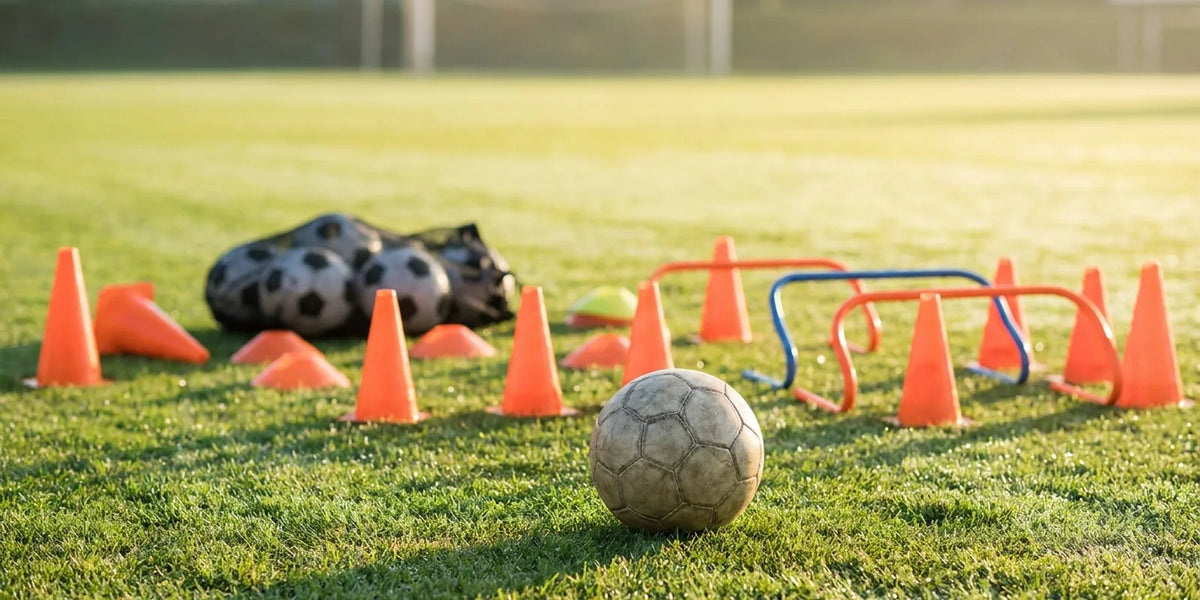
The best soccer dribbling drills for beginners are toe taps, inside foot taps, sole rolls, cone weaving, figure 8 dribbling, stop and go dribbling, pull back turns, shadow dribbling, and 1v1 gate dribbling. These drills build close control, weak foot confidence, faster direction changes, and better decision making under pressure.
This guide gives you a simple progression from basic ball mastery to game realistic dribbling, so you can train alone, with a partner, or inside a beginner soccer practice plan.
Key Takeaways
- Close control comes first: Beginners should master small touches before trying fast dribbling or advanced moves.
- Both feet matter: Weak foot practice makes players harder to defend and more confident in tight spaces.
- Cone drills build control: Cone weaving, figure 8 dribbling, and stop and go drills teach clean direction changes.
- Pressure should be added gradually: Solo drills should progress into shadow dribbling, gate dribbling, and 1v1 practice.
- Strength supports skill: Balance, acceleration, and lower body power help players cut faster and protect the ball better.
- Quick Answer
- Why Dribbling Matters for Beginners
- Soccer Dribbling Fundamentals
- Equipment Needed for Dribbling Practice
- Level 1 Ball Mastery Drills
- Level 2 Cone Dribbling Drills
- Level 3 Direction Change Drills
- Level 4 1v1 Dribbling Drills
- Level 5 Speed Dribbling Drills
- Solo Dribbling Drills
- Common Dribbling Mistakes
- 4 Week Beginner Dribbling Plan
- Physical Conditioning for Better Dribbling
- Age Specific Dribbling Development
Quick Answer
Beginners should start with ball mastery drills, then progress to cone dribbling, direction changes, speed dribbling, and simple 1v1 games. The goal is to keep the ball close, use both feet, scan the field, and learn when to slow down or accelerate.
Why Dribbling Matters for Beginners
Dribbling is one of the most important beginner soccer skills because it connects ball control, balance, vision, and confidence. Research on children and dribbling skill environments also shows that young players learn best when practice gives them real opportunities to perceive space, defenders, and movement options.[1]
- Ball control foundation: Dribbling improves first touch, foot coordination, and comfort with the ball.
- Game impact: A confident dribbler can keep possession, escape pressure, and create space for teammates.
- Confidence builder: Beating a defender in training helps beginners feel more comfortable during real matches.
- Decision making: Dribbling teaches players when to protect the ball, pass, shoot, or attack open space.
Soccer Dribbling Fundamentals
Good dribbling starts with close control, soft touches, body balance, and field awareness. Beginners should focus on technique first because speed without control often leads to turnovers.
Keep the Ball Close
Keep the ball within one or two feet when you are in traffic. Small touches give you time to change direction before a defender can reach the ball.
Use Multiple Foot Surfaces
Use the inside of the foot for control, the outside for quick direction changes, the sole for stops and pull backs, and the laces for speed dribbling. Learning all surfaces makes your movement less predictable.
Keep Your Head Up
Look up every few touches so you can see defenders, teammates, and open space. Beginners can glance at the ball, but staring down too long slows decision making.
Stay Low and Balanced
Bend your knees and keep your body slightly forward when dribbling. A lower center of gravity helps you cut, stop, and accelerate with better control.
Train Both Feet
Use your weaker foot in every session because one footed players are easier to defend. Even 5 minutes of weak foot work per practice can make a visible difference over time.
Equipment Needed for Dribbling Practice
You only need a soccer ball, a small open space, and a few markers to start dribbling practice. Cones, water bottles, shoes, a phone timer, and flat training space make the drills easier to organize.
- Soccer ball: Use the correct ball size for your age group.
- Cones or markers: Use 6 to 10 cones, flat markers, or water bottles.
- Open space: A backyard, driveway, park, or small field works for most beginner drills.
- Training surface: Use grass for cleats and a flat hard surface for indoor or driveway practice.
- Home training support: If you train strength at home, simple tools like RitFit dumbbells and RitFit plyo boxes can support balance, acceleration, and lower body power.
Level 1 Ball Mastery Drills
Ball mastery drills help absolute beginners build the connection between the feet and the ball. Start slowly and increase speed only when the ball stays under control.
Drill 1: Toe Taps
Toe taps build foot coordination and comfort on top of the ball. Alternate tapping the ball with the sole of each foot for 3 rounds of 30 seconds.
- Setup: Place one ball in front of you and stand tall with light feet.
- Coaching point: Keep the ball still and avoid heavy stomping.
- Progression: Look up every 3 touches while keeping the rhythm.
Drill 2: Inside Foot Taps
Inside foot taps teach soft contact and side to side control. Tap the ball gently between both feet for 3 rounds of 30 seconds.
- Setup: Stand behind the ball with knees slightly bent.
- Coaching point: Keep touches short and controlled.
- Progression: Move forward slowly while tapping the ball between your feet.
Drill 3: Sole Rolls
Sole rolls help beginners control the ball with the bottom of the foot. Roll the ball right, left, forward, and backward for 3 rounds of 30 seconds.
- Setup: Stand beside or behind the ball with one foot ready to roll it.
- Coaching point: Use gentle pressure instead of pushing the ball away.
- Progression: Add circular rolls once side to side control feels smooth.
Drill 4: Inside Outside Touches
Inside outside touches build the foundation for cutting and changing direction. Push the ball with the inside of one foot, then use the outside of the same foot to move it back the other way.
- Setup: Place 5 to 6 cones in a straight line about 1 yard apart.
- Sets: Complete 5 runs with the right foot and 5 runs with the left foot.
- Progression: Reduce the space between cones to challenge close control.
Level 2 Cone Dribbling Drills
Cone dribbling drills add movement, spacing, and sharper changes of direction. These drills teach players to guide the ball while their body is moving through space.
Drill 5: Cone Weave
The cone weave develops close control while moving forward. Dribble through 6 to 8 cones using small inside and outside touches.
- Setup: Place cones in a straight line about 1 yard apart.
- Sets: Complete 5 runs at slow speed, then 5 runs at moderate speed.
- Progression: Try right foot only, left foot only, and outside foot only variations.
Drill 6: Figure 8 Dribbling
Figure 8 dribbling improves tight turns and smooth body control. Dribble around two cones in a figure 8 pattern for 3 rounds of 60 seconds.
- Setup: Place two cones 3 to 5 yards apart.
- Coaching point: Slow down around each cone and keep the ball near your foot.
- Progression: Use only the inside of the foot for one round and only the outside for the next round.
Drill 7: Circle Dribbling
Circle dribbling builds balance while the body moves around a curve. Dribble around the inside of a cone circle for 3 rounds of 60 seconds.
- Setup: Arrange 8 to 10 cones in a circle about 3 yards apart.
- Coaching point: Use both feet and avoid drifting outside the circle.
- Progression: Change direction after every round.
Drill 8: Stop and Go Dribbling
Stop and go dribbling teaches players to accelerate and decelerate without losing the ball. Dribble to each cone, stop the ball with the sole, pause for one second, then accelerate again.
- Setup: Place 5 cones in a straight line 5 yards apart.
- Sets: Complete 4 runs while alternating right foot and left foot stops.
- Progression: Add a quick fake before each acceleration.
Level 3 Direction Change Drills
Direction change drills help players beat defenders by stopping, turning, and accelerating into new space. Soccer specific testing research supports the value of evaluating change of direction while dribbling the ball, not just running without it.[2]
Drill 9: Pull Back Turn
The pull back turn is the simplest way to escape pressure from the front. Dribble toward a cone, place one foot beside the ball, pull the ball backward with the sole, turn, and dribble away.
- Setup: Place one cone 5 to 8 yards away.
- Sets: Complete 10 turns per foot for 3 sets.
- Common mistake: Rushing the pull back before the ball is fully under control.
Drill 10: Cruyff Turn
The Cruyff turn teaches a pass fake followed by a sharp change of direction. Approach the cone, fake a forward pass, drag the ball behind your standing leg, and turn away.
- Setup: Use one cone as the defender marker.
- Sets: Complete 8 turns per foot for 3 sets.
- Progression: Add a defender shadowing you at low pressure.
Drill 11: Direction Change Shuttle
The direction change shuttle combines running rhythm with turning under control. Dribble to the 5 yard line, turn back, return to the start, then repeat to the 10 yard line.
- Setup: Mark a start line, 5 yard line, and 10 yard line.
- Sets: Complete 3 sets with 2 minutes of rest.
- Progression: Use a different turn on every repetition.
Level 4 1v1 Dribbling Drills
1v1 dribbling drills teach beginners how to use ball control against real pressure. Small sided soccer games can develop technical actions and conditioning together because they recreate more game like decisions than isolated running drills.[3]
Drill 12: Shadow Dribble
Shadow dribbling builds awareness because the dribbler must follow a moving player while controlling the ball. One player jogs and changes direction, while the player with the ball follows at a 2 to 3 yard distance.
- Setup: Use a 15 by 15 yard grid and one ball per pair.
- Sets: Switch roles every 60 seconds for 3 rounds each.
- Progression: Ask the leader to change speed as well as direction.
Drill 13: 1v1 Gate Dribbling
Gate dribbling teaches attackers to beat a defender by choosing open space. The attacker scores by dribbling through any cone gate while the defender tries to block or win the ball.
- Setup: Place 2 to 3 cone gates inside a 15 by 20 yard grid.
- Scoring: First player to 5 points wins, then players switch roles.
- Progression: Make gates smaller as control improves.
Drill 14: 1v1 to Goal
1v1 to goal combines dribbling with finishing under pressure. The attacker starts 25 yards from goal, the defender starts 5 yards behind, and the attacker must beat pressure before shooting.
- Setup: Use one attacker, one defender, and a goalkeeper if available.
- Sets: Complete 10 repetitions each while alternating roles.
- Coaching point: Shoot when the ball is under control instead of forcing an extra move.
Drill 15: Shark Island
Shark Island is a fun pressure drill that builds composure and spatial awareness. Players with balls dribble across the grid while sharks try to kick the balls out.
- Setup: Mark a large square grid and choose 1 to 2 sharks.
- Rule: If your ball is kicked out, you become a shark.
- Progression: Reduce the grid size to increase pressure.
Level 5 Speed Dribbling Drills
Speed dribbling is different from close control because the ball can travel farther ahead in open space. Repeated dribbling ability has been studied in young soccer players as a measurable skill that varies by competitive level, which makes timed dribbling useful for tracking progress.[4]
Drill 16: Speed Lane Dribbling
Speed lane dribbling teaches players to cover ground quickly without losing the ball. Push the ball ahead with the outside of the foot or laces and take 2 to 3 strides between touches.
- Setup: Create a lane 4 to 6 yards wide and 30 to 40 yards long.
- Sets: Complete 6 timed runs with full control before chasing speed.
- Progression: Narrow the lane once the ball stays under control.
Drill 17: Sprint and Control
Sprint and control trains the switch from open space speed to tight control near a defender. Speed dribble to the first cone, then use small touches through the second cone zone.
- Setup: Place one cone at 20 yards and another at 25 yards.
- Sets: Complete 8 runs with full recovery between reps.
- Progression: Add a passive defender at the control zone.
Solo Dribbling Drills
Solo dribbling practice is enough to build strong beginner ball control when it is structured. Use a wall, cones, a timer, and a small space to make each session purposeful.
- Wall dribbling: Pass against a wall, receive the ball, then dribble away in a new direction.
- Cone courses: Create zigzags, circles, L shapes, and T shapes to train varied movement.
- Timed dribbling: Time one cone course each week and track clean attempts, not just speed.
- Juggling: Add 3 to 5 minutes of juggling to improve touch and foot coordination.
Common Dribbling Mistakes
Most beginner dribbling mistakes come from moving too fast before control is stable. Fixing these habits early helps players keep possession and make better decisions.
Mistake 1: Looking Down Too Much
Looking down too long makes it harder to see defenders and space. Fix it by looking up every 2 to 3 touches during every drill.
Mistake 2: Using Only One Foot
Using only the dominant foot makes your dribbling predictable. Fix it by spending at least 40 percent of each session on your weaker foot.
Mistake 3: Dribbling Too Fast Too Soon
Speed without control causes heavy touches and turnovers. Fix it by mastering each drill slowly before adding pace.
Mistake 4: Touching the Ball Too Far Ahead
Long touches are useful in open space but risky near defenders. Fix it by keeping the ball within one or two feet when training close control.
Mistake 5: Running in Straight Lines
Straight line dribbling is easy for defenders to read. Fix it by adding cuts, turns, stops, and changes of speed to every session.
Essential Dribbling Moves Every Beginner Should Learn
Beginner moves should be simple, repeatable, and useful in real games. Focus on inside cuts, outside cuts, pull back turns, step overs, and roll and push moves before trying advanced tricks.
- Inside cut: Use it when a defender overcommits to one side.
- Outside cut: Use it when you want to accelerate away into open space.
- Pull back turn: Use it when pressure comes from the front.
- Step over: Use it when facing a defender in a 1v1 situation.
- Roll and push: Use it in tight spaces when you need a smooth change of angle.
4 Week Beginner Dribbling Plan
A 4 week plan gives beginners a clear path from basic touch to pressure based dribbling. Train 3 to 4 times per week and keep each session between 20 and 35 minutes.
Week 1: Ball Familiarity
Focus on toe taps, inside foot taps, sole rolls, and inside outside touches. Keep the ball close and train both feet in every session.
Week 2: Cone Control
Add cone weaving, figure 8 dribbling, circle dribbling, and stop and go work. Move slowly until the ball stays close through every turn.
Week 3: Direction Changes
Practice pull back turns, Cruyff turns, and directional shuttles. Add speed only when your turns stay balanced and controlled.
Week 4: Pressure and Speed
Add shadow dribbling, gate dribbling, speed lane dribbling, and sprint and control drills. The goal is to transfer clean technique into game like pressure.
Physical Conditioning for Better Dribbling
Dribbling is a technical skill, but balance, core stability, acceleration, and lower body power help players perform it better. Strength training research in soccer supports the role of neuromuscular qualities in performance, especially when training is planned around soccer demands.[5]
Balance and Stability
Single leg squats, single leg Romanian deadlifts, and plank variations improve balance during cuts and turns. Players building a small home setup can pair skill practice with a stable bench such as the RitFit GATOR Adjustable Weight Bench.
Acceleration
Squats, lunges, step ups, and jumps help players accelerate after beating a defender. A compact setup with RitFit Rubber Hex Dumbbells can support lower body strength without taking much space.
Agility
Cone drills, ladder patterns, shuttle runs, and jump training improve foot speed and direction changes. Players who want a broader home training area can protect their floor with RitFit interlocking gym flooring mats.
Strength Training Setup
A simple strength area can support soccer training when it improves balance, landing control, and acceleration. For players building a home gym, the RitFit P3 Power Cage and the RitFit strength machines collection can support progressive strength work beyond basic field drills.
Age Specific Dribbling Development
Dribbling practice should match the player age, attention span, and training experience. Younger players need fun and repetition, while older players need pressure, speed, and tactical decision making.
Ages 6 to 9
Use fun games like Red Light Green Light, Shark Island, and clean your room. The goal is ball familiarity, not perfect technique.
Ages 10 to 13
Introduce structured cone drills, figure 8 dribbling, and pull back turns. This age group can begin training both feet and scanning habits more consistently.
Ages 14 to 18
Add 1v1 drills, speed dribbling, and game realistic pressure. Players should learn when to dribble, pass, shield, or shoot.
Adults
Adult beginners can improve dribbling with the same progression if they start slowly. Extra mobility, balance work, and recovery time may help adults train more consistently.
Frequently Asked Questions
What are the best soccer dribbling drills for beginners?
The best soccer dribbling drills for beginners are toe taps, inside foot taps, sole rolls, cone weave, figure 8 dribbling, stop and go dribbling, and 1v1 gate dribbling. These drills build close control, weak foot touch, direction changes, and confidence under pressure.
How often should beginners practice soccer dribbling drills?
Beginners should practice soccer dribbling drills three to four times per week. Short focused sessions of 20 to 30 minutes work best because they build touch quality, weak foot control, and confidence without creating excessive fatigue or sloppy habits during skill learning.
Can I improve soccer dribbling without a partner?
Yes. You can improve soccer dribbling without a partner by using cone drills, wall passes, timed dribbling courses, sole rolls, and weak foot practice. Solo training is effective when you track clean touches, keep the ball close, and increase speed only after control improves.
What is the difference between close control and speed dribbling?
Close control keeps the ball near your feet for tight spaces, while speed dribbling pushes the ball farther ahead in open space. Beginners should learn close control first, then practice longer touches when they have room to run without immediate defender pressure.
Should beginners learn fancy soccer dribbling moves?
No. Beginners should master simple soccer dribbling moves before trying fancy tricks. Inside cuts, outside cuts, pull back turns, step overs, and roll and push moves are more useful in real games because they help players protect the ball and change direction quickly.
How long does it take to improve soccer dribbling?
Most beginners can notice better soccer dribbling control within four to six weeks of consistent practice. Game confidence usually takes longer because players must transfer clean touches into pressure situations, such as 1v1 gate drills, small sided games, and match play.
Conclusion
The best way to improve soccer dribbling as a beginner is to start with close control, train both feet, and progress from solo ball mastery to pressure based 1v1 drills. Practice 3 to 4 times per week, keep sessions focused, and measure progress through cleaner touches, faster turns, and better decisions in game situations.
Master the basics first, then add speed, defenders, and finishing. Every confident dribbler starts with one controlled touch.
Disclaimer: This article is for general soccer training education only and is not medical advice. Players with pain, injury, balance issues, or medical conditions should consult a qualified coach, trainer, or healthcare professional before starting new drills, strength training, plyometrics, or high speed practice.
References
- Duncan MJ, Martins RMG, Noon M, Eyre ELJ. Perception of Affordances for Dribbling in Soccer: Exploring Children as Architects of Skill Development Opportunity. Sports. 2022;10(7):99. doi:10.3390/sports10070099
- Makhlouf I, Tayech A, Mejri MA, Haddad M, Behm DG, Granacher U, Chaouachi A. Reliability and validity of a modified Illinois change-of-direction test with ball dribbling speed in young soccer players. Biol Sport. 2022;39(2):295-306. doi:10.5114/biolsport.2022.104917
- Katis A, Kellis E. Effects of small-sided games on physical conditioning and performance in young soccer players. J Sports Sci Med. 2009;8(3):374-380.
- Duarte JP, Tavares Ó, Valente-dos-Santos J, Severino V, Ahmed A, Rebelo-Gonçalves R, Pereira JR, Vaz V, Póvoas S, Seabra A, Cumming SP, Coelho-e-Silva MJ. Repeated dribbling ability in young soccer players: reproducibility and variation by the competitive level. J Hum Kinet. 2016;53:155-166. doi:10.1515/hukin-2016-0019
- Silva JR, Nassis GP, Rebelo A. Strength training in soccer with a specific focus on highly trained players. Sports Med Open. 2015;1(1):17. doi:10.1186/s40798-015-0006-z





