The best soccer drills for beginners are simple ball control, dribbling, passing, shooting, first touch, and small sided game drills. Start with slow controlled touches, then add speed, pressure, direction changes, and game decisions as your confidence improves.
This guide gives beginners, parents, and coaches a structured way to practice soccer fundamentals at home, in the backyard, or on the training field.
Key Takeaways
- Start with ball control: Beginners improve faster when they first learn to keep the ball close, use both feet, and look up while moving.
- Practice short and often: Three to four focused sessions per week usually work better than one long unfocused practice.
- Use progressions: Master each drill slowly before adding speed, defenders, shooting, or competitive pressure.
- Play small sided games: Small sided games help players apply technique in realistic situations and can improve technical execution in young players.[1]
- Train safely: Warm up before practice, avoid excessive heading, and stop immediately if pain, dizziness, or concussion symptoms appear.
Table of Contents
Quick Answer
Beginners should start with toe taps, inside foot taps, sole rolls, cone weaving, wall passing, target shooting, wall first touch, and 3v3 games. These drills build the foundation for controlling the ball, moving with confidence, passing accurately, and making simple decisions under pressure.
What Beginners Should Practice First
Beginners should practice ball control first because every other soccer skill depends on clean first contact with the ball. Passing, shooting, dribbling, and defending all become easier when the player can control the ball without panic.
- Ball control: Learn to touch the ball softly with the sole, inside, outside, and laces of both feet.
- Dribbling: Learn to move with the ball while changing direction, stopping, and accelerating.
- First touch: Learn to receive the ball into space instead of trapping it under the body.
- Passing: Learn to use the inside of the foot for accurate ground passes.
- Small sided play: Learn to apply drills in games with pressure, teammates, and defenders.
Ball Mastery Drills
Ball mastery drills teach beginners to feel comfortable with the ball at their feet. These are the best first drills because they need little space and can be practiced alone.
Drill 1: Toe Taps
Toe taps build rhythm, coordination, and comfort with the ball. Stand over the ball and alternate tapping the top of it with the sole of each foot.
- Setup: Use one ball and a flat space.
- Beginner target: Complete 3 rounds of 30 seconds.
- Coaching cue: Stay light on your toes and look up every few touches.
- Progression: Increase speed without letting the ball roll away.
Drill 2: Inside Foot Taps
Inside foot taps teach the most common touch surface in soccer. Gently move the ball side to side using the inside of each foot.
- Setup: Stand with the ball between both feet.
- Beginner target: Complete 3 rounds of 30 seconds.
- Coaching cue: Keep the touches soft and controlled.
- Progression: Lift your eyes while keeping the ball moving.
Drill 3: Sole Rolls
Sole rolls teach beginners how to move the ball sideways, backward, and away from pressure. Place one foot on top of the ball and roll it across your body.
- Setup: Use one ball and 5 square yards of space.
- Beginner target: Complete 3 rounds of 20 rolls per foot.
- Coaching cue: Keep your knees slightly bent for balance.
- Progression: Roll the ball forward, backward, and in circles.
Drill 4: Inside Outside Touches
Inside outside touches teach quick changes between two foot surfaces. Push the ball with the inside of the foot, then guide it back with the outside of the same foot.
- Setup: Use 5 cones spaced 1 yard apart.
- Beginner target: Complete 5 runs with each foot.
- Coaching cue: Keep the ball close enough to touch again immediately.
- Progression: Add speed only after the pattern feels smooth.
Drill 5: Drag Backs
Drag backs teach beginners how to stop and change direction quickly. Place the sole on top of the ball, pull it backward, turn, and dribble away.
- Setup: Use one ball and a clear lane.
- Beginner target: Complete 3 sets of 10 drag backs per foot.
- Coaching cue: Pull the ball under your body before turning.
- Progression: Add a defender or cone as the pressure point.
Dribbling Drills
Dribbling drills help beginners move with the ball while staying balanced and aware. Good dribbling uses small touches, body control, and smart changes of speed.
Drill 6: Cone Weave
The cone weave builds close control and direction change. Dribble through 6 to 8 cones using small touches with both feet.
- Setup: Place cones 1 yard apart in a straight line.
- Beginner target: Complete 5 clean runs.
- Coaching cue: Use many small touches instead of one heavy touch.
- Progression: Use only the right foot, then only the left foot.
Drill 7: Figure 8 Dribbling
Figure 8 dribbling teaches tight turning and body control. Dribble around two cones in a continuous figure 8 pattern.
- Setup: Place two cones 3 to 5 yards apart.
- Beginner target: Complete 3 rounds of 60 seconds.
- Coaching cue: Slow down before each turn and accelerate out.
- Progression: Time each round and try to stay clean while getting faster.
Drill 8: Red Light Green Light
Red Light Green Light teaches players to stop the ball instantly. Dribble forward on green light and stop the ball with the sole on red light.
- Setup: Use a 20 yard lane with one ball per player.
- Beginner target: Stop the ball within 1 second of the command.
- Coaching cue: Keep the ball close enough to control at any time.
- Progression: Add yellow light for slow dribbling.
Drill 9: Stop and Go
Stop and Go teaches acceleration and deceleration with the ball. Dribble to a cone, stop the ball, pause for one second, then explode to the next cone.
- Setup: Place 5 cones in a line, 5 yards apart.
- Beginner target: Complete 4 clean runs.
- Coaching cue: Lower your hips when stopping.
- Progression: Alternate the stopping foot at each cone.
Passing Drills
Passing drills teach beginners how to keep possession and connect with teammates. Accuracy matters more than power at the beginner level.
Drill 10: Wall Passes
Wall passing is the best solo drill for passing accuracy and first touch. Pass the ball against a flat wall, control the rebound, and pass again.
- Setup: Stand 5 to 7 yards from a safe wall.
- Beginner target: Complete 50 total passes.
- Coaching cue: Strike through the middle of the ball with the inside of the foot.
- Progression: Try one touch passing after two touch passing feels easy.
Drill 11: Two Touch Partner Passing
Two touch passing teaches beginners to receive and pass with control. Take one touch to prepare the ball and one touch to pass it back.
- Setup: Stand 8 to 10 yards from a partner.
- Beginner target: Complete 3 sets of 20 passes.
- Coaching cue: Aim for your partner's feet, not just their general direction.
- Progression: Add movement after each pass.
Drill 12: Triangle Passing
Triangle passing teaches angled passes and movement after passing. Player A passes to Player B, follows the pass, and the pattern continues around the triangle.
- Setup: Use three cones 8 to 10 yards apart and three players.
- Beginner target: Complete 3 rounds of 2 minutes.
- Coaching cue: Move after every pass instead of standing still.
- Progression: Limit players to two touches.
Drill 13: Gate Passing
Gate passing improves accuracy by giving the player a clear target. Pass the ball through pairs of cones placed at different distances and angles.
- Setup: Set up 5 to 6 gates, each about 1 yard wide.
- Beginner target: Hit at least 7 out of 10 gates.
- Coaching cue: Point your plant foot toward the target.
- Progression: Narrow the gates or increase the distance.
Shooting Drills
Shooting drills help beginners learn clean contact before they chase power. A controlled shot on target is more useful than a hard shot with poor technique.
Drill 14: Stationary Ball Striking
Stationary ball striking teaches proper shooting form without a moving ball. Approach at a slight angle, plant beside the ball, lock the ankle, and strike with the laces.
- Setup: Place the ball 12 to 15 yards from a goal or target.
- Beginner target: Take 20 to 30 shots per session.
- Coaching cue: Focus on accuracy first, then power.
- Progression: Aim at corners or small targets.
Drill 15: Dribble and Shoot
Dribble and Shoot teaches players to finish after moving with the ball. Dribble toward goal, take a setup touch, plant the non kicking foot, and shoot.
- Setup: Start 20 to 25 yards from goal.
- Beginner target: Complete 15 to 20 shots.
- Coaching cue: Make the setup touch slightly ahead and to the side.
- Progression: Add a cone defender before the shot.
Drill 16: Target Practice
Target practice builds shooting accuracy and focus. Place cones or safe targets in the goal and shoot toward one target at a time.
- Setup: Use a goal, wall target, or cone target.
- Beginner target: Hit 5 out of 10 targets.
- Coaching cue: Keep the head steady through contact.
- Progression: Use the weaker foot for half the shots.
First Touch Drills
First touch drills teach players to prepare the next action before pressure arrives. A good first touch moves the ball into useful space.
Drill 17: Wall First Touch
Wall first touch teaches beginners to control rebounds in different directions. Pass into the wall and use the first touch to guide the ball left, right, or forward.
- Setup: Stand 5 to 7 yards from a wall.
- Beginner target: Complete 3 rounds of 20 touches.
- Coaching cue: Cushion the ball instead of letting it bounce away.
- Progression: Call out the direction before the rebound returns.
Drill 18: Aerial Control
Aerial control teaches players to bring down high balls safely. Use the foot, thigh, or chest while softening the receiving surface on contact.
- Setup: Have a partner gently toss the ball or toss it to yourself.
- Beginner target: Complete 10 clean controls per body surface.
- Coaching cue: Withdraw the receiving surface slightly to absorb force.
- Progression: Control the ball and pass within two touches.
Drill 19: Receive and Turn
Receive and Turn teaches players to scan, receive, and face forward. Check the shoulder before the pass arrives, then take the first touch into open space.
- Setup: A partner passes from behind or from the side.
- Beginner target: Complete 15 turns each direction.
- Coaching cue: Scan before the ball arrives, not after.
- Progression: Add a passive defender behind the receiver.
Defensive Drills
Defensive drills teach beginners to delay attackers and protect space. Good defending starts with patience, balance, and body position.
Drill 20: 1v1 Defending
1v1 defending teaches positioning, patience, and timing. The defender stays between the attacker and the target line while forcing the attacker away from danger.
- Setup: Use a 15 by 20 yard grid with one attacker and one defender.
- Beginner target: Defend 5 rounds per player.
- Coaching cue: Jockey first and tackle only when the ball is exposed.
- Progression: Make the grid narrower to reward good positioning.
Drill 21: Mirror Drill
The mirror drill builds lateral quickness and reaction speed. One player leads with small movements while the other mirrors and stays in front.
- Setup: Two players face each other 3 yards apart.
- Beginner target: Complete 3 rounds of 30 seconds per role.
- Coaching cue: Stay low and move on the balls of the feet.
- Progression: Add a ball for the leader.
Heading Safety and Drills
Heading should not be a priority for young beginners because head impact exposure requires strict safety limits. U.S. youth soccer header policy banned heading for players age 10 and under and limited players age 11 to 13 to 30 minutes of heading practice per week, and one study found a 25.6 percent relative reduction in soccer related concussion emergency department presentations after policy implementation.[2]
Drill 22: Self Toss Headers
Self toss headers are only appropriate for players who are old enough, properly supervised, and cleared under local rules. Toss the ball lightly above the forehead and head it back into the hands with controlled technique.
- Setup: Use a properly inflated ball and coach supervision.
- Beginner target: Use low volume only and follow local age rules.
- Coaching cue: Use the forehead, keep the eyes open, and avoid neck strain.
- Safety note: Stop immediately if headache, dizziness, nausea, or confusion appears.
Drill 23: Partner Toss Headers
Partner toss headers should be slow, controlled, and supervised. The partner tosses gently from 3 to 5 yards away and the player heads the ball back to the partner's hands.
- Setup: Use short underhand tosses only.
- Beginner target: Keep volume low and technique controlled.
- Coaching cue: Attack the ball gently instead of letting it hit the head.
- Safety note: Do not use this drill for young children or unsupervised beginners.
Small Sided Games
Small sided games help beginners transfer drills into real play. They increase touches, decisions, pressure, and movement compared with standing in long lines.
3v3 or 4v4 Games
3v3 and 4v4 games give every player more touches and more decisions. Use small goals, short fields, and simple rules so beginners stay active.
- Setup: Use a small field with cone goals or mini goals.
- Beginner target: Play 3 rounds of 4 minutes.
- Coaching cue: Encourage players to pass, move, and look up.
- Progression: Add a rule that every player must touch the ball before scoring.
Rondo Possession Game
Rondo teaches quick passing, awareness, and calm decision making. Attackers pass around a circle while one or two defenders try to win the ball.
- Setup: Use 4 to 5 attackers and 1 defender.
- Beginner target: Complete 5 passes before the defender wins it.
- Coaching cue: Create passing angles before receiving.
- Progression: Limit attackers to two touches.
Shark Island
Shark Island teaches dribbling under pressure in a fun format. Fish dribble across the grid while sharks try to knock balls out of bounds.
- Setup: Use a square grid with one ball per fish.
- Beginner target: Cross the island without losing the ball.
- Coaching cue: Keep the ball close when a defender approaches.
- Progression: Add more sharks as players improve.
Fun Games for Kids
Young beginners learn best when drills feel like games. For ages 6 to 10, focus on ball touches, movement, confidence, and enjoyment before detailed correction.
Clean Your Room
Clean Your Room teaches kicking technique and urgency. Two teams kick balls into the other half and try to have the fewest balls on their side when time ends.
- Setup: Divide the field in half with a safe middle zone.
- Beginner target: Play 3 rounds of 60 seconds.
- Coaching cue: Use the inside of the foot for accuracy and laces for distance.
- Progression: Require players to use both feet.
Rob the Nest
Rob the Nest teaches dribbling, stopping, and quick transitions. Players run to the center, collect a ball, dribble it home, and tag the next teammate.
- Setup: Put balls in the center and teams in corners.
- Beginner target: Finish with the most balls in the team nest.
- Coaching cue: Keep the ball under control while returning.
- Progression: Allow players to steal from other nests after the center is empty.
Traffic Jam
Traffic Jam teaches close control and awareness in a crowded space. Players dribble in a grid while the coach calls stop, go, turn, slow, or freeze.
- Setup: Use one ball per player in a small grid.
- Beginner target: Complete 5 minutes without collisions.
- Coaching cue: Look up before changing direction.
- Progression: Add weaker foot only commands.
Training Session Plan
A beginner soccer session should move from simple control to game application. Start with low pressure drills, then add speed, decision making, and small sided play.
- Warm up, 5 minutes: Use light jogging, dynamic movement, toe taps, and gentle ball touches. Neuromuscular warm up programs such as FIFA 11 plus have been associated with reduced injury odds in soccer settings.[3]
- Ball mastery, 8 minutes: Use toe taps, inside foot taps, sole rolls, and drag backs.
- Skill focus, 15 minutes: Choose one theme, such as dribbling, passing, first touch, or shooting.
- Small sided game, 12 minutes: Use 3v3, 4v4, rondo, or Shark Island to apply the skill.
- Cool down, 5 minutes: Use slow jogging, gentle stretching, breathing, and hydration.
Simple 4 Week Beginner Soccer Progression
A 4 week plan helps beginners avoid random practice and build skills in the right order. Repeat each week until the player can complete the drills with clean control.
- Week 1, ball control: Practice toe taps, inside foot taps, sole rolls, and drag backs.
- Week 2, dribbling: Add cone weave, figure 8 dribbling, Red Light Green Light, and Stop and Go.
- Week 3, passing and first touch: Add wall passes, two touch partner passing, gate passing, and wall first touch.
- Week 4, shooting and games: Add stationary shooting, dribble and shoot, rondo, and 3v3 games.
Common Beginner Mistakes
Most beginner mistakes come from rushing the skill before the body understands the movement. Slow practice with clear feedback builds better habits than fast sloppy repetition.
- Looking down too much: Look up every few touches to build field awareness.
- Using only one foot: Practice every drill with both feet so the weak foot improves early.
- Kicking too hard: Use soft touches first because control matters more than power.
- Skipping warm ups: Prepare the body before sprinting, cutting, or shooting.
- Avoiding game play: Use small sided games so skills transfer into real soccer decisions.
Equipment You Need
Beginners do not need expensive gear to improve soccer skills. A ball, cones, a safe wall, shin guards, and enough open space are enough for most drills.
- Soccer ball: Use size 3 for under 8, size 4 for ages 8 to 12, and size 5 for ages 12 and older.
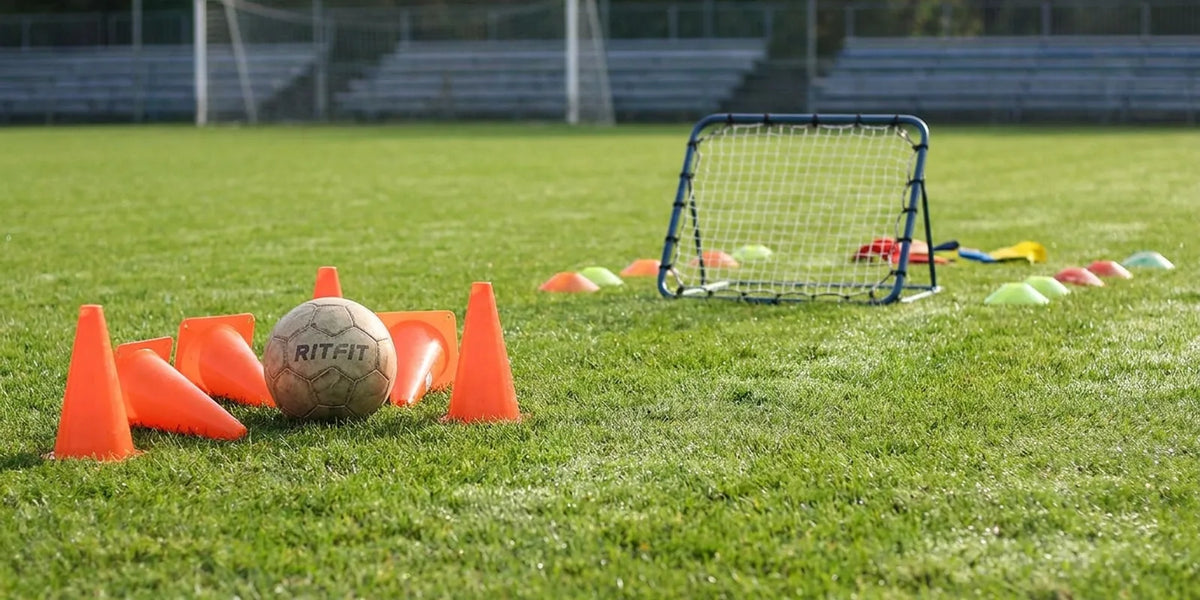
- Cones: Use 6 to 10 flat cones for dribbling, passing gates, and small grids.
- Shin guards: Use shin guards whenever training with defenders or contact.
- Cleats or turf shoes: Match footwear to the training surface.
- Home space: For indoor or garage training, rubber gym flooring mats can help create a safer training and strength area.
Optional Off Field Strength Support
Older teens and adult beginners can add simple strength training to support sprinting, balance, stability, and injury resilience. Balance training has been shown to improve balance and technical skills in adolescent soccer players, and agility focused training can improve agility with and without the ball in young players.[4][5]
- Dumbbells: Use RitFit dumbbells for split squats, lunges, calf raises, and single leg strength work.
- Benches: Use adjustable weight benches for step ups, hip thrusts, and supported core work.
- Barbells and plates: Use barbells and weight plates only when form, supervision, and age appropriate training are in place.
- Plyo boxes: Use plyo boxes for step ups and controlled landing practice.
- Strength machines: Use strength machines as optional support for general fitness, not as a replacement for field skill practice.
- Home gym planning: Visit RitFit Sports for home gym equipment that supports consistent off field training.
Progress Tracker
Beginners improve faster when they track simple results. Use one or two measurements per session instead of tracking everything at once.
- Ball control: Count how many toe taps you complete in 30 seconds without losing control.
- Dribbling: Time your cone weave and record clean runs only.
- Passing: Count how many wall passes you complete without a missed touch.
- Shooting: Track how many shots hit the target out of 10.
- Weak foot: Record how many clean passes, touches, or shots you complete with the weaker foot.
Frequently Asked Questions
What are the best soccer drills for complete beginners?
The best soccer drills for complete beginners are toe taps, sole rolls, cone weave, wall passes, target shooting, and 3v3 games. These drills build control, coordination, passing accuracy, shooting confidence, and simple decision making without requiring advanced skill or expensive equipment.
How often should beginners practice soccer drills?
Beginners should practice soccer drills two to four times per week. Short sessions of 30 to 45 minutes are usually enough when the training is focused, consistent, and age appropriate, especially if players also have team practice or weekend games.
Can beginners improve soccer skills without a coach?
Yes. Beginners can improve soccer skills without a coach by practicing ball mastery, wall passing, cone dribbling, and target shooting. A coach can speed up correction, but solo training still builds touch, confidence, weak foot control, and repeatable technique.
What soccer drills can kids do at home?
Kids can do toe taps, sole rolls, inside foot taps, Red Light Green Light, Traffic Jam, and wall passing at home. The safest home drills use small spaces, soft touches, simple commands, and plenty of breaks so children stay engaged and controlled.
Should beginners practice dribbling or passing first?
Beginners should practice ball control first, then add dribbling and passing together. Ball control helps players feel comfortable, dribbling teaches movement with the ball, and passing teaches connection with teammates, so all three should appear early in training.
How long does it take to get better at soccer?
Most beginners can notice better ball control in four to six weeks with consistent practice. Passing, dribbling, shooting, and game confidence usually take longer, but simple tracking, weekly repetition, and small sided games make improvement easier to see.
Are heading drills safe for young soccer beginners?
No. Heading drills are not appropriate for many young beginners and should follow local youth soccer rules. Children should avoid unsupervised heading, and any player with headache, dizziness, confusion, nausea, or vision changes should stop immediately and seek qualified medical guidance.
What equipment do beginners need for soccer training?
Beginners need a properly sized soccer ball, a few cones, shin guards, safe footwear, and open space. A wall, small goal, or target can make solo practice more effective, but expensive equipment is not required to build strong fundamentals.
Conclusion
The best soccer drills for beginners are the drills that build control first and game confidence second. Start with ball mastery, add dribbling and passing, practice shooting with accuracy, and use small sided games to apply each skill under pressure.
Keep sessions short, track one simple metric, and repeat the basics until they feel natural. Consistent practice with the right progression is the fastest path from beginner touches to confident play.
Disclaimer: This article is for general educational purposes only and is not medical, coaching, or injury treatment advice. Youth players should follow local soccer rules, age based heading restrictions, and guidance from qualified coaches, athletic trainers, or healthcare professionals. Stop training immediately if pain, dizziness, confusion, headache, nausea, or unusual symptoms appear.
References
- Clemente FM Afonso J Castillo D Arcos AL Silva AF Sarmento H. Effects of small sided game interventions on the technical execution and tactical behaviors of young and youth team sports players, a systematic review and meta analysis. Front Psychol. 2021;12:667041. doi:10.3389/fpsyg.2021.667041
- Sullivan GR Lin EA Hoffer A Richardson M Chhabra A. Pediatric concussion injuries in soccer, emergency department trends in the United States from 2012 to 2023. Orthop J Sports Med. 2024;12(12):23259671241303180. doi:10.1177/23259671241303180
- Nuhu A Jelsma J Dunleavy K Burgess T. Effect of the FIFA 11 plus soccer specific warm up programme on the incidence of injuries, a cluster randomised controlled trial. PLoS One. 2021;16(5):e0251839. doi:10.1371/journal.pone.0251839
- Mitrousis I Bourdas DI Kounalakis S Bekris E Mitrotasios M Kostopoulos N Ktistakis IE Zacharakis E. The effect of a balance training program on the balance and technical skills of adolescent soccer players. J Sports Sci Med. 2023;22(4):645-657. doi:10.52082/JSSM.2023.645
- Milanović Z Sporiš G Trajković N James N Šamija K. Effects of a 12 week SAQ training programme on agility with and without the ball among young soccer players. J Sports Sci Med. 2013;12(1):97-103.