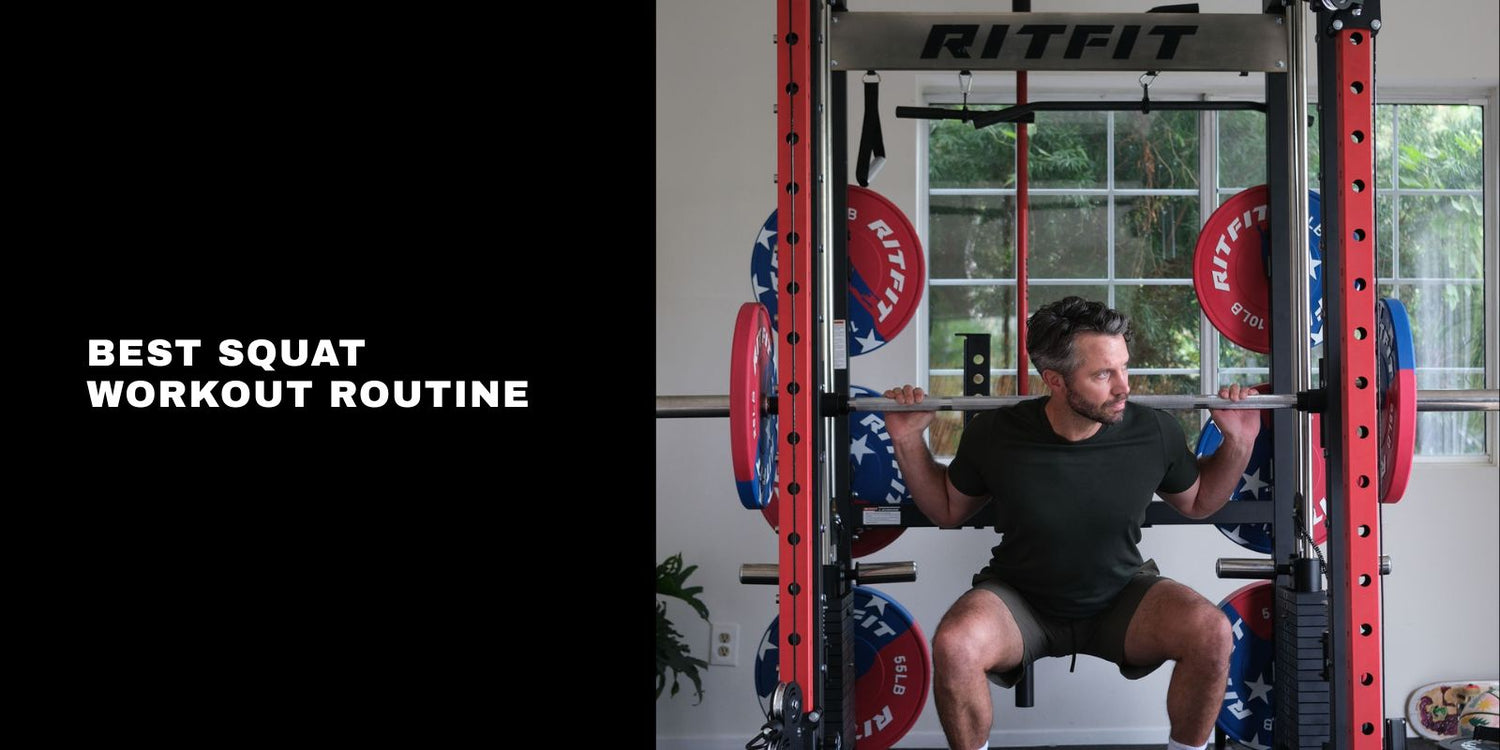
The best squat workout routine helps you build stronger legs, better movement control, and a safer home gym training structure. This guide gives you an 8 week squat progression, form cues, equipment setup, and leg day accessories for building lower body strength with RitFit.
Key Takeaways
- Best routine structure: Train squats 2 times per week, with one strength day and one technique or volume day.
- Best beginner starting point: Use goblet squats or light barbell squats before pushing heavy loads.
- Best home gym safety rule: Set safety bars, spotter arms, or Smith machine stops before every working set.
- Best progression method: Add small amounts of weight only when depth, bracing, and bar path stay consistent.
- Best equipment path: A power cage, Olympic barbell, plates, bench, dumbbells, and leg machine create a complete squat focused home gym.
Why Squats Matter for Leg Strength
Squats matter because they train the quads, glutes, hamstrings, trunk, and upper back in one coordinated movement. A biomechanical review notes that squat technique variables such as trunk position, stance, depth, and load placement can meaningfully change joint demands and training emphasis.[1]
Muscles Worked During Squats
Squats primarily train the quadriceps and glutes while also requiring the hamstrings, calves, spinal erectors, and core to stabilize the movement.
- Quadriceps: Extend the knees and help drive the body upward from the bottom position.
- Glutes: Extend the hips and become especially important when the lifter reaches strong, controlled depth.
- Hamstrings: Help control the descent and support hip stability during the movement.
- Core and spinal erectors: Maintain torso position and help keep the spine stable under load.
- Calves and feet: Stabilize the ankle and help the lifter maintain full foot pressure.
Benefits of a Structured Squat Program
A structured squat program helps you train strength, muscle, balance, and technique without guessing what to do each leg day.
- Strength progression: A planned routine gives you clear targets for sets, reps, load, and recovery.
- Better form consistency: Repeated practice helps you improve depth, knee tracking, bracing, and bar path.
- Lower body hypertrophy: Squat variations can support quad, glute, and thigh development when volume and recovery are managed well.
- Home gym efficiency: One rack, barbell, and plate setup can support squats, lunges, split squats, Romanian deadlifts, and step ups.
- Safer solo training: Proper equipment setup helps reduce risk when training without a spotter.
Who This Squat Workout Routine Is Best For
This routine is best for home gym lifters who want a repeatable lower body plan instead of random leg day workouts. It works especially well for beginners and intermediate lifters who can squat without sharp pain and want to improve strength gradually.
- Home gym beginners: Start with goblet squats, bodyweight squats, and light barbell squats before using heavier working sets.
- Intermediate lifters: Use the 8 week plan to organize strength work, volume work, and accessory movements.
- Solo trainers: Prioritize a rack or Smith machine setup with safeties before loading challenging squat sets.
- Leg day focused users: Add split squats, Romanian deadlifts, leg curls, calf raises, and leg press variations for complete lower body work.
How to Squat Properly
Proper squat form starts with stable feet, a braced torso, controlled depth, and a balanced ascent. The goal is not to force one perfect stance, but to find a repeatable position that allows safe depth and strong leg drive.
Step 1: Set Your Stance
Stand with your feet about hip width to shoulder width apart and turn your toes slightly outward. Keep your full foot connected to the floor so pressure stays balanced through the heel, big toe, and little toe.
Step 2: Brace Before Each Rep
Take a deep breath into your midsection and tighten your trunk before you descend. This helps maintain torso position and reduces unwanted movement under the bar.
Step 3: Descend With Control
Bend your hips and knees together while keeping your knees tracking in the same direction as your toes. Descend only as far as you can control without your heels lifting or your lower back rounding.
Step 4: Drive Up Through the Midfoot
Push the floor away and keep your chest and hips rising together. Avoid letting your knees collapse inward or your hips shoot up faster than your shoulders.
Step 5: Reset Before the Next Rep
Finish tall, regain your breath, and reset your brace before starting again. Clean repeated reps are more valuable than rushed reps with poor control.
Best Squat Variations for Home Gym Training
The best squat variation depends on your equipment, goal, mobility, and training experience. A study on different squat variations found that changing depth, stance, and loading style can alter muscle activation patterns, which supports using more than one squat style across a training plan.[2]
High Bar Back Squat
The high bar squat is a strong choice for general leg development because it usually keeps the torso more upright and places high demand on the quads.
- Best for: Overall leg strength, quad development, general fitness, and structured barbell training.
- Home gym note: Use a stable rack, properly set J hooks, and safety bars before adding heavy weight.
Low Bar Back Squat
The low bar squat places the bar lower on the upper back and usually involves more forward torso angle. Research comparing high bar and low bar squats reports differences in muscle activation, so lifters should choose the version that fits their goal and anatomy.[3]
- Best for: Strength focused lifting, hip dominant mechanics, and powerlifting style training.
- Home gym note: Practice with moderate loads first because the position can feel less natural for beginners.
Front Squat
The front squat uses an anterior load that encourages a tall torso and strong upper back position.
- Best for: Quad focused strength, upright squat mechanics, and lifters who tolerate front loaded movements well.
- Home gym note: Use clean grip, strap grip, or crossed arm grip depending on wrist and shoulder comfort.
Goblet Squat
The goblet squat is one of the best teaching tools because the front held weight helps many lifters sit into depth with better balance.
- Best for: Beginners, warm ups, mobility practice, and lighter home gym leg workouts.
- Home gym note: Use a dumbbell from the RitFit Hex Rubber Dumbbells collection for goblet squats, lunges, and split squats.
Smith Machine Squat
The Smith machine squat can be useful for solo training because the guided bar path and adjustable catches help lifters train with more control.
- Best for: Controlled reps, beginner confidence, hypertrophy work, and home gym users training without a spotter.
- Home gym note: Learn the setup in the Smith machine squat form guide before using heavier working sets.
The Best Squat Workout Routine
This 8 week squat workout routine uses two squat focused days per week and two optional full body support days. Progressive resistance training has evidence for improving strength and physical function when the load is increased gradually and matched to the lifter ability.[4]
Weekly Training Structure
Use Day 1 for strength, Day 2 for upper body support, Day 3 for squat volume and technique, and Day 4 for optional full body hypertrophy.
- Day 1: Heavy squat day with moderate to heavy barbell work.
- Day 2: Upper body and core support with pressing, pulling, and trunk control.
- Day 3: Squat volume day with lighter loading, clean depth, and controlled tempo.
- Day 4: Optional full body hypertrophy with lunges, rows, presses, and core work.
Weeks 1 to 2: Build Your Squat Pattern
Train with light to moderate loads and leave 2 to 3 reps in reserve on every set. Focus on depth, bracing, stance, and controlled rep speed before increasing weight.
- Day 1 main lift: Back squat, 4 sets of 6 reps.
- Day 1 accessory: Romanian deadlift, 3 sets of 8 reps.
- Day 1 unilateral work: Bulgarian split squat, 2 sets of 8 reps per leg.
- Day 3 main lift: Goblet squat or front squat, 4 sets of 8 reps.
- Day 3 accessory: Step ups, 3 sets of 10 reps per leg.
Weeks 3 to 4: Add Progressive Overload
Add a small amount of weight only when all reps are completed with stable depth and clean control. Repeat the same weight next session if your knees cave, heels lift, or bar path changes.
- Day 1 main lift: Back squat, 5 sets of 5 reps.
- Day 1 posterior chain: Romanian deadlift, 3 sets of 8 to 10 reps.
- Day 1 core: Hanging knee raise or dead bug, 3 sets of 10 to 15 reps.
- Day 3 main lift: Pause squat, 4 sets of 5 reps with a 2 second pause.
- Day 3 accessory: Dumbbell lunge, 3 sets of 10 reps per leg.
Weeks 5 to 6: Build Strength and Volume
Use slightly heavier sets on Day 1 and controlled volume on Day 3. Reduce accessory work if soreness or bar speed begins to limit your main squat sets.
- Day 1 main lift: Back squat, 5 sets of 4 reps.
- Day 1 secondary lift: Front squat, 3 sets of 5 reps.
- Day 1 accessory: Standing calf raise, 4 sets of 12 to 15 reps.
- Day 3 main lift: Tempo squat, 4 sets of 6 reps with a 3 second descent.
- Day 3 accessory: Leg curl or Romanian deadlift, 3 sets of 10 reps.
Weeks 7 to 8: Test Strength Without Forcing a Max
Use Week 7 to practice heavier but controlled sets, then use Week 8 to test a strong 3 rep or 5 rep set. A controlled rep max is usually safer for home gym lifters than a true 1 rep max attempt.
- Day 1 Week 7: Back squat, 4 sets of 3 reps at a challenging but clean load.
- Day 3 Week 7: Pause squat, 3 sets of 4 reps at a moderate load.
- Day 1 Week 8: Work up to one strong 3 rep or 5 rep set with no form breakdown.
- Day 3 Week 8: Deload with goblet squats, split squats, and light core work.
Accessory Exercises for Stronger Squats
Accessory exercises help build the muscles and movement patterns that support stronger squats. Choose 2 to 4 accessories per session instead of adding every possible movement.
- Romanian deadlift: Builds hamstrings, glutes, and hip hinge strength.
- Bulgarian split squat: Improves single leg strength and helps balance left to right differences.
- Step up: Trains knee and hip extension with a home gym bench or plyo box.
- Leg curl: Adds direct hamstring work to support knee stability and posterior chain balance.
- Calf raise: Trains ankle support and lower leg strength for a stronger base.
- Core brace drill: Builds trunk control for safer loaded squats.
Common Squat Mistakes and How to Fix Them
Most squat mistakes come from poor setup, weak bracing, mobility limits, or loading too heavy too soon. Fix the cause before adding more weight.
Knees Caving Inward
Knees caving inward usually means the lifter is losing hip control or foot pressure. Reduce load, push the knees in line with the toes, and practice slow bodyweight or goblet squats.
Heels Lifting Off the Floor
Heels lifting usually means the lifter lacks ankle control or shifts too far forward. Use lighter loads, practice ankle mobility, and keep pressure across the full foot.
Lower Back Rounding
Lower back rounding often means the lifter is going deeper than they can control. Limit depth temporarily, brace harder, and rebuild the pattern with goblet squats or box squats.
Rushing the Descent
A rushed descent makes it harder to control depth, brace, and knee tracking. Use a 2 to 3 second lowering phase until your form becomes consistent.
Maxing Out Too Often
Testing maximum strength too often can interfere with technique and recovery. Most home gym lifters should build strength through consistent submaximal sets instead.
Best Home Gym Equipment for Squat Training
The best home gym squat setup gives you safe starting height, safe failure options, stable loading, and enough accessory options for complete leg training. Safe training guidance across sports consistently emphasizes preparation, progressive exposure, and technique quality rather than uncontrolled intensity.[5]
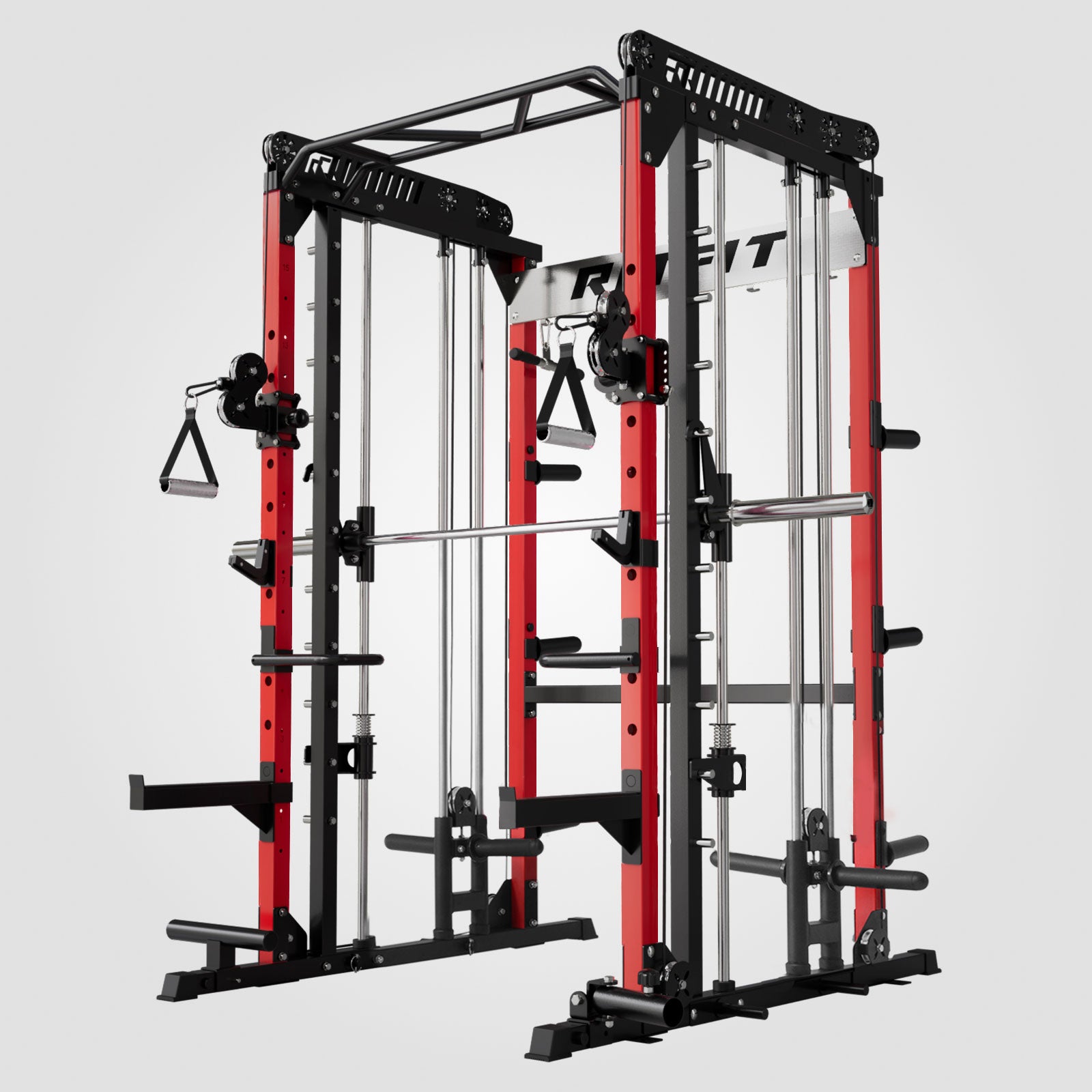
- Power cage: A RitFit P3 Power Cage supports barbell squats, rack pulls, presses, and cable accessories in one home gym station.
- Smith machine: The RitFit Smith Machine Collection is useful for guided bar training, controlled squat variations, and solo lifting setups.
- All in one system: The RitFit M1 PRO Smith Machine Home Gym Package can support squat training, cable work, upper body training, and accessory movements in one compact system.
- Olympic barbell: A RitFit 7FT Olympic Barbell gives you the standard bar path and loading feel for back squats and front squats.
- Weight plates: RitFit Barbells and Weight Plates help you progress in small, repeatable load jumps.
- Adjustable bench: The RitFit GATOR Adjustable Weight Bench supports split squats, step ups, hip thrusts, and upper body training.
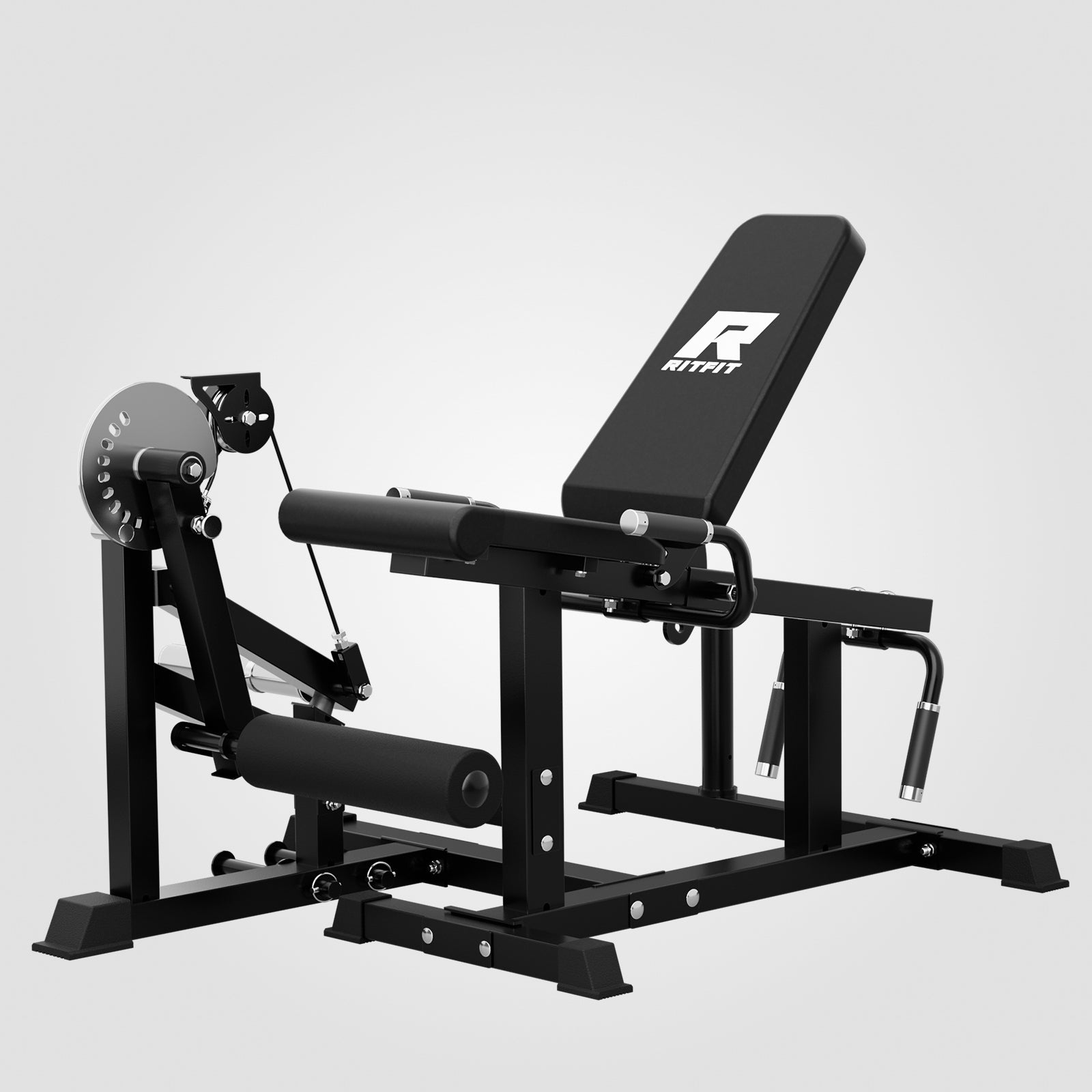
- Leg press machine: The RitFit GAZELLE PRO 3 In 1 Leg Press and Hack Squat Machine adds leg press, hack squat, and calf raise work for a more complete leg day.
Warm Up Protocol for Squat Sessions
A good squat warm up prepares the hips, ankles, knees, trunk, and nervous system before the working sets begin. Keep it short, specific, and progressive.
Mobility and Activation
Use 5 to 8 minutes of simple movements that improve squat depth and control without causing fatigue.
- Bodyweight squat: 2 sets of 10 slow reps.
- Goblet squat hold: 2 holds of 20 to 30 seconds.
- Ankle rock: 10 reps per side.
- Hip flexor stretch: 20 seconds per side.
- Dead bug: 2 sets of 8 reps per side.
Barbell Warm Up
Use several lighter sets before your working weight so your body can rehearse the exact squat pattern.
- Empty bar: 2 sets of 8 to 10 reps.
- Light warm up: 1 set of 5 reps.
- Moderate warm up: 1 set of 3 to 5 reps.
- Final warm up: 1 set of 2 to 3 reps before the first work set.
How to Progress Your Squat Safely
Progress your squat by adding small amounts of weight only after your technique is repeatable. A good progression should improve strength without turning every session into a max effort test.
- Add load slowly: Increase by 5 to 10 lb when every working set looks stable.
- Use reps in reserve: Keep 1 to 3 reps in reserve on most working sets.
- Repeat when needed: Repeat the same weight if form breaks down or recovery feels poor.
- Film from the side: Check depth, torso angle, heel position, and bar path.
- Deload when necessary: Reduce volume for one week if soreness, fatigue, or joint discomfort accumulates.
Nutrition and Recovery for Squat Training
Squat progress depends on training stress, food intake, sleep, and recovery habits. You do not need a perfect diet, but you do need enough energy and protein to support hard lower body training.
- Protein: Eat protein consistently across the day to support muscle repair.
- Carbohydrates: Use carbs around training when squat sessions feel low energy.
- Hydration: Drink enough fluid before training so fatigue does not appear early.
- Sleep: Prioritize consistent sleep because heavy leg training is recovery demanding.
- Active recovery: Walk, stretch lightly, or use easy mobility work on rest days.
Advanced Squat Techniques for Breaking Plateaus
Advanced techniques should be added only after your basic squat form and weekly recovery are consistent. Use one technique at a time so you can tell what is actually helping.
Paused Squats
Paused squats build control and strength out of the bottom position. Hold the bottom for 1 to 3 seconds while staying braced and balanced.
Tempo Squats
Tempo squats improve control by slowing the descent. Use a 3 second lowering phase and stand up with smooth force.
Box Squats
Box squats help teach consistent depth and controlled sitting back. Use the box as a depth target, not as a place to relax completely.
Smith Machine Squats
Smith machine squats can help lifters use controlled reps and higher volume with less setup complexity. Keep the feet in a position that allows comfortable knee tracking and full foot pressure.
FAQs
What is the best squat workout routine for beginners?
The best squat workout routine for beginners uses two squat focused sessions per week, light technique practice, and gradual load increases. Start with goblet squats or controlled barbell squats, keep one to three reps in reserve, and add weight only when depth and balance stay consistent.
How many times per week should I do squats?
Most home gym lifters should squat two times per week for steady progress and manageable recovery. One session can focus on heavier strength work, while the second uses lighter volume, pause squats, tempo squats, or goblet squats to improve form and build confidence.
Can I build strong legs with a home gym squat routine?
Yes. A home gym squat routine can build strong legs when it includes progressive loading, enough weekly volume, and accessory exercises. A rack, barbell, dumbbells, bench, and leg machine can train squats, lunges, split squats, Romanian deadlifts, calf raises, and leg press variations.
Is a Smith machine good for squat workouts at home?
Yes. A Smith machine can be useful for home squat workouts because it gives a guided bar path and adjustable catch points. It works best for controlled reps, higher volume leg training, and solo lifters who want a stable setup, but foot placement still matters.
Should I use a power cage or Smith machine for squats?
Use a power cage if you want free barbell movement and traditional squat mechanics. Use a Smith machine if you want guided reps and easier solo setup. Many home gym lifters benefit from both, because each option supports different training goals and confidence levels.
How do I know if I am squatting deep enough?
You are squatting deep enough when you reach a controlled depth that your mobility and technique can support. Many lifters aim for hip crease near or below knee level, but depth should never come from heel lift, knee collapse, or lower back rounding.
What equipment do I need for a home gym leg workout?
A strong home gym leg workout starts with a stable rack or Smith machine, an Olympic barbell, weight plates, dumbbells, and an adjustable bench. Add a leg press or hack squat machine if you want more quad, glute, hamstring, and calf volume without relying only on barbell squats.
When should I add weight to my squat workout routine?
Add weight when every working set reaches consistent depth, stable foot pressure, and clean knee tracking. Small increases are better than aggressive jumps. If your form changes, your heels lift, or your back rounds, repeat the same weight before progressing again.
Conclusion
The best squat workout routine is simple, progressive, and safe enough to repeat for weeks. Use this 8 week plan to build technique, add load gradually, and create a stronger home gym leg day with the right RitFit rack, barbell, plates, dumbbells, bench, or leg machine.
Disclaimer
This article is for general fitness education only and is not medical advice. Stop training if you feel sharp pain, dizziness, numbness, or unusual joint discomfort, and consult a qualified medical or fitness professional before starting a squat program if you have an injury, medical condition, or recent surgery.
References
- Straub RK, Powers CM. A biomechanical review of the squat exercise: implications for clinical practice. Int J Sports Phys Ther. 2024;19(4):490-501. doi:10.26603/001c.94600
- Coratella G, Tornatore G, Caccavale F, Longo S, Esposito F, Cè E. The activation of gluteal, thigh, and lower back muscles in different squat variations performed by competitive bodybuilders: implications for resistance training. Int J Environ Res Public Health. 2021;18(2):772. doi:10.3390/ijerph18020772
- Murawa M, Fryzowicz A, Kabaciński J, Jurga J, Gorwa J, Galli M, Zago M. Muscle activation varies between high bar and low bar back squat. PeerJ. 2020;8:e9256. doi:10.7717/peerj.9256
- Liu CJ, Latham NK. Progressive resistance strength training for improving physical function in older adults. Cochrane Database Syst Rev. 2009;(3):CD002759. doi:10.1002/14651858.CD002759.pub2
- Vincent HK, Brownstein M, Vincent KR. Injury prevention, safe training techniques, rehabilitation, and return to sport in trail runners. Arthrosc Sports Med Rehabil. 2022;4(1):e151-e162. doi:10.1016/j.asmr.2021.09.032