








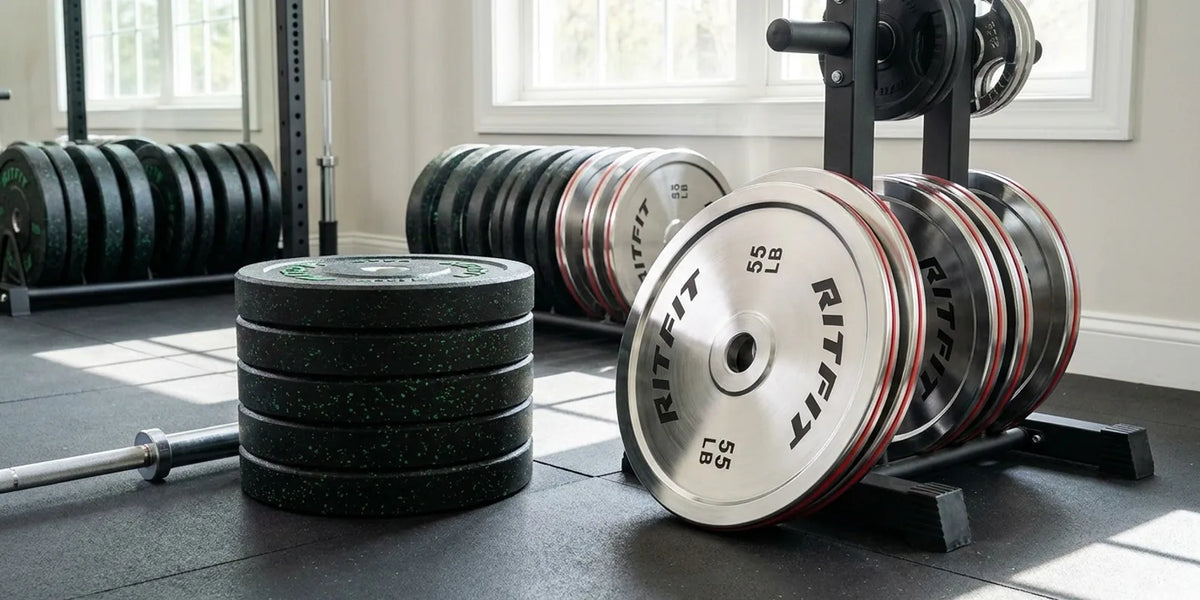
Bumper plates and iron plates both load an Olympic barbell, but they are built for different workouts and different home gyms.
Bumper plates are rubber and made to be dropped, while iron plates are dense, thin, and affordable.
This guide compares noise, floor protection, durability, price, and how much weight fits on one bar, then gives you a clear answer for your training style.
Use the Quick Answer for the short version, the comparison table for the details, and the training-style section for the exact recommendation. All comparisons stay inside the RitFit plate lineup, so you can buy with confidence.
Quick Answer: Bumper plates are the right choice if you do Olympic lifts, CrossFit, or any movement where you drop the bar, because rubber protects your floor and cuts noise. Iron plates are the budget pick for controlled squat, bench, and deadlift training, and many home gyms run a hybrid of both for loading capacity.
Key Takeaways
- Construction: Bumper plates are rubber with a steel insert and are made to be dropped; iron plates are solid cast metal for controlled lowering.
- Loading capacity: Iron plates are thinner, so far more weight fits on one bar; bumper-only bars top out near 450-500 lb.
- Cost: Iron runs about half the price per pound of bumpers for a comparable set.
- Noise and floors: Bumpers are quieter and gentler on concrete; iron is loud and chips when dropped.
- Best setup: A hybrid with bumpers on the outside and iron change plates behind gives drop safety and loading capacity.
What Is the Real Difference Between Bumper Plates and Iron Plates?
Bumper plates are rubber plates with a steel insert that share one diameter at every weight, while iron plates are dense cast metal that gets thinner as the weight drops. The practical difference is drop safety: bumpers are built to be dropped from overhead and iron is not.
- Rubber vs steel: Bumper plates use dense rubber over a steel core, while iron plates are solid cast iron with a painted or rubber-coated finish.
- Same diameter at every weight: A 10 lb bumper is 450 mm across, exactly like a 45 lb bumper, so the bar always starts at the same pull height. Iron plates shrink as they get lighter, so a bar loaded with small iron sits lower than it would in a commercial gym.
- Drop safety: Bumpers absorb overhead drops in Olympic lifts and bail-outs. Dropping iron on concrete chips the plate and marks the slab.
For a garage or basement setup where the bar might leave your hands, the RitFit Bumper Plates collection is the drop-friendly option. If you lower the bar under control, the RitFit Iron Plates line loads heavy for less.
Bumper Plates vs Iron Plates: Side-by-Side Comparison
The comparison below shows where each type wins: iron takes price and maximum bar load, while bumpers take noise, floor protection, and drop safety. Let the row that matters most to your setup drive the decision.
| Feature | Bumper Plates | Iron Plates |
|---|---|---|
| Price per pound | $1.50-2.50 | $0.80-1.50 |
| 300 lb set | $300-600 | $150-300 |
| 45 lb plate thickness | About 75-85 mm | About 25-33 mm |
| Diameter | 450 mm at every weight | Varies by weight |
| Safe to drop | Yes | No |
| Max on a standard bar | About 450-500 lb | Far more |
| Noise | Low, muffled thud | High, metal clang |
| Durability | Rubber can crack; insert can loosen | Nearly indestructible |
| Weight tolerance | Usually 2-3% | Usually about 2% |
| Best for | Olympic lifting, CrossFit | Powerlifting, bodybuilding |
Approximate values from 2026 industry buying guides. Price is a per-pound range and varies by brand, finish, and sale.
"The standard bar length is a little over 7 feet, has '2-inch'/50mm diameter sleeves for loading the plates on, and weighs 20kg/44.1lbs. For home gym purposes, a 28.5 or 29mm bar will be the most durable and provide the best service over time. NEVER buy a 32mm bar. They are either junk, or a specialty squat bar that a home gym doesn't need."
Mark Rippetoe, Strength Coach and Author of Starting Strength, Starting Strength
Which Should You Buy for Your Training Style?
Buy bumper plates if you do Olympic lifts, CrossFit, or any workout where the bar is dropped; buy iron plates if you squat, bench, press, and deadlift under control and want maximum load for the money.
- Olympic lifting and CrossFit: Snatches, cleans, jerks, and most WODs end with the bar leaving your hands, so bumpers are non-negotiable. The RitFit Black Bumper Plates or the color-coded RitFit Color Bumper Plates handle the drops without punishing your floor.
- Powerlifting and bodybuilding: Controlled squats, bench presses, and deadlifts load thinner iron plates, so you can fit far more weight on one bar. The RitFit Cast Iron Weight Plates keep the cost per pound low for heavy sets.
- Beginners and shared gyms: If you are new or family members train together, bumpers give a safer miss and a quieter session, which is worth the premium over bare iron.
- Heavy deadlifters: If you plan to pull 500 lb or more, bumper-only bars top out near 450-500 lb, so add thin iron behind the bumpers to keep loading.
A 2022 peer-reviewed study of CrossFit training noted that workouts combine barbell lifts with running and gymnastics, so no single piece of equipment fits every movement.[1] That variety is exactly why a drop-friendly bumper set is the practical base for that style of training, with iron change plates rounding out the load.
For most home lifters the honest answer is a hybrid, covered in the last section, rather than one type alone.
Do Bumper Plates Protect Your Floor and Cut Noise Better Than Iron?
Yes, bumper plates absorb impact and produce a muffled thud, while iron plates on concrete are loud and can chip both the plate and the slab. Rubber is the quieter, floor-friendly option in every drop scenario.
- Floor protection: Bumpers are designed to be dropped, so a missed rep lands on rubber instead of cracking your slab. Iron plates should never be dropped from height, and even careful loading on bare concrete can mark the floor.
- Noise control: Iron on concrete is loud and percussive, the kind of sound that travels through a building. Bumpers absorb most of the impact, which matters if you train in an apartment, over a bedroom, or near family members.
- Durability: Quality iron plates last essentially forever because they are solid metal. Bumper rubber can crack or chip over time and the steel insert can loosen with repeated drops, so check used bumpers for separation between rubber and insert before you buy.
For the drop-safe build, the RitFit Fleck Bumper Plates use dense rubber over a steel insert, with full sizing in the Fleck Bumper Plates Technical Specification. Pair any plate type with rubber gym matting, because flooring solves more of the noise and floor-damage problem than plate choice alone.
Are Bumper Plates Worth the Higher Price per Pound?
Bumper plates cost about twice as much per pound as iron, so the premium is worth it only when you actually drop the bar or lift above someone else's living space. If you control the bar on every rep, iron does the same job for less.
- Price gap: Industry guides put bumpers around $1.50-2.50 per pound and quality cast iron around $0.80-1.50, so a 300 lb set runs about $300-600 for bumpers against $150-300 for iron.
- What you pay for: The extra cost buys drop safety, noise reduction, and a correct pull height for Olympic lifts, not more load on the bar.
- Long-term value: If you do Olympic lifting or CrossFit, bumpers protect your biggest asset, the concrete floor, and last many years with normal home use.
If your budget only stretches to one option, buy rubber flooring first, because flooring solves more of the noise and damage problem than plate choice alone. Then choose bumpers if you drop the bar and iron if you train under control.
Can You Use Bumper and Iron Plates Together on the Same Bar?
Yes, and most experienced home gym owners do: put bumper plates on the outside and load iron change plates behind them. This hybrid gives you drop protection and the correct pull height while keeping costs down.
- How it works: Load 45 lb bumpers on the outside so the heaviest plates hit the ground during deadlifts, then add thin iron 10s, 5s, and 2.5s behind them to dial in your working weight.
- Loading capacity: Iron plates are about a third as thick as bumpers, so the hybrid lets you keep adding weight past the 450-500 lb ceiling of a bumper-only bar.
- Storage: Thin iron stores flat and takes less wall space, while a small bumper pair handles the drop zones and keeps your deadlift height consistent.
This is the setup most garage gym builders end up with after buying one type first, and it is why a cast iron set pairs naturally with a bumper collection in the same home gym. You can start with one type and add the other as your strength grows.
FAQs About Bumper Plates and Iron Plates
Are bumper plates worth it for a home gym?
Bumper plates are worth it if you drop the bar during Olympic lifts, train without a rack, or lift above someone else's living space. Rubber absorbs impact, protects your floor, and cuts noise. If you squat, press, and deadlift under control, iron does the same job for about half the price.
Can you drop iron plates on concrete?
No. Dropping cast iron plates on a concrete floor can chip the plate, crack the concrete, and mark the slab. Iron plates are for lifts you lower under control. If you plan to drop the bar, choose bumper plates, which are designed to be dropped from overhead, and add rubber flooring for extra protection.
How much weight can you put on a bar with bumper plates?
About 450 to 500 pounds with a standard Olympic barbell. A 45 pound bumper plate is about 80 mm thick and the sleeve holds roughly 419 mm per side, so five plates per side fill it. Iron plates are about a third as thick, so far more weight fits on the same bar.
Are bumper plates quieter than iron plates?
Yes, noticeably. The rubber in bumper plates absorbs most of the impact, so they produce a muffled thud instead of the loud clang of iron hitting concrete. Rubber flooring makes a bigger difference to what your neighbors hear than plate choice does, so combine bumpers with flooring for the quietest setup.
Do bumper plates last as long as iron plates?
Quality iron plates last essentially forever because they are solid metal. Bumper plates also last many years in a home gym, but the rubber can crack or chip and the steel insert can loosen with repeated drops. Check used bumpers for separation between the rubber and the insert before you buy.
Should you mix bumper and iron plates on one bar?
Yes. Put bumper plates on the outside so the heaviest plates hit the floor during deadlifts, then load iron change plates behind them to dial in your working weight. This hybrid gives you drop protection and correct pull height while keeping costs down and maximizing how much weight fits on the bar.
Conclusion
Choose bumper plates for Olympic lifting, CrossFit, and any training where the bar leaves your hands, because rubber protects your floor and cuts noise.
Choose iron plates for controlled squats, bench presses, and deadlifts where loading capacity and price matter most.
Most home gyms get the best result from a hybrid: bumpers on the outside, iron change plates behind.
Start with one pair of 45 lb bumpers and build your iron change plates from there, and always train on rubber matting. Check the RitFit discount guide before you order to save on your first plate set.
Disclaimer
This article is a general buying guide and is not a substitute for professional coaching or facility safety advice. Always use proper lifting technique and gym flooring, and consult a qualified trainer before beginning a new training program.
References
1. Mangine GT, Seay TR. Quantifying CrossFit(®): Potential solutions for monitoring multimodal workloads and identifying training targets. Front Sports Act Living. 2022;4:949429. doi:10.3389/fspor.2022.949429. PMCID: PMC9613943





