Table of Contents
- Video Guide: Cable vs Dumbbell Bicep Curl Form
- Quick Comparison Overview
- What Are Dumbbell Bicep Curls?
- What Are Cable Bicep Curls?
- Cable Bicep Curls vs Dumbbell Curls: Head to Head Comparison
- Which Is Better for Different Training Goals?
- Which Option Is Better for a Home Gym?
- Programming Examples
- Form Tips and Common Mistakes
Cable bicep curls and dumbbell curls both build the biceps, but they train your arms with different resistance profiles. Dumbbells are better for simple loading and unilateral strength, while cables are better for steady tension, angle control, and high rep isolation.
The best choice depends on your goal, equipment access, joint comfort, and training style. Most lifters will get the best results by using both instead of treating the debate as one exercise versus the other.
Key Takeaways
- Dumbbell curls are best for simple strength progression: They are easy to load, easy to track, and ideal for home gym training.
- Cable curls are best for constant tension: They help keep the biceps working through more of the range of motion, especially near the top.
- Both exercises train the elbow flexors: The biceps brachii, brachialis, and brachioradialis all contribute to curl performance.
- Cables may feel more joint friendly: A rope or single handle can make wrist and elbow positioning easier to adjust.
- The best hypertrophy plan uses both: Use dumbbells for heavier work and cables for controlled volume, pump work, and finishers.
Video Guide: Cable vs Dumbbell Bicep Curl Form
This video gives a quick visual comparison of how cable and dumbbell curls look in practice. Watch the elbow position, wrist path, and body control rather than only the amount of weight being lifted.
Quick Comparison Overview
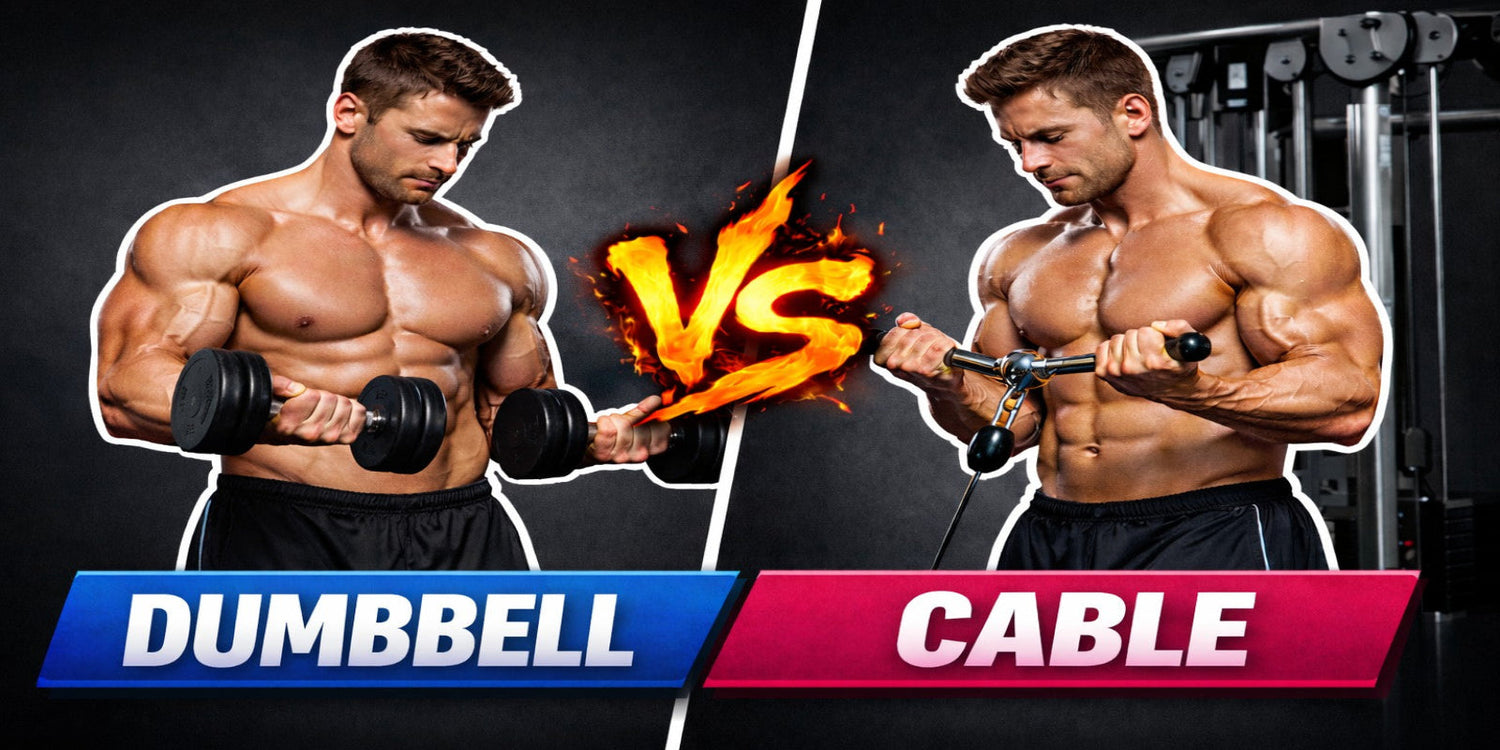
Dumbbell curls are the simpler choice, while cable curls give you more control over tension and angle. Use the table below to match the exercise to your training goal.
| Comparison Point | Dumbbell Bicep Curls | Cable Bicep Curls | Best Choice |
|---|---|---|---|
| Resistance profile | Hardest around the middle of the curl | More consistent tension across the movement | Cables for tension control |
| Strength progression | Simple weight jumps and easy tracking | Fine adjustments depend on the cable stack | Dumbbells for raw loading |
| Home gym access | Easy to use in small spaces | Requires a cable system or rack attachment | Dumbbells for most beginners |
| Joint comfort | Depends on wrist path and load control | Often easier to adjust with handles or rope | Cables for sensitive elbows |
| Muscle growth | Excellent for heavy curls and stretched work | Excellent for constant tension and pump work | Both together |
What Are Dumbbell Bicep Curls?
Dumbbell bicep curls are free weight elbow flexion exercises performed with one dumbbell in each hand. They are one of the most practical ways to train the biceps at home or in a gym.
Basic Description and Technique
Hold the dumbbells at your sides, keep your elbows close to your torso, and curl the weights upward by bending your elbows. For a full technique breakdown, read the RitFit guide on how to do dumbbell bicep curls.
Biomechanics and Strength Curve
Dumbbell curls are shaped by gravity, so the exercise usually feels hardest when your forearm is near parallel to the floor. The bottom and top may feel lighter, which means you need deliberate control to keep the biceps engaged.
Benefits of Dumbbell Curls
Dumbbell curls are valuable because they combine simplicity, unilateral control, and direct loading. They also let each arm move independently, which can help reveal strength or coordination differences.
- Simple progression: You can track progress by adding reps, adding load, or improving control.
- Unilateral balance: Each arm works separately, so the stronger side cannot hide the weaker side.
- Home gym friendly: A pair of dumbbells needs little space and works well for beginners.
- Variation friendly: Standard curls, incline curls, concentration curls, and dumbbell hammer curls can target slightly different arm positions.
Drawbacks and Limitations
Dumbbell curls become less effective when the weight is too heavy to control. Swinging, shoulder movement, and shortened reps reduce biceps tension and increase stress on the lower back or wrists.
- Less tension at the top: Gravity reduces direct biceps resistance when the dumbbell sits close to the shoulder.
- More cheating risk: Heavy dumbbells can encourage hip drive, back arching, and shoulder swinging.
- Wrist stress: Fixed hand positions may bother some lifters when the load gets heavy.
What Are Cable Bicep Curls?
Cable bicep curls are curl variations performed with a cable pulley, handle, rope, straight bar, or EZ style attachment. They are especially useful when you want smoother resistance and a more adjustable line of pull.
Basic Description and Technique
Set the pulley low, hold the attachment, stand tall, and curl without letting your elbows drift forward. For a step by step setup, read the RitFit guide on how to do cable bicep curls on a Smith machine.
Biomechanics and Line of Pull
Cables let you adjust the resistance angle by changing pulley height, body position, and attachment type. This can make it easier to keep tension on the biceps through the curl, which matters because time under tension can influence muscle protein synthetic responses after resistance exercise.[1]
Benefits of Cable Curls
Cable curls are valuable because they provide smooth resistance and flexible setup options. They are especially useful for high rep arm work, finishing sets, and lifters who want more control over wrist position.
- More consistent tension: The cable keeps pulling even when the dumbbell version feels easier near the top.
- Adjustable grip options: Rope, bar, and single handle attachments can change wrist comfort and muscle emphasis.
- Joint friendly setup: The line of pull can often be adjusted to reduce elbow or wrist irritation.
- Better finishing work: Cable curls pair well with controlled reps, slow lowering, and higher rep pump sets.
Drawbacks and Limitations
Cable curls require a cable station, Smith machine cable system, or cable attachment setup. They are also harder to compare directly across machines because pulley ratios and stack labels can change the resistance you feel.
- Equipment access: You need a cable machine or a compatible home gym cable setup.
- Load tracking complexity: Cable stack numbers may not match true free weight resistance.
- Leaning risk: Some lifters lean back and turn the curl into a body movement instead of an arm exercise.
Cable Bicep Curls vs Dumbbell Curls: Head to Head Comparison
The biggest difference is not which exercise is “better,” but where each exercise creates the most useful training stress. Dumbbells excel at simple loading, while cables excel at controlled tension and angle management.
Muscle Activation and Growth Potential
Both exercises target the biceps brachii, brachialis, and brachioradialis, but grip and curl variation can shift how strongly different elbow flexors contribute. Research on biceps curl variations shows that exercise setup can change electromyographic activity across the biceps brachii and brachioradialis.[2]
Strength Development and Progression
Dumbbells are usually easier to progress because the load is direct and easy to record. Cables can still support progressive overload, but your tracking should stay consistent on the same machine, pulley height, and attachment.
Joint Health and Injury Considerations
Cables may feel more comfortable for lifters with wrist or elbow sensitivity because the handle path is less fixed. Dumbbells can also be joint friendly when you use a controlled tempo, avoid swinging, and select a grip that matches your anatomy.
Mind Muscle Connection and Control
Cables often make it easier to feel the biceps working because tension stays present through more of the movement. Dumbbells require more intent at the top and bottom of each rep because the resistance curve changes more noticeably.
Convenience, Equipment, and Accessibility
Dumbbells are the easiest option for most home gyms because they are compact and simple. If you need a home setup, compare best dumbbell sets for home gym and the RitFit dumbbells collection before deciding.
Which Is Better for Different Training Goals?
Your best curl choice depends on what problem you are trying to solve. Use the recommendations below to match the exercise to your training goal.
For Beginners
Start with dumbbell curls because they are simple, direct, and easy to practice. Add cable curls later when you can control your elbows, wrists, and torso without swinging.
For Muscle Size
Use both exercises for hypertrophy because muscle growth is influenced by mechanical tension, metabolic stress, training volume, and effort. Reviews on hypertrophy oriented resistance training support the value of combining effective loading with sufficient volume and controlled execution.[3]
For Strength and Performance
Use dumbbells first when your goal is heavier loading and measurable strength progression. Cable curls work best as accessory work that adds volume without requiring maximal loads.
For Aesthetics and Peak Contraction
Cables can help you practice a hard squeeze at the top because resistance stays present near peak contraction. Biceps shape is still influenced by genetics, total training history, body fat level, and consistent progressive overload.
For Joint Friendly Training
Cables are often the better first choice when a fixed dumbbell path irritates the elbows or wrists. A rope, single handle, or rotating cable handle can help the wrist find a more natural path.
Which Option Is Better for a Home Gym?
Dumbbells are the best first choice for most home gyms because they are compact, simple, and useful for many exercises. Cables become more attractive when you already own a rack, Smith machine, or cable station.
- Choose dumbbells if: You want the simplest arm training tool with minimal setup and easy progression.
- Choose cables if: You want smoother resistance, more attachment options, and better high rep isolation work.
- Choose both if: You want a complete arm training setup that supports heavy curls, hammer curls, cable curls, and finishers.
- For compact setups: A dumbbell pair or adjustable dumbbell system usually gives the fastest return on space.
- For rack based setups: A compatible cable handle or bicep curl attachment for power racks can add more curl options without needing a separate machine.
If you already use a cable system, a dedicated handle can improve comfort and setup speed. The RitFit aluminum alloy handle set for cable machines is a relevant option when your routine includes cable curls, rows, pulldowns, and other attachment based movements.
Programming Examples
The best biceps program uses enough weekly work without letting elbow discomfort or poor reps accumulate. Resistance training variables such as volume, frequency, intensity, contraction type, and repetition duration can influence hypertrophy outcomes, so start conservatively and progress based on recovery.[4]
If You Only Have Dumbbells
Use dumbbells for a complete biceps routine by combining standard curls, incline curls, hammer curls, and concentration curls. This setup works well for home training and pairs naturally with the RitFit guide on whether you can build muscle with just dumbbells.
- Dumbbell bicep curls: 3 sets of 8 to 12 reps.
- Incline dumbbell curls: 3 sets of 10 to 15 reps.
- Dumbbell hammer curls: 2 sets of 12 to 15 reps.
- Dumbbell concentration curls: 2 sets of 10 to 12 reps per arm.
If You Only Have Cables
Use cables to build a biceps routine around smooth tension and multiple grip angles. Keep the stack from crashing between reps so the biceps stay loaded.
- Standing cable bicep curls: 4 sets of 10 to 15 reps.
- Rope cable hammer curls: 3 sets of 12 to 15 reps.
- Single arm cable curls: 3 sets of 12 to 18 reps per arm.
- Reverse grip cable curls: 2 sets of 12 to 15 reps.
If You Have Access to Both
Use dumbbells first for heavier work, then cables for controlled volume. This gives you simple overload plus consistent tension in the same weekly plan.
- Workout 1 heavy focus: Dumbbell curls for 3 to 4 sets of 6 to 10 reps, then cable hammer curls for 3 sets of 10 to 15 reps.
- Workout 2 volume focus: Incline dumbbell curls for 3 sets of 10 to 15 reps, then cable curls for 3 sets of 12 to 20 reps.
- Finisher option: Single arm cable curls for 2 sets of 15 to 20 reps per arm with strict control.
Form Tips and Common Mistakes
Good curl form keeps tension on the target muscles and reduces compensation from the shoulders, hips, and lower back. Curl variation also matters because handgrip changes can alter biceps brachii and brachioradialis excitation during biceps curl exercise.[5]
Shared Mistakes
The most common mistake is using momentum instead of elbow flexion. If your hips, lower back, or shoulders move more than your elbows, the weight is probably too heavy.
- Swinging the body: Keep your torso still and reduce the load if you need momentum.
- Dropping the weight: Lower each rep under control to keep the biceps loaded.
- Short reps: Use a full comfortable range rather than rushing partial reps.
- Elbows drifting forward: Keep elbows close to your sides unless you are intentionally using a specific curl variation.
Dumbbell Specific Tips
Use a load you can curl without leaning back or shrugging. Rotate into a supinated grip for classic curls or keep a neutral grip for hammer curls when wrist comfort matters.
- Control the top: Do not relax just because the dumbbell feels lighter near the shoulder.
- Control the bottom: Avoid bouncing out of the stretched position.
- Match grip to comfort: Use standard, hammer, or incline variations based on your joints and goals.
Cable Specific Tips
Set the pulley and body position so the cable pulls in a direction that matches your curl path. Keep the stack slightly suspended during the set so tension does not disappear between reps.
- Stand tall: Do not lean back to turn the curl into a row.
- Choose the right attachment: A rope, bar, or single handle can change wrist comfort and muscle feel.
- Keep tension steady: Stop the stack from touching down between reps.
Frequently Asked Questions
Are cable bicep curls better than dumbbell curls for biceps?
Not always. Cable bicep curls are better for steady tension and controlled high rep work, while dumbbell curls are better for simple loading and unilateral strength. Most lifters build better arms by using both across the week instead of treating one as the only option.
Do cable curls build biceps faster than dumbbell curls?
No. Cable curls do not automatically build biceps faster than dumbbell curls. Growth depends on progressive overload, total weekly volume, effort, recovery, and form. Cables may help you feel the contraction better, but dumbbells can still build serious size when performed consistently.
Can I build big biceps with only dumbbells?
Yes. Dumbbells can build big biceps when you train with enough volume, control, and progressive overload. Use standard curls, incline curls, hammer curls, and concentration curls to challenge the biceps, brachialis, and forearms from different positions across the full range.
Which is better for beginners, cable bicep curls or dumbbell curls?
Dumbbell curls are usually better for beginners because they are simple, accessible, and easy to progress. Cable curls are still useful once the lifter understands elbow position, wrist control, and how to keep tension without leaning back or turning the curl into a body swing.
Are cable bicep curls easier on the elbows?
Yes. Cable bicep curls may feel easier on the elbows because the resistance path is smoother and the handle position is easier to adjust. A rope or single handle can also let the wrist move more naturally during the curl and reduce unwanted strain.
Should I do dumbbell curls before cable curls?
Yes. Do dumbbell curls first when your goal is heavier loading or strength progression. Do cable curls later in the workout when you want higher reps, constant tension, slower lowering, and a stronger finishing pump without needing very heavy loads.
What cable attachment is best for bicep curls?
The best cable attachment depends on your wrist comfort and training goal. A straight bar is simple for classic curls, a rope supports neutral grip work, and single handles allow each arm to move independently with a more natural path and better control.
How many sets of cable and dumbbell curls should I do per week?
Most lifters can start with 8 to 14 direct biceps sets per week across cable and dumbbell curls. Increase only when recovery, elbow comfort, and rep quality remain strong, because more volume is not always better for long term progress.
Conclusion
Cable bicep curls and dumbbell curls are both excellent for building stronger arms, but they solve different training problems. Dumbbells are best for simple strength progression, while cables are best for constant tension, joint friendly angles, and high rep isolation.
If you want the most complete biceps routine, use both. Start with dumbbells for heavier work, then use cables for controlled volume, better peak contraction, and a strong finishing pump.
Disclaimer: This article is for general fitness education only and is not medical advice. Stop any exercise that causes sharp pain, numbness, or unusual joint discomfort. If you have an injury, medical condition, or post surgery limitation, consult a qualified healthcare professional or certified trainer before changing your training plan.
References
- Burd NA, Andrews RJ, West DWD, Little JP, Cochran AJR, Hector AJ, et al. Muscle time under tension during resistance exercise stimulates differential muscle protein sub-fractional synthetic responses in men. J Physiol. 2012;590(2):351-362. doi:10.1113/jphysiol.2011.221200
- Marcolin G, Panizzolo FA, Petrone N, Moro T, Grigoletto D, Piccolo D, Paoli A. Differences in electromyographic activity of biceps brachii and brachioradialis while performing three variants of curl. PeerJ. 2018;6:e5165. doi:10.7717/peerj.5165
- Krzysztofik M, Wilk M, Wojdała G, Gołaś A. Maximizing muscle hypertrophy: a systematic review of advanced resistance training techniques and methods. Front Physiol. 2019;10:1442. doi:10.3389/fphys.2019.01442
- Bernárdez-Vázquez R, Raya-González J, Castillo D, Beato M. Resistance training variables for optimization of muscle hypertrophy: an umbrella review. Front Sports Act Living. 2022;4:949021. doi:10.3389/fspor.2022.949021
- Coratella G, Tornatore G, Longo S, Toninelli N, Padovan R, Esposito F, Cè E. Biceps brachii and brachioradialis excitation in biceps curl exercise: different handgrips, different synergy. Sports. 2023;11(3):64. doi:10.3390/sports11030064