








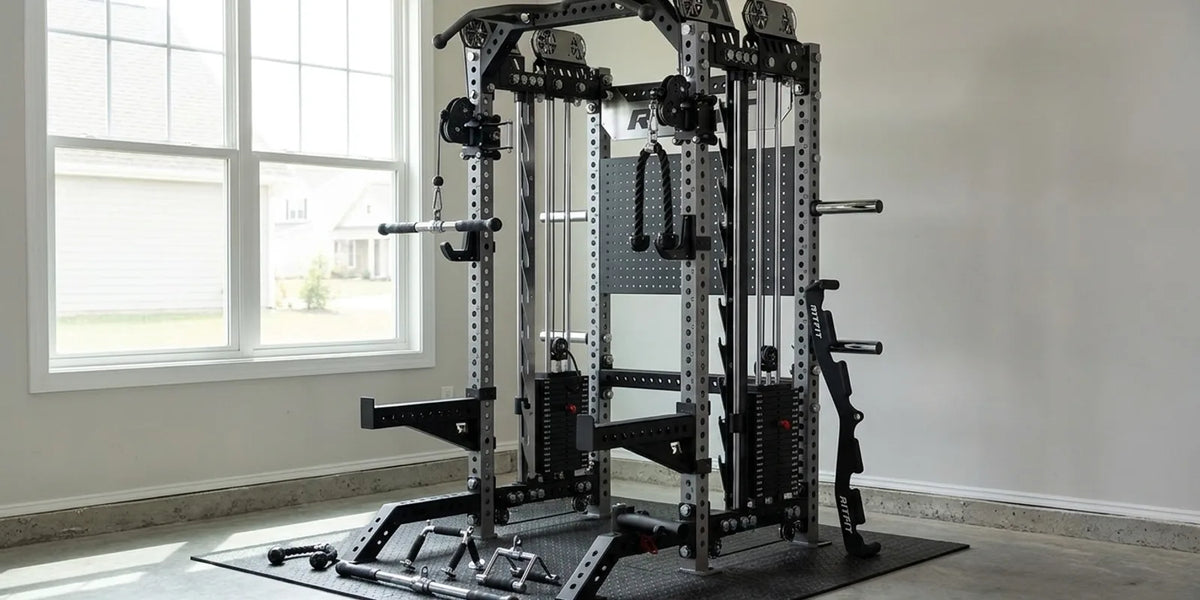
A cable machine tricep pressdown setup comes down to three adjustments: pulley height, attachment choice, and where you stand.
Get those right and the cable pulls against your forearm through the whole rep instead of unloading at the bottom.
Most pressdown problems are setup problems, not strength problems.
This guide covers the adjustments only: how high to set the pulley, which bar to clip on, how far back to step, and the stops that tell you a set is done. It assumes you already know what a pressdown is.
Quick Answer: A cable machine tricep pressdown setup works best with the pulley near head height, a straight or V bar clipped on, and a short step back so the cable meets your forearm near a 90-degree angle. Keep your elbows pinned, lean about 10 degrees forward, and let only your forearms move.
Key Takeaways
- Height sets the line of pull: A pulley near head height, roughly 60 to 66 inches off the floor, keeps the cable pulling against your forearm instead of straight down your arm.
- The 90-degree check: A step back of about 12 to 18 inches creates the near perpendicular angle between cable and forearm that trainers use to keep load on the triceps.
- Attachment changes travel: Straight bars and V bars stop at full elbow extension, while a rope adds travel because the ends spread apart at the lockout.
- Lean, do not press: A torso angle of about 10 to 15 degrees keeps your shoulders over your hands without turning the pressdown into a chest press.
- Reset, do not grind: When your elbows drift forward or your torso starts driving the stack, end the set and reset the pulley before the next one.
What Pulley Height Should You Use for a Tricep Pressdown?
The pulley height for a tricep pressdown sits near head height so the cable pulls back against your forearm. Set it too high and the bottom of the rep goes slack.
- Default setting: Bring the pulley to roughly shoulder or head height, about 60 to 66 inches off the floor on most home cable stations.
- What height changes: A high pulley loads the start of the rep, while dropping one or two notches shifts tension toward the middle and the lockout.
- The angle test: Once you hook on the bar and stand in your pressdown stance, the cable should meet your forearm close to 90 degrees, the point trainers treat as maximum triceps load.
- Thirty-second measurement: Set the height once, then mark the upright notch with tape so the same position repeats every session.
Height also has to suit the whole elbow extensor group, because in a study of 25 trained lifters pressing down at 45 percent of one-rep max, the lateral, long, and medial heads of the triceps fatigued independently rather than as a single unit[1]. A height that lines up your forearm therefore beats copying someone else's notch number.
The same numbers move on different hardware, so treat 60 to 66 inches as a starting point and adjust from there. If you are comparing stations, the cable machine range lists pulley travel and stack sizes, which is what actually decides how low you can set the attachment.
Which Tricep Pressdown Bar Matches Your Grip and Range of Motion?
The best tricep pressdown bar is the one whose grip lets you finish with a stacked wrist. Grip geometry, not brand, decides how much of the rep your triceps actually control.
| Attachment | Grip and wrist position | Travel at the lockout |
|---|---|---|
| Straight bar | Pronated grip with wrists stacked over the bar | Stops at full elbow extension, which suits heavier loads |
| V bar | Angled neutral grip with wrists rotated inward | Stops at full elbow extension with less wrist torque |
| Rope | Neutral grip with hands rotating outward at the bottom | Longest travel because the rope ends spread apart |
| Rotating solid pressdown V bar | Angled grip mounted on swiveling ends | Travel follows the swivel instead of fighting your wrist |
Attachment behavior describes standard cable handle geometry on a single-pulley station and assumes a straight cable run with no crossover angle.
- Straight bar: The default for a heavy tricep pressdown bar, and the easiest to load evenly with both hands.
- V bar: A good swap if a pronated grip irritates your wrists, because the angled handles keep the forearm and hand in one line.
- Rope: Pick it when you want extra travel and a hard lockout squeeze, since spreading the ends adds distance the bar cannot give you.
- Rotating solid pressdown V bar: Choose it when you want the V bar angle without the wrist twist, because the swiveling ends follow your hands instead of resisting them.
In one trial, 25 subjects pressed down at 30, 45, and 60 percent of one-rep max, and the rate of fatigue climbed as load rose while endurance time fell, and the same paper describes the medial head of the triceps as fully involved in elbow extension once the elbow flexes beyond 90 degrees[2]. Cable angle matters for the same reason, because a 2020 trial found the cable version of a preacher curl placed greater torque at longer muscle lengths than the barbell version[3].
Attachments are cheap relative to the machine, which is the argument for owning more than one. A straight bar, a V bar, and a rope between them cover almost every pressdown angle you will actually use.
"If you have a limited space, then if you just have one even just one selectorized cable attachment you can buy tons of different bars for it and essentially multiply with every new bar."
Dr. Mike Israetel, PhD, PhD in Sport Physiology, Co-founder, Renaissance Periodization, My Home Gym Tour - See My Insane Workout Setup!
Most of these bars share the same carabiner connection, so a set covers a pressdown, a pushdown, and a lat pulldown without new hardware. Compare the cable machine handles collection, the aluminum alloy handle set, and the cable machine attachments bundle to see which geometry your station already supports.
Where Should You Stand for a Cable Tricep Pressdown?
Stand one short pace back from the pulley, about 12 to 18 inches, with your feet shoulder width apart. That distance is what turns a straight cable drop into a diagonal pull your triceps can work against.
- Set your feet: Shoulder width apart, toes forward, weight spread evenly so the stack cannot swing you sideways.
- Step back: One short pace from the upright puts the cable at an angle instead of in line with your forearm.
- Set the torso: Lean forward about 10 to 15 degrees so your shoulders sit over your hands, then hold that angle for the whole set.
- Pin the elbows: Keep your upper arms tight to your ribs so only the forearms travel during the pressdown.
One training guide describes the same setup order: attach the handle, grip it with palms facing the floor, step back to take the load, and lean slightly forward while pulling the elbows toward the torso so the shoulders sit over the hands. The check is simple, because if the stack pulls you upright between reps, you are standing too close.
Home stations with a built-in cable system make this easier to repeat because the upright spacing is fixed. On a RitFit P3 Power Cage with Smooth Cable System, for example, the pulley carriage and upright give you the same reference point every session, which is what makes a taped notch reliable.
"Love it. Can't wait to get the matching bench"
Juan J. Verified Buyer, RitFit BUFFALO Multifunctional Smith Machine with Lat Pull Down and Cable Crossover for Versatile Strength Training
What Are the Common Mistakes in a Cable Tricep Pressdown Setup?
Pressdown tension usually disappears when you stand too close to the pulley. From there the cable lines up with your forearm and the triceps stop doing the work at the bottom of the rep.
- Standing under the pulley: The cable runs straight down your arm, so the bottom of the rep loses load. Step back until the pull turns diagonal.
- Leaning to move the stack: Driving the weight with your torso turns the pressdown into a partial chest press and pulls your elbows forward.
- Cutting the range short: Stopping before full elbow extension leaves the last few degrees untrained, which is exactly where a cable attachment still has something to give.
- Letting the wrists break: If the bar rolls back in your hands, either the grip is too narrow or the load is too heavy for a straight bar.
- Copying another lifter's notch: A pulley height that suits a taller lifter will not put your forearm at the same angle.
Swapping bars is the cheapest fix for most of these, and the cable machine exercise handles plus the lat pulldown attachments share the same carabiner connection. Set the attachment before you load the stack so you are not testing a new cable angle under tension.
When Should You Stop a Set and Reset the Machine?
End the set when your elbows drift forward or your torso starts driving the stack. Grinding past that point trains the wrong muscles and undoes the cable angle you just set.
- Elbows travel: Once the upper arms leave your ribs, the pressdown has become a different exercise, so end the set and reset your stance.
- Range shrinks: If the lockout gets shorter with each rep, the triceps are no longer reaching full elbow extension under load.
- Joint discomfort: Sharp elbow or wrist pain is a stop signal rather than a cue to push through, especially with a fixed straight bar.
- The stack slams: A slamming stack means you lost control on the way up, so drop the load before the next set.
- You changed attachments: Every new bar moves your hand position, so re-check the pulley height and step-back distance before the first rep.
Set structure changes what the triceps actually do at that angle. One trial on drop-set and reverse drop-set methods found triceps activity and intramuscular oxygenation shift with how a set is structured, so ending on form breakdown preserves the intent of the session[4].
Once your three settings hold up, the next variable is the station itself. The M3 power rack cable crossover and the M1 Smith machine with cable crossover both run a fixed upright, which keeps the notch you taped reliable from session to session.
FAQs About Cable Tricep Pressdown Setup
How high should the pulley be for a tricep pressdown?
Most lifters set the pulley near head height, roughly 60 to 66 inches off the floor, so the cable runs at a shallow angle into your hands. A higher pulley makes the start of the rep easier and shifts tension toward the lockout. Lower it until the cable line feels heavy through the whole range.
Which bar is best for a cable tricep pressdown?
A straight bar or a V bar suits most lifters because the neutral or angled grip keeps your wrists stacked and lets you finish with full elbow extension. A rope attachment lets you rotate your hands outward at the bottom, which adds travel at the lockout. Rotating pressdown V bars combine the angled grip with swiveling ends.
Should I lean forward during a cable tricep pressdown?
A slight forward lean, about 10 to 15 degrees, keeps your shoulders stacked over your hands and stops the stack from pulling you upright. Leaning too far turns the movement into a press and moves the work onto your chest and shoulders. Keep your ribs down and your hips still so only your forearms travel.
How far should I stand from the cable machine?
Step back one short pace, about 12 to 18 inches, so the cable leaves the pulley at an angle instead of running straight down your arm. Standing directly under the pulley lines the cable up with your forearm and drops the tension near the bottom of the rep. A step back restores the perpendicular pull.
Is a cable tricep pressdown enough to grow the triceps?
A cable pressdown trains all three triceps heads, and coaches usually pair it with heavy pressing rather than treating it as a standalone builder. The long head responds best when your elbows stay close to your sides or drift slightly behind your torso. Add pressing plus one or two pressdown variations rather than one setup.
What should I check before I start pressing down?
Check that the attachment is clipped through the carabiner, the cable runs cleanly through the pulley, and the pin sits fully inside the weight stack. Then set your feet shoulder width apart and grip the bar evenly so the load hangs level. A crooked grip is the fastest way to lose tension.
Conclusion
A cable machine tricep pressdown setup is three settings you can repeat: pulley near head height, a bar whose grip keeps your wrist stacked, and a stance one short pace back. Change one at a time and the difference shows up in where the rep gets hard.
Tape the notch, write down the attachment, and hold the same three settings for a full training block before you change anything. Check the RitFit discount guide before you add hardware to the station.
Disclaimer
This article provides general fitness information about cable machine setup and is not medical advice. Consult a qualified healthcare or fitness professional before starting a new routine, especially if you have a shoulder, elbow, or wrist condition.
References
1. Hussain J, Sundaraj K, Subramaniam ID. Cognitive stress changes the attributes of the three heads of the triceps brachii during muscle fatigue. PLoS One. 2020;15(1):e0228089. doi:10.1371/journal.pone.0228089. PMCID: PMC6992167
2. Hussain J, Sundaraj K, Subramaniam ID, Lam CK. Muscle Fatigue in the Three Heads of Triceps Brachii During Intensity and Speed Variations of Triceps Push-Down Exercise. Front Physiol. 2020;11:112. doi:10.3389/fphys.2020.00112. PMCID: PMC7047337
3. Nunes JP, Jacinto JL, Ribeiro AS, et al. Placing Greater Torque at Shorter or Longer Muscle Lengths? Effects of Cable vs. Barbell Preacher Curl Training on Muscular Strength and Hypertrophy in Young Adults. Int J Environ Res Public Health. 2020;17(16). doi:10.3390/ijerph17165859. PMCID: PMC7460162
4. Goto M, Nirengi S, Kurosawa Y, Nagano A, Hamaoka T. Effects of the Drop-set and Reverse Drop-set Methods on the Muscle Activity and Intramuscular Oxygenation of the Triceps Brachii among Trained and Untrained Individuals. J Sports Sci Med. 2016;15(4):562-568. PMCID: PMC5131208





