Cable pulleys for gym equipment transform a single anchor point into a full-body training station, delivering constant tension through every degree of motion that free weights simply cannot replicate. Whether you are building a garage gym from scratch or upgrading an existing power rack, understanding how cable pulley systems work will save you money and prevent costly setup mistakes.
This guide covers the five main types of cable pulley systems, the space and ceiling requirements for each, how to decode pulley ratios, what safety specs matter, and which attachments unlock the most exercise variety from one unit.
Quick Answer: Cable pulleys for gym equipment redirect force through rotating wheels to deliver smooth, constant resistance across a full range of motion. The five main system types range from compact single pulleys to dual adjustable functional trainers, with selection depending on ceiling height (7 to 9 feet minimum), floor footprint, and pulley ratio.
Key Takeaways
- Constant tension: Cable pulleys redirect force through rotating wheels, keeping muscles under load throughout the full range of motion, which a study found produces equivalent hypertrophy to free-weight exercises over 10 weeks.
- Five system types: Single pulley, dual adjustable (functional trainer), wall-mounted, rack-integrated, and cable crossover each suit different spaces and budgets, from a 5x5 ft footprint to a 12 ft wide span.
- Ceiling and floor requirements matter: Lat towers need at least 7 ft; functional trainers need 7.5 ft; full cable crossovers need 8 ft or more. Measure before buying.
- Pulley ratio affects felt resistance: A 1:1 ratio means the weight you load equals what you feel. A 2:1 ratio halves felt resistance but doubles cable travel, which suits functional training movements.
- Safety specs are non-negotiable: Choose cables rated above your working load with a 3:1 safety factor, sealed-bearing pulleys, and anchors through-bolted into structural beams.
How Does a Cable Pulley System Work?
A cable pulley system works by routing a steel cable over one or more rotating wheels to redirect the direction of force, allowing you to pull from any angle against a resistance source. Unlike a dumbbell, a pulley can redirect that load horizontally, diagonally, or overhead, keeping constant tension on the target muscle throughout the full range of motion.
One study found that cable-based exercises and free-weight barbell movements produced similar hypertrophy gains (7% vs 8%) over 10 weeks, confirming that cables are an effective resistance training tool.[1]
- Pulley wheel: Rotates on a bearing to change the cable's direction with minimal friction.
- Steel cable: Typically vinyl-coated 1/8 inch wire rope, rated for the working loads involved.
- Resistance source: Either a weight stack (pin-selectable) or a plate-loaded carriage (load plates manually).
- Loading pin or carriage: Connects the cable end to the weight, allowing smooth travel.
- Attachments: Handles, bars, ropes, and straps connect at the other cable end for the user to grip or anchor to the body.
- Frame or anchor: Holds the pulley in place, whether that is a power rack upright, a wall bracket, a ceiling mount, or a standalone cable tower.
The result is a training tool that can load muscles at virtually any joint angle and through diagonal or rotational planes, making cable pulleys one of the most versatile pieces of home gym equipment available.
What Are the 5 Types of Cable Pulley Systems for Home Gyms?
The five main cable pulley system types differ in footprint, exercise variety, and cost, so matching the type to your available space is the most important first decision.
Single Pulley System
A single pulley system uses one wheel and one cable attached to a loading pin or weight stack, making it the most affordable and space-efficient entry point for cable training. It excels for vertical pulls (lat pulldowns) and tricep pushdowns, and can be ceiling-mounted or rack-attached without a large footprint.
Dual Adjustable Pulley (Functional Trainer)
A dual adjustable pulley, also called a functional trainer, features two independent cable columns with height-adjustable pulleys and separate weight stacks. According to one home gym buying guide, a functional trainer fits in roughly a 5x5 ft floor area and requires a minimum ceiling height of 7.5 ft, making it the best all-around choice for most dedicated home gyms.
You can explore the full range of cable machines to find a functional trainer that fits your space.
Wall-Mounted Cable Station
A wall-mounted cable station bolts directly into wall studs or concrete, taking almost no floor space while providing a stable single or dual cable point. It suits smaller rooms and apartments where a freestanding unit would dominate the space.
Power Rack Integrated Pulley
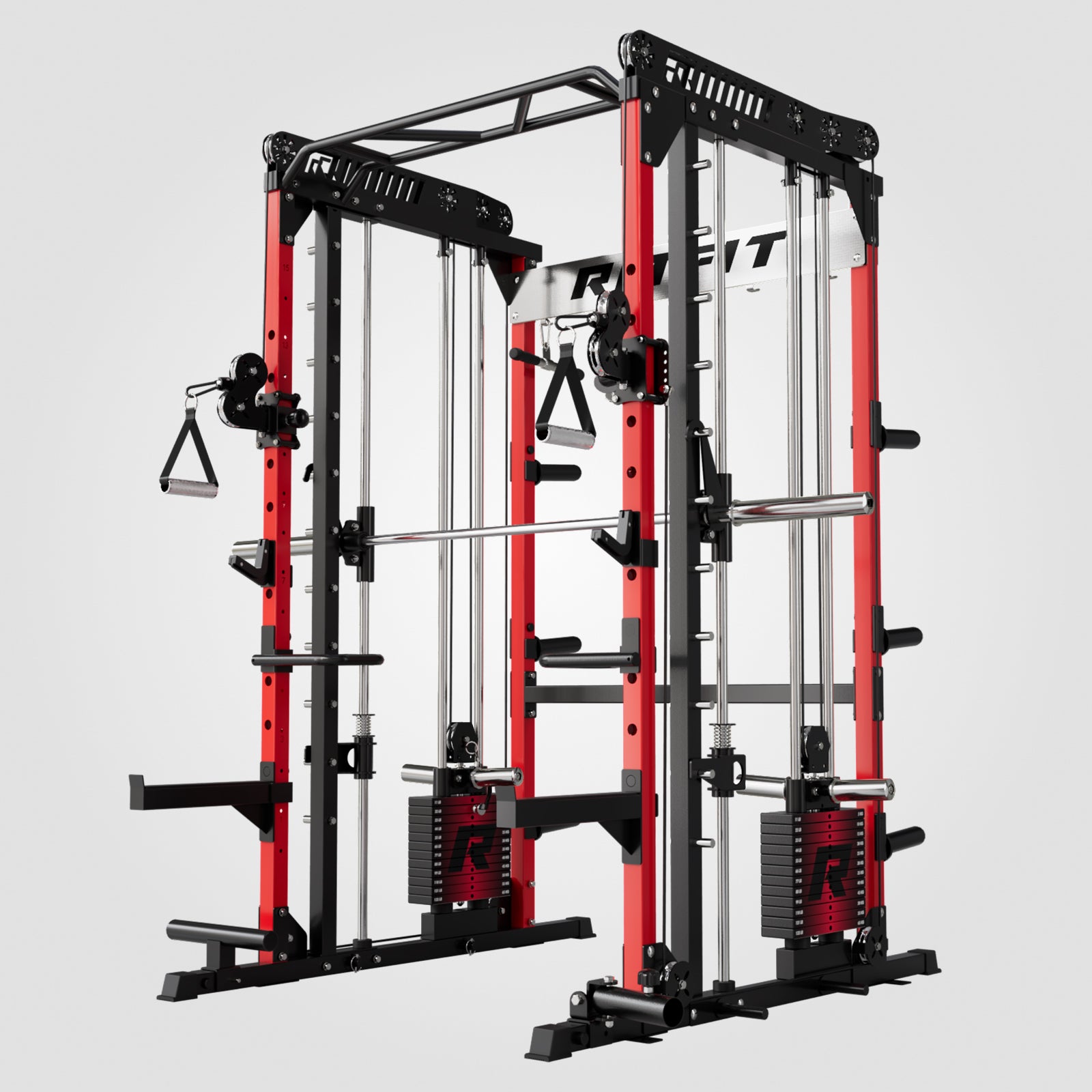
A rack-integrated cable pulley attachment mounts onto an existing power rack's uprights, combining barbell and cable training in one footprint. The RitFit M3 power rack with cable crossover integrates a full cable system into a single multi-function unit.
The RitFit M1 all-in-one home gym combines Smith machine, cable, and squat rack in one structure for a complete training solution.
Plate-Loaded vs Weight Stack Pulley
Plate-loaded cable machines cost less upfront and allow unlimited top resistance limited only by your plate supply, while weight stack machines offer faster resistance changes via a pin and produce less noise. One home gym guide notes that weight stacks suit most home gyms for convenience, while plate-loaded systems suit those chasing maximum load on a tighter initial budget.
| Type | Floor Footprint | Min Ceiling | Best For |
|---|---|---|---|
| Single Pulley | Minimal (rack/wall mount) | 7 ft | Budget entry, lat pulldowns, tricep work |
| Functional Trainer (Dual Adjustable) | ~5x5 ft | 7.5 ft | Most home gyms, maximum variety |
| Wall-Mounted Station | Almost none | 8 ft | Small rooms, apartments |
| Rack Integrated | Same as rack | 7.5 ft | Existing rack owners, one footprint |
| Cable Crossover | 9-12 ft wide span | 8 ft | Large garages, commercial-style setups |
Space minimums based on industry installation guidelines; always measure floor-to-ceiling height including any beams or ductwork before purchasing.
How Do You Choose the Right Cable Pulley System?
Choosing the right cable pulley system comes down to four decision factors: ceiling height and floor space, pulley ratio, weight capacity, and whether you want a weight stack or plate-loaded design.
Ceiling Height and Floor Space Requirements
Ceiling height is the single most common buying mistake for cable systems, because many buyers discover too late that their ceiling is too low for the machine they ordered. Always measure from floor to the lowest point in the room, including beams, pipes, and ductwork, before shopping.
According to one home gym buying guide, a lat pulldown tower requires at least 7 ft, a functional trainer needs 7.5 ft or more, and a full cable crossover requires 8 ft minimum. For floor space, a functional trainer fits in a 5x5 ft zone while a cable crossover needs a 9-12 ft wide corridor.
For home gyms with limited space, also consider basement gym equipment essentials and garage gym equipment packages that address ceiling and floor planning directly.
Pulley Ratio: What Is the Difference Between 1:1 and 2:1?
Pulley ratio determines how the weight you load relates to the resistance you feel during an exercise. A 1:1 ratio means 20 lb on the stack equals 20 lb of pull force at the handle, while a 2:1 ratio makes that 20 lb feel like 10 lb but doubles cable travel distance.
As one equipment guide explains, a 2:1 ratio is common on functional trainers for smoother overhead movements, while dedicated lat pulldown machines typically run 1:1 for precise load matching.
Weight Capacity and Safety Specs
Weight capacity ratings and hardware specifications determine whether a cable system is safe under real training loads. Three specs deserve close attention before buying.
- Cable working load limit (WLL): One installation guide notes that vinyl-coated cables carry around 350 lb WLL. Choose hardware with at least a 3:1 safety factor relative to the heaviest set you plan to do.
- Sealed bearings: Pulleys with sealed or no-gap bearings produce smooth, low-friction rotation and minimal noise. Hardware-store pulleys without bearings are louder and produce rougher movement under load.
- Anchor point rating: The mounting point must be through-bolted into a structural beam, ceiling joist, or wall stud, not just drywall. Dynamic loads during exercise exceed static weight, so the anchor must be rated for the movement forces involved.
- Cable condition: Inspect the full cable length for kinks, fraying, or worn coating at the pulley contact points. Damaged cables should be replaced immediately regardless of remaining length.
How Do You Set Up a Cable Pulley System Safely?
Setting up a cable pulley system safely requires choosing a structurally sound anchor, matching cable and hardware specs to your working loads, and testing progressively before full-load training.
Anchor Point Selection and Installation
The anchor point is the most critical element of any cable pulley installation, and using drywall anchors or a ceiling without a structural beam is the most dangerous common mistake. Locate a load-bearing ceiling joist, wall stud, or purpose-built structural bracket, then use through-bolts.
- Ceiling joist anchor: Drill through the joist and use a carriage bolt with large washers on both sides to distribute load across the wood grain.
- Wall stud anchor: Use lag bolts into studs for wall-mounted systems, with a bracket rated for dynamic rather than just static loads.
- Rack-mounted: Follow the manufacturer's torque specifications for all bolts when attaching a cable pulley to an existing power rack's uprights.
- Clearance check: Leave at least 12 inches of overhead clearance between the top of the pulley assembly and the ceiling to allow the cable to travel freely without contact.
Cable and Hardware Specs
Cable type and pulley hardware must match your working load before installation, not after. One installation guide notes that vinyl-coated cables carry around 350 lb WLL, while paracord-style cables approach 550 lb but introduce some elasticity at high loads.
- 1/8 inch vinyl-coated wire rope: Classic and durable, rated around 350 lb WLL, resistant to kinking with normal use.
- Sealed bearing pulleys: Provide smooth, low-noise rotation compared to plain bushing hardware-store pulleys. Verify the bearing gap is compatible with your cable diameter to prevent snagging.
- Carabiners and shackles: Must be rated for the load. Use locking carabiners to prevent accidental gate opening under tension.
Common Setup Mistakes to Avoid
Most cable pulley setup failures trace back to a small set of avoidable errors that are easy to prevent with a quick pre-installation checklist.
- Anchoring into drywall only: Drywall cannot hold dynamic load. Always locate the structural element behind it before drilling.
- Mismatching cable diameter to pulley groove: A cable that is too thin for the pulley groove can jump the wheel under load, creating a snap risk.
- Skipping the progressive load test: Start with the lightest weight and increase gradually to check for cable sway, anchor movement, or unusual noise before training at full load.
- Ignoring fraying at pulley contact points: The pulley groove is where cables wear fastest. Inspect the cable at the bend point weekly, especially in the first month of use.
- Incorrect ceiling height for planned exercises: Measure ceiling clearance with your full overhead reach plus 6 inches before mounting. An insufficient ceiling height limits the exercise range and can force cable contact with the structure under load.
What Exercises and Attachments Can You Use with a Cable Pulley System?
A cable pulley system can train every major muscle group by adjusting the pulley height, attachment type, and body position relative to the anchor, making it one of the most exercise-versatile pieces of equipment in a home gym.
Must-Have Cable Attachments
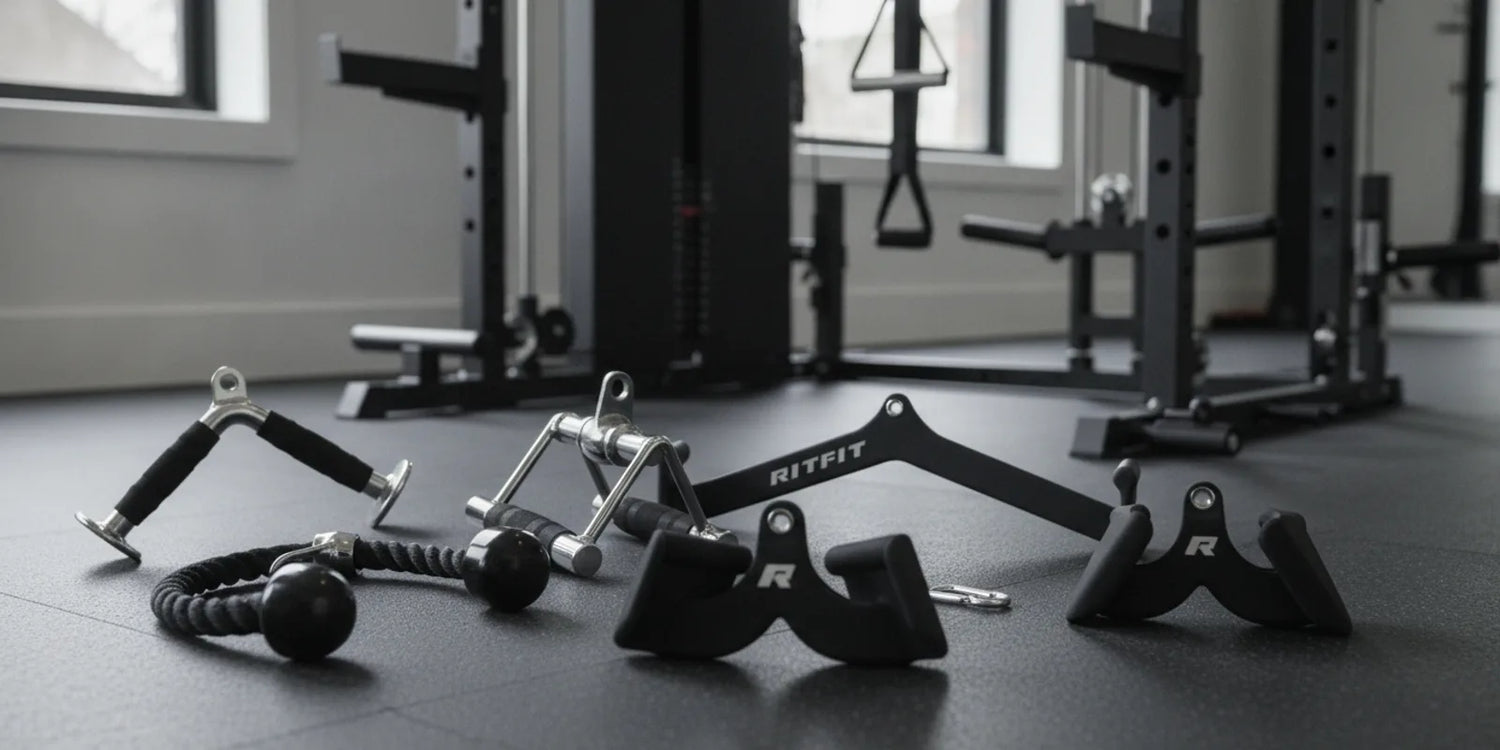
The right attachments expand a single cable station into a multi-muscle training tool. The following attachments cover the majority of cable exercises most home gym users will ever need.
- Single-grip handles: Allow unilateral training and neutral, pronated, or supinated grip positions. The RitFit cable machine exercise handles are designed for secure grip across all cable exercises.
- Straight bar: Used for lat pulldowns, tricep pushdowns, and cable rows. Browse the full range of cable machine handles and attachments for compatibility with your system.
- Lat pulldown bar: A wider, curved bar for lat pulldowns and seated cable rows. The lat pulldown bar attachments from RitFit are compatible with standard cable machines.
- Rope attachment: Ideal for tricep pushdowns, face pulls, and hammer curls. Allows a neutral grip and a wider end-range split for increased muscle activation.
- Ankle strap: Enables leg exercises like cable kickbacks, hip abduction, and standing leg curls from a low pulley.
- D-handle: A single rotating handle for chest flyes, cable curls, and rotational core movements from any pulley height.
The RitFit cable machine attachments bundle covers the core attachment types needed for a full-body cable training program.
Top Exercises by Muscle Group
Cable pulley exercises cover the full body by changing the pulley height and attachment, with each height targeting a different set of muscles and movement patterns.
- Back (high pulley): Lat pulldowns, straight-arm pulldowns, and seated rows target the latissimus dorsi and rhomboids through a long pulling arc.
- Chest (mid pulley): Cable chest flyes and cable presses deliver constant tension across the pectorals in both the stretch and contracted positions.
- Shoulders (high or mid pulley): Face pulls, lateral raises, and front raises train the rear deltoids and rotator cuff with controllable resistance throughout the range.
- Biceps (low or mid pulley): Cable curls with a straight bar or rope keep the biceps under tension at the top of the curl, unlike free weights that unload at peak contraction. One study found that maintaining a 90-degree angle between the forearm and pulley cable with slight muscle stretch produced the highest elbow flexor muscle activation during pulley exercises.[2]
- Triceps (high pulley): Tricep pushdowns and overhead tricep extensions from a high cable keep the long head of the tricep under load throughout its range.
- Glutes and posterior chain (low pulley): Cable pull-throughs keep the glutes active while reducing lower back demand. One study found that a cable pull-through significantly decreased lumbar erector and hamstring activation compared to an RDL,[3] making it a practical option for users managing lower back sensitivity.
- Core (any height): Woodchoppers, cable crunches, and Pallof presses train rotational and anti-rotational core stability with consistent resistance through the full movement arc.
The following video demonstrates 10 cable pulley system exercises that cover back, triceps, biceps, chest, and core from a home gym setup:
"It starts with setting up the right height. That asks the question of what are you actually trying to train. What part of your chest? Because depending upon how high you set this, you could train different areas."
Jeff Cavaliere, MSPT, CSCS, Physical Therapist and Strength Coach, Athlean-X
How Do You Maintain and Inspect Your Cable Pulley System?
Regular maintenance of a cable pulley system prevents equipment failure, extends hardware life, and keeps workouts safe, making a weekly 5-minute inspection one of the highest-value habits in any home gym routine.
- Cable inspection (weekly): Run your hand along the full cable length to check for kinks, fraying, cuts, or areas where the vinyl coating has worn through to bare wire. Replace the cable immediately if any damage is found.
- Pulley bearing check (monthly): Spin the pulley wheel by hand to confirm it rotates freely and quietly. Grinding, resistance, or lateral wobble indicates a worn bearing that should be replaced before the next session.
- Anchor hardware check (monthly): Inspect all bolts, carabiners, shackles, and structural fasteners for signs of corrosion, deformation, or loosening. Re-torque any fasteners that have shifted from spec.
- Cable lubrication (every 3 months): Apply a light coat of dry lubricant or cable conditioner to the full length of vinyl-coated cable to reduce friction at the pulley groove and slow coating wear.
- Weight stack or loading pin (weekly): Check that the selector pin seats fully and the stack travels smoothly with no lateral movement that could cause cable misalignment on the pulley.
- Know when to stop: Any unusual sound (popping, grinding, metal-on-metal contact), visible cable fraying, or anchor movement under load are hard stop conditions. Do not continue the session until the issue has been identified and resolved.
For those building a complete training space, the minimum home gym equipment list can help prioritize purchases for different budgets and space constraints.
FAQs About Cable Pulleys for Gym Equipment
What is the difference between a 1:1 and 2:1 cable pulley ratio?
A 1:1 ratio means the weight you load equals the resistance you feel. A 2:1 ratio halves felt resistance, so 20 lb on the stack feels like 10 lb of pull, but the cable travels twice as far. Most functional trainers use a 2:1 ratio for smoother movements, while dedicated lat pulldown machines run 1:1 for precise load matching.
How much ceiling height do you need for a cable pulley system?
Minimum ceiling height depends on the system type. A lat pulldown tower requires at least 7 feet, a functional trainer needs 7.5 feet or more, and full cable crossover machines require 8 feet minimum for overhead movements. Always measure from floor to the lowest obstruction, including beams and ducts, before buying.
Can you add a cable pulley system to an existing power rack?
Yes. Rack-mounted cable pulley attachments bolt directly onto most standard power racks and are one of the most cost-effective ways to add cable training. They typically include a lat pulldown and a low row pulley, giving you barbell and cable training from one footprint. Confirm the attachment fits your rack upright dimensions before purchasing.
What safety specs should I check before buying a cable pulley system?
Check three things: the cable working load limit (vinyl-coated cables carry around 350 lb WLL, so choose hardware with at least a 3:1 safety factor), sealed bearing pulleys for smooth rotation, and an anchor point through-bolted into a structural beam or stud rated for dynamic loads. Inspect cables weekly for fraying or kinks.
What muscles can you train with a cable pulley system?
A cable pulley system lets you train virtually every major muscle group. High-pulley positions target the back, triceps, and rear deltoids. Mid-pulley settings work the chest and biceps. Low-pulley positions hit the back, glutes, hamstrings, and core. Adjustable-height systems offer the most exercise variety from a single unit, making them an efficient choice for full-body training.
What is the difference between a functional trainer and a cable crossover machine?
A functional trainer fits in roughly a 5x5 ft area, with independent weight stacks on each side for unilateral training. A cable crossover machine has two tall columns spaced 9-12 feet apart for exercises like flyes and crossovers. Functional trainers suit most home gyms, while cable crossovers better fit larger garages with the floor room to accommodate the wide span.
Conclusion
Cable pulleys for gym equipment deliver constant tension, multi-angle resistance, and full-body exercise variety that free weights alone cannot match. Choosing the right system starts with measuring your ceiling height and floor space, then selecting a type based on those dimensions and your budget.
Start by measuring your available space, then explore the best home gym equipment under $500 guide for budget planning, and browse RitFit cable products to find the system that fits your home gym from day one.
Disclaimer
The information in this article is intended for general educational purposes and does not constitute professional engineering, structural, or medical advice. Consult a qualified structural engineer or certified fitness professional before installing load-bearing gym equipment in your home.
Save on your next RitFit order
Tap the button to copy your code, then paste it at checkout.
References
1. Nunes JP, Jacinto JL, Ribeiro AS, et al. Placing Greater Torque at Shorter or Longer Muscle Lengths? Effects of Cable vs. Barbell Preacher Curl Training on Muscular Strength and Hypertrophy in Young Adults. Int J Environ Res Public Health. 2020;17(16). doi:10.3390/ijerph17165859
2. Kang T, Seo Y, Park J, Dong E, Seo B, Han D. The effects of elbow joint angle change on the elbow flexor muscle activation in pulley with weight exercise. J Phys Ther Sci. 2013;25(9):1133-6. doi:10.1589/jpts.25.1133
3. Dicus JR, Ellestad SH, Sheaffer JE, Weber CA, Novak NC, Holmstrup ME. A Comparison of Muscle Recruitment Across Three Straight-Legged, Hinge-Pattern Resistance Training Exercises. Int J Exerc Sci. 2023;16(4):12-22. doi:10.70252/ZAOJ6139