








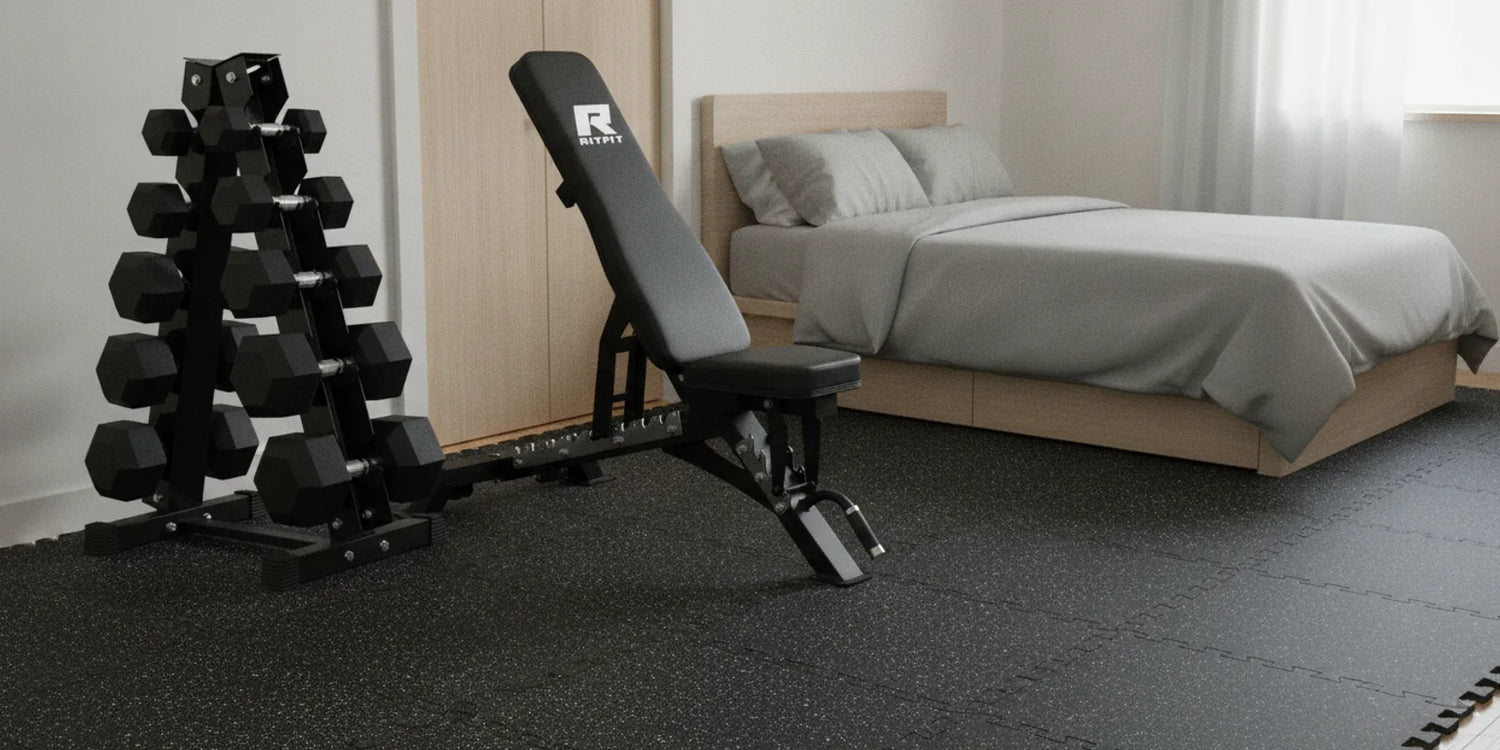
Converting a bedroom to a home gym is one of the most practical fitness upgrades you can make, but most guides skip the three problems that actually stop people: protecting your floors, managing noise for neighbors below, and fitting real equipment into a 10x12 space. A scoping review found that home-based physical activity programs are an effective strategy for reducing sedentary behavior and improving health in adults.[1]
This guide covers the measurement checklist, floor protection system, soundproofing, and compact equipment choices for urban apartment dwellers with a $1,000 to $2,500 budget.
Quick Answer: To convert a bedroom to a home gym, first verify at least 60 square feet of clear floor space and 8-foot ceiling height, then lay a three-layer floor protection system (plywood base plus 3/4-inch rubber horse stall mats), choose a compact 30-inch-depth power rack and adjustable dumbbells, and apply rubber dampening under all equipment feet to reduce neighbor noise.
Key Takeaways
- Space minimum: A 10x10 bedroom provides 100 square feet, enough for a compact power rack, barbell, and bench with safe walking clearance around all sides.
- Floor protection first: Lay 3/4-inch rubber horse stall mats over a plywood base before placing any equipment, protecting hardwood or carpet underneath from permanent damage.
- Soundproofing priority: Floor treatment and rubber rack feet eliminate most impact noise without drilling, making the bedroom gym renter-safe and neighbor-friendly.
- Equipment fit: A compact power rack with 30-inch depth (not the standard 40-inch competition cage) preserves the walk-around space a bedroom requires for safe lifting.
- Budget range: A functional bedroom gym costs $1,000 to $1,500 new, or $600 to $800 buying used equipment from local marketplaces, built over 4 to 5 weeks.
Is Your Bedroom Ready? Measurements and Floor Load Check
Before purchasing any equipment, a bedroom gym requires three confirmed minimums: at least 60 square feet of clear workout zone, a ceiling height of 8 feet or more, and a standard 30-inch door opening for equipment delivery.
What Are the Minimum Space Requirements?
The minimum viable bedroom gym needs a 60-square-foot clear zone for barbell work, with at least 8 feet of ceiling height for overhead pressing if you are under 6 feet 2 inches tall. Standard interior doors are 30 inches wide, which means a 4x6 horse stall mat will not fit through rolled and must be carried diagonally or cut in two pieces.
- Floor area: Measure length times width. Mark the clear workout zone separately from storage and walking paths.
- Ceiling height: Stand, hold a broomstick overhead, add 6 inches. That total is your minimum clearance for overhead press.
- Door width: 30 inches is standard. Confirm before ordering a power rack or mats larger than 4 feet wide.
- Window placement: Position the rack along a windowless wall to avoid accidental contact with glass during loaded movements.
For rooms smaller than 80 square feet, skip the full rack and use a squat stand or adjustable dumbbells instead. See the Best Home Gym Size Guide for detailed room-by-room planning.
Can a Bedroom Floor Hold the Weight of a Home Gym?
Most residential floors can handle a standard bedroom gym setup without modification, because the load distributes across a large surface area rather than concentrating in one spot. Industry guides note that residential floors are typically engineered for 40 to 50 pounds per square foot of live load, and a compact rack with barbell plus 300 pounds of plates spread across roughly 16 square feet stays well within that range for a 200-pound lifter.
- Avoid point loading: Never place a plate tree or rack with all the weight balanced on a single small foot without a mat underneath.
- Distribute with mats: A 4x6 rubber mat spreads rack leg loads across 24 square feet of floor, reducing any concentration risk.
- Second-floor caution: For older buildings or noticeable floor flex, consult a building professional before adding heavy equipment.
What Are the Deal-Breakers to Check Before Buying Anything?
Certain room conditions make a bedroom gym impractical or unsafe, and identifying them before purchase saves significant money and effort.
- Ceiling under 7 feet 6 inches: Rules out barbell overhead pressing and most pull-up bars without modification.
- Floor area under 60 square feet: A full rack does not fit safely with walking clearance, drop the rack and go dumbbell-only.
- Active lease restriction on floor modifications: Most standard leases allow freestanding equipment but may prohibit wall anchors or drilled floor mounts, check before drilling anything.
- Severe floor flex or bounce: Noticeable springiness when walking indicates a structural concern worth investigating before adding 500 or more pounds of equipment.
Step-by-Step Floor Protection and Soundproofing System
The most effective bedroom gym soundproofing system starts at the floor, not the walls, because impact noise travels through floor joists to neighbors below far more efficiently than airborne sound travels through walls.
How Do You Build the Three-Layer Floor Stack?
The three-layer floor stack combines plywood, rubber horse stall mat, and optional foam to block impact transmission at its source before it reaches the building structure.
- Layer 1, plywood base: A 3/4-inch CDX plywood sheet distributes the point loads of rack legs and plate trees across a wide surface, and decouples the rubber mat from the subfloor.
- Layer 2, horse stall mat: A 3/4-inch rubber horse stall mat (4 by 6 feet, around $60 to $75 each) goes on top. Two mats cover a 10x12 lifting zone. One soundproofing guide reported that the full plywood plus rubber stack brings iron plate drop noise from 95-105 dB on bare concrete down to 60-65 dB, near the level of normal conversation.
- Layer 3, optional foam tile: Interlocking foam tiles on top improve aesthetics and add slight decoupling, but skip this layer if you lift heavy, as foam compresses under barbell load within months and stops absorbing impact.
- Hardwood protection note: On hardwood floors, place thin plastic sheeting or a felt rug pad under the plywood first. Rubber directly on expensive hardwood for extended periods can cause off-gassing stains on the finish.
For renters: the plywood base prevents permanent impressions in carpet when you move out, keeping the security deposit intact. Review options in the full guide to home gym flooring for material comparisons.
How Do You Dampen Equipment Noise Without Drilling?
Equipment dampening addresses the second major noise source, the vibration that transfers from rack frames and weight plates through the floor even after the floor stack is in place.
- Rubber feet under every rack leg: Rubber pads ($5 to $15 per pack) or felt furniture pads placed under each rack foot eliminate creak transmission through the floor joists.
- Bumper plates vs. iron plates: Rubber bumper plates absorb impact when set down, while iron plates on a good floor stack with controlled descent keep noise low. For any floor above neighbors, avoid dropping plates entirely and use a deliberate 2 to 3 second eccentric (lowering) on every rep.
- Dampening cubes for deadlifts: Rubber dampening cubes placed under the plates during deadlifts absorb the set-down impact and work well with iron plates when you use controlled eccentrics.
- Cardio equipment: Treadmills generate both motor noise and footstrike impact that is difficult to mitigate in a bedroom. A magnetic rower or spin bike is virtually silent and fits in far less floor space.
Is Wall Treatment Worth It for a Bedroom Gym?
Wall and ceiling acoustic treatment addresses airborne noise (clanging plates, music) rather than structural impact noise, and is the lowest-priority layer in a bedroom gym soundproofing plan.
- Acoustic foam panels: A 12-pack runs $40 to $80 and absorbs mid and high frequency airborne sound. Mount on the wall closest to your barbell.
- Carpet remnants on walls: A piece of thick carpet tacked to a shared wall absorbs airborne sound at zero cost if you have leftover material.
- Skip ceiling treatment: Noise does not travel upward from a gym in meaningful amounts. Ceiling acoustic panels in a bedroom gym are a waste of budget.
- Train during reasonable hours: No floor stack replaces good-neighbor timing. Keep sessions between 7 AM and 9 PM in shared buildings.
Choosing Compact Equipment for a Bedroom Gym ($1,000 to $2,500)
The best bedroom gym equipment shares two qualities: a small footprint and a high function-to-space ratio, meaning each piece covers multiple training patterns rather than serving a single exercise.
What Is the Best Anchor Piece for a Bedroom Gym?
A compact power rack in the 30-inch depth range (not the standard 40-inch competition cage) is the single highest-impact purchase for a bedroom gym, providing safe barbell squats, bench press, and overhead press in under 16 square feet of floor space. Fitness guides recommend racks in the 30-inch depth range to preserve walk-around clearance in rooms under 144 square feet.
- Compact power rack: Look for a 30 to 32-inch depth model. This is the foundation for squat, bench, deadlift, and press.
- Folding wall rack: Mounts flush to the wall and folds out for training, collapsing to 8 inches of depth when stored. The best option for dual-use guest rooms or bedrooms under 100 square feet.
- Squat stands: Freestanding, movable, and require zero floor space when stored. Suitable for rooms between 60 and 80 square feet, but provide less safety than a racked unit for heavy squats.
Browse the full RitFit M1 Multi-Functional Home Gym for an all-in-one compact solution that combines a smith machine, cable, and rack functions in one frame footprint. The RitFit Home Gym Package includes everything needed to start training from day one.
What Bench, Barbell, and Plates Work Best in a Small Space?
An adjustable folding bench, a standard 7-foot Olympic barbell, and a 300-pound iron plate set cover the core compound lifts without wasting floor space during storage.
- Folding adjustable bench: A bench that folds flat stores upright against a wall or under a bed, recovering 6 to 8 square feet of workout floor between sessions.
- 7-foot Olympic barbell: Standard barbell length fits inside a compact rack. Do not purchase a shorter barbell, as it will not seat properly on standard-width rack hooks.
- Iron plates vs. bumper plates: Iron plates are cheaper, thinner (more weight per inch of bar), and quiet with controlled descent. Bumper plates take up more bar space, cost more, and are only worth the premium if you drop weights from overhead during Olympic movements.
How Do Adjustable Dumbbells and Cable Alternatives Save Space?
Adjustable dumbbells replace an entire wall of fixed-weight racks in under 2 square feet of floor space, making them the most space-efficient strength tool in a bedroom gym. See options in the best dumbbell sets for home gym guide for range and mechanism comparisons.
- Adjustable dumbbell range: A set covering 5 to 90 pounds handles isolation work, accessory movements, and conditioning drills that the barbell setup cannot replicate as efficiently.
- Compact cable alternative: A plate-loaded cable tower or resistance band anchor system covers cable fly, tricep pushdown, and face pull patterns without the large footprint of a standard cable machine.
- Doorframe pull-up bar: Leverage-mount bars (not friction-tension bars that damage door paint) install and remove in seconds and require zero floor space.
What Equipment Does Not Belong in a Bedroom Gym?
Certain machines waste floor space, generate neighbor-complaint-level noise, or simply cannot fit through a standard bedroom door.
- Treadmills: Motor vibration plus footstrike impact is the most common noise complaint source in apartment gyms. A walking pad on a rubber mat is the quieter alternative.
- Air bikes: Fan noise at high intensity rivals a vacuum cleaner in volume. Magnetic spin bikes are silent and take up the same footprint.
- Large multi-station cable machines: Most standard cable machine footprints exceed 50 square feet, consuming more than half a 10x10 room. Plate-loaded or band-based cable alternatives accomplish the same movements in a fraction of the space.
"Working out at home is legit if you bring the right mindset, plan, and intensity, and you do not need a ton of gear. A few basic pieces like resistance bands, dumbbells, or a pull-up bar can help you get a killer workout."
Jeff Cavaliere, MSPT, CSCS, Physical Therapist and Strength Coach, Athlean-X
How Do You Lay Out a Bedroom Gym Based on Room Size?
The most effective bedroom gym layouts anchor the largest piece of equipment against the longest wall and keep the center of the room open as the movement zone for deadlifts, floor work, and conditioning drills.
How Should You Divide the Available Space?
Room size determines whether you can create one training zone or two separate zones for strength and conditioning.
- 10x10 room (100 sq ft): One-zone layout. Position the compact rack against the back wall. The adjustable bench slides inside or alongside the rack when not in use. Adjustable dumbbells on a small corner stand. Active lifting zone is 8x8 feet in the center.
- 10x12 room (120 sq ft): Two-zone layout. Rack and bench form the strength zone against one wall. A 6x8 foot mat area along the opposite wall serves as the conditioning zone for band work, stretching, and floor exercises.
- 12x12 room (144 sq ft): Three-zone layout. Strength zone, conditioning zone, and a compact cardio option (magnetic rower or spin bike) along the third wall without competing for lifting space.
Visit home gym ideas for visual layout examples across different room configurations.
What Storage Solutions Keep a Bedroom Gym Functional?
Plates and dumbbells left on the floor are the single most common reason bedroom gyms feel cramped and unusable within weeks of setup.
- Plate tree: Holds 300 pounds of plates in 2 square feet of floor space. Non-negotiable for any barbell setup.
- Wall-mounted bar rack: Stores barbells vertically against the wall, taking zero floor footprint.
- Pegboard: A 2x4-foot pegboard panel holds resistance bands, straps, accessories, and chalk in one organized wall area.
- Closet strategy: Dedicate one section of the bedroom closet to organized equipment storage. Install hooks for bands, a shelf for foam rollers, and a small rack for light plates.
- Rolling tool cart: Stores dumbbells and kettlebells on wheels, rolls into the closet between training sessions to open up floor space.
What Does a Complete Bedroom Gym Cost at Each Budget Level?
A research study found that structured home-based resistance training is an effective and safe way for adults to maintain functional strength without a commercial gym membership.[2] The investment to get there ranges from $1,000 for a fully functional setup to $2,500 for a comprehensive barbell gym.
| Budget | Core Equipment | What You Can Train |
|---|---|---|
| $1,000 | Adjustable dumbbells (5-90 lb), folding bench, pull-up station, rubber tile flooring, resistance bands, pegboard storage | Full upper and lower body dumbbell training, pull movements, conditioning |
| $1,500 | $1,000 items plus compact power rack, Olympic barbell, 200 lb plate set | All major barbell lifts: squat, bench, deadlift, overhead press, row |
| $2,500 | $1,500 items plus upgraded plates to 300 lb, bumper plate set, magnetic rower or spin bike, wall-mounted storage system, lighting upgrade | Full strength and conditioning program, Olympic-style movements, quiet cardio |
Prices reflect new equipment; buying used from local marketplaces cuts total cost by 30 to 50 percent. Racks, plates, and bars lose no performance with age.
- $1,000 build priority order: Adjustable dumbbells first (the anchor piece), folding bench second, pull-up station third, flooring fourth. Buy in this order and you can start training after the first item arrives.
- $1,500 addition: A compact power rack is the single purchase that most expands training capability. The rack enables loaded squats, heavy bench press, and barbell rows that adjustable dumbbells cannot replicate at higher weights.
- $2,500 completion: The full plate set and a silent cardio option complete the gap between a home gym and a commercial gym experience for most training goals.
- Used gear strategy: A rack, plates, and barbell sold used on local marketplace apps are the highest-value used purchases, since they have no electronic components to fail and show wear only cosmetically.
Browse the complete Home Gym Guide or explore the full home gym equipment collection to see all available configurations.
What Are the Most Common Mistakes When Converting a Bedroom to a Home Gym?
Most bedroom gym failures trace to the same handful of setup errors that feel minor initially but compound into unusable spaces or costly repairs over time. A review on habit formation found that consistent physical activity routines depend more on stable environment setup than on motivation alone.[3]
- Buying equipment before measuring: The single most expensive mistake. Confirm ceiling height, floor area, and door width before ordering anything. A rack that does not fit through the door is an unboxing problem with a difficult return.
- Skipping the plywood base: Rubber mats alone on a wood floor still transmit vibration through the joists. The plywood-plus-rubber sandwich is what decouples the impact from the structure. Skipping it means your neighbor notices every deadlift.
- Using foam interlocking tiles for barbell work: Foam tiles feel cushioned when installed but compress permanently under rack legs and heavy plates within weeks. Use 3/4-inch rubber horse stall mats for any barbell or rack load.
- Leaving plates and dumbbells on the floor: Unorganized equipment kills usable floor space faster than any other factor. A plate tree and pegboard installed on day one prevent the slow drift toward a storage room that doubles as a gym.
- Overbuilding for the space: A 10x10 room cannot safely house a 40-inch-depth competition power rack, a treadmill, and a cable machine. Prioritize multi-function pieces and resist adding equipment until you have trained the existing setup for 90 days.
- Soundproofing after the first complaint: Most apartment building noise issues escalate quickly once a neighbor has filed a complaint. Installing floor protection on day one costs the same as installing it after the complaint, but costs far less in neighbor goodwill and lease risk.
- Ignoring cardio noise: A treadmill added to an otherwise quiet gym creates more neighbor complaints than all the barbell work combined. Choose silent alternatives from the start.
Review the home gym building tips article for additional setup guidance, and see benefits of a home gym for the long-term case for home training over a gym membership.
FAQs About Converting a Bedroom to a Home Gym
Can I convert a 10x10 bedroom into a functional home gym?
Yes, a 10x10 bedroom provides 100 square feet, enough for a compact power rack, adjustable bench, and barbell setup with walking room on all sides. Clear at least 60 square feet of workout zone and verify 8-foot ceiling height before ordering any equipment.
What is the best flooring for a bedroom home gym?
3/4-inch rubber horse stall mats laid over a plywood base are the most effective option. Horse stall mats cost around $60 to $75 each, protect hardwood or carpet underneath, absorb impact noise from dropped weights, and hold up under heavy rack loads without compressing over time like foam puzzle tiles.
How do I soundproof a bedroom gym without drilling?
Prioritize floor treatment over walls: lay a plywood base topped with 3/4-inch rubber mats, place rubber pads under every rack leg, and use bumper plates or controlled slow eccentrics instead of dropping iron plates. This floor-first approach reduces most impact noise without any wall modifications or drilling.
How much weight can a bedroom floor hold for gym equipment?
Most residential floors support 40 to 50 pounds per square foot. A compact rack, barbell, and 300 pounds of plates spread across roughly 16 square feet stays within that limit, so avoid concentrating all weight in one spot and always use rubber mats to distribute the load.
What compact gym equipment is best for a bedroom?
Adjustable dumbbells, a folding adjustable bench, and a compact 30-inch-depth power rack cover the vast majority of strength training needs. For cardio, a magnetic rower or spin bike produces minimal noise, folds for storage, and avoids the treadmill impact noise that generates neighbor complaints in apartment buildings.
Do I need permission from my landlord to set up a bedroom gym?
Most leases do not prohibit freestanding gym equipment since it leaves no permanent marks, so you typically do not need permission for mats, racks, or benches. Drilling wall anchors or ceiling mounts generally requires landlord approval, so always check your lease first.
What is a realistic budget to convert a bedroom to a home gym?
A functional $1,000 build covers adjustable dumbbells, a folding bench, a pull-up station, and rubber tile flooring for everything you need to start training. A $1,500 to $2,500 budget adds a compact power rack and Olympic barbell for full barbell training, and buying used from local marketplaces cuts that cost by 30 to 50 percent.
Conclusion
Converting a bedroom to a home gym is a straightforward project when tackled in the right order: measure first, install floor protection before any equipment arrives, choose compact pieces sized for the room, and soundproof at the source rather than as an afterthought. Most bedrooms support a complete strength training setup on a $1,000 to $2,500 budget.
Start with the floor protection layer and one anchor piece, add equipment as training habits solidify, and read the best rowing machine for home gyms guide to find a quiet cardio option that fits your bedroom setup.
Disclaimer
This article provides general guidance on home gym setup, flooring, and equipment selection for informational purposes only and does not constitute structural engineering, building code, or professional contractor advice. Consult a qualified professional before making structural modifications to your floor, walls, or building, particularly in older buildings or rental properties with specific lease restrictions.
Save on your next RitFit order
Tap the button to copy your code, then paste it at checkout.
References
1. Javadivala Z, et al. Home-based physical activity strategies for healthy adults: A scoping review. J Educ Health Promot. 2025;14:424. doi:10.4103/jehp.jehp_814_24. PMCID: PMC12662578
2. De Maio M, Bratta C, Iannaccone A, et al. Home-Based Physical Activity as a Healthy Aging Booster before and during COVID-19 Outbreak. Int J Environ Res Public Health. 2022;19(7). doi:10.3390/ijerph19074317. PMCID: PMC8998434
3. Ma H, Wang A, Pei R, Piao M. Effects of habit formation interventions on physical activity habit strength: meta-analysis and meta-regression. Int J Behav Nutr Phys Act. 2023;20(1):109. doi:10.1186/s12966-023-01506-x. PMCID: PMC10498635





