








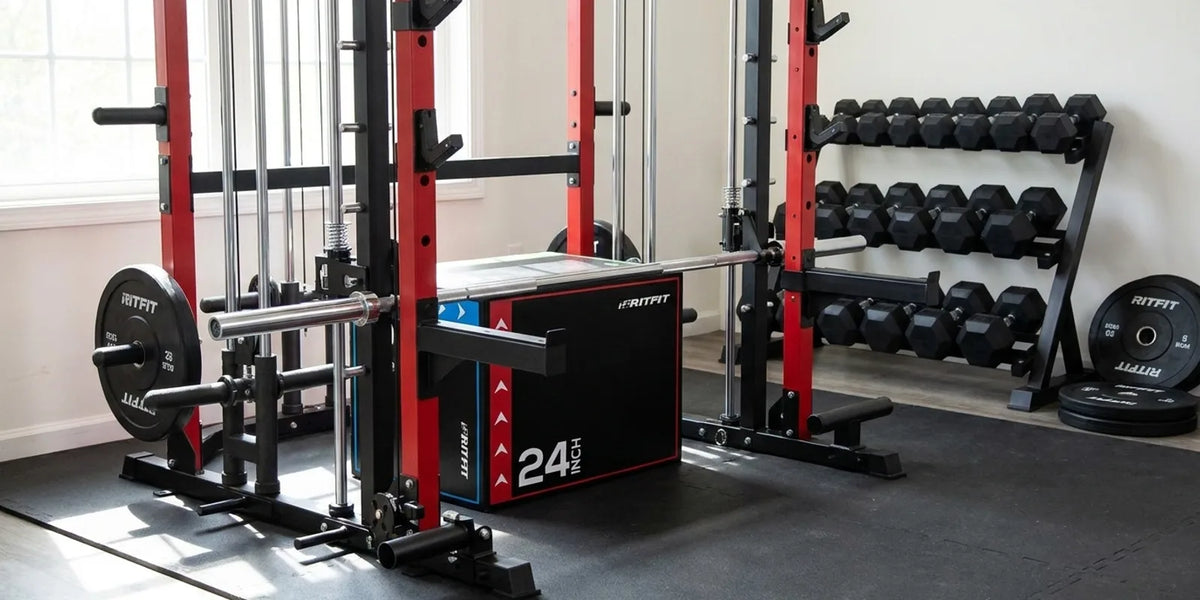
You can do a donkey calf raise on a Smith machine, and the setup is simpler than the name suggests. The guided bar holds the load across your lower back so you can hinge forward, keep the knees nearly straight, and press up onto the balls of your feet without a training partner.
This guide covers the exact bar height, block height, and foot position, explains why the bent-over stance trains the gastrocnemius differently, and separates the movement from the unrelated donkey kick.
Quick Answer: Donkey calf raises work on a Smith machine because the guided bar replaces the balance a donkey machine supplies. Set the padded bar around hip height, stand with the balls of your feet on a 2 to 4 inch block, keep the knees almost straight, and press up onto your toes to train the gastrocnemius in a lengthened position.
Key Takeaways
- Machine fit: A Smith machine can host a donkey calf raise because the guided bar supplies the back support and the balance that a dedicated donkey machine provides.
- Setup: Set the padded bar around hip height, stand on a 2 to 4 inch block, and keep the ball of each foot on the block edge so the heels can drop below the toes.
- Mechanics: Keeping the knees nearly straight holds the gastrocnemius in a lengthened position, and a 2023 comparison measured 12.4% versus 1.7% lateral gastrocnemius growth for the knee-extended and knee-flexed versions.
- Not a donkey kick: A donkey kick trains the glutes from a quadruped position, while a donkey calf raise trains the calves from a bent-over stance.
- Loading: Start light and add weight only after you can pause 2 seconds at the top and lower over 3 seconds on every rep.
- Progression: Two calf sessions per week of 3 to 5 sets of 10 to 15 reps is a practical starting point for most home lifters.
Can You Do Donkey Calf Raises on a Smith Machine?
Yes, a donkey calf raise fits a Smith machine because the guided bar carriage supports your torso and removes the balance demand the movement normally creates. Dedicated donkey calf raise machines are rare in home gyms, so the bar becomes the fixed point you lean into. The load still travels vertically, which is exactly how a calf raise moves.
Three details decide whether the setup feels secure or awkward.
- What the machine supplies: a fixed vertical path and a stable contact point, so your torso can hinge forward without tipping you off balance.
- What you supply: the hip hinge, the foot position on the block, and control of the tempo on every rep.
- What stays the same: the knees stay nearly straight, which keeps the gastrocnemius in a lengthened position instead of the shortened position a seated calf raise creates.
If you already train on a Smith machine at home, this is one more movement the frame covers without adding another machine to the room.
"I love Smith machine front squats. I do them with a medium stance and my toes pointed outward. By doing so, I'm really trying to focus on the outer sweep. I do these very deep, as deep as I can go. The Smith machine allows you to position yourself underneath and take the glutes and hips out of it and really focus on your quads without worrying about balancing."
Jay Cutler, Four-time Mr. Olympia, Cutler Nutrition, Jay Cutler Answers 10 Questions About His Quad Training
How to Set Up the Smith Machine for Donkey Calf Raises
The setup for a Smith machine donkey calf raise comes down to three choices: bar height, block height, and where your feet sit on the block. Each one changes how the bottom stretch feels, so dial them in before you add load.
Set the Bar Height for Your Hinge
Set the padded bar at roughly hip height while you stand tall, then hinge forward to check it. With your torso close to parallel with the floor, the bar should cross your lower back and sacrum, never your spine or ribs.
Pick a Block Height You Can Control
Use a stable block 2 to 4 inches tall, such as an adjustable plyo box, a 45 lb plate, or a low step. A taller block deepens the stretch at the bottom, but it also raises the demand on the ankle, so earn the extra height before you take it.
Stance, Grip, and Where Your Hands Go
Place the balls of your feet on the block edge with the heels hanging free, roughly hip-width apart and pointing straight ahead. An analysis of heel raises with three foot positions reported that foot placement changes how the ankle is loaded, so pick one stance and keep it consistent so your numbers mean something.[1]
- Hands: grip the Smith uprights or the frame with both hands and keep a slight bend in the elbows to stay braced.
- Torso: keep the spine long and let the hips do the hinging rather than rounding the lower back.
- Neck: look at a spot on the floor about 2 feet ahead so the head does not crane up.
How to Perform the Rep, Step by Step
Every rep of a Smith machine donkey calf raise follows the same four beats: hinge, settle, press, and lower under control. Rush any one of them and the calves stop doing the work.
- Step 1: Stand on the block with the balls of your feet on the edge, then hinge at the hips until your torso is close to parallel with the floor.
- Step 2: Rock the bar onto your lower back and settle the weight there before you move, keeping the knees just short of locked.
- Step 3: Lower the heels slowly until you feel a strong stretch through the calves, then drive up onto the balls of your feet.
- Step 4: Pause 2 seconds at the top with the ankles fully extended, then lower over 3 seconds and repeat.
Stop each set when the top pause shortens or the heels stop clearing the block, because that is where the useful reps end.
Why the Bent-Over Position Trains the Gastrocnemius Differently
The bent-over position keeps the knees nearly straight, and knee position decides how much of the calf work lands on the gastrocnemius. The gastrocnemius crosses the knee joint, so bending the knee slackens it while the soleus keeps working underneath.
A 2023 study compared standing, knee-extended calf raises with seated, knee-flexed calf raises in 14 untrained adults. Each leg trained at 70% of one-rep max for 10 reps, 5 sets, 2 sessions per week, for 12 weeks.[2]
The knee-extended leg grew far more at the gastrocnemius, with lateral gastrocnemius volume up 12.4% versus 1.7%, medial gastrocnemius up 9.2% versus 0.6%, and whole triceps surae up 5.6% versus 2.1%.
- What that means for the donkey position: the near-straight knee keeps the gastrocnemius long, which is the condition the study favored.
- Where the hip hinge fits: hinging over the block loads the calf through that long range without the balance demand of a standing raise.
- Why loading style matters: a 2020 review in Physiological Reports noted that a muscle's anatomy and physiology shape how it responds to different loading protocols.[3]
One honest limit applies here: the study tested knee angle, not the Smith machine, so treat the machine as a delivery tool rather than a proven training effect of its own.
Donkey Calf Raise vs Donkey Kick: Not the Same Exercise
A donkey calf raise and a donkey kick are two different exercises that share only a name. Mixing them up sends you into a glute movement when you wanted a calf movement, so the distinction is worth 30 seconds of attention.
| Detail | Donkey Calf Raise | Donkey Kick |
|---|---|---|
| Primary muscles | Calves, meaning the gastrocnemius and soleus | Glutes, with the hamstrings assisting |
| Starting position | Standing, hinged forward over a block | On all fours, hands and knees on the floor |
| Main joint action | Ankle plantarflexion, the toes press down | Hip extension, the leg drives backward and up |
| Load source | A bar across the lower back or bodyweight | Bodyweight, ankle weights, or a cable |
| Smith machine setup | Low bar, hinged torso, feet on a block | Bar on the floor for a knee or foot anchor, hips high |
Category comparison based on standard exercise descriptions, not on measured muscle activation data.
On a Smith machine the calf version needs a low bar and a block, while the kick version needs the bar out of the way so the hip can drive back freely.
How Much Weight, How Many Reps, and How Often Should You Train Calves
Weight on a Smith machine donkey calf raise should start light enough that you can pause at the top and still control the lower. Calves respond to the same progressive overload that builds other muscles, they just need a longer runway.
- Starting load: Begin with bodyweight or a lightly loaded bar, then add 5 to 10 lb at a time rather than jumping to a plate per side.
- Rep range: 10 to 15 reps per set keeps the gastrocnemius under tension long enough to matter without turning the set into an ankle endurance test.
- Sets and rest: Use 3 to 5 working sets with 60 to 90 seconds of rest so the calves recover enough to keep the full range of motion.
- Frequency: Two sessions per week suits calf training well, and the 2023 protocol that produced the biggest gastrocnemius gains also used two sessions weekly for 12 weeks.
- When to add weight: Move up once you complete every planned rep with a 2 second top pause and a 3 second lower on the final set.
- When to back off: If the top pause disappears two sessions in a row, drop the load by about 10% and rebuild the tempo before you add again.
Common Mistakes and When to Stop
The most common mistakes on a Smith machine donkey calf raise are over-bending the knees, choosing a block that is too tall, and letting the bar sit on the spine. Each one quietly removes the gastrocnemius from the exercise.
- Knees too bent: A deep knee bend turns the movement into a soleus raise and takes the gastrocnemius out of its lengthened position.
- Bar on the spine: The bar belongs across the sacrum and lower back, where it can be braced, never on the bony spine itself.
- Block too tall: Extra height without ankle control shortens the useful range and pushes the heel out of line with the foot.
- Half reps: If the heels never drop below the toes, you skip the lengthened position that makes the exercise worth doing.
- Loaded rounding: If your lower back rounds as the bar settles, the load is too heavy and the hinge is past your control.
- Stop signals: Sharp calf or Achilles pain, a sudden loss of ankle range, or numbness that persists after the set all mean stop and have the area checked rather than pushing through.
None of these signals are a training problem to solve with a smaller range. They are a reason to end the session and treat the calves like any other joint you want to keep training for years.
"Super nice machine, small foot print, big features!"
Brent B. Verified Buyer, RitFit PSR05 2.0 Multifunctional Smith Machine Power Rack with LAT-Pull Down System
Does the RitFit PSR05 2.0 Smith Machine Work for Donkey Calf Raises?
The RitFit PSR05 2.0 works for donkey calf raises because its bar carriage runs on a fixed path and the frame stays planted while you hinge over. RitFit lists the machine at 82 inches of total height including the pull-up bar, a 70.8 inch rack length, a 46.3 inch rack width, and a 14.91 sq ft soft footprint. The 353 lb pulley capacity belongs to the cable system, so it does not limit how much you can load the Smith bar itself.
- Bar height range: The carriage has enough hook positions to set the bar near hip height for a hinged torso, which is the range this movement needs.
- Room to hinge: The 14.91 sq ft soft footprint leaves space in front of the uprights for the block you stand on, which matters in a one-car garage bay.
- Frame stability: Owners describe the rack as sturdy and note that it can be bolted to the floor with the included hardware if you want extra insurance under load.
- Ceiling fit: At 82 inches of total height, the PSR05 suits rooms with 7 to 8 foot ceilings, the same constraint that rules out taller all-in-one frames.
Choose the RitFit PSR05 2.0 for Low-Ceiling Calf Training
Choose the RitFit PSR05 2.0 if ceiling height is your hard limit, because its 82 inch total height clears 7 foot rooms that larger frames cannot. Add the PSR05 home gym package if you still need a bench and plates, or pick the PSR05 2.0 in pink if you want the same frame in a different finish.
"The Smith machine has been amazing! I've been loving all the different ways to use it for the full total body workout experience. We also paired the multiple grip pull-down bar with it and it's been perfect!"
Danielle H. Verified Buyer, RitFit PSR05 2.0 Multifunctional Smith Machine Power Rack with LAT-Pull Down System
Donkey Calf Raise Alternatives Without a Smith Machine
Without a Smith machine you can still train the same lengthened-position calf work with a rack, a bench, a leg press, or a single dumbbell. The key is keeping the knees close to straight and letting the heels drop below the toes.
- Bench-supported donkey raise: Hinge over a flat bench and hold the edge for support, then raise the heels from a block with bodyweight only.
- Partner donkey raise: A training partner sits across your hips for load, which is the original gym version of the movement before machines existed.
- Barbell standing calf raise: Load a barbell in a rack, stand on the same block, and lock the knees so the gastrocnemius stays long through the rep.
- Leg press calf press: Press the platform with the balls of the feet and keep the knees nearly straight to bias the gastrocnemius over the soleus.
- Seated calf raise: The bent knee shortens the gastrocnemius and shifts work to the soleus, so treat it as a complement rather than a replacement.
- Single-leg dumbbell raise: Hold one dumbbell and raise the heel from a step to check for side-to-side calf strength differences.
Compare the bent-over version with the standing one in the Smith machine calf raise guide, which keeps both knees locked and loads the same muscles from a taller position.
If you are weighing a machine purchase, the RitFit M1 covers the same calf work in a larger frame, the Buffalo Wild Smith machine adds an adjustable dual cable system, and the RitFit M3 suits lifters who want heavier loading in a bigger station.
FAQs About Donkey Calf Raises on a Smith Machine
Can you do donkey calf raises on a Smith machine?
Yes. Set the Smith bar low across your lower back, hinge at the hips, and stand with the balls of your feet on a block. The fixed bar path replaces the balance a donkey calf raise machine normally provides, so the setup works on almost any Smith machine.
How high should the Smith machine bar be for donkey calf raises?
Set the padded bar at roughly hip height when you stand tall, then check it after you hinge over. With your torso near parallel to the floor, the bar should rest across your lower back and sacrum, not your spine or ribs.
What should you stand on for a Smith machine donkey calf raise?
Use a stable block two to four inches tall, such as a plyo box, a 45 pound plate, or a low step. Taller platforms add stretch but also ankle load, so start low and only raise the block once you control the bottom position.
Is a donkey calf raise the same as a donkey kick?
No. A donkey kick is a quadruped hip extension that trains the glutes, while a donkey calf raise is a bent over plantarflexion that trains the calves. The names sound similar, but the muscles, joints, and setups are completely different.
Why do donkey calf raises target the gastrocnemius?
Keeping the knees close to straight puts the gastrocnemius in a lengthened position, which is the position that grew the most in a 2023 training study. Hinging at the hips adds load without the balance demand of a standing calf raise.
When should you add weight to Smith machine donkey calf raises?
Add weight once you complete every planned rep with a two second pause at the top and a controlled three second lower. Calves adapt slowly, so progress in small increments and keep the same range of motion rather than shortening the rep.
Conclusion
Donkey calf raises belong in a Smith machine program because the guided bar gives you the back support and balance a dedicated machine would provide. Set the bar near hip height, stand on a 2 to 4 inch block, keep the knees nearly straight, and train two sessions a week with a 2 second pause at the top.
If you want more lower body work on the same frame, browse the Smith machine leg workouts and build the calf work into that plan.
Disclaimer
This article provides general fitness information and is not medical advice. Consult a qualified healthcare professional before starting a new training program, especially if you have a history of calf, Achilles, ankle, or lower back issues.
References
1. Arnsdorff K, Limbaugh K, Riemann BL. Analysis of Heel Raise Exercise with Three Foot Positions. Int J Exerc Sci. 2011;4(1):13-21. doi:10.70252/YPIC8188. PMCID: PMC4738962
2. Kinoshita M, Maeo S, Kobayashi Y, et al. Triceps surae muscle hypertrophy is greater after standing versus seated calf-raise training. Front Physiol. 2023;14:1272106. doi:10.3389/fphys.2023.1272106. PMCID: PMC10753835
3. Schoenfeld BJ, Vigotsky AD, Grgic J, et al. Do the anatomical and physiological properties of a muscle determine its adaptive response to different loading protocols?. Physiol Rep. 2020;8(9):e14427. doi:10.14814/phy2.14427. PMCID: PMC7186566





