








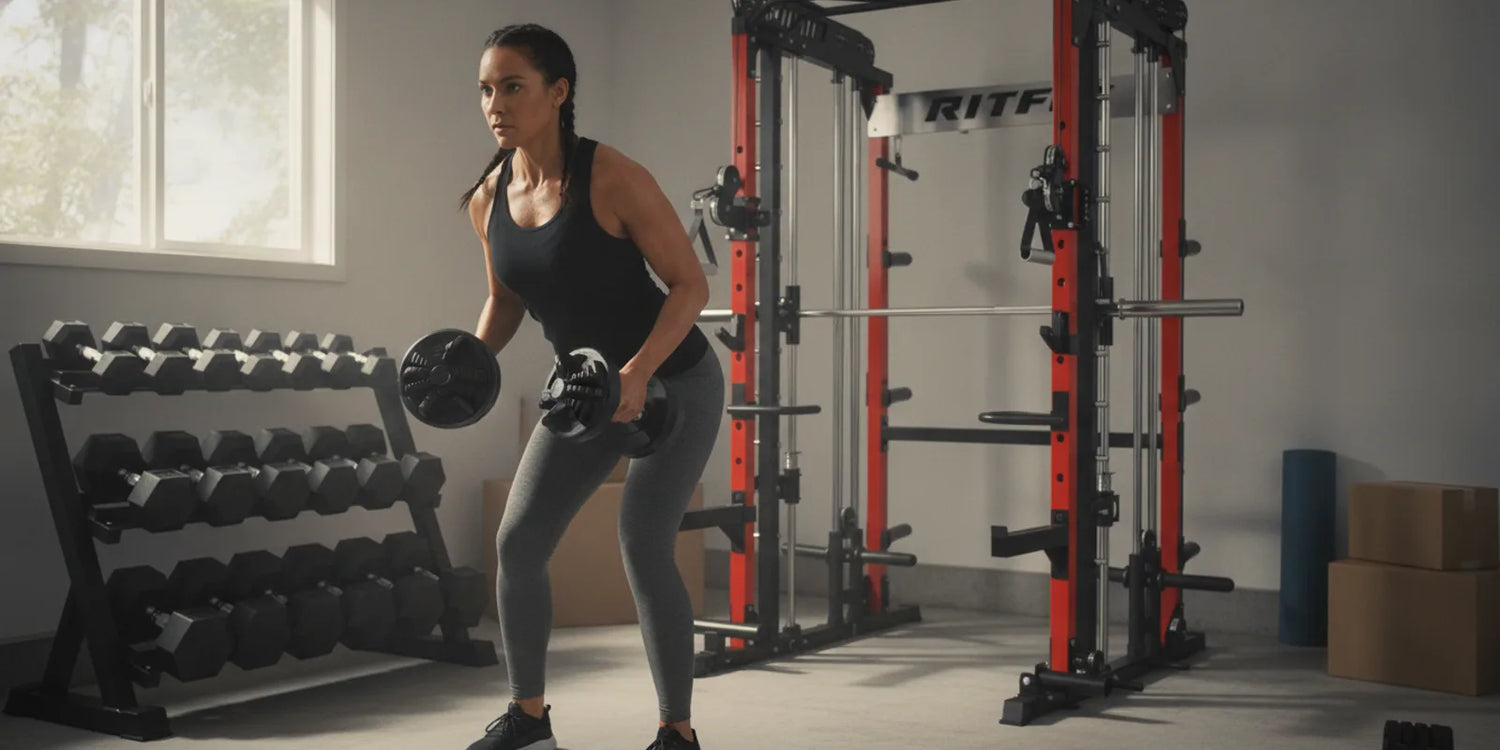
Dumbbell and machine exercise combinations for a home gym pair one stable guided lift with one free weight movement, giving you both safe heavy loading and balance work in a small footprint. This guide shows the exact pairings to use.
You will get region-by-region combinations, weight selection rules, a 3-day split, easy swaps, progression cues, and safety limits. It suits anyone running a compact Smith machine plus adjustable dumbbell setup at home.
Quick Answer
The best dumbbell and machine exercise combinations for a home gym pair a stable machine compound, such as a Smith machine squat or press, with a free weight finisher like a dumbbell flye or row. The machine loads the pattern heavy and safely, while dumbbells add range and stabilizer work the machine cannot.
Key Takeaways
- Pair, do not pick: A study found machine and free weight training give similar muscle growth, so combining them beats choosing one.
- Machine first, dumbbell second: Run the stable machine compound while fresh, then add the dumbbell movement as a finisher.
- Match the load to the goal: Strength gains are largely specific to the exact movement you train, so training both transfers wider.
- Start light, progress one side: Add weight only when every rep is clean, and change one side at a time.
- Compact is enough: One Smith machine plus adjustable dumbbells covers a full-body routine in a small space.
Why Pair Dumbbells and Machines in a Home Gym
Pairing dumbbells and machines lets a home gym cover more of what drives results than either tool alone. A study found machine and free weight training produce similar muscle growth, so the two complement each other within one program rather than competing.[1]
- Space efficiency: One guided machine plus a pair of adjustable dumbbells replaces a wall of single-purpose stations.
- Safety and intensity: Machines let you push close to failure without a spotter, while dumbbells build control.
- Skill friendly: Beginners can lean on the stable machine and add dumbbell work as coordination improves.
You do not have to abandon machines to train hard, and a balanced setup mixes both. Browse the strength machines collection to see what fits your room.
What Is the Core Pairing Principle
The core principle is simple, pair one stable machine compound with one free weight finisher. The machine handles balance so you can load the big pattern heavy, then the dumbbell adds the stabilizer demand and range the fixed path leaves out.[2]
- Machine role: Provides a guided path so you focus force on the target muscle and train near failure safely.
- Dumbbell role: Forces stabilizers to balance the load in space and allows a longer stretch.
- Why both transfer: Maximal strength gains are largely specific to the movement trained, so doing both broadens carryover.[1]
Order matters because the heaviest, most technical lift should come when you are freshest. Keep the dumbbell movement as the accessory that chases a deeper contraction afterward.
What Are the Best Combinations by Body Region
The best combinations pair a heavy machine compound with a dumbbell accessory for each region. Use the machine for the main lift, then the dumbbell movement to round out the muscle from a different angle.
Legs: Smith Machine Squat plus Dumbbell Romanian Deadlift
Start with the Smith machine squat for stable, heavy quad and glute loading, then hinge with dumbbells to hit the hamstrings and glutes through a long stretch.
Chest: Smith Machine Incline Press plus Dumbbell Flye
Press heavy on the guided bar path, then open the chest with controlled dumbbell flyes for the stretch and squeeze a fixed bar cannot give.
Back: Lat Pulldown or Cable Row plus Dumbbell Row
Build vertical and horizontal pulling volume on the machine, then add a single arm dumbbell row to even out side to side strength.
Shoulders: Smith Machine Overhead Press plus Dumbbell Lateral Raise
Press overhead on the stable bar for safe heavy loading, then isolate the side delts with light dumbbell lateral raises.
Arms: Cable Pushdown plus Dumbbell Curl
Keep constant tension on the triceps with the cable, then load the biceps directly with dumbbell curls you can progress in small steps.
Posterior Chain: Back Extension Machine plus Dumbbell Hip Hinge
Strengthen the lower back and glutes on the BE01 adjustable back extension machine, then reinforce the hinge pattern with light dumbbells.
Mix and match these six pairings to build any session. Pick the dumbbell side from a quality set, and our guide to the best dumbbell sets for a home gym can help.
How Do You Choose Starting Weights for Each Side
Choose a weight that lets you finish every rep with two clean reps still in reserve on both the machine and dumbbell sides. Research with novice lifters found both tools build strength and muscle, so beginners can start light on the machine and add dumbbells as control improves.[3]
- Machine compound: Aim for 8 to 12 reps where the last rep is firm but controlled, not grinding.
- Dumbbell finisher: Use a lighter load for 12 to 15 reps, focusing on a full range and a clear muscle contraction.
- Test before you commit: Do one easy warm up set, then judge the working weight from how the last two reps feel.
Pick a starting load you can clearly control, then build up over the following weeks. Adjustable dumbbells make small jumps easy without filling your floor with pairs.
What Does a 3-Day Full-Body Split Look Like
A practical home split runs three full-body sessions a week, each built from three to five machine plus dumbbell pairings. This frequency hits every muscle group multiple times while leaving rest days between sessions.
- Day 1: Smith machine squat plus dumbbell RDL, Smith incline press plus dumbbell flye, lat pulldown plus dumbbell row.
- Day 2: Smith overhead press plus dumbbell lateral raise, cable pushdown plus dumbbell curl, back extension plus dumbbell hinge.
- Day 3: Repeat Day 1 with a small load increase, or swap in the chest and back pairings you want to prioritize.
The video below shows how a compact home setup flows through a full-body session using both tools.
What Are Common Mistakes and Easy Swaps
The most common mistake is treating dumbbells and machines as rivals instead of partners, which leaves gaps in stability or loading. Easy swaps keep a session productive when a movement feels awkward or a body part stalls.
- Doing both heavy: Avoid maxing out both sides, keep the dumbbell movement as a controlled accessory.
- Awkward Smith squat: Swap to a goblet squat with a dumbbell if the fixed bar path strains your knees or hips.
- Shoulder pinch on press: Replace the Smith overhead press with a seated dumbbell press for a freer shoulder path.
- Limited grip on rows: Trade the heavy dumbbell row for a machine or cable row to keep the back working past grip fatigue.
Swaps are not failures, they keep stimulus on the target muscle. For pulling variety, see our overview of a rowing machine for home gyms.
When Should You Add Weight
Add weight when you can complete every prescribed rep with clean form and the last one or two reps still feel controlled rather than grinding. This keeps progress steady without sacrificing technique on either side of the pairing.
- Machine side: Move up by the smallest stack increment once you hit the top of your rep range with form intact.
- Dumbbell side: Step up to the next available pair only after the current load feels easy for all reps.
- One change at a time: Progress one side per session so you can tell which change your body is adapting to.
Small, consistent jumps beat big leaps that wreck form. Browse the broader strength training equipment range when you outgrow your current loads.
When Should You Stop for Safety
Stop a set immediately if you feel sharp joint pain, a pinch, or any movement that does not feel like normal muscle effort. Pain that is sudden or localized to a joint is a signal to rest, not to push through.
- Sharp or stabbing pain: End the set and switch to a pain-free swap, such as a machine version of the movement.
- Form breakdown: Rack the weight when your technique collapses, since most home injuries happen on sloppy final reps.
- Persistent ache: Take extra rest days if a joint stays sore for more than two days after training.
Training at home means you are your own spotter, so err on the safe side. The Smith machine catch hooks add a margin of safety on heavy presses and squats.
How Do You Build a Setup That Fits Together
Build the setup around one all-in-one machine plus a pair of adjustable dumbbells, since that combination covers squats, presses, rows, pulldowns, and free weight accessories in a small footprint. Add pieces only as your training demands grow.
| Brand | RitFit Sports |
|---|---|
| Featured Products | M1 multi-functional home gym Smith machine plus adjustable dumbbells |
| Key Specs | Smith bar with catch hooks, lat pulldown and cable attachments, 8 to 12 rep compounds, 12 to 15 rep finishers |
| Best For | Home lifters with limited space wanting full-body training |
| Skill Level | Beginner to intermediate |
- Start core: A guided Smith or home-gym machine handles the heavy compounds safely.
- Add free weights: Adjustable dumbbells supply the finishers and stabilizer work in one compact pair.
- Upgrade later: Step up to the M3 home gym Smith machine when you need more capacity.
A complete package removes the guesswork of matching parts. The RitFit M1 Smith machine home gym package bundles the machine pieces that pair well with dumbbells.
FAQs About Dumbbell and Machine Combinations
Should I use dumbbells or machines first in my home gym workout?
Start each session with the stable machine compound, such as a Smith machine squat or press, while you are fresh and can move the most weight safely. Follow it with the dumbbell movement as a finisher. This order lets you load the big pattern hard, then chase a deeper stretch and stabilizer work with the free weight afterward.
Can I build muscle combining dumbbells and machines at home?
Yes. Research comparing machine and free weight training found similar muscle growth between the two, so combining them in one program is an effective approach. Machines let you safely push close to failure and isolate a target, while dumbbells recruit stabilizers and allow a longer range of motion. Together they cover more of what drives growth than either alone.
How many machine and dumbbell exercises should one home workout have?
A practical full-body session has three to five paired movements, each combining one machine compound with one dumbbell accessory, which usually means six to ten total exercises. Keep the machine lift in the eight to twelve rep range and the dumbbell finisher a touch higher, around twelve to fifteen reps, to balance heavy loading with quality muscle work.
Do I need a Smith machine to combine dumbbells and machines?
No, but an all-in-one Smith or home-gym machine makes pairing easy because it covers squats, presses, rows and pulldowns in one footprint. If you only have a power rack and cables, you can still pair cable or pulldown movements with dumbbells. The principle is the same, a stable guided lift plus a free weight movement that demands balance.
When should I add weight to my machine and dumbbell exercises?
Add load when you can complete every prescribed rep with clean form and the last one or two reps still feel controlled rather than grinding. Progress the machine side in small stack increments and the dumbbells by the next available pair, increasing one side at a time so you can tell which change your body is adapting to and keep form intact.
Conclusion
The best dumbbell and machine exercise combinations for a home gym pair a stable machine compound with a free weight finisher, giving you safe heavy loading plus the balance and range only dumbbells provide. Run the machine lift first, keep the dumbbell move as a controlled accessory, and progress one side at a time.
Start with one guided machine and a set of adjustable dumbbells, then add capacity as you grow. Explore the Smith machine collection to anchor your setup.
Disclaimer
This article is for general educational purposes only and is not medical or professional training advice. Consult a qualified healthcare or fitness professional before starting any new exercise program, especially if you have an injury or health condition.
Save on your next RitFit order
Tap the button to copy your code, then paste it at checkout.
References
1. Haugen ME, Vårvik FT, Larsen S, et al. Effect of free-weight vs. machine-based strength training on maximal strength, hypertrophy and jump performance - a systematic review and meta-analysis. BMC Sports Sci Med Rehabil. 2023;15(1):103. doi:10.1186/s13102-023-00713-4 https://pmc.ncbi.nlm.nih.gov/articles/PMC10426227/
2. Saeterbakken AH, Olsen A, Behm DG, Bardstu HB, Andersen V. The short- and long-term effects of resistance training with different stability requirements. PLoS One. 2019;14(4):e0214302. doi:10.1371/journal.pone.0214302 https://pmc.ncbi.nlm.nih.gov/articles/PMC6443166/
3. Aerenhouts D, D'Hondt E. Using Machines or Free Weights for Resistance Training in Novice Males? A Randomized Parallel Trial. Int J Environ Res Public Health. 2020;17(21):7848. doi:10.3390/ijerph17217848 https://pmc.ncbi.nlm.nih.gov/articles/PMC7662789/





