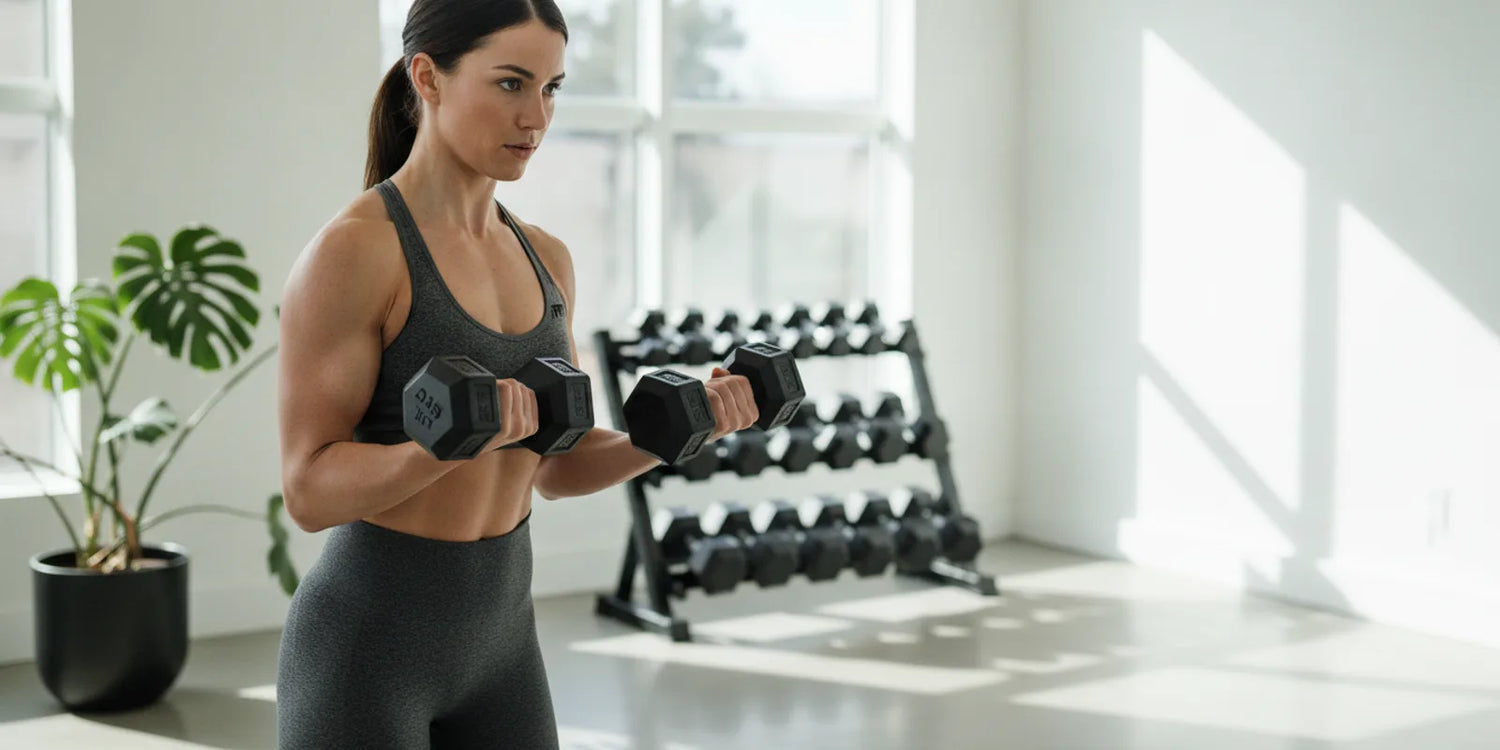
The best dumbbell set for home gym training is the one that fits your floor space, your current strength, and the weight range you will still need next year. A rack that is a few inches too deep for the wall, or a set that tops out after four months, costs you twice.
This guide covers the three set types and the rooms they suit, how to measure storage and clearance before you order, which weight range matches a beginner or a shared household, and which RitFit configuration fits your space and budget.
Quick Answer: The best dumbbell set for home gym use comes down to two numbers, storage depth and target weight. An apartment or shared living room favors an adjustable pair that stows in a shallow tray, while a dedicated corner supports a fixed rubber hex set on a 3-tier rack for faster weight changes.
Key Takeaways
- Your room picks the type: A multi-setting adjustable pair lives in a tray that slides under a bench, while a fixed 5-50 lb hex set on a 3-tier rack claims a wall section roughly 48 inches wide and 20 inches deep.
- Measure two zones, not one: Storage depth for the rack or tray, plus 4-6 feet of open floor in front for lunges, rows, and presses.
- A low ceiling is the costly mistake: Most beginners outgrow a 25 lb maximum on rows and goblet squats within the first year, so aim for a range that reaches at least 40-50 lb per hand.
- The tool shapes the strength: In a 2023 pooled analysis of 13 studies, strength measured in free-weight tests improved more after free-weight training than after machine training.
- Volume decides the result: An umbrella review of 44 systematic reviews found that weekly training volume in sets shaped muscle mass gains, so the set you actually use beats the set with the widest range.
Why Is a Dumbbell Set the Smartest First Investment for Your Home Gym?
A dumbbell set delivers more training variety per square foot than any other single purchase for a home gym, covering every major muscle group from one storage spot. A 2023 systematic review and network meta-analysis of 178 randomized trials found that every resistance training prescription beat no exercise, and that higher-load work ranked highest for strength gains.[1]
- Full-body coverage: One pair supports pressing, pulling, hinging, squatting, and isolation work, so you do not need a separate machine for each pattern.
- Each side works alone: Arms and legs load independently, which exposes side-to-side differences that a fixed barbell path hides.
- Tiny storage demand: A tray or a compact rack replaces the wall of equipment a cable stack or a plate-loaded machine would need.
- Progressive overload in small steps: Dumbbells let you add the smallest available increment, which matters most for shoulders, arms, and calves.
- No schedule to keep: Training at home removes the commute, the wait for a bench, and the monthly fee that ends most gym memberships.
- One purchase, several users: A single adjustable pair or a full rack spans the weights a beginner, a teenager, and a returning lifter each need.
In a tight room the type of set matters more than the total weight you buy, because a set that has to be moved before every session stops getting used. If you are still planning the room itself, start with the home gym guide.
"The RitFit dumbbells are phenomenal quality! Adding them to my home gym has made all the difference!"
Letha C. Verified Buyer, RitFit PVC-Coated Round Dumbbells Set with Rack
Adjustable, Fixed Hex, or Spin-Lock: Which Set Fits a Small Space?
Space, not budget, is what separates the three set types. A fixed hex set on a rack gives the fastest weight changes but claims a wall section, an adjustable pair folds a whole rack of weights into one tray, and a spin-lock set costs the least but slows every change to about a minute.
Free weights also carry their own strength signature: a 2023 meta-analysis of 13 studies found that strength measured in free-weight tests improved more after free-weight training, while the direct comparison against machines showed no difference between modalities.[2]
Fixed Hex Sets With a Rack: Fastest Weight Changes
Fixed hex dumbbells offer the fastest, most intuitive weight selection because each pair is a single pre-set weight with no mechanism to operate.
- Best for: A dedicated corner where you rotate between several weights in one session and want zero friction between sets.
- Floor space: A 3-tier rack holding 5-50 lb in 5 lb increments measures roughly 48 inches wide by 20 inches deep, with 4-6 feet of clear floor in front of it.
- Durability: Rubber or PVC-coated heads protect flooring and keep working with no selector mechanism to damage or misload.
- Limitation: The full range needs a wall section and a rack, which rarely works in a room that has to look like a living room again by evening.
"Was hesitant about adding a dumbbell set when I already had the cable-pulley system, but figured it would make a great addition to the overall gym. The weights have a great feel to them. Kind of odd that there is no 40# set, but I can live without that...may add that set later on."
Robert H. Verified Buyer, RitFit Rubber Hex Dumbbell Set with Rack
Adjustable Sets: The Small-Apartment Default
Adjustable dumbbells use a dial, pin, or twist-lock mechanism to move between weight settings, which is why one tray can replace a rack of fixed pairs in a room that has to stay a room.
- Best for: Apartments, shared living rooms, and beginners who need one pair to cover warm-up sets through working sets.
- Storage: The tray slides under a bench or onto a closet shelf, so the set takes no permanent floor space between sessions.
- Weight span: A single pair covers the range a household needs in one purchase instead of five separate ones.
- Limitation: Weight changes take a few seconds, and the selector mechanism has to be set down carefully rather than dropped.
Watch how the mechanism actually works before you commit to one:
Spin-Lock Sets: Lowest Entry Cost, Slowest Weight Changes
Spin-lock sets thread collars onto standard plates, which makes them the least expensive way to start training at home. The trade-off is time rather than space.
- Best for: Buyers who want to test whether a home routine sticks before spending more on equipment.
- Cost: Entry-level spin-lock pairs sit at the bottom of the price range because you buy plates rather than a mechanism.
- Limitation: Changing weight takes 30-60 seconds, which breaks up supersets, and the collars need checking between sets.
Compare the styles side by side in the full RitFit dumbbell lineup, or go straight to adjustable dumbbells if storage depth is your hard limit.
How Much Floor Space Does a Dumbbell Set Require in a Small Apartment?
A dumbbell set needs two separate space allocations: the storage footprint of the rack or tray, and the open floor in front of it for movement. Skipping the second number is why a set that fits the wall can still feel unusable.
How to Measure Storage Footprint and Exercise Clearance
Measure your wall section, your open floor, and your ceiling before ordering anything, because rack listings usually quote base dimensions only.
- Rack storage: A 3-tier rack holding 5-50 lb in 5 lb increments measures about 48 inches wide by 20 inches deep at the base.
- Exercise clearance: Leave at least 4-6 feet of open floor in front of the rack for lunges, rows, and presses.
- Overhead pressing: Compare ceiling height with your standing overhead press reach, because a press needs room above your hands, not at your shoulders.
- Tray storage: An adjustable pair in its tray takes only the depth of the tray, which is why it disappears under a bench or onto a closet shelf.
RitFit publishes base dimensions for its rack configurations on the hex dumbbell set with rack technical specifications page.
Storage Options for Shared Living Rooms and Closets
In a shared room the set has to leave no trace between sessions, which pushes the decision toward the smallest storage footprint instead of the fastest weight change.
- Under-bench storage: A tray fits beneath a flat bench, keeping the floor clear for everything else the room does.
- Vertical rack: An A-frame dumbbell rack stand stores 3 or 5 pairs at waist height, so you are not bending to the floor for every set.
- Closet option: One adjustable pair fits on a closet shelf and takes no permanent floor space at all.
- Floor protection: Coated heads reduce impact, and a mat under the rack protects hardwood and cuts noise for the rooms below.
"If your space is limited, a good set of adjustable dumbbells might be your better option. They will allow you to progress to heavier weight as you get stronger."
Jeff Cavaliere, MSPT, CSCS, Physical Therapist and Strength Coach, Ultimate Total Body Dumbbell Workout (Athlean-X)
"Love this set! Great quality and the rack is space saving! Completed my home gym!"
Yadira M. Verified Buyer, RitFit PVC-Coated Round Dumbbells Set with Rack
How Do You Match a Weight Range to Your Strength Level?
The right weight range is set by the load you expect to handle in a year, not the load you lift today. The ceiling is what forces an early upgrade, and for most beginners that means a range reaching at least 40-50 lb per hand.
Beginner Starting Range and Increment Size
A first set should open light enough for shoulder and arm work and still leave headroom for compound movements within a few months.
- Starting range: 5-15 lb covers lateral raises, front raises, and tricep kickbacks, where control matters more than load.
- Early compound work: 15-25 lb supports rows, floor presses, and goblet squats while you learn the patterns.
- Increment size: Sets with 2.5-5 lb steps let you keep progressing on shoulders and arms instead of stalling until you can jump 10 lb.
- Upgrade signal: When you complete 3 sets of 12 reps at your heaviest weight with good form, the range is the limit rather than your strength.
Intermediate Targets and Shared Households
Once rows and hinges become the main lifts, the top of the range is the number that decides how long the set stays useful.
- Rows and hinges: Intermediate lifters commonly need 40-60 lb per hand for dumbbell rows and Romanian deadlifts.
- Pressing: Bench press and overhead press loads climb with training age, so a 25 lb ceiling becomes the bottleneck long before technique does.
- Shared use: If a partner or a teenager trains too, buy one wide span rather than two sets, and check that the lightest setting is still usable for the newest lifter.
- Small jumps where they count: Save the increments for isolation work and take the larger steps on rows and deadlifts, where the relative jump is far smaller.
If price is the binding constraint, the best budget dumbbell set with rack guide covers configurations below common thresholds.
Which RitFit Dumbbell Set Should You Buy?
The right RitFit configuration follows from your storage depth and your training age, not from the total weight printed on the label. Buyers with a closet instead of a corner should start with the adjustable line, while anyone with a permanent wall section gets faster, harder-wearing work from a fixed hex set on a rack.
Training volume is what turns a purchase into progress, and an umbrella review of 44 systematic reviews found that weekly set volume shaped muscle mass gains while inter-set rest and periodization did not appear to change the outcome.[3]
Decision Matrix: Match Your Room and Training Age to a RitFit Set
| RitFit Configuration | Weight Range | Storage | Best For |
|---|---|---|---|
| RitFit Adjustable Dumbbells | Multi-setting pair | Tray that slides under a bench | Apartments, shared rooms, and beginners who need one pair from warm-up to working sets |
| RitFit PVC-Coated Round Head Dumbbell Set with Rack | 5-50 lb PVC coated | Compact rack | Beginners and quiet, floor-friendly setups in a spare bedroom |
| RitFit PWR05 3-Tier Dumbbell Rack with Rubber Hex Dumbbell Set | 5-50 lb fixed hex in 5 lb increments | 3-tier rack | A dedicated corner where you rotate weights every session |
| 550 lb Rubber-Coated Dumbbell Set with Rack Stand | 5-50 lb rubber coated | Full rack stand | Buyers who want the complete range in one purchase and own the floor space for it |
Configurations reflect current RitFit product pages. Verify exact specifications, weight ranges, and availability on each product page before ordering.
Durability, Coating, and What the RitFit Warranty Covers
Durability in a home dumbbell set comes down to two parts, the heads that meet the floor and the storage that holds them.
- Coated heads: Rubber and PVC coatings absorb floor contact and resist chipping better than bare iron, which also matters for hardwood and for the neighbors below.
- No selector to wear: A fixed hex pair has no adjustment mechanism between handle and head, so the failure point adjustable models carry is simply absent.
- Rack as the long-life part: A 3-tier rack is the piece you keep as the collection grows, because it accepts new pairs instead of being replaced with them.
- Warranty terms: Coverage length, what is included, and what counts as normal wear are set out on the RitFit product pages, and terms change over time, so read the current policy for the exact configuration before you order.
Long-Term Upgrade Path and the Cost of Growing a Set
Growing a set costs less than replacing one, provided the first purchase leaves room for heavier pairs.
- Start where you train today: A beginner who buys the light PVC-coated set can add heavier pairs later from the hexagon dumbbell sets line rather than starting over.
- Buy the span once: A full 5-50 lb range costs more up front and usually costs less across three years than two mid-range purchases.
- Space-constrained path: Buy the adjustable pair first, then add one fixed pair at your most-used weight for the exercises where changing settings is a nuisance.
- When to skip the upgrade: If you train twice a week on a handful of movements, a wider range buys capacity you will never load, and the compact set already covers it.
Three fixed configurations sit in the same lineup: the RitFit PWR05 3-tier dumbbell rack with rubber hex dumbbells for a permanent corner, the RitFit PVC-coated round head dumbbells set with rack for a quiet shared room, and the 550 lb rubber-coated dumbbell set with rack stand for the whole range in one order.
"A great set of dumbbells for the home gym, arrived quickly and in good shape. Very little odor to the rubber coating which was a pleasant surprise."
Brian R. Verified Buyer, RitFit Rubber Hex Dumbbells Pairs and Sets
What Full-Body Exercises Can You Do with One Pair of Dumbbells?
One pair covers a complete program for a beginner or intermediate lifter, because every major movement pattern has a dumbbell version. The limit is load, not variety.
Upper-Body Pressing and Pulling Movements
Upper-body dumbbell training covers the chest, back, shoulders, biceps, and triceps through pressing and pulling patterns.
- Dumbbell bench press: Press from chest height to full arm extension on a bench or the floor, working up to 3 sets of 10-12 reps.
- Bent-over dumbbell row: Hinge forward at the hip and pull each dumbbell toward the hip for 3 sets of 8-12 reps per side.
- Shoulder press: Press from shoulder height to overhead without letting the lower back arch to make the lift.
- Bicep curl and tricep kickback: Small muscles respond to the smallest increment you can buy, which is why 2.5 lb steps matter here more than anywhere else.
- Lateral raise: Raise both dumbbells to shoulder height with a slight elbow bend, one of the most increment-sensitive movements in a home program.
Lower-Body and Core Movements
Lower-body dumbbell work trains glutes, quads, hamstrings, and core through loaded hinge, squat, and lunge patterns.
- Goblet squat: Hold one dumbbell vertically at chest height and squat to parallel for 3 sets of 10-15 reps.
- Romanian deadlift: Hold both dumbbells in front of the thighs and hinge at the hip with a flat back and soft knees.
- Reverse lunge: Step one foot back into a lunge while holding dumbbells at your sides to build single-leg balance and quad strength.
- Dumbbell Russian twist: Sit with feet elevated and rotate the torso side to side holding one dumbbell, keeping the movement controlled to protect the lower back.
- Dumbbell step-up: Hold a dumbbell in each hand and step onto a stable surface through a full range of motion.
When to Add Weight
Add weight with one rule: when every planned set and rep is complete with good form, take the smallest available step at the next session.
- Progression signal: Finish 3 sets at the top of your rep target with 2-3 reps still in reserve, then add the smallest increment next time.
- Isolation work: Move in 2.5 lb steps on curls, raises, and kickbacks where a 10 lb jump is a huge relative increase.
- Compound work: Move in 5 lb steps on rows, presses, and squats where larger muscles absorb the jump safely.
- Frequency: Train each muscle group twice a week with 3 sets of 8-15 reps as a workable default for a home program.
- Back off: If form breaks down at a weight you handled a month ago, drop one increment, rebuild, and then progress again.
Construction details and exact rack measurements for fixed sets are covered in the best hex dumbbell set with rack for home gyms guide.
"Got the pink set for myself! Love these for my goblet squats!"
Yadira M. Verified Buyer, RitFit Pink PVC-Coated Round Dumbbells in Pairs
Which Buying Mistakes Leave You Upgrading Within a Year?
The expensive buying mistakes are the predictable ones. A weight ceiling that arrives too early, a rack that does not fit the wall it was bought for, and a floor with no protection under the first dropped dumbbell all force a second purchase.
- Buying too light: A 25 lb maximum feels generous until rows and goblet squats catch up with it, which usually happens inside the first year of consistent training.
- Ignoring floor protection: Rubber or PVC heads reduce damage, but a mat under the working area is what saves hardwood from a single bad drop.
- Underestimating the rack: Published base dimensions exclude the dumbbell heads, which extend past the frame and add effective width on both sides of a loaded rack.
- Buying a single pair: One fixed pair locks you to one weight, while a range or an adjustable system covers warm-up sets and working sets from the same spot.
- Skipping the coating: Bare iron can rust in a humid basement and is harder on flooring than rubber or PVC, and coatings need no maintenance.
- Overlooking handle diameter: Thick handles feel fine on rows and punishing on high-rep raises, so match the handle to the movements you actually train.
For a wider comparison of set configurations by price tier, read the best dumbbell sets for home gym roundup.
FAQs About Dumbbell Sets for Home
What is the best dumbbell set for a small home gym?
For most small home gyms, an adjustable dumbbell set covering 5-52.5 lb is the most space-efficient choice, fitting in a 2-square-foot tray. If you prefer the feel of fixed weights and have more floor space, a rubber hex dumbbell set with a compact 3-tier rack offers quick access without fumbling with adjustment mechanisms between sets.
How heavy should a dumbbell set be for home use?
Beginners should start with a 5-30 lb range, which covers most upper-body and core exercises with enough headroom for several months of progress. Choosing a set with 2.5-5 lb increments prevents stalling on smaller muscle groups like shoulders and biceps where large jumps exceed what most people can control safely.
Are adjustable dumbbells worth it for a home gym?
Yes. Adjustable dumbbells replace 10-16 fixed pairs in a roughly 2-square-foot tray, making them the top choice for apartments where a full rack is not practical. The trade-off is a few extra seconds per weight change, which is a minor inconvenience compared to the floor space saved.
Can you build muscle with just a dumbbell set at home?
Yes. A 2023 meta-analysis of 178 randomized trials confirmed that all resistance training, including dumbbell training, consistently increased muscle strength and mass versus no exercise. Progressive overload, adding weight or reps over time, is the mechanism that drives continued gains.
How much space do I need for a dumbbell set at home?
A compact 3-tier rack with a 5-50 lb rubber hex set occupies about 48 inches wide by 20 inches deep, roughly the size of a small sideboard. You also need at least 4-6 feet of clearance in front for safe exercise movement.
What dumbbell exercises can I do at home for a full-body workout?
A home dumbbell set supports a complete full-body routine. Key upper-body exercises include bench press, bent-over rows, shoulder press, and bicep curls, while lower-body work includes goblet squats, Romanian deadlifts, and reverse lunges. Performing 3 sets of 8-12 reps per exercise, two to three times per week, builds strength and muscle consistently.
What should you measure before buying a dumbbell set for a small apartment?
Measure three things in inches before you order. First, the wall section or closet depth where the set will live when it is not in use. Second, the open floor you can leave in front of that spot, since lunges and rows need somewhere to travel. Third, the ceiling height minus your standing overhead press reach, so a press does not hit a joist.
How many fixed dumbbell pairs does one adjustable set replace?
One adjustable pair typically replaces ten to sixteen fixed pairs, which is why it frees up so much floor space in a shared room. The trade-off is a few seconds per weight change and a selector mechanism that needs careful handling, so you should never drop an adjustable dumbbell the way you might drop a rubber hex pair.
Conclusion
A dumbbell set for home is the most practical way to start training in a small space. Measure your storage depth and open floor first, then pick the type that matches the room: an adjustable pair for a shared living room, a fixed hex set on a rack for a dedicated corner, and a range that reaches at least 40-50 lb per hand.
Start with the set that fits today, and check the RitFit discount guide before you order so the upgrade path stays affordable.
Disclaimer
The information in this article is general fitness guidance and is not medical or professional training advice. Consult a qualified fitness professional or physician before starting a new training program, particularly if you have an existing injury or health condition.
References
1. Currier BS, Mcleod JC, Banfield L, et al. Resistance training prescription for muscle strength and hypertrophy in healthy adults: a systematic review and Bayesian network meta-analysis. Br J Sports Med. 2023;57(18):1211-1220. doi:10.1136/bjsports-2023-106807. PMCID: PMC10579494
2. Haugen ME, Vårvik FT, Larsen S, Haugen AS, van den Tillaar R, Bjørnsen T. Effect of free-weight vs. machine-based strength training on maximal strength, hypertrophy and jump performance - a systematic review and meta-analysis. BMC Sports Sci Med Rehabil. 2023;15(1):103. doi:10.1186/s13102-023-00713-4. PMCID: PMC10426227
3. Mcleod JC, Currier BS, Lowisz CV, Phillips SM. The influence of resistance exercise training prescription variables on skeletal muscle mass, strength, and physical function in healthy adults: An umbrella review. J Sport Health Sci. 2024;13(1):47-60. doi:10.1016/j.jshs.2023.06.005. PMCID: PMC10818109