








A dumbbell workout for breast reduction cannot shrink breast tissue, but it strengthens the chest muscles beneath it for a firmer, more lifted upper body. This guide is built for women who want to tone the chest and upper back at home with dumbbells.
You will find the essential dumbbell chest exercises, a 20-minute routine, starting weights, and equipment picks. Training shapes muscle while overall fat loss drives visible change, and this article is not a substitute for medical advice.
Quick Answer: A dumbbell workout for breast reduction builds the pectoral muscles underneath the breast for a firmer, more lifted look, but it cannot remove chest fat on demand. Pair chest presses and flies with upper back rows and an overall calorie deficit for the best visible result.
Key Takeaways
- Muscle over spot reduction: Dumbbell training firms the chest muscles underneath, while breast size itself changes mostly with overall fat loss.
- Chest plus upper back: Presses build the pectorals, and rows plus reverse flies improve posture so the chest line sits higher.
- The core moves: Dumbbell bench press, incline press, fly, and pullover cover the chest from several angles.
- Twice a week: A 20-minute chest and upper back session two days weekly delivers steady, sustainable progress.
- Start light: Choose a weight that is challenging on the last reps, often five to ten pounds for beginners.
What Dumbbell Training Can and Can't Do for Breast Appearance
Dumbbell training strengthens the pectoral muscles behind the breast, which can make the chest look firmer and more lifted, but it cannot selectively remove fat from the breast area because the body does not burn fat from one spot on demand. Breast size is set by glandular and fatty tissue, so the change you see comes from overall fat loss combined with strength work.
- Muscle support: A stronger chest wall gives the breast a firmer foundation and a more lifted profile.
- Posture matters: Rounded shoulders make the chest look lower, so upper back training changes the silhouette even without breast tissue change.
- The boundary: No exercise targets fat in one area, and this training is not a treatment or a replacement for medical care.
Be honest about expectations, and the workout becomes a reliable part of an overall fat loss plan rather than a quick fix.
The Muscles Behind a More Lifted Chest, Why Upper-Back Matters
The pectoralis major is the main chest muscle, and the upper chest, front shoulder, triceps, and a strong upper back all determine how high and firm the chest line looks. Balanced training that pairs pressing with pulling keeps the shoulders back and makes posture work in your favor.
- Pectoralis major: The clavicular head lifts the upper chest, so incline presses build that area.
- Anterior deltoid and triceps: They assist every press and give the upper arm a defined shape.
- Upper back: Rear deltoids, rhomboids, and mid traps pull the shoulders back for a taller chest line.
- Why balance: Chest only training can pull the shoulders forward, so pair every press with a pulling movement.
Add a shoulder workout with dumbbells to support the same muscles from a different angle.
Essential Dumbbell Chest Exercises for Women (with Form Cues)
Five dumbbell movements build the pectorals and upper back that create a firmer, more lifted chest line, and you can do them all at home on a flat or incline surface. In one trial measuring muscle activity, a study found that pressing at 70% to 100% of one rep max increases chest muscle activation, so progressive loading matters.[1]
Dumbbell bench press
Lie on a flat bench with a dumbbell in each hand and press them up until your arms are straight, then lower them under control.
- Form cue: Keep your shoulder blades pulled together and your feet planted for a stable press.
- Pressing range: Stop just above the chest to protect the shoulders, then push up and slightly together.
Incline dumbbell press
Set the bench to a 30 to 45 degree incline and press to target the upper chest.
- Upper chest focus: The incline shifts the emphasis to the clavicular head of the pectoralis major.
- Adjustment: A steeper angle works more shoulder, so keep the incline moderate for chest emphasis.
Dumbbell fly
With a slight bend in the elbows, open your arms wide and bring the dumbbells together above your chest.
- Stretch position: Keep the arc controlled and stop when you feel a stretch across the chest.
- Light weight: Flies stress the shoulder joint, so use a lighter weight than your press.
Dumbbell pullover
Lie across a bench with one dumbbell held over your chest and lower it back behind your head.
- Lats and chest: The pullover lengthens the chest while it works the lats and serratus.
- Control: Keep a soft elbow bend and move through a comfortable range.
Single-arm row and reverse fly for upper back
Support your body with one hand on a bench, row one dumbbell, and finish with reverse flies to open the upper back.
- Single-arm row: Pull the dumbbell to your hip while keeping your back flat.
- Reverse fly: Hinge forward and raise the dumbbells out to the sides to hit the rear deltoids.
Sample 20-Minute Dumbbell Chest Workout for a Toned Upper Body
The 20-minute chest and upper back session pairs pressing with pulling so you build a balanced, toned upper body in one short workout. Warm up for two to three minutes, then move through two to three rounds with 30 to 45 seconds of rest between sets.
- Warm-up: Two minutes of arm circles, band pulls, and light marching to wake up the shoulders.
- Dumbbell bench press: 3 sets of 10 to 12 reps.
- Incline dumbbell press: 3 sets of 10 to 12 reps.
- Dumbbell fly: 2 sets of 12 to 15 reps with a light weight.
- Single-arm row: 3 sets of 10 to 12 reps per side.
- Reverse fly: 2 sets of 12 to 15 reps.
Keep rest short and pick a weight that makes the last two or three reps of each set challenging.
How to Choose Your Starting Dumbbell Weight
Start with a weight you can press for 10 to 12 reps with good form while the last two or three reps feel challenging, which for many beginners is five to ten pounds. Your pressing weight will be lower than your rowing weight, so test each movement separately.
- Test the press: If rep 10 is easy, move up two to five pounds; if form breaks early, step down.
- Test the fly: Flies need a lighter weight because the shoulder is the weak link.
- Test the row: Rows can handle more weight, so choose a heavier dumbbell for back work.
- Progression rule: When all sets feel comfortable, add the smallest increment you own, then repeat.
Choosing Dumbbells and a Bench for Home Chest Training
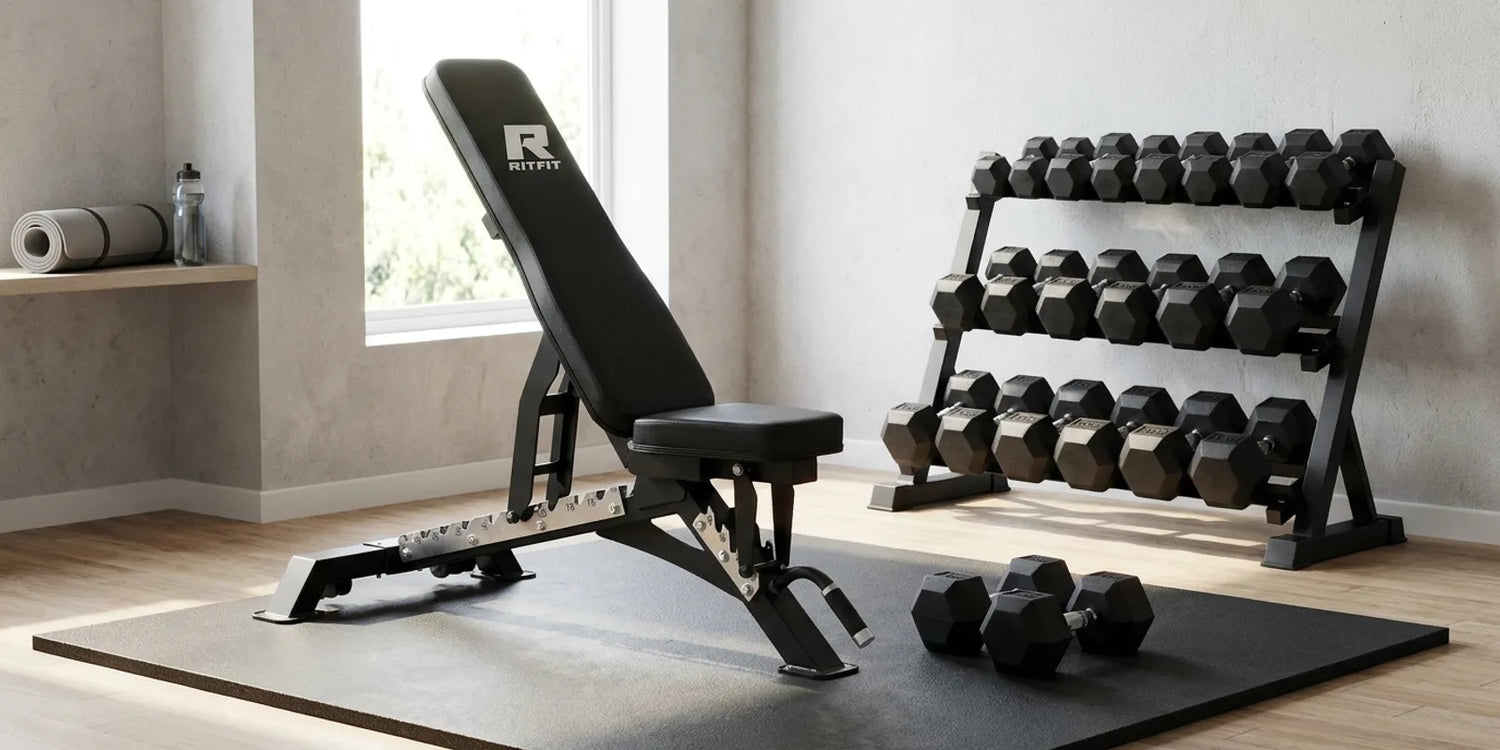
For home chest training you need a pair of dumbbells that covers your working range and a bench that adjusts to an incline for upper chest work. A rack keeps pairs organized, and adjustable dumbbells save space when your home gym is small.
- Fixed pairs: RitFit hex rubber dumbbells give you a stable grip and a durable hex shape that prevents rolling between sets.
- Adjustable option: If floor space is tight, the RitFit adjustable dumbbells collection replaces several fixed pairs with one compact set.
- Bench: An adjustable bench with a flat and incline setting covers presses, flies, and rows in one station.
- Storage: A RitFit 3-tier dumbbell rack or the compact RitFit A-frame dumbbell rack keeps pairs sorted, and the RitFit PWR05 dumbbell rack holds a larger set.
- Entry package: The RitFit dumbbells with rack package pairs a starter set with a rack for a tidy first setup, and the RitFit dumbbells collection shows the full range.
"If your space is limited, a good set of adjustable dumbbells might be your better option. They will allow you to progress to heavier weight as you get stronger."
Jeff Cavaliere, Physical Therapist and Strength Coach, Athlean-X
How Often to Train Chest and How to Progress
Training the chest twice a week with at least one rest day between sessions is a solid rhythm that allows strength to build without overloading the shoulders. Each session can be around 20 minutes with three to four exercises and two to three sets per exercise.
- Frequency: Two chest days per week, separated by a rest day, suit most beginners and intermediates.
- Add a rep first: When a set becomes easy, add one or two reps before you change the weight.
- Then add weight: When you hit the top of your rep range with clean form, move up the smallest increment.
- Track it: Note the weight and reps for each session so progress is visible week to week.
Common Mistakes and Safety Notes
The most common mistakes are choosing weights that are too heavy, arching the back under load, and skipping upper back work, and each one raises the risk of shoulder or lower back strain. Warm up, keep the ribs down on presses, and balance every pushing movement with a pulling one.
- Too heavy too soon: Sacrificing form to lift a bigger dumbbell loads the shoulder joint and reduces chest activation.
- Arching the back: Lifting the ribs off the bench shifts the work away from the chest and onto the spine.
- Skipping the back: Press only training pulls the shoulders forward, so include rows and reverse flies.
- Hold your breath: Breathe out on the effort and breathe in on the lowering phase to stay braced.
- Stop on sharp pain: A stretch or fatigue is normal, but joint pain means lower the weight or stop.
Final Checklist, Start Your Dumbbell Chest Routine
You are ready to start when you have a dumbbell weight that is challenging on the last reps, a bench with a flat and incline setting, and a twice weekly plan. Keep the routine simple, and let consistency across months do the work.
- Set realistic goals: Expect a firmer, more lifted chest line rather than a change in breast size.
- Pick your weight: Five to ten pounds to begin, then progress in small steps.
- Follow the format: Two chest days weekly with 10 to 12 reps and short rest.
- Balance pushing and pulling: Pair every press with a row or fly.
- Track your sets: Record weight and reps each session.
FAQs About Dumbbell Workouts for Breast Reduction
Can dumbbell exercises reduce breast size?
Dumbbell training cannot remove fat from the breast area on demand, because the body does not burn fat from one spot.
It strengthens the chest muscles underneath, which can make the chest look more lifted and firm.
Combining strength training with an overall calorie deficit is what reduces total body fat.
Which dumbbell exercises help lift the chest?
Exercises that work the pectoralis major and the upper chest are most helpful, including dumbbell bench press, incline dumbbell press, and dumbbell fly. Strengthening the upper back with rows and reverse flies also improves posture, which makes the chest appear higher and more balanced.
How heavy should dumbbells be for chest workouts for women?
Choose a weight that lets you complete the full set with good form while feeling challenging on the last two or three reps. For many beginners that means starting with five to ten pound dumbbells for pressing and flying movements, then moving up in small increments as you get stronger.
How often should I do dumbbell chest workouts?
Training the chest twice a week with a rest day between sessions is a solid rhythm for most people.
Each session can be around twenty minutes with three to four exercises and two to three sets per exercise.
Consistency across several months matters more than doing one intense session.
Can dumbbell chest exercises help with sagging breasts?
Strength training strengthens the chest muscles and improves posture, which can give the upper body a firmer, more lifted appearance. It cannot reverse tissue changes or replace medical treatment, but combined with overall fat loss it is a natural way to improve how the chest looks.
Conclusion
A dumbbell workout for breast reduction shapes the chest muscles and upper back for a firmer, more lifted silhouette, while overall fat loss drives the visible change. Do the chest presses, flies, and rows twice a week and progress the weight slowly.
Start with five to ten pound dumbbells and add weight only when you can hold your form. For a full first year of training, follow the beginner workout plan for females, and check the latest bundle deals on the RitFit sales page.
Disclaimer
Dumbbell training is a fitness activity, and this article is for education only rather than a substitute for medical advice. Talk to a doctor before starting a new program, especially if you have shoulder pain, a recent injury, or any health concern.
References
1. Krol H, Golas A. Effect of Barbell Weight on the Structure of the Flat Bench Press. J Strength Cond Res. 2017;31(5):1321-1337. PMCID: PMC5400411





